What is My Footprint?

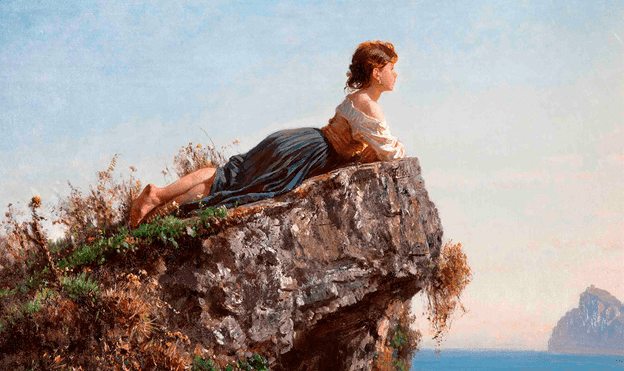
Fillipo Pallizi, Franciulla sulla roccia

Lives of great men all remind us
We can make our lives sublime,
And, departing, leave behind us
Footprints on the sands of tim
e

Henry Wadsworth Longfellow — A Song of Life

Geert Hofstede’s research suggests that striving for a life that will be noticed is fundamental to the American psyche.  And, in a big country, the longing is often equally big and broad.  From Patrick Henry to John Wayne, large and swaggering (and male) is what is noticed.  I saw myself in the narrative, but identified as a thoughtful visionary seeking a bigger world – like Pallizi’s romantic 19th c. portrait.  As I noted previously, my husband called this “International Karen” who, as frequently as possible, moved beyond contemplation to collaboration with people in other countries who also wanted to make their schools better. But, between Covid travel restrictions and a dwindling passion for experiences far from home, International Karen is coming to terms with the obvious:  the past will not be the future.  What is emerging is a different longing—to figure out how to leave smaller but still meaningful footprints.

Several years ago, some friends and I – (aka, The Retirement Biddies Workgroup) — read Sarah Susanka’s reflections on living a “not so big life”.    A well-known architect, she urges us to think about what really matters through analogies between designing a smaller home and designing a smaller life.  Some of her questions are relevant to anyone at any age:  How is what we are purchasing fitting in with what we need?  How are we using our resources?  When do we have enough?  But then, her zinger:  How have you wanted to change the world and how are you looking for related changes in yourself?  Her challenge suggests beginning with our biggest aspirations (do they come much bigger than changing the world?) and then look internally to see as if we are up to the task. 

But that question needs reframing in a life that has become radically smaller during Covid, while I am also busy considering a future that will inevitably be different from my expectations of a few years ago.  As I look at “international Karen” and cringe at the carbon offsets that I owe the world, I know that I could not go back, even if it were possible.  I pulled Susanka out of my bookshelf….

At a personal level, I have already made a commitment to a smaller life. A decade ago, Dan and I made a radical move from a rather large house to a condo, which was about the size of Susanka’s designs for a “not so big house”.  When The Retirement Biddies were contemplating the “not so big life”, Dan and I had given away many of our possessions, including furniture, books that we finished reading many years ago, and appliances that we rarely used.  We felt lighter and patted ourselves on the back, while filling every nook of our new walk-in closets.

But I was still working.  Although my home office was small, I had a bigger office at work for all the professional stuff.  The only question “not so big” question that had immediate resonance was a more thoughtful consideration of what we were buying. It was all about “the stuff.”

But now retirement-during-Covid is a reality, along with the unanticipated consequence of our decision to stay in Boulder, CO where we are engaged in a noble experiment: two people living peaceably in a 1000 square foot 1960s ranch that has only two interior doors that don’t lead to a toilet.  But this requires a different kind of decluttering.  The grand project of moving and starting over – just like those who are part of “the great resignation” or who have otherwise changed their lives in the last few years – requires a decluttering of the spirit and heart. 

The challenges are huge.  I have always been BUSY, largely with activities that are not essential. I  am easily distracted by emails or random thoughts.  I have never meditated, and have been totally unsuccessful at journaling because it requires discipline.  Since childhood, I have been unable to cope with boredom and have a long list of attractive projects that I can turn to if that awful feeling appears.  But these habits, some of which were functional when I was “busy working”, are now impediments.  In Susanka’s terms, I am unable to turn away from alluring “time clutter”. 


Clearing out the heart requires stillness – so different from concentration —  that does not come naturally.  I have taken a course on contemplative prayer.  I have read poetry out loud.  I have worked on a skill that never came naturally to me – listening to what other people are really saying rather than immediately generating a stimulating conversation.  I am even weaning myself off the computerized calendar that beeps too often, and writing out to-dos and appointments using a fountain pen.  More importantly, I am tracking a new habit – explicitly noticing, contemplating, and being grateful for something that is exquisitely beautiful, whether in nature (frost covered ornamental grass or snow on the Flatirons outside our house) or when making faces with a four-and-a-half-year-old.  And writing down a few of those things in turquoise ink.  I really love the turquoise ink. 

But what about changing the world?   I take heart in reading aloud Mary Oliver, who suggests that, at least for a poet, a large life can be inscribed through small acts: 

I don’t want to live a small life. Open your eyes,

open your hands. I have just come

from the berry fields, the sun

kissing me with its golden mouth all the way

(open your hands) and the wind-winged clouds

following along thinking perhaps I might

feed them, but no I carry these heart-shapes

only to you. Look how many small

but so sweet and maybe the last gift

I will bring to anyone in this

world of hope and risk, so do

Look at me. Open your life, open your hands.

Mary Oliver – I Don’t Want to Live a Small Life, Red Bird

To live a more open and intentional life, I need to consistently remind myself that small efforts, expanded over many committed people can make a difference in this world of hope and risk. I think of the years when I hauled dozens of yogurt containers to my office before my city started recycling – only to find out now that the containers were not actually recycled.  So, my Instant Pot and I now have a bi-weekly routine that involves yogurt making.  I find local issues that are pressing – affordable housing, unjust judicial practices, and the continued exclusion of the Native people who once owned this land – and find others who want to change them.  Goodbye International Karen:  You did good work and had fun.  Now I want to bring small gifts to the place where I live and to those I am with – and I also remind myself that large footprints in sand will be washed away.  

In All Visible Things. . .

Mirabell Gardens, Salzburg, Austria

One holiday evening this year, I watched the Sound of Music. It’s one of my favorite movies. I love the music, but mostly it makes me recall a four-month mini-sabbatical I had in Salzburg where the movie was filmed. Nostalgia overwhelmed me as I viewed the nuns walking through the Nonnberg Abbey, and the children and their nanny, Julie Andrews, cavorting in the Mirabell Gardens, all set against the Austrian Alps, places I remember from my time there.

I recalled my zimmer with chickens beneath my window, whose eggs I ate for breakfast, and the shop down the street where I could buy a takeout Austrian dinner. I was doing research on school lunch in Europe, and I had access to Salzburg schools because my son, his wife, and my new grandson were living there and through their work had met local educators.

I could go on about the many memories, but what struck me as I watched the moviewas that I was remembering this time as happy when, in truth, it was not. My husband had died three years before, and I was in a prolonged grief, crying easily at almost everything, feeling like a role player in a meaningless life, while struggling to build an authentic one.  The only joy I felt was spending time with my grandson, Peter, a toddler with unlimited wonder at his unfolding world. Otherwise, I spent way too much time in my room, forcing myself to revise field notes of my research observations and to read about cultural learning—with the goal of delaying going to bed and crying myself to sleep. 

It wasn’t a happy time at all! And yet, today I remember it fondly. What is going on, I asked myself, as I reflected on my faulty memory? Was I rewriting the experience to make a bleak time look rosier?  Or was nostalgia for Salzburg and my grandson overriding my memory of unremitting grief. Perhaps my process was a part of a subconscious life review, consolidating my memories into something that would eventually make the whole of my life hang together? Regardless, if I was honest with myself, accurate memory had given way to nostalgia.

I’ve written about nostalgia before in Nostalgia 101, noting that it is healthy and tends towards positive memories. Its highest occurrence is when we are young and old with the middle years of life less given to nostalgia. Experts believe it’s helpful during life transitions when we’re unsure of where we’re going. We can look back and see the past as happy, thus the future feels safer. My time in Austria was part of a long transition to reestablishing my life without my husband. Though I was incredibly sad, deep within me, I believed I’d find my way. That said, I was still troubled by my disparate memories. How could I allow what I knew as truth be glossed over with nostalgia?

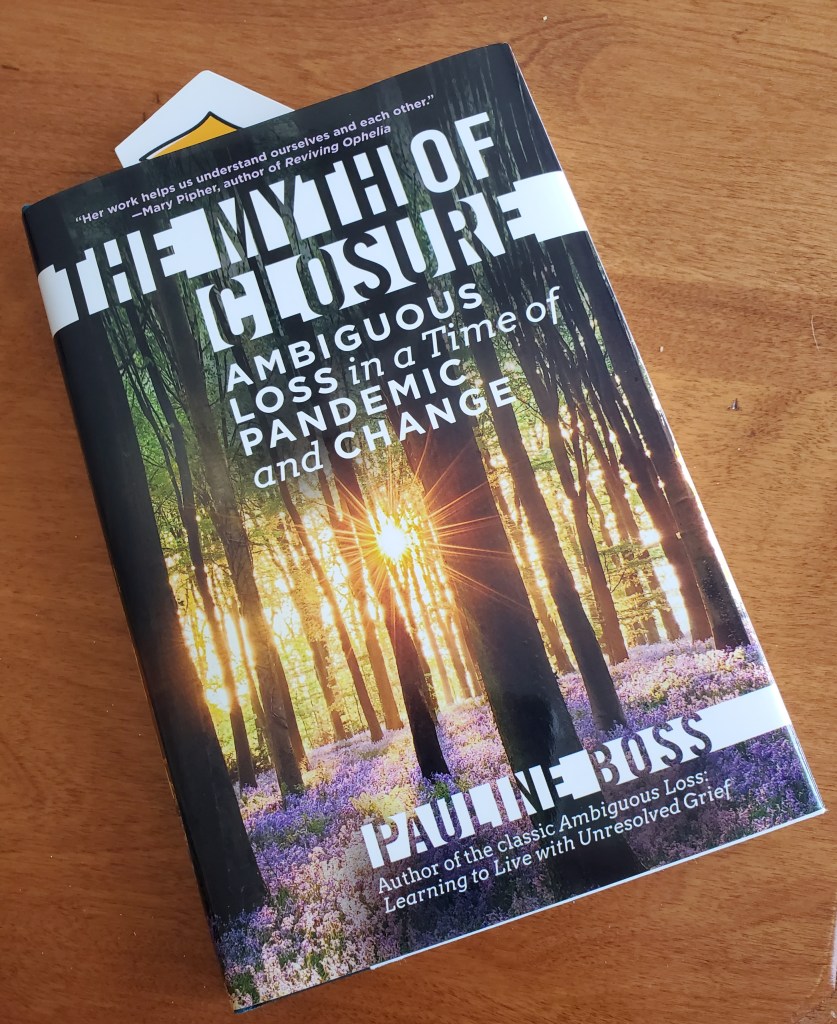
I walked around for several days asking myself what does it mean to have conflicted memories. Which one is really true?  Then I started reading Pauline Boss’s The Myth of Closure: Ambiguous Loss in a Time of Pandemic and Change. One of her central ideas is that  in adapting to losses, we should not think either/or—which was exactly what I was doing by seeking one truth about my perceptions of my time in Salzburg. She says we need both/and thinking. In terms of the pandemic, she writes: “I am both hungry for alone time and for social contacts; I both disagree with my neighbor and continue talking with him. . . “

After reading this, I revised my thinking.  I was both happy in Salzburg experiencing a beautiful city, and I was deeply sad about losing my husband. I was making progress with finding my way as a researcher and feeling up-ended by the loss of my marriage-infused dreams. I was happy to spend time with my family there, especially my new grandson, and sad that I couldn’t share this with my husband. It feels so right to be able to say all these things, there’s a clarity and truth to the statements that either/or doesn’t provide.

In the days following this insight, I found myself infatuated with both/and thinking, ready to chuck dualism as obsolete.  And like any good revelation, I kept seeing both/and everywhere.  Even the New York Times was onboard, running an op ed about both hating one’s husband and loving him. Then I asked myself if both/and adds up to a whole, and that stopped me in my tracks.  It was too simplistic.

I turned to my fellow blogger, Karen Rose, who assured me that there’s more going on than simple addition, and she pointed me to a passage in Parker Palmer’s new book, On the Brink of Everything: Grace, Gravity and Getting Old. The passage isn’t from Palmer, however, rather Thomas Merton in Hagia Sophia. It begins: There is in all visible things an invisible fecundity. . . Suddenly I saw it, the fecundity immanent in all human experience. In Salzburg, I was healing and in pain, and at the same time laying the groundwork for things to come, like my deepening relationship with my grandson, Peter; like insights about the culture of school lunches; even like the relationship with Karen Rose, such that we now write a blog together. 

Two insights—both/and and the fecundity in human experience. Wow, what a way to start a new year!

I floated only a short time on the excitement of these new ideas, mainly because we are living in a pandemic that’s always with us. I cannot help but think about our present situation as a country and planet. Omicron, political dissent, and climate change are among the issues. I am getting towards the end of my life, while others, including my loved ones, are at the beginning and middle. We are all living in uncertainty. My hope is that Merton has it right, beneath the travails of this troubled time are seeds to a new and better world.

Hagia Sophia

Belonging….Young and Old

My friend Kathryn recently asked me to write a forward to her newest book on the importance of place and belonging in schools.  Using vignettes culled from decades of trying to understand the experience of children who don’t feel as if they belong in school, she stitches together a story about what adults can do to change that.  As I thought about children and belonging in school, I could not help but connect their experiences—good and bad—with my own.

–image courtesy of K.A. Riley

Kathryn does not define belonging, but her descriptions suggest that young people have a fundamental need to feel that they are in a psychologically safe space.  The drawing above, one of the most evocative in book, makes clear the devastating effects that feeling excluded have on identity.  Joe Murphy has said for years that the first goal of any school must be to weave an invisible cord between a caring adult and each student, so that if the child begins to be pulled away, the adult will know and figure out how to draw them back in.  In other words, personal connectedness is key to safety and belonging.

Woven throughout Kathryn’s book is an imperative:  Educators must be attentive to the experiences that each young person brings with them because children, like adults, need to be known and understood to feel that they belong.  A child who recently immigrated from a war-torn country may gratefully acknowledge that physical safety is fundamental to his feeling of belonging in school, while another whose family experiences routinized racism will need a different form of care to feel safe.

But there is another message, also reflected in Tupac Shakur’s evocative poem, A Rose that Grew from Concrete:  The communities in which young people live deserve the same compassion and understanding.  And belonging can be inseparable from physical place – a sense of being rooted that goes beyond positive relationships and comfort inside a particular school building.  Shakur’s poem is a metaphor for finding resilience in community, and for more attention to all places as a source of individual identity that support social and emotional development.

While contemplating the stories of young people that Kathryn collected, I could not help but think about how belonging also colors my life – and how questions about “where I belong” have come up in so many post-COVID conversations with others.  Dan looked up the other day and said, out of the blue, “we skated through COVID” – no one that we know even got very ill.  But we were in Boulder for a warmer winter close to family when the world shut down and we stayed.  We felt safer and more connected because we were in a “pod” with a daughter, son-in-law, and grandchild, which meant that we were not alone.  We had zoom connections with groups that we were already part of, so we felt engaged – even surrounded — by others.  Of course, we missed hugs, but we were ok and as safe as anyone could be during a global pandemic.

By the time that the 2020 election heated up, however, we had to acknowledge that the passage of time meant that we had effectively moved from Minneapolis, without really planning to do so.  We registered to vote in Colorado.

I keep thinking about  my reaction to Brian Friel’s Home Place, which I saw 14 years ago at the Guthrie Theater.  While the play is ostensibly about racism and class as English rule begins to erode in Ireland in the late 19th century, the dominant narrative is not what stuck.  Instead – then and now — It was that the English owner of The Lodge at Ballyweg kept referring to his real home as a place in Suffolk– where he had not lived for decades.  In other words, where you live is not always where you feel that you belong

And although Dan and I are reasonably content, we were uprooted from Minneapolis but are not rooted where we are.  This feels like a big deal because we are getting older, and like the plants in our garden, we need water, sun, and time to thrive in a place – and we know that this is probably our final chance to find a home. 

The last time I made a major move, from Boston to Minneapolis, I was just over 40.  I had always belonged to groups that were tied to place and space – in Boston, I floated between different jobs but I “belonged” with a close-knit “moms of young children club” and a sister close-by in a house that I loved.  I felt understood and rooted.  When I first landed at the University of Minnesota, I immediately decided that my itchy desires to try new things could be easily satisfied there – in other words, I found a professional home place.  But I changed houses, churches, book groups, and preferred grocery stores on a regular basis.  Now I have not been in Minneapolis for 18 months, during the trauma of COVID and the murder of George Floyd — and am retiring.  I don’t feel that I belong in a city where I lived for over 30 years – I miss the close friends whose lives have enriched mine over the years, but it feels as if the city and I have both changed.  Although Colorado is where I live, it is still not a home place. Everything from the gorgeous scenery to the strange weather feels slightly foreign.  The awe when I look at the Flat Irons each morning (finally, the view that I always wanted) is real, but it still doesn’t fully engage my heart. And, having lived a very circumscribed life during the COVID shutdown, I still have to use Waze to get anywhere but Target.

I am vaguely envious of friends who do have a home place and a sense of roots that connect people and a place to which they always return:  the couple who has Thanksgiving (and an extended vacation) with friends in the town where they lived after they first married; the middle-aged children who go “home” to their parents and old friends on a regular basis; others who spent a substantial sum renovating a house that they cannot imagine leaving because most of those they love the most live in the neighborhood.   The exquisite feeling of knowing that you belong someplace can be visceral…when it connects all the elements that I saw in Kathryn’s description of young people and belonging.

My friends who have a home place take it for granted and cannot imagine what life would be like without that touchstone.  I take for granted the fact that at various times in my life, I have experienced the psychologically safe space and personal connectedness elements of belonging that the children talk about even though I may not have them both today.   This leads me to wonder whether there is a rooted element to belonging for some people, but for others belonging is more fluid and situational.  In my case, generational wandering and relocation has been the dominant narrative of the Seashore clan ever since my father’s family left their tiny, rocky “home place” in Småland as immigrants to the U.S. in the 1860s.  Yet others from my great grandmother’s side, who came from Sweden at the same time, cannot imagine living anywhere but southern Minnesota and attending 4 generational family reunions each year. Are  some people simply more likely to need belonging and place, while others are sustained with the availability of safe spaces and satisfying relationships?

Belonging

(Benbecula)

Martins own this ragged edge

stitching sky peat water cloud

where land weds salt.

Cobalt ripples draw

The sun joyful

Through a mackerel sky.

I scan the gloss of deep

feel the sea   cradle this isle

these crofts   this past

— Fiona Scott

Sticking with What Works or Starting Anew?

Catching a Big Fish at Post Lake, Wisconsin, about 1955 (looked big to me)

I remember as a child waking up in the morning to a day fresh and new, filled with possibility. Something exciting was waiting to be discovered, maybe just around the corner. All I had to do was get dressed, scarf down a bowl of cereal, and walk outside. Sometimes I rode my bike around the neighborhood, looking for something interesting. Other times I’d try to find a friend to join me. I’d walk to my friend Carole’s house, and from the street, I’d call “Oh, Carole.” If she could play, she came outside and off we’d go inventing on the way. If not, her mother opened the door and said, “Carole can’t play right now.” In that case, I’d wander to the park or go home and read a book of my choosing. I was between five and ten when I experienced my life this way, the unadorned curiosity of a young girl.

          Idealized, of course, but I remember that time seemed to stretch on forever (especially when I was bored at the end of summer).  Bored or not, I didn’t look outside myself for something to do, rather, I acted from within, indulging my moods and curiosity. My notion of work was uncomplicated, something imposed by adults, “Practice your clarinet, finish your homework, do your chores.” It was before I learned that work was ubiquitous to living, any and all work, jobs, housework, yard work, volunteer work, and meaningful work, however it is defined. I had not yet assimilated the byproducts of work, productivity, success, and accomplishment, as guideposts for adult life.

          I remember telling my son, out of college and frustrated because he couldn’t find a job, “don’t worry about it. You won’t escape working. You will spend basically your whole life working.” At the time, I believed that the necessity of work had absolute power over my life, what I called the “tyranny of work,” because I saw work, too often, as something that needed to get done. I’d lost the inner direction that had, as a child, given so much impetus to my daily living. I didn’t see my work in context, as a necessary part of life but also, if completed purposefully, as an expression of my authentic self. I had not yet come face-to-face with the question of what life would be like without work—retirement, if you please.

And Then It Came. . .  Retirement

          On December 11, 2015, I retired at age 73. I woke up that first Monday, after the retirement toasts at the bar on the previous Friday, feeling that overnight the ground had become unsteady. I was prepared to shower, get dressed for work, fight the traffic, and get a good parking space, but there was nowhere to go. I knew I could sleep in, hang out in blue jeans. . . but then what? Unlike my fellow blogger, Karen Rose, I had not taken a phased retirement. I simply decided that it was time to step aside for someone younger with fresh enthusiasm. I worked on soft money, and I was tired of chasing it. As for getting “busy with something that looks a lot like work,” (Falling from Grace, posted 7/8/2019) I thought it would be easy. Finally, I would have the time to sit at my desk doing the creative writing I’d longed to do but had put off throughout my life.

My Facebook posting with the caption:  This is where it ends. . .

Writing, however, didn’t happen. Ideas suddenly went dormant. Rather, I spent three months having panic attacks until I read a book about how to overcome them. But overcoming them wasn’t the same as addressing the root cause. That little girl who once welcomed a day of possibilities had lost the ability to not only see those possibilities but also to act on them. I was caught in the conundrum of living from within or living from the cultural and societal norms that describe work—I’d fallen from grace and had no idea how to catch myself. . . .

Part 2: One Big Step for Karen-Kind                                           

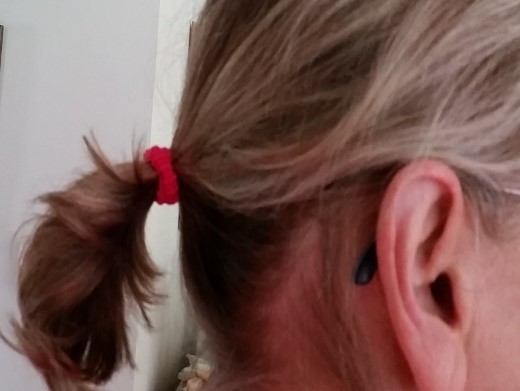
I shared my angst about adapting to retirement with friends—and I mean “adapt.” I saw it more as forced obsolescence. Friends said to find a new routine.  Do the things you’ve been putting off—like cleaning closets. Find a new direction. I bought into it and muddled my way into a sort of routine, cleaned my desk in lieu of the closets, and started searching for that new direction. I grew a ponytail—I’d never had long hair. It was something I could accomplish.

          I started tutoring fourth graders in math at my local school—I wanted to be productive, feel useful, and there’s nothing as regenerating as being around ten-year-olds. I taught a couple of classes as an adjunct professor, and I joined a research project in my field as a consultant. Writing ideas resurfaced, and I found myself at my desk again. Whew, finally those panic attacks waned. I was in safe territory—work ( I cut off the ponytail).

          Then, as life will do when you’re ready for it, I was thrown a curve, albeit a pleasant one. My husband and I and Karen R. and Dan went on vacation to the Cowboy Poetry Gathering in Alpine, Texas http://texascowboypoetry.com/. For two days we were immersed in a culture different than upper midwestern city life. A culture of cowboys, in boots, bolo ties, Ariat shirts freshly pressed, creased jeans, and wide belts with polished silver buckles, standing for over an hour reciting new and classic poems. These poems were about life on the range, around the campfire, under the stars, and the meaning of life when everything slows down and you feel the immensity of our world beneath that naked night sky. Corny poems, sometimes, but poignant, nevertheless, and framed by the big questions we all grapple with—is there someone who watches over us? What is the meaning of our time on earth? Do our lives matter? Turned out, there was more to cowboy poetry than campfires.

          Thinking about the poetry gathering on the plane home and later as I went about my routine of teaching and tutoring, a glimmer of something started to break through. Experiencing the cowboy culture reminded me that there are multiple ways to live and know the world. I was living retirement like my former work life, with never-ending assignments where productivity ruled. I was judging my life through the lens of work, and that’s why I had found retirement wanting, a time for panic, and a need to find something, anything, new to do and quickly.

          I’d crossed that demarcation between work and retirement, and I’d found it painful, so I kept trying to go back to what I knew and had valued for some fifty years—working, doing something meaningful in the eyes of the world. Yet available to me was the life of that young girl who awoke every day to possibilities, unless, of course, I chose to clutter it up with the detritus of those fifty years of working. I realized that I didn’t need to “find a new direction.” I was free to have no direction. To wake up and follow my curiosity. To read a book of my choosing.  To call a friend and hang out at a museum. Even to go to Wales and live (something I’ve dreamed of doing). To sit on the deck and stare at the stars, unless of course, the mosquitos got me first. The point was, I didn’t need to have an agenda, unless that agenda was relearning how to be this person who allows the day to unfold as it wants to. Retirement wasn’t so much the end of work as it was a challenge to “start anew,” to just be and to awaken with curiosity about what the day will bring, and to rediscover the joy of that young girl, which, hopefully, is still in me.

From Anthem

So mornings now I’ll go out riding
Through pastures of my solemn plain,
And leather creaking in the quieting
Will sound with trot and trot again.
I’ll live in time with horse hoof falling;
I’ll listen well and hear the calling
The earth, my mother, bids to me,
Though I will still ride wild and free.
And I ride out on the morning
Before the bird, before the dawn,
I’ll be this poem, I’ll be this song.
My heart will beat the world a warning—
Those horsemen will ride all with me,
And we’ll be good, and we’ll be free.

Buck Ramsey