Part 1: Stuff. . . and Change

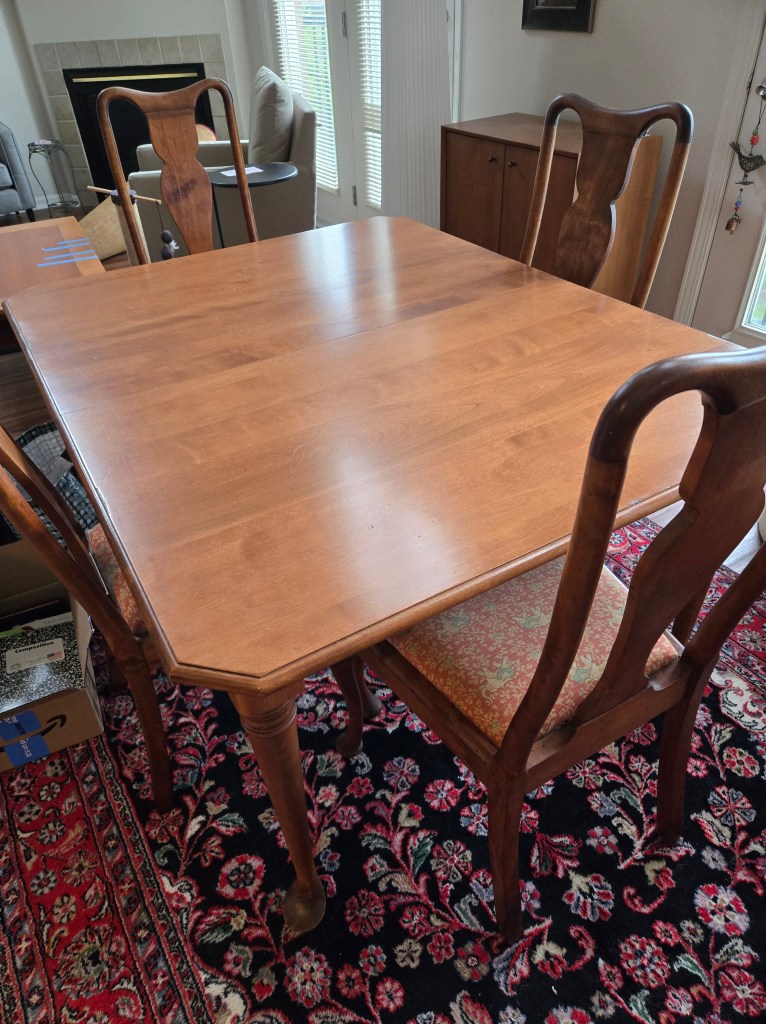
I rested my hand on my cherry dining room table, knowing they would soon load it on the moving truck. I’d contacted Bridging, a local organization that furnishes homes for families in need, to pick up items from our house that wouldn’t fit in my new, downsized, condo. The table was to be last on the truck, so I had time to linger.

My hand was still, but my heart screamed at my mind. “What are you doing? Remember those family dinners, ten people talking at once? Remember the times you used your china? You know, that is going to end up in a thrift shop, too.”

I saw the cards flying in bridge games with our friends, Karen and Dan. My husband, Jim, sitting opposite me, would maneuver the bidding so I’d be the one playing the hand.
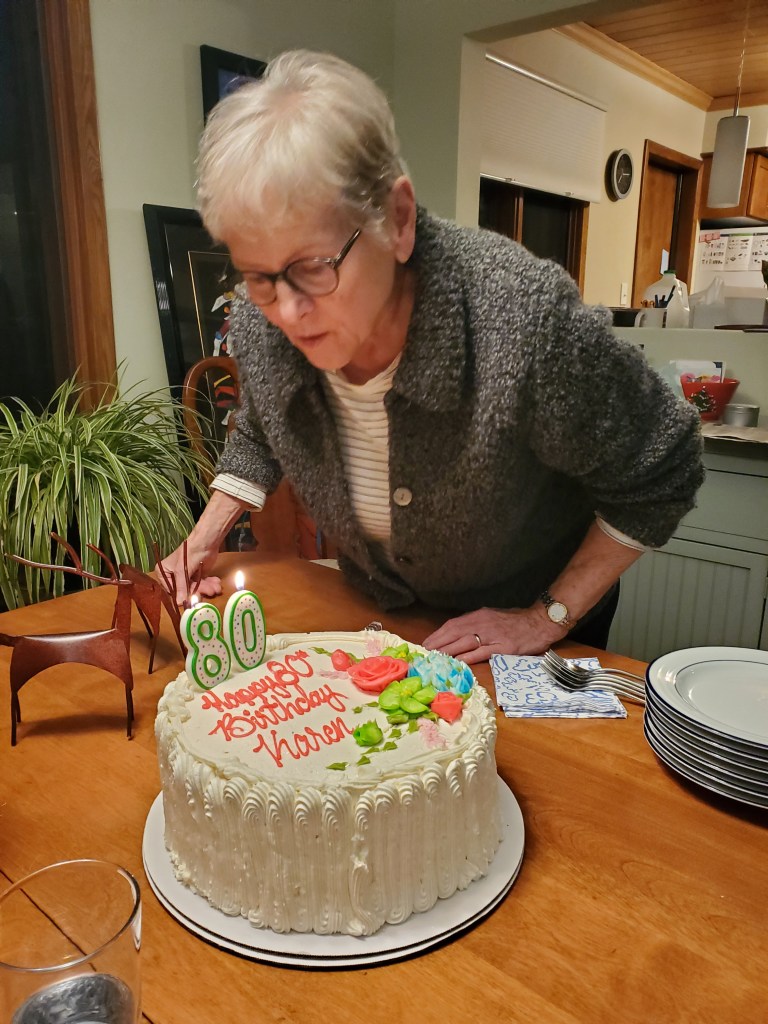
Birthday celebrations—I remembered my cake for my 80th—Jim had died three months prior, so we didn’t get to share the milestone birthday. We’d shared much at that table. During COVID, endless games of Scrabble—I played to win, and he played to engage.
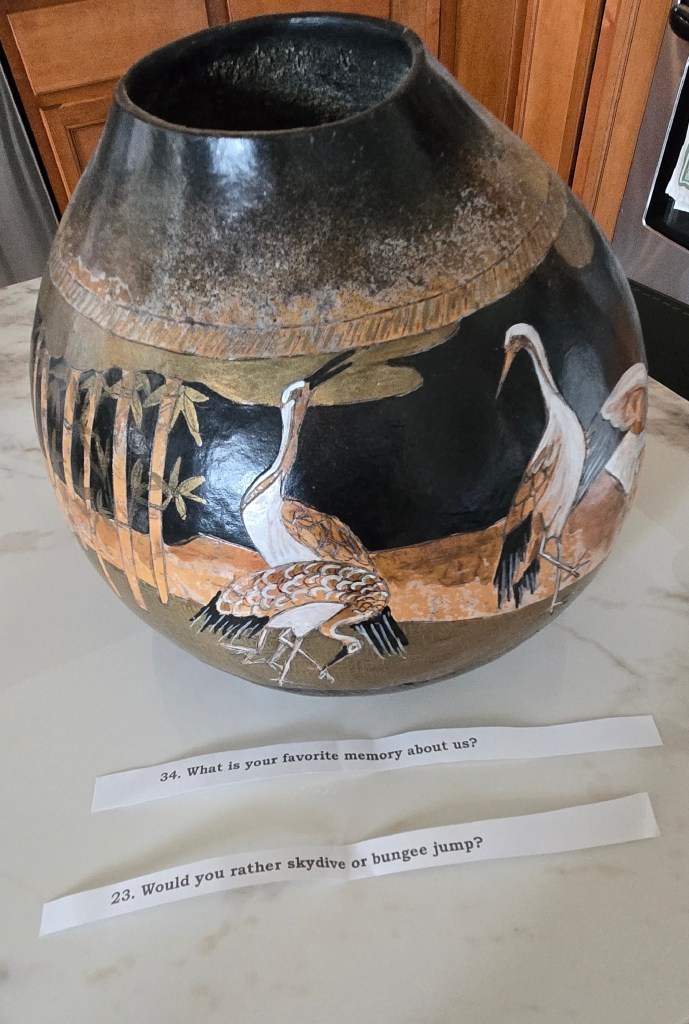
And my vase that I filled with questions about each other that we answered after meals. It was revealing fun.

“Don’t worry. Someone will love that table as much as you have.” The man from Bridging reassured me. I let my hand drop and they loaded the table, aghast when they started to put boxes on it.

“That’ll scratch it!” I shouted. They took the boxes off.

It was no longer my table. I didn’t want to think about what might happen next to it.

I bought the table at Dayton’s Warehouse Sale, back when Dayton’s existed. It wasn’t my style, but the beautiful wood caught my eye, and it was the right size. The legs matched chairs left to me by my second husband, Gary, who died at age 55. He didn’t value stuff, but he loved these chairs, which he’d bought in Pennsylvania, another memory. Every time I pulled a chair out, I’d see Gary at his desk, which was the dining room table.  

My table was hard to part with, but holding on felt like grasping at a life that used to be—the one filled with family, friends, careers, holidays, parties, the sad and the happy, around that central gathering place. My heart hoped that letting the table go would make room for my children to carry on traditions.

“Stop it!” my mind admonished. Stuff is work, and it takes up space. Remember how you had to store those leafs under the bed. They were so heavy, you needed help to slide them out and carry them to the dining room. Wake up! No one’s here to do that anymore. Let it go!”

My heart gave up, watching the door of the van close, the men getting in and driving the truck out of the lot. “Goodbye,” my heart whispered.

*****

What was I really grieving when I gave away the table?

Memories stay with me, whether I own the table or not. What I grieved are the roles the table signified, mother, grandmother, hostess, and the keeper of traditions. Beneath my sadness about the table was facing the problem of who I am as life shifts and changes, particularly in retirement

My husband, Jim, who was more sanguine in his approach to retirement, stayed involved, with people, sports interests, and adult education courses. He didn’t seem worried about roles, but then he never downsized as a widow either. One Easter, when our families were mostly busy, Jim suggested that we invite other people with no immediate plans for a light brunch. I look back and remember how interesting that day was. Roman Verotsko, a well-known artist and neighbor came. He spent much of the time talking art with my granddaughter, who came without parents. Other neighbors mixed with each other. The party created a new role for Jim and me. We didn’t need to be the grandparents who have everyone over. We could bring friends together.

Shortly after, Jim bought a big Bunn coffee maker and started inviting neighborhood men for coffee. He’d found his niche. My friend, Johan, used to hold what he called “musical soirees” about old jazz and Mozart. He’d invite all the people he knew who lived alone and had an interest in music. In my condo association, various people give short talks about finding and roasting coffee, astronomy, and even puppets.   

It’s not easy to find new ways of being in the world, yet the ubiquity of change requires adaptation. Roles, to some extent, are what we project to the world, but what about inside us, our personal authenticity. As I’ve aged, I’ve turned more inward to access that person.

Memories from the past, like the ones my table evokes, can cohere around life themes. Timelines of your life can also reveal these. The classic about doing this is Writing about Your Life, by William Zinsser. I participate in a church group called the Elder (wince) Gathering, and we are reading a book called The Inner Work of Age: Shifting from Role to Soul, a book I’d already read in another church group. Soul work seems to call people my age. But that’s a big topic for another blog.

Where does this leave me about the table?

I treasure my memories ‘round that table. It’s an album of my life. But now when I feel sad about giving it away, I imagine a family in their first real home. It’s tiny, but there’s room for a table—a lovely cherry one. Children are gathered at it doing their homework. Someone nearby is making dinner.

          “Put your stuff away,” she calls.

Books and pencils and paper and laptops are put away. Someone sets the table. Everyone sits down. Dinner time.

I smile. My table is home.

Stay tuned for Part 2
In All Visible Things. . .

Mirabell Gardens, Salzburg, Austria

One holiday evening this year, I watched the Sound of Music. It’s one of my favorite movies. I love the music, but mostly it makes me recall a four-month mini-sabbatical I had in Salzburg where the movie was filmed. Nostalgia overwhelmed me as I viewed the nuns walking through the Nonnberg Abbey, and the children and their nanny, Julie Andrews, cavorting in the Mirabell Gardens, all set against the Austrian Alps, places I remember from my time there.

I recalled my zimmer with chickens beneath my window, whose eggs I ate for breakfast, and the shop down the street where I could buy a takeout Austrian dinner. I was doing research on school lunch in Europe, and I had access to Salzburg schools because my son, his wife, and my new grandson were living there and through their work had met local educators.

I could go on about the many memories, but what struck me as I watched the moviewas that I was remembering this time as happy when, in truth, it was not. My husband had died three years before, and I was in a prolonged grief, crying easily at almost everything, feeling like a role player in a meaningless life, while struggling to build an authentic one.  The only joy I felt was spending time with my grandson, Peter, a toddler with unlimited wonder at his unfolding world. Otherwise, I spent way too much time in my room, forcing myself to revise field notes of my research observations and to read about cultural learning—with the goal of delaying going to bed and crying myself to sleep. 

It wasn’t a happy time at all! And yet, today I remember it fondly. What is going on, I asked myself, as I reflected on my faulty memory? Was I rewriting the experience to make a bleak time look rosier?  Or was nostalgia for Salzburg and my grandson overriding my memory of unremitting grief. Perhaps my process was a part of a subconscious life review, consolidating my memories into something that would eventually make the whole of my life hang together? Regardless, if I was honest with myself, accurate memory had given way to nostalgia.

I’ve written about nostalgia before in Nostalgia 101, noting that it is healthy and tends towards positive memories. Its highest occurrence is when we are young and old with the middle years of life less given to nostalgia. Experts believe it’s helpful during life transitions when we’re unsure of where we’re going. We can look back and see the past as happy, thus the future feels safer. My time in Austria was part of a long transition to reestablishing my life without my husband. Though I was incredibly sad, deep within me, I believed I’d find my way. That said, I was still troubled by my disparate memories. How could I allow what I knew as truth be glossed over with nostalgia?

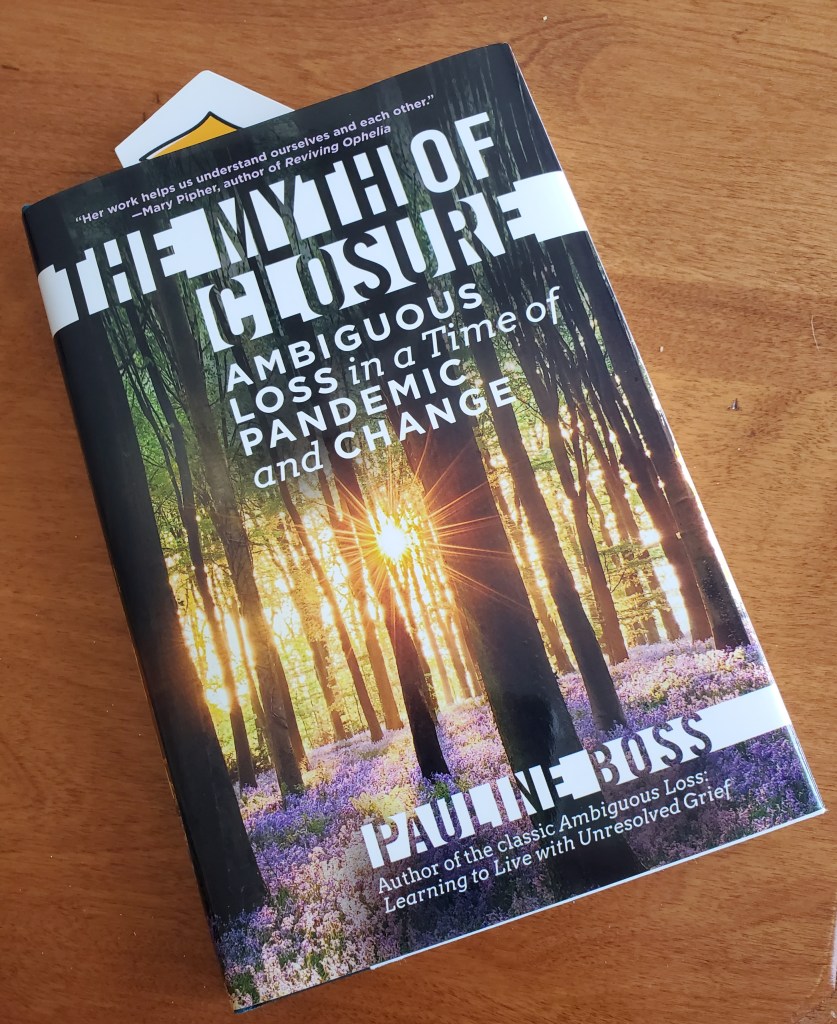
I walked around for several days asking myself what does it mean to have conflicted memories. Which one is really true?  Then I started reading Pauline Boss’s The Myth of Closure: Ambiguous Loss in a Time of Pandemic and Change. One of her central ideas is that  in adapting to losses, we should not think either/or—which was exactly what I was doing by seeking one truth about my perceptions of my time in Salzburg. She says we need both/and thinking. In terms of the pandemic, she writes: “I am both hungry for alone time and for social contacts; I both disagree with my neighbor and continue talking with him. . . “

After reading this, I revised my thinking.  I was both happy in Salzburg experiencing a beautiful city, and I was deeply sad about losing my husband. I was making progress with finding my way as a researcher and feeling up-ended by the loss of my marriage-infused dreams. I was happy to spend time with my family there, especially my new grandson, and sad that I couldn’t share this with my husband. It feels so right to be able to say all these things, there’s a clarity and truth to the statements that either/or doesn’t provide.

In the days following this insight, I found myself infatuated with both/and thinking, ready to chuck dualism as obsolete.  And like any good revelation, I kept seeing both/and everywhere.  Even the New York Times was onboard, running an op ed about both hating one’s husband and loving him. Then I asked myself if both/and adds up to a whole, and that stopped me in my tracks.  It was too simplistic.

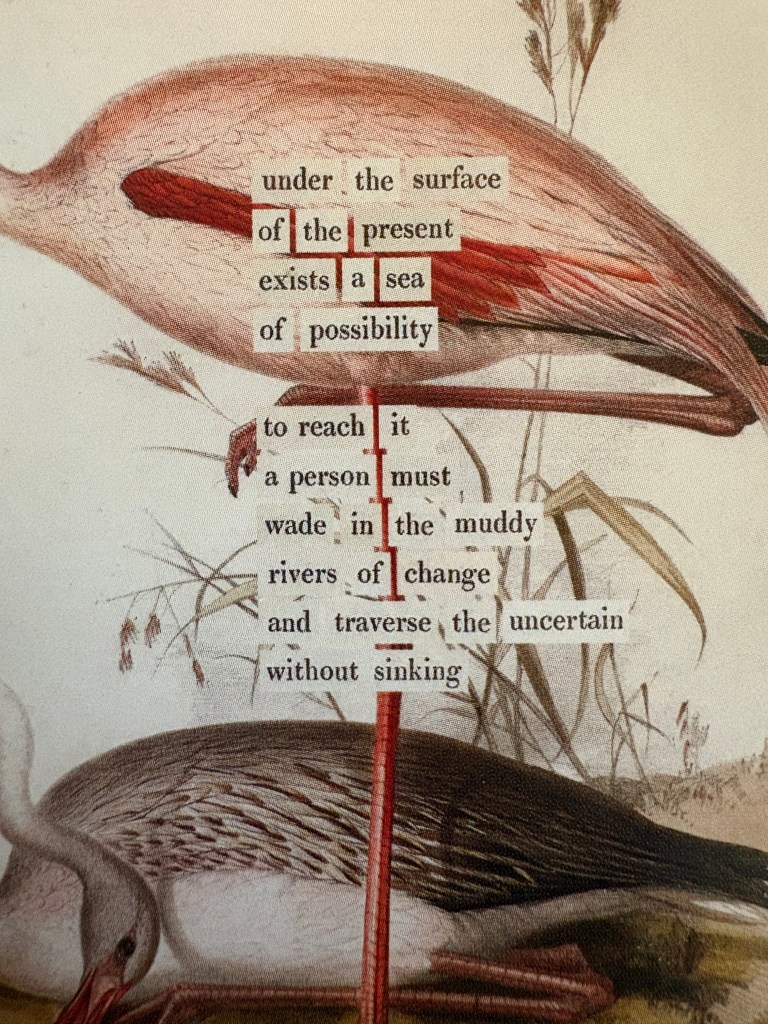
I turned to my fellow blogger, Karen Rose, who assured me that there’s more going on than simple addition, and she pointed me to a passage in Parker Palmer’s new book, On the Brink of Everything: Grace, Gravity and Getting Old. The passage isn’t from Palmer, however, rather Thomas Merton in Hagia Sophia. It begins: There is in all visible things an invisible fecundity. . . Suddenly I saw it, the fecundity immanent in all human experience. In Salzburg, I was healing and in pain, and at the same time laying the groundwork for things to come, like my deepening relationship with my grandson, Peter; like insights about the culture of school lunches; even like the relationship with Karen Rose, such that we now write a blog together. 

Two insights—both/and and the fecundity in human experience. Wow, what a way to start a new year!

I floated only a short time on the excitement of these new ideas, mainly because we are living in a pandemic that’s always with us. I cannot help but think about our present situation as a country and planet. Omicron, political dissent, and climate change are among the issues. I am getting towards the end of my life, while others, including my loved ones, are at the beginning and middle. We are all living in uncertainty. My hope is that Merton has it right, beneath the travails of this troubled time are seeds to a new and better world.

Hagia Sophia

“Both Sides Now?”

Lake Superior Path

When my mother was dying of excruciating kidney cancer that had spread to her bones, even though she was completely bedridden on strong painkillers, she insisted on going over and over her life. She wanted to ask forgiveness for things she saw as mistakes. To Dr. Robert Butler, what she was doing was a life review, a “naturally occurring, universal mental process characterized by the progressive return to consciousness of past experiences, and, particularly, the resurgence of unresolved conflicts.” According to Butler and others, such a review allows the dying to die in peace by reintegrating life events so that they give meaning to a life.

Butler (1927-2010) is a giant in the field of aging and gerontology,  winning a Pulitzer Prize for Why Survive?: Being Old in America (1975), serving as the first director of the National Institute on Aging, and founding the first department of geriatric medicine. But the contribution that has permeated so much of psychology and self-help, is the notion of a “life review,” which has grown into a therapeutic treatment used with adults at all stages of life.

Others have seized on the life review concept as a way of creating a meaningful retirement. Julia Cameron in It’s Never Too Late to Begin Again, advises dividing your life into sections—your age divided by 12—and reviewing a section each week in a memoir. Other retirement gurus like Richard Leider use the idea of life review to promote writing an ethical will in which you distill your life experiences into wisdom and values you have gained. Gene Cohen also advises writing an autobiography that includes unfinished interests and dreams. Even a book written for all ages, Designing Your Life incorporates a version of the life review.

I read all these books, but I mostly ignored the advice to do a life review.  I didn’t have time; I wanted to get on with the new chapter I was writing in retirement. Then came the pandemic and lots of time. Suddenly I found myself looking back. I realized that my life has turned a corner. I no longer have more time ahead than behind me. Life might seem like a circle, childhood, adulthood, elderhood, and circling back to dependent old age, but, chronologically, it’s not a circle, and we don’t get do-overs. We traverse a straight line forward, ending in death. That said, we have the ability to look back and make emotional sense of our lives, to find meaning, and in the language of Erikson, to achieve ego integrity. But am I ready for this?

Last week I visited a cabin on Lake Superior. The weather was abysmal, an occluded gray of mist. I wanted to hike, but the woods near the cabin was a morass of red mud and exposed roots. I decided to walk the paved path in Two Harbors, a community of about 3700 people just south of the cabin on the shore of Lake Superior. The trail was an out-and-back, straight walk, repeating the same path in each direction. On the way north, with my eyes peeled on the lake shore, I passed the city water works, a somewhat rickety old light house at the end of a long pier, an equally long freighter in the harbor, and scrubby wooded areas. It wasn’t particularly scenic, aside from the natural beauty of Lake Superior.

On the way back, over that same path, my focus turned to the side away from the lake. I noticed a wetland, with cattails and grass waking up to spring. As I walked further, a small woods, preserved by the people of Two Harbors, sheltered my walk. I realized that I had not noticed either of these beauties on my way out. It wasn’t until turning around, heading back, looking from another perspective that I saw what I had missed by being so focused on the enormity of the lake. I’d missed the whole of the walk, both sides.

A picture containing water, sky, outdoor, boat

Description automatically generated
Two Harbors, Minnesota

Which brings me to a favorite Joni Mitchell song, Both Sides Now. For me, the last stanza captures precisely what I feel and am afraid to face when I consider doing a life review.

I’ve looked at life from both sides now

From up and down and still somehow

It’s life’s illusions I recall

I really don’t know life at all.

Mitchell herself says that “This is a song that talks about sides to things. In most cases, there are both sides to things and in a lot of cases, there are more than just both.” So am I ready to see not just both but all sides, the whole of my life? To let go of my present narrative of the past for a different one? Or if I do a life review, will I end up feeling, “I really don’t know life at all?” I’m not sure. Perhaps my older self, no longer in such a hurry to get somewhere will make something different of the past. Like most of us, I’ve often imagined what I would do if I could have a do-over of some parts of my life, knowing there is no such thing. But there’s still the think-over, the life review, and I don’t have to wait like my mother did until I’m dying. Now I just need the courage to take the risk of a life review, and do it now, not later!