What is My Footprint?

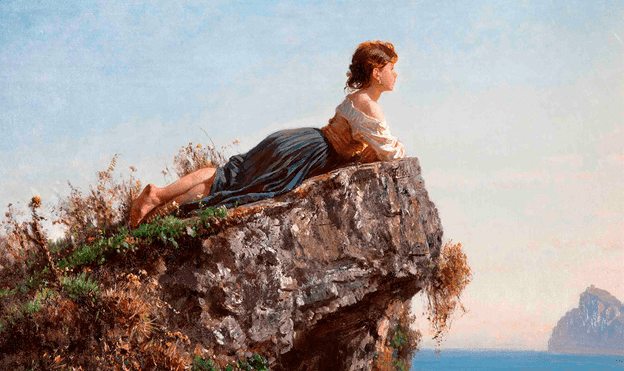
Fillipo Pallizi, Franciulla sulla roccia

Lives of great men all remind us
We can make our lives sublime,
And, departing, leave behind us
Footprints on the sands of tim
e

Henry Wadsworth Longfellow — A Song of Life

Geert Hofstede’s research suggests that striving for a life that will be noticed is fundamental to the American psyche.  And, in a big country, the longing is often equally big and broad.  From Patrick Henry to John Wayne, large and swaggering (and male) is what is noticed.  I saw myself in the narrative, but identified as a thoughtful visionary seeking a bigger world – like Pallizi’s romantic 19th c. portrait.  As I noted previously, my husband called this “International Karen” who, as frequently as possible, moved beyond contemplation to collaboration with people in other countries who also wanted to make their schools better. But, between Covid travel restrictions and a dwindling passion for experiences far from home, International Karen is coming to terms with the obvious:  the past will not be the future.  What is emerging is a different longing—to figure out how to leave smaller but still meaningful footprints.

Several years ago, some friends and I – (aka, The Retirement Biddies Workgroup) — read Sarah Susanka’s reflections on living a “not so big life”.    A well-known architect, she urges us to think about what really matters through analogies between designing a smaller home and designing a smaller life.  Some of her questions are relevant to anyone at any age:  How is what we are purchasing fitting in with what we need?  How are we using our resources?  When do we have enough?  But then, her zinger:  How have you wanted to change the world and how are you looking for related changes in yourself?  Her challenge suggests beginning with our biggest aspirations (do they come much bigger than changing the world?) and then look internally to see as if we are up to the task. 

But that question needs reframing in a life that has become radically smaller during Covid, while I am also busy considering a future that will inevitably be different from my expectations of a few years ago.  As I look at “international Karen” and cringe at the carbon offsets that I owe the world, I know that I could not go back, even if it were possible.  I pulled Susanka out of my bookshelf….

At a personal level, I have already made a commitment to a smaller life. A decade ago, Dan and I made a radical move from a rather large house to a condo, which was about the size of Susanka’s designs for a “not so big house”.  When The Retirement Biddies were contemplating the “not so big life”, Dan and I had given away many of our possessions, including furniture, books that we finished reading many years ago, and appliances that we rarely used.  We felt lighter and patted ourselves on the back, while filling every nook of our new walk-in closets.

But I was still working.  Although my home office was small, I had a bigger office at work for all the professional stuff.  The only question “not so big” question that had immediate resonance was a more thoughtful consideration of what we were buying. It was all about “the stuff.”

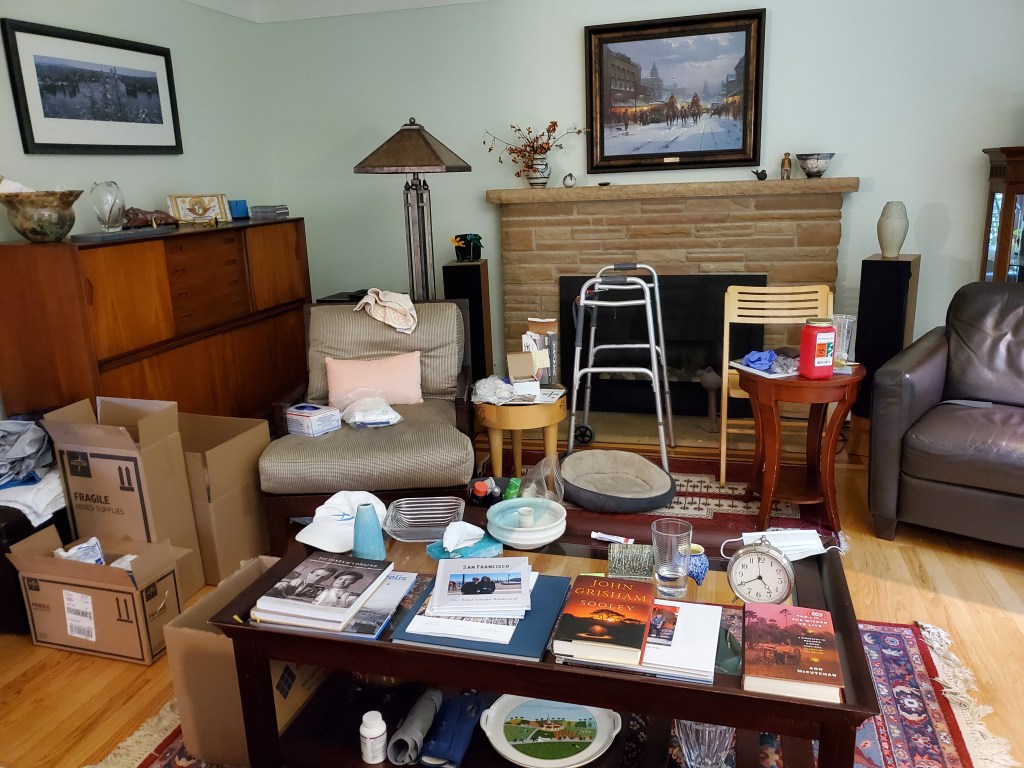
But now retirement-during-Covid is a reality, along with the unanticipated consequence of our decision to stay in Boulder, CO where we are engaged in a noble experiment: two people living peaceably in a 1000 square foot 1960s ranch that has only two interior doors that don’t lead to a toilet.  But this requires a different kind of decluttering.  The grand project of moving and starting over – just like those who are part of “the great resignation” or who have otherwise changed their lives in the last few years – requires a decluttering of the spirit and heart. 

The challenges are huge.  I have always been BUSY, largely with activities that are not essential. I  am easily distracted by emails or random thoughts.  I have never meditated, and have been totally unsuccessful at journaling because it requires discipline.  Since childhood, I have been unable to cope with boredom and have a long list of attractive projects that I can turn to if that awful feeling appears.  But these habits, some of which were functional when I was “busy working”, are now impediments.  In Susanka’s terms, I am unable to turn away from alluring “time clutter”. 


Clearing out the heart requires stillness – so different from concentration —  that does not come naturally.  I have taken a course on contemplative prayer.  I have read poetry out loud.  I have worked on a skill that never came naturally to me – listening to what other people are really saying rather than immediately generating a stimulating conversation.  I am even weaning myself off the computerized calendar that beeps too often, and writing out to-dos and appointments using a fountain pen.  More importantly, I am tracking a new habit – explicitly noticing, contemplating, and being grateful for something that is exquisitely beautiful, whether in nature (frost covered ornamental grass or snow on the Flatirons outside our house) or when making faces with a four-and-a-half-year-old.  And writing down a few of those things in turquoise ink.  I really love the turquoise ink. 

But what about changing the world?   I take heart in reading aloud Mary Oliver, who suggests that, at least for a poet, a large life can be inscribed through small acts: 

I don’t want to live a small life. Open your eyes,

open your hands. I have just come

from the berry fields, the sun

kissing me with its golden mouth all the way

(open your hands) and the wind-winged clouds

following along thinking perhaps I might

feed them, but no I carry these heart-shapes

only to you. Look how many small

but so sweet and maybe the last gift

I will bring to anyone in this

world of hope and risk, so do

Look at me. Open your life, open your hands.

Mary Oliver – I Don’t Want to Live a Small Life, Red Bird

To live a more open and intentional life, I need to consistently remind myself that small efforts, expanded over many committed people can make a difference in this world of hope and risk. I think of the years when I hauled dozens of yogurt containers to my office before my city started recycling – only to find out now that the containers were not actually recycled.  So, my Instant Pot and I now have a bi-weekly routine that involves yogurt making.  I find local issues that are pressing – affordable housing, unjust judicial practices, and the continued exclusion of the Native people who once owned this land – and find others who want to change them.  Goodbye International Karen:  You did good work and had fun.  Now I want to bring small gifts to the place where I live and to those I am with – and I also remind myself that large footprints in sand will be washed away.  

Welcome to the Club

The Clubhouse

I wake up from pleasant dreams that I can’t remember, but I do know I felt good in them. Slamming awake I realize that it’s still there, the reality of my life. My husband, Jim, has a chronic condition that will require care the rest of his life.  Currently, it’s acute and my days revolve around it. I eat breakfast, not only standing, but taking a bite and then doing something that needs doing before the lymphedema nurse arrives. I haven’t showered, but the dog’s been walked, I’ve tidied, and I’ve thrown a load in the washer. This is the life of a caregiver, disjointed and always on call.

I am not alone in my call to give care, indeed, having joined a club that welcomes all members. Nearly 42 million adults in the US care for elderly parents or friends, with three out of five of these, women. The average age of caregiving recipients is 68.9 while the average age of caregivers is 49. I’m outside the norm on that one. But I’m not outside the norm of a 20 hour work week for caregivers (See https://www.aarp.org/content/dam/aarp/ppi/2020/05/full-report-caregiving-in-the-united-states.doi.10.26419-2Fppi.00103.001.pdf.).

I’ve been thrust in the roll of caregiver four times in my life, and each experience was completely different. Context matters, who you are taking care of matters, your life at the time matters, the malady matters, how long the caregiving will go on matters, and your attitude matters. I suspect this is just a minimal list of all the permutations. For now, let me tell you a little about how caregiving has impacted my life. Maybe others will be inclined to share their experiences.

Two thoughts dominate my internal monologue. The first is how long will this last? Will it consume my entire retirement? There’s anger behind this thought, and I don’t like that in myself. But I’m not only angry. My second prevailing thought is compassion. Someone I love is coping with pain and the knowledge that his life will never be the same, that many of his favorite ways of spending time are gone. Probably toughest of all is watching him cope with the knowledge that this recurring illness is a harbinger of the end of life.

My first introduction to caregiving was when my mother, Margaret, was dying of kidney cancer. My two sisters and I agreed to do two-week stints to help her and our stepfather. I went first. It was heart wrenching to see her in pain all the time. Her cancer had spread to her bones, and she lay, mostly moaning in pain. A strong painkiller patch deadened some of her pain, but she was also in pain about dying. “I’m not ready,” she told me. “I wanted more time.” She never talked about how she would use more time. She knew she wasn’t going to have it.

My mother lived three months from those first two weeks when I cared for her.  I never had a chance to care for her again. When I returned home, my second husband, Gary, was diagnosed with pancreatic cancer. I was to be a caregiver to him instead. Caring for my mother felt like a loving responsibility. I was to quickly learn that caring for a husband whom you love very much is a completely different experience.

Gary lived fourteen months from his diagnosis of cancer. We had a mix of good and bad times, and I never resented caring for him. During the hard times, he was extremely cross from his pain—understandable, but still difficult. During the good times, we mourned the loss of our future together. I was with him every step of the way. A part of my heart was broken when he died. A wise counselor has taught me that within the brokenness is the memory of a man I dearly loved. I can hold that memory and go forward with my own life.

Seventeen years after Gary died, I met Jim, my third husband, whose own wife had died of cancer. We were going along nicely, forgetting how life can turn on a dime. Over one Labor Day weekend, he developed sepsis and went into septic shock, almost dying. We later learned it was from a perforated ulcer. When he came home from the hospital, I was back in the club. What I didn’t expect were the demands of helping someone who’s in great emotional turmoil from the aftermath of the disease itself—depression. We muddled through, not realizing that chronic edema, a consequence of his illness, would create the ideal conditions for another bout of sepsis three years later.  

So here I am again, a fourth time, which I sense will be indeterminate. I must say it feels different. Two days ago, a nurse bluntly said to us “It’s not edema, it’s lymphedema, a different condition. And you’ll have it the rest of your life.”  She kindly didn’t add, “Get used to it,” but it was implied.

Once again, those same two thoughts haunt me—what will happen to my life? Will I be able to do the things I enjoy? Will I ever be able to travel again? And what about my writing? Rosemaling?

Then there’s that second haunting thought about his suffering and fears. I feel challenged to alleviate these and help him go forward. I also feel great sadness for him. Am I up to the challenge?

Susan Allen Toth wrote an excellent memoir, No Saints Around Here: A Caregiver’s Days,  about caring for her husband who died of Parkinson’s disease. She writes:

“So much.” I think that simple phrase could easily be the motto emblazoned on a caregiver’s shield. Love, pain, courage, endurance, loss. So much, so much.

We caregivers are a club. We don’t have to feel isolated because we are in the company of caregivers all over the world, not to mention the circle of help from home nursing services, friends, and family. And we have love, the foundation that helps us go forward no matter how uncertain the future may be. As for me, it’s early, and doggone it, I will do my utmost to take care of both Jim and Karen. If there’s one thing the caregivers club has honed in me, it’s determination!

Belonging….Young and Old

My friend Kathryn recently asked me to write a forward to her newest book on the importance of place and belonging in schools.  Using vignettes culled from decades of trying to understand the experience of children who don’t feel as if they belong in school, she stitches together a story about what adults can do to change that.  As I thought about children and belonging in school, I could not help but connect their experiences—good and bad—with my own.

–image courtesy of K.A. Riley

Kathryn does not define belonging, but her descriptions suggest that young people have a fundamental need to feel that they are in a psychologically safe space.  The drawing above, one of the most evocative in book, makes clear the devastating effects that feeling excluded have on identity.  Joe Murphy has said for years that the first goal of any school must be to weave an invisible cord between a caring adult and each student, so that if the child begins to be pulled away, the adult will know and figure out how to draw them back in.  In other words, personal connectedness is key to safety and belonging.

Woven throughout Kathryn’s book is an imperative:  Educators must be attentive to the experiences that each young person brings with them because children, like adults, need to be known and understood to feel that they belong.  A child who recently immigrated from a war-torn country may gratefully acknowledge that physical safety is fundamental to his feeling of belonging in school, while another whose family experiences routinized racism will need a different form of care to feel safe.

But there is another message, also reflected in Tupac Shakur’s evocative poem, A Rose that Grew from Concrete:  The communities in which young people live deserve the same compassion and understanding.  And belonging can be inseparable from physical place – a sense of being rooted that goes beyond positive relationships and comfort inside a particular school building.  Shakur’s poem is a metaphor for finding resilience in community, and for more attention to all places as a source of individual identity that support social and emotional development.

While contemplating the stories of young people that Kathryn collected, I could not help but think about how belonging also colors my life – and how questions about “where I belong” have come up in so many post-COVID conversations with others.  Dan looked up the other day and said, out of the blue, “we skated through COVID” – no one that we know even got very ill.  But we were in Boulder for a warmer winter close to family when the world shut down and we stayed.  We felt safer and more connected because we were in a “pod” with a daughter, son-in-law, and grandchild, which meant that we were not alone.  We had zoom connections with groups that we were already part of, so we felt engaged – even surrounded — by others.  Of course, we missed hugs, but we were ok and as safe as anyone could be during a global pandemic.

By the time that the 2020 election heated up, however, we had to acknowledge that the passage of time meant that we had effectively moved from Minneapolis, without really planning to do so.  We registered to vote in Colorado.

I keep thinking about  my reaction to Brian Friel’s Home Place, which I saw 14 years ago at the Guthrie Theater.  While the play is ostensibly about racism and class as English rule begins to erode in Ireland in the late 19th century, the dominant narrative is not what stuck.  Instead – then and now — It was that the English owner of The Lodge at Ballyweg kept referring to his real home as a place in Suffolk– where he had not lived for decades.  In other words, where you live is not always where you feel that you belong

And although Dan and I are reasonably content, we were uprooted from Minneapolis but are not rooted where we are.  This feels like a big deal because we are getting older, and like the plants in our garden, we need water, sun, and time to thrive in a place – and we know that this is probably our final chance to find a home. 

The last time I made a major move, from Boston to Minneapolis, I was just over 40.  I had always belonged to groups that were tied to place and space – in Boston, I floated between different jobs but I “belonged” with a close-knit “moms of young children club” and a sister close-by in a house that I loved.  I felt understood and rooted.  When I first landed at the University of Minnesota, I immediately decided that my itchy desires to try new things could be easily satisfied there – in other words, I found a professional home place.  But I changed houses, churches, book groups, and preferred grocery stores on a regular basis.  Now I have not been in Minneapolis for 18 months, during the trauma of COVID and the murder of George Floyd — and am retiring.  I don’t feel that I belong in a city where I lived for over 30 years – I miss the close friends whose lives have enriched mine over the years, but it feels as if the city and I have both changed.  Although Colorado is where I live, it is still not a home place. Everything from the gorgeous scenery to the strange weather feels slightly foreign.  The awe when I look at the Flat Irons each morning (finally, the view that I always wanted) is real, but it still doesn’t fully engage my heart. And, having lived a very circumscribed life during the COVID shutdown, I still have to use Waze to get anywhere but Target.

I am vaguely envious of friends who do have a home place and a sense of roots that connect people and a place to which they always return:  the couple who has Thanksgiving (and an extended vacation) with friends in the town where they lived after they first married; the middle-aged children who go “home” to their parents and old friends on a regular basis; others who spent a substantial sum renovating a house that they cannot imagine leaving because most of those they love the most live in the neighborhood.   The exquisite feeling of knowing that you belong someplace can be visceral…when it connects all the elements that I saw in Kathryn’s description of young people and belonging.

My friends who have a home place take it for granted and cannot imagine what life would be like without that touchstone.  I take for granted the fact that at various times in my life, I have experienced the psychologically safe space and personal connectedness elements of belonging that the children talk about even though I may not have them both today.   This leads me to wonder whether there is a rooted element to belonging for some people, but for others belonging is more fluid and situational.  In my case, generational wandering and relocation has been the dominant narrative of the Seashore clan ever since my father’s family left their tiny, rocky “home place” in Småland as immigrants to the U.S. in the 1860s.  Yet others from my great grandmother’s side, who came from Sweden at the same time, cannot imagine living anywhere but southern Minnesota and attending 4 generational family reunions each year. Are  some people simply more likely to need belonging and place, while others are sustained with the availability of safe spaces and satisfying relationships?

Belonging

(Benbecula)

Martins own this ragged edge

stitching sky peat water cloud

where land weds salt.

Cobalt ripples draw

The sun joyful

Through a mackerel sky.

I scan the gloss of deep

feel the sea   cradle this isle

these crofts   this past

— Fiona Scott

Hand It Over!

A chance, that is. . . for a career in whatever drives someone. In my case it was education, being a teacher. When I entered teaching in the early ‘70s, jobs were scarce. I was lucky to get a job at the local school teaching two hours a day—no one wanted a job that breaks up your day and doesn’t pay much. But it allowed me to ease into teaching after being a stay-at-home mom. I was much younger than the teaching staff at my school; I was filled with liberating ideas, too, like having students call me by my first name, and playing rock music during home room. The culture of my school quickly put me in my place, but I persisted with my “new” ideas about how to support learning. When my low group math class out-performed the middle group at the end of the year on standardized tests, I earned a new respect from my colleagues.

I stayed in education my entire career, first as a classroom teacher, then as a professor, next working on a drop-out prevention program, Check & Connect, and finally as an evaluator for something called reflective practice for nurse home visitors. What a span, and from the vantage point of looking back, I loved it all. But as I hit my 70’s, I became increasingly aware that my passion was moderating and changing. I didn’t go to work with the fire I had once had. Let me say that as a teacher, by Friday afternoon, I was spent. I needed two days to recuperate, but by Monday, I was once again ready to take on the challenge. I’d lost that ability to bounce back, but I saw it in others. A young woman, Angie, with whom I worked on Check & Connect; Ann, a new Ph.D. in evaluation, my partner in the reflective practice evaluation; my own daughter who lived and breathed evaluation. It was time. Time to . . . 

Pass the baton to the new professionals. When I first grabbed the baton in that parttime teaching job, it was light, easy to carry. But by retirement, that baton was heavy, made of intractable human problems like babies getting poor nurturing from chronically depressed mothers; homeless kids, kids with great potential who drop out, persistent gaps in learning—I could go on and on. From my vantage, which might be colored by the fact that my “time is more gone than not,” passing the baton was my rite of retirement. I would pass it to the next runner, the Angie’s and Ann’s full of knowledge, training and inspiration, waiting expectantly to grab the baton and run with it.

Yet I still want to run at least for a while or maybe as long as I can. I haven’t given up on ameliorating the problems, but I’ve changed how I want to run. My way of running suits where I’m at, mostly retired with new interests. I continue to teach an introductory evaluation class, hoping to inspire others to enter the field, and I tutor fifth and sixth graders in math. In my tutoring I work with great teachers who use smart boards and videos and classroom techniques that are the result of years of educational research. I learn from them. But they learn from me, too, because I have teaching strategies from years of practice and study in the field. We are a team and respectful of the knowledge each brings. 

A picture containing text, person, indoor, group

Description automatically generated

Salient is Cattell’s theory of intelligence. Cattell posited two types of intelligence, fluid and crystallized. Fluid is strong when we’re young. It allows us to problem solve, innovate, and think abstractly. It goes down through age—but doesn’t disappear. Crystallized is our accumulated knowledge that we acquire through life.

Think young teachers with their new approaches working together with the seasoned tutor who has accumulated knowledge about how to teach math to struggling students, a win-win.

Older people do know things the young do not. But if that’s true why did I reach a point that passing the baton seemed the right thing to do? It was a combination of two realizations. First, fluid intelligence does count, at least when you are younger. I saw new Ph.D.s with fresh ideas for solving those wicked problems. Second, in seeing that, I believed that they deserved their chance. I’d had mine. It wasn’t that I couldn’t do the work and that I didn’t have a wealth of experience to bring to the work. Instead it was because I saw an eagerness in them to take on these intractable problems, while I was eager to try my hand at deferred dreams, like writing and rosemaling. 

So, I passed the baton and retired. In passing the baton, I moved on to a different race, one with an accelerated pace but a wide-open track of new adventures. And like most finish lines in life, even in retirement, it’s always shifting. I love the vision of a finish line that keeps changing, moving forward, whatever stage of life one is in, whatever track one is running on. 

A green sign with white text

Description automatically generated with low confidence