She Wants to Put Me in a Box

By Guest Blogger Katharine Malaga

This week we’ve invited Katharine Malaga as our guest blogger. Katherine is a retired RN, ESL teacher, and Spanish interpreter and lives in Minneapolis, Minnesota. She is writing a memoir about the multilayered aspects of caregiving after her husband’s stroke and dementia.

Katharine’s husband, Ross, had a massive stroke several years ago, which drastically changed their lives of travel and adventure. Ross is now facing dementia. One interesting thing about Ross is his uncanny ability to use words in a way that seems slightly off but is incredibly insightful. We wanted to post this because many of us have similar struggles or may have them in the future. Thanks, Katharine!

Here are some of the unique ways he has relearned to use language:

  1. “He’s unhelpful,” he said of his dangling right arm.
  2.  “Who’s coming tomorrow?” he asked one Wednesday evening.

             “Rachel,”  I said. “Your favorite.”

             He looked down and moved his jaw back and forth while gathering his words.

             “I would like a degree of freedom.”

3. “Hee..loo,” Ross said.

             A  loud bang thundered in the background. Maybe a truck backfiring.

             “Where are you?” 

             “ I…I…am… at the… apogee… of my walk.” 

“She wants to put me in a box,” Ross said one day.  He had overheard me discussing memory care options on the phone.

I don’t want to put him in a “box,” but he needs more care.  His doctors are recommending 24-hour supervision because of his decreasing memory, judgment, and poor balance. 

I am home twenty-four hours on most days. But sometimes I take the bus to a grocery store or to get a haircut. Today I had an appointment with a retina specialist and Ross was alone from 8:15 to 10:00. Last week I saw another eye doctor and a physical therapist. I have a mammogram on the 28th. I could take him with me, but that would be hard for him.  I text him when I arrive somewhere and he texts back. I come and go as fast as I can. He worries about me as much as I worry about him.   

My efforts to find home health care have not been successful. Between the pandemic issues and the shortage of home health aides, agencies cannot find workers.  (Minnesota is reporting a need for 15,000 home health aides.) “We hear that all the time,” his doctors tell us.

I put him on a waiting list for the Veterans Administration Home (VA) last June. They told me there was a two-year wait for veterans with  “immediate needs.”  I was surprised when they called last week and said he was getting close to the “top of the list.”  

I spent about thirty hours filling out their thick packet: tax forms, one year of bank statements, insurance forms, health records, marriage and divorce degrees, rental agreements, and more. 

The facility is on the Mississippi River and sits on 53-acres of woods.  Every resident has a large private room and bath that meet disability needs. They have a medical, dental, and podiatry clinic in the building and provide transportation to the nearby VA hospital and clinics. I take Ross to those appointments at Hennepin County Medical Center (HCMC) now, but it is getting more difficult for him to get into cars. They also have a barber shop which after COVID has been very difficult to schedule.

“I like it,” he said. I was impressed, too.  There are a lot of patios and gardens for walking, as well as decks on each floor.  They can accommodate a vegetarian diet.  They have mass on Saturdays on the first floor. It is on the bus and light rail lines. All visitors must wear an N95 or surgical mask, plus a face shield in the skilled nursing area. They must mask in the hallways.

If not for the price, $11,000/month, I would be making plans for his move there.  (The community  standard for skilled nursing/memory care is $10,000 to 12,000 per month.)  He has long term care insurance that would pay about a third of that, but so far they have denied him coverage.  We are applying for the sliding scale payment plan, based on income.  I still have more paperwork to fill out. The VA is doing a background check and getting his medical records from HCMC.  (Unlike assisted living, he must prove medical needs.) It may take a month or two before we can make a decision.

We don’t know if it will work out, but we are looking into the possibility.  These are not easy decisions, not what we planned, at least this early in our lives.  But, we have to try to meet his ever increasing needs for care.  

It’s not a “box,” but it is a more restrictive way of life for both of us.  This is what so many face with age and disease.  

How to Retire During a Pandemic. . . or Any Other Time

A group of people on a stage

Description automatically generated
Rolling Stones, 2018

Karen Rose and I promised not to give advice, so don’t think of this as advice, rather encouragement.

First of all, why not retire? There’s nothing that says you shouldn’t. It’s completely your own decision. Retirement right now could make you part of the Great Resignation—and who doesn’t want to be a trend-setter? So, in the spirit of all the self-help gurus who have gone before me, here’s my list of how-to’s.

  1. Tell your friends, family, and colleagues how you want to celebrate.  You could have a bonfire or even a Zoom meeting (I’m kidding). Restaurants and bars are starting to open. It’s not impossible anymore. I like cake, so that’d be my go-to, a Danish layer cake from a bakery in Racine, my hometown, or if not available, a big white cake with white frosting from Whole Foods with vanilla flavor—you might be trying a lot of new foods when you retire, that’s one way to pass time—eat. 

If you retire in summer, you can always have an outdoor party. In fact I went to a couple last summer, and the retirees didn’t seem intimidated by the pandemic at all. And there was lots to eat—even cake.

There’s always the person that wants to go quietly. The one who rather slides into retirement; some even take it year by year, never really announcing it until they’ve completely left the playing field (E.g., KRS?) It’s not a bad way during a pandemic, or during any hard times, as everyone is busy watching CNN, the CDC, NBC, OSHA, SCOTUS, ETC.

  1. Let those feelings come forward. Maybe you’ll be relieved—you’ve had enough of working for a lifetime. You might be discombobulated—I certainly was. That first Monday morning after my drinks at the bar party—no, I didn’t get cake—left me unmoored. Should I wear jeans?  Jeans are for weekends. What time should I have breakfast? Lunch? What am I going to work on? Does my spouse have to be near me all the time? I can hear him rattling around the house. Is he always like this? When do I get to “quit” for the day—oh, I never started.  

You will have feelings. I promise!  Let them all hang out!

  1. If you live with someone, warn them. They may have had the house all to themselves, but that’s changing. Someone new will be sitting on the couch reading the morning paper, playing the stereo during the day, making lunch right when they like to make lunch. Maybe you’ll start to clean closets, throwing things out. Someone else might not be ready for this.  And are you ready?  Your close relationships will change, hopefully for the better.
  1. Don’t sweat having a purpose. This is a biggie!  I know, you’ve read all those books about the importance of having a purpose when you retire, Something to Live For, Retirement Reinvention, Purposeful Retirement, and Encore Adulthoodamong the many—but I’m here to tell you retirement is all about the unknown, and that’s what makes it both interesting and challenging. In the world of work, you needed goals. The idea was to get ahead, to strive (more about this from Karen Rose), to seek, to find. . .  to make a name for yourself, do better than meeting quotas, etc. You are done with all that. New paradigm coming your way! And you get to create it.

The Purpose experts argue that having a purpose is linked with better outcomes for aging, living longer, etc. But you’re not an outcome, a statistic. You are you, and if you don’t have a purpose, that’s just fine.  I’ve written about Big P and Little p, arguing that Big Purpose is a male oriented way to live and that there are lots of Little purposes in our daily lives—relationships, family, great books, helping out in the community, that can evolve daily. By letting go of the need to find some big, all encompassing Purpose, you can let the day’s own offerings be sufficient—and you’ll be more inclined to show up for them, because you won’t be busy searching for that big Purpose. 

If you have a big Purpose for your retirement, by all means, go for it. My take is because so many of us love our lives but probably can’t identify some big Purpose in how we live them. But then living a moral and kind life is rather a big Purpose.

Instead of worrying about purpose, resolve to be CURIOUS–like the Torstein Hagen advertising for Viking Cruise Ships. When the pandemic first hit, and we were all scared, staying home, isolating, I started daily walks—like everyone else—around the little lake by our house. After several of these walks, I noticed stumps, which had been cut off in the prime of life, had branches growing out of them; they were putting out shoots of hopefulness. I photographed these stumps and shoots and followed them throughout the spring. I saw them turn green and produce leaves. Later a friend told me about something called coppicing, a process used to manage forests by taking advantage of these persistent trees. What astonished me about this discovery was how I’d walked by it most of my life! (https://karensdescant.com/2020/04/20/condition-provisional/0)

So be easy on yourself about purpose. Maybe you’ll find one, maybe you won’t, but retirement allows you time to be with the unknown, to pay attention to the details, or, as a friend once advised me—to smell the roses.

  1. Let go of expectations! I absolutely believe that we would all live happier lives if we could let go of expectations. In the dictionary, 1) expectation is defined as the state of looking forward to or waiting for something. 2) A belief that someone will or should achieve something. Until the pandemic, retirements were full of expectations—“I’m going to travel.” “I plan on spending more time volunteering.” “Maybe I’ll take some classes.” All worthwhile endeavors, but this pandemic has certainly put us on pause.

So what recourse do we have? We could approach our new retirement lives without those expectations, instead curious and willing to engage with what shows up. You now have time to explore who you are inside and act from within rather than without, based on expectations set by others, the society, and eventually by ourselves. 

If you’re planning on retiring, go ahead. You will have a chance to approach life with curiosity, seeing what unfolds, and maybe, with that curiosity, learn more about yourself and the world around you. I wouldn’t normally turn to the Rolling Stones to talk about retirement, but their song, No Expectations perfectly sums up my idea for approaching retirement:

Take me to the station
And put me on a train
I’ve got no expectations
To pass through here again.

A retired Keith Richards

What is My Footprint?

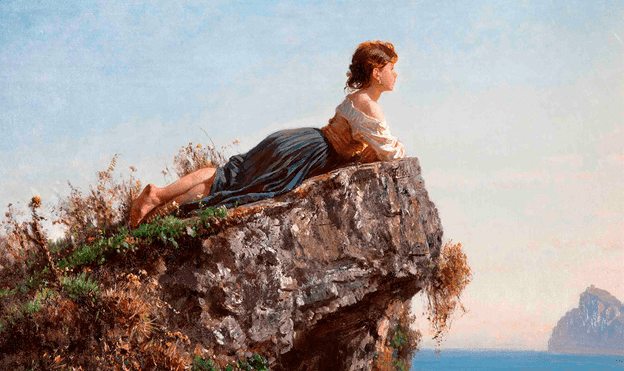
Fillipo Pallizi, Franciulla sulla roccia

Lives of great men all remind us
We can make our lives sublime,
And, departing, leave behind us
Footprints on the sands of tim
e

Henry Wadsworth Longfellow — A Song of Life

Geert Hofstede’s research suggests that striving for a life that will be noticed is fundamental to the American psyche.  And, in a big country, the longing is often equally big and broad.  From Patrick Henry to John Wayne, large and swaggering (and male) is what is noticed.  I saw myself in the narrative, but identified as a thoughtful visionary seeking a bigger world – like Pallizi’s romantic 19th c. portrait.  As I noted previously, my husband called this “International Karen” who, as frequently as possible, moved beyond contemplation to collaboration with people in other countries who also wanted to make their schools better. But, between Covid travel restrictions and a dwindling passion for experiences far from home, International Karen is coming to terms with the obvious:  the past will not be the future.  What is emerging is a different longing—to figure out how to leave smaller but still meaningful footprints.

Several years ago, some friends and I – (aka, The Retirement Biddies Workgroup) — read Sarah Susanka’s reflections on living a “not so big life”.    A well-known architect, she urges us to think about what really matters through analogies between designing a smaller home and designing a smaller life.  Some of her questions are relevant to anyone at any age:  How is what we are purchasing fitting in with what we need?  How are we using our resources?  When do we have enough?  But then, her zinger:  How have you wanted to change the world and how are you looking for related changes in yourself?  Her challenge suggests beginning with our biggest aspirations (do they come much bigger than changing the world?) and then look internally to see as if we are up to the task. 

But that question needs reframing in a life that has become radically smaller during Covid, while I am also busy considering a future that will inevitably be different from my expectations of a few years ago.  As I look at “international Karen” and cringe at the carbon offsets that I owe the world, I know that I could not go back, even if it were possible.  I pulled Susanka out of my bookshelf….

At a personal level, I have already made a commitment to a smaller life. A decade ago, Dan and I made a radical move from a rather large house to a condo, which was about the size of Susanka’s designs for a “not so big house”.  When The Retirement Biddies were contemplating the “not so big life”, Dan and I had given away many of our possessions, including furniture, books that we finished reading many years ago, and appliances that we rarely used.  We felt lighter and patted ourselves on the back, while filling every nook of our new walk-in closets.

But I was still working.  Although my home office was small, I had a bigger office at work for all the professional stuff.  The only question “not so big” question that had immediate resonance was a more thoughtful consideration of what we were buying. It was all about “the stuff.”

But now retirement-during-Covid is a reality, along with the unanticipated consequence of our decision to stay in Boulder, CO where we are engaged in a noble experiment: two people living peaceably in a 1000 square foot 1960s ranch that has only two interior doors that don’t lead to a toilet.  But this requires a different kind of decluttering.  The grand project of moving and starting over – just like those who are part of “the great resignation” or who have otherwise changed their lives in the last few years – requires a decluttering of the spirit and heart. 

The challenges are huge.  I have always been BUSY, largely with activities that are not essential. I  am easily distracted by emails or random thoughts.  I have never meditated, and have been totally unsuccessful at journaling because it requires discipline.  Since childhood, I have been unable to cope with boredom and have a long list of attractive projects that I can turn to if that awful feeling appears.  But these habits, some of which were functional when I was “busy working”, are now impediments.  In Susanka’s terms, I am unable to turn away from alluring “time clutter”. 


Clearing out the heart requires stillness – so different from concentration —  that does not come naturally.  I have taken a course on contemplative prayer.  I have read poetry out loud.  I have worked on a skill that never came naturally to me – listening to what other people are really saying rather than immediately generating a stimulating conversation.  I am even weaning myself off the computerized calendar that beeps too often, and writing out to-dos and appointments using a fountain pen.  More importantly, I am tracking a new habit – explicitly noticing, contemplating, and being grateful for something that is exquisitely beautiful, whether in nature (frost covered ornamental grass or snow on the Flatirons outside our house) or when making faces with a four-and-a-half-year-old.  And writing down a few of those things in turquoise ink.  I really love the turquoise ink. 

But what about changing the world?   I take heart in reading aloud Mary Oliver, who suggests that, at least for a poet, a large life can be inscribed through small acts: 

I don’t want to live a small life. Open your eyes,

open your hands. I have just come

from the berry fields, the sun

kissing me with its golden mouth all the way

(open your hands) and the wind-winged clouds

following along thinking perhaps I might

feed them, but no I carry these heart-shapes

only to you. Look how many small

but so sweet and maybe the last gift

I will bring to anyone in this

world of hope and risk, so do

Look at me. Open your life, open your hands.

Mary Oliver – I Don’t Want to Live a Small Life, Red Bird

To live a more open and intentional life, I need to consistently remind myself that small efforts, expanded over many committed people can make a difference in this world of hope and risk. I think of the years when I hauled dozens of yogurt containers to my office before my city started recycling – only to find out now that the containers were not actually recycled.  So, my Instant Pot and I now have a bi-weekly routine that involves yogurt making.  I find local issues that are pressing – affordable housing, unjust judicial practices, and the continued exclusion of the Native people who once owned this land – and find others who want to change them.  Goodbye International Karen:  You did good work and had fun.  Now I want to bring small gifts to the place where I live and to those I am with – and I also remind myself that large footprints in sand will be washed away.  

In All Visible Things. . .

Mirabell Gardens, Salzburg, Austria

One holiday evening this year, I watched the Sound of Music. It’s one of my favorite movies. I love the music, but mostly it makes me recall a four-month mini-sabbatical I had in Salzburg where the movie was filmed. Nostalgia overwhelmed me as I viewed the nuns walking through the Nonnberg Abbey, and the children and their nanny, Julie Andrews, cavorting in the Mirabell Gardens, all set against the Austrian Alps, places I remember from my time there.

I recalled my zimmer with chickens beneath my window, whose eggs I ate for breakfast, and the shop down the street where I could buy a takeout Austrian dinner. I was doing research on school lunch in Europe, and I had access to Salzburg schools because my son, his wife, and my new grandson were living there and through their work had met local educators.

I could go on about the many memories, but what struck me as I watched the moviewas that I was remembering this time as happy when, in truth, it was not. My husband had died three years before, and I was in a prolonged grief, crying easily at almost everything, feeling like a role player in a meaningless life, while struggling to build an authentic one.  The only joy I felt was spending time with my grandson, Peter, a toddler with unlimited wonder at his unfolding world. Otherwise, I spent way too much time in my room, forcing myself to revise field notes of my research observations and to read about cultural learning—with the goal of delaying going to bed and crying myself to sleep. 

It wasn’t a happy time at all! And yet, today I remember it fondly. What is going on, I asked myself, as I reflected on my faulty memory? Was I rewriting the experience to make a bleak time look rosier?  Or was nostalgia for Salzburg and my grandson overriding my memory of unremitting grief. Perhaps my process was a part of a subconscious life review, consolidating my memories into something that would eventually make the whole of my life hang together? Regardless, if I was honest with myself, accurate memory had given way to nostalgia.

I’ve written about nostalgia before in Nostalgia 101, noting that it is healthy and tends towards positive memories. Its highest occurrence is when we are young and old with the middle years of life less given to nostalgia. Experts believe it’s helpful during life transitions when we’re unsure of where we’re going. We can look back and see the past as happy, thus the future feels safer. My time in Austria was part of a long transition to reestablishing my life without my husband. Though I was incredibly sad, deep within me, I believed I’d find my way. That said, I was still troubled by my disparate memories. How could I allow what I knew as truth be glossed over with nostalgia?

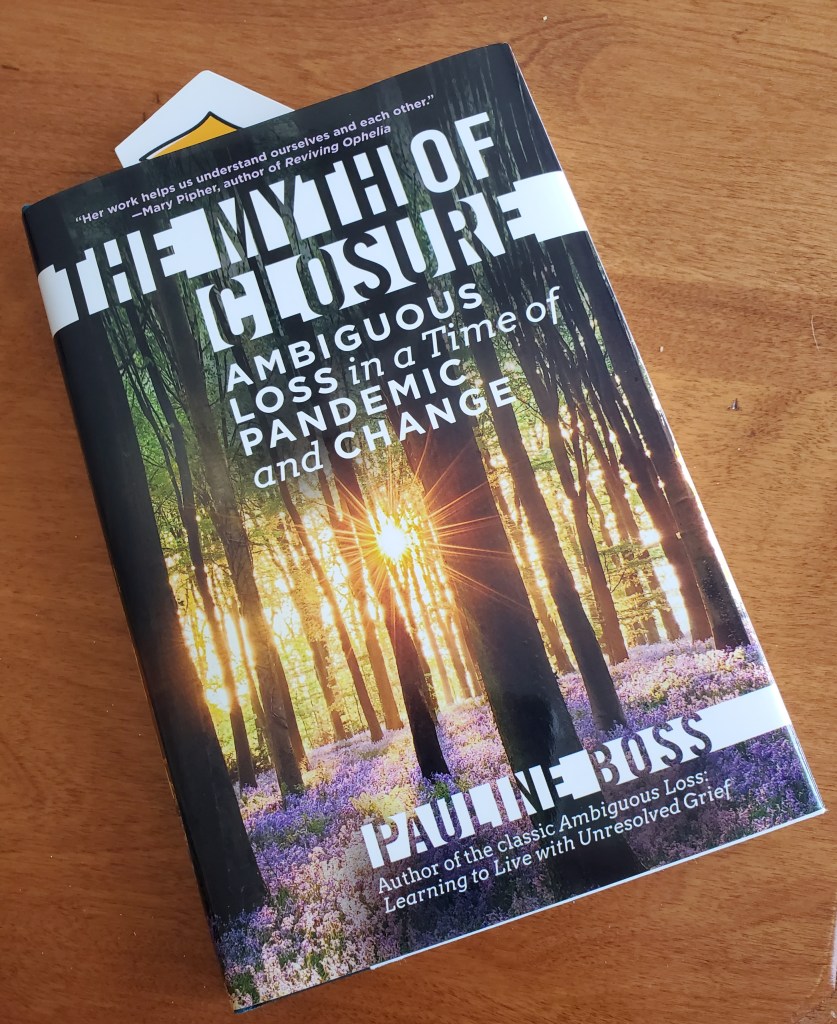
I walked around for several days asking myself what does it mean to have conflicted memories. Which one is really true?  Then I started reading Pauline Boss’s The Myth of Closure: Ambiguous Loss in a Time of Pandemic and Change. One of her central ideas is that  in adapting to losses, we should not think either/or—which was exactly what I was doing by seeking one truth about my perceptions of my time in Salzburg. She says we need both/and thinking. In terms of the pandemic, she writes: “I am both hungry for alone time and for social contacts; I both disagree with my neighbor and continue talking with him. . . “

After reading this, I revised my thinking.  I was both happy in Salzburg experiencing a beautiful city, and I was deeply sad about losing my husband. I was making progress with finding my way as a researcher and feeling up-ended by the loss of my marriage-infused dreams. I was happy to spend time with my family there, especially my new grandson, and sad that I couldn’t share this with my husband. It feels so right to be able to say all these things, there’s a clarity and truth to the statements that either/or doesn’t provide.

In the days following this insight, I found myself infatuated with both/and thinking, ready to chuck dualism as obsolete.  And like any good revelation, I kept seeing both/and everywhere.  Even the New York Times was onboard, running an op ed about both hating one’s husband and loving him. Then I asked myself if both/and adds up to a whole, and that stopped me in my tracks.  It was too simplistic.

I turned to my fellow blogger, Karen Rose, who assured me that there’s more going on than simple addition, and she pointed me to a passage in Parker Palmer’s new book, On the Brink of Everything: Grace, Gravity and Getting Old. The passage isn’t from Palmer, however, rather Thomas Merton in Hagia Sophia. It begins: There is in all visible things an invisible fecundity. . . Suddenly I saw it, the fecundity immanent in all human experience. In Salzburg, I was healing and in pain, and at the same time laying the groundwork for things to come, like my deepening relationship with my grandson, Peter; like insights about the culture of school lunches; even like the relationship with Karen Rose, such that we now write a blog together. 

Two insights—both/and and the fecundity in human experience. Wow, what a way to start a new year!

I floated only a short time on the excitement of these new ideas, mainly because we are living in a pandemic that’s always with us. I cannot help but think about our present situation as a country and planet. Omicron, political dissent, and climate change are among the issues. I am getting towards the end of my life, while others, including my loved ones, are at the beginning and middle. We are all living in uncertainty. My hope is that Merton has it right, beneath the travails of this troubled time are seeds to a new and better world.

Hagia Sophia