Doubt and Reflections

In this short Life that only lasts an hour

How much – how little – is within our power

-Emily Dickenson

Almost a year ago I asked Fran Vavrus if I could have a copy of her new book, Schooling as Uncertainty, and I would write a review in return.  I finished reading it some time ago, but pulling my thoughts together to prepare a review for a scholarly journal – something I am usually able to do easily – has been challenging.  As I texted Fran ( and have repeated to many other people), her work gob smacked me:  I thought I had signed up for an exegesis of her ethnographic experience studying women’s education in Tanzania – a country about which I know so little that I was sure that it would be an intriguing read.  Instead, what I encountered was a book that is equal parts scholarship, personal memoir, and a timeless story. 

Fran’s big message is that the accepted mantra, “get more education to get ahead and have a good life,”, may be accurate for some populations, but it obscures the circumstances that disrupt the narrative’s accuracy for individuals.  She recounts in loving and sometimes intimate details the histories of talented rural Tanzanian children, whose life paths she has followed for years.  Their journeys  through secondary or higher education – some successful, some not – often depended less on their own effort and more on the appearance (or disappearance) of family members or mentors who could afford school fees, or their family’s geographic location at  a convenient distance from schools for which they were qualified.  As she wrote searingly about those whose chances were permanently derailed by the AIDS crisis, which orphaned or impoverished many, I was struck less by the foreignness of their stories than by their congruence with my experience.    

I read Jonathan Kozol’s Death at an Early Age, when I was in graduate school in New York City.  It was the late 60s – a peak period of street crime and also the “great school wars”, where poor parents in Ocean Hill-Brownsville rallied for more say in their children’s schools and teachers called for more professional determination.  The conflict was a true dilemma – both sides had a point.  Those experiences led to my 40-year obsession with studying urban schools.  But, in the end, it is still often the children who have lost.  Big visions, like the Great Society or Eugene Lang’s I have a Dream, did not dent the immediate realities of family economics, under-resourced and segregated schools, and the distraction of immediate opportunities that promised survival.

Ok, so those are the facts, backed up by solid analysis.  But what about all the other unseen stories of uncertainty that are deeply painful although not associated with dramatic, newsworthy failure?  Even for my friends who are not impoverished, life has a way of interfering with the dream that education is easily available and can open all doors.  Just as in Tanzania, early marriage or unplanned pregnancy, a parent’s death, or temporary homelessness throw careful plans into disarray:  the hope for something big “out there” is abandoned (or delayed).  For my mother, being orphaned in the Great Depression meant that the generous uncle who paid her tuition at the University of Minnesota thoughtfully added a requirement that she become a teacher (sure employment) rather than a biologist (risky, especially for a woman). Karen Martha waved her sister off to college, but had to confront her parents’ financial collapse when it was her turn.

Uncertainty is always close to the surface as Fran interweaves her own life experiences in the U.S. with those of friends and colleagues in Tanzania.  Her personal stories make me cringe with recognition.  Fran’s dissertation was viewed as “theoretically inadequate” by a single faculty member, which required her to spend vast amounts of energy and time in revisions and prevented her from graduating on time; my experience was similar, although my advisor bulldozed the less powerful member of my committee.  Fran’s critical promotion to a tenured position was almost derailed, again by a single faculty member.  In my friend Doug’s case, an erratic committee in one of the U.S.’s most prestigious institutions sent his five years of post-graduate work into a black hole, to be resuscitated much later at a different institution.  I stepped off the tenure track for a decade to avoid the tenuous assistant professor role while I was a young mother (no, you can’t have it all….) and managed, largely through unanticipated opportunities, to get back on track. Those are happy accidents.  But I have seen other colleagues sidelined because they didn’t follow all the unwritten rules on the way to tenure – or had a dean who disliked them.  Conformity is required, but it does not eliminate uncertainty.

Speaking from my own vantage point, the timeless story in Fran’s book is more than a cautionary tale about the certainty of financial and personal payoff from education.  Instead, her narrative leads me to consider each of the uncertainties I have encountered and how my struggle and occasional despair remains within me but disappears from the abbreviated public arc of a life that looks seamlessly successful (my close friends know better).  As with Fran, thinking about my personal encounters with uncertainty at this juncture in my life has affected how I retell my story, not only to myself but to others.  Perhaps that is why I do not run out of things to write about for Karens’ Descant….

A final reaction to Fran’s description of the effects of Tanzania’s post-colonial turmoil on educational careers requires me to consider how individual experiences are situated in their larger context.  When and where we are born – in times of affluence, war, or environmental crisis – adds an existential uncertainty that we cannot escape.  Like most people, I have intense reactions to social unrest as it happens but often become aware of its long-term impact only much later.  I grew up aware of the magnetic evil of McCarthyism in the 1950s because academics were among those he targeted, and my father was at the beginning of his own career as a professor.  A lasting consequence is that I do not trust the wisdom of crowds and popular opinion. I grew into early adulthood in the 60’s and early 70s, when it felt as if the foundations of the country were at risk, so aptly captured in the last few months by Ken Burns’ probing visual chronicle of Mohammed Ali, and the (for me) very personal movie about the Boys Who Said No! to the Vietnam War.  Now, as the country feels, once again, as if it has lost its collective mind, I am pricked again by the menacing prescience of William Butler Yeats’ Second Coming, written in 1919, just after World War I:

Turning and turning in the widening gyre   

The falcon cannot hear the falconer;

Things fall apart; the centre cannot hold;

Mere anarchy is loosed upon the world,

The blood-dimmed tide is loosed, and everywhere   

The ceremony of innocence is drowned

Fran’s depiction of the larger conditions over which we have no control echoes throughout her story, initially set in one of the poorest countries in Africa, but also situated in her own experiences.  I am humbled by the resilience that accepting uncertainty brings to those who live with it as a fact of their own and other’s lives. The art of muddling through life’s inevitable ambiguities and failures is not a skill that we usually promote to our children (or grandchildren), but as I view events through the rear-view mirror, it feels like one of the most important lessons.  Fran has reminded me that, when I cling too closely to something, the universe is laughing. 

I Want Out!

A picture containing diagram

Description automatically generated

Today I told my daughter that I’ve been thinking that I need to get out of my comfort zone, which Dan Buettner describes as the “behavioral and psychological construct in which our activities and thinking fit a routine pattern.” 

My daughter replied, “You think you want out! I don’t leave the house!” Between COVID and working from home she knows exactly what I mean about being stuck, comfort zone notwithstanding.

My clinging to a comfort zone was brought home to me last week when my husband and I visited the “other Karen” and Dan at their new home in Boulder, Co. In pre-historic times, i.e. prior to COVID, Karen and Dan intended to winter in Boulder, which has four seasons but a milder and shorter winter than Minneapolis, and then return home in the spring. During the second year of this plan, while they were still in Boulder, along came COVID, making it feel both difficult and risky to come back for spring and summer in Minneapolis. After a back and forth of emotions and reasoning, also a couple of trips “home,” they decided to make a clean break with the only home they’d known together and experience something new; they moved permanently to Boulder. 

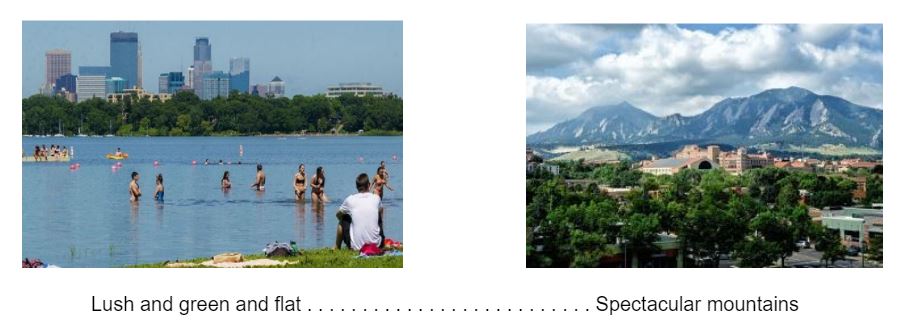
Immediately they were thrust into a world of differences, taking them out of the comfort zone of neighborhood, people, coffee shops and politics that fit them well. Visiting them, I realized the many changes they’ve made and experienced. There’s the ethos of the west—independence and self-reliance. Then there’s the difference between the lush green, mostly flat terrain of the Twin Cities and the Flatiron mountains framing a basin that is mostly dry and dusty.

The move required selling their Uptown condo and moving into a tiny house, which meant truly embracing Susanka’s “not so big life.” Loved pieces of furniture and art objects had to be considered one by one and either kept or sent to another home (I got an amazing desk). They needed to find a new church, friends, and ways to spend time. I won’t belabor the innumerable decisions and differences, rather note that a taken-for-granted way of life had to be changed.

Karen and Dan’s new life was what precipitated my preoccupation with my own “comfort zone” (see Karen’s blog about wrestling with her comfort zone). They are having an adventure, and I’ve always been up for an adventure. Karen glowed when she talked about all the new things they are experiencing, the adaptations they’ve made to living a smaller life, and their emerging new friendships. Moving has clearly taken them out of their comfort zone, and from my vantage point, it looks like FUN!

Starting about the day we enter school, our world expands, from our family, to the school, the community, state, country and world. We grow outward to a bigger life, leaving home, finding our way, and making our own home. It seems like the natural order of things.

Now here I am as an older, retired person, and it feels like I’m going in the opposite direction. Instead of life getting bigger, it’s getting smaller. Some of the progression is my own doing. I like an orderly life, which hardly sets me apart from the norm. The price of that orderly life, however, can be a fence that keeps me in and life out—like a border wall, intended for psychological safety but locking out the other, the unknown and the chance to learn and grow.

We stay in our comfort zones because they make the world predictable. We stay because we don’t want to disrupt others and because physical changes can make us hesitant. Our judgments can obscure how the world works. Some of us have caretaker responsibilities. And then there’s COVID, which has constrained us all. It’s not hard to produce a list of plausible reasons—maybe I should call them excuses. But that seems too harsh.

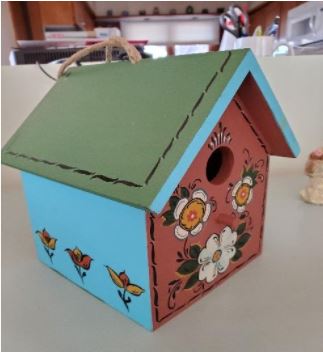
About a month ago, I signed up for a short class on writing about sacrifice. Karen Hering, the leader, asked us to focus on any object in our sight and write about why we need it. I focused on a birdhouse that I had covered in rosemaling (I couldn’t bear to leave it outside over winter, so I’d brought it into my office). I found myself writing that I need the birdhouse because it allows me “to be whimsical in the world, to step out of predictable Karen into creative Karen. . . to see what the predicable Karen can’t see when she’s always doing what people expect her to do. The birdhouse reminds me of art and beauty and playfulness while being a home for birds—birds that fly—leave the ground and fly.” 

Writing those words was a revelation to me. I suddenly saw why I need to break out of my comfort zone (at the time I didn’t call it that). For me right now, during the restrictions of COVID, my rosemaling class has given me some of the stretch I need. I have never considered myself artistic—and here I am painting! In the process I’ve met new people, learned about folk art, worked with one of the prize-winning rosemalers in the US, found a way to honor my Norwegian father, and have had the joy of creating, even when my line work is shaky and my flowers somewhat crooked

I’m reminded of other risks I’ve taken in my life, moving numerous times, including to Utah and Pennsylvania, and quitting a secure job that I liked to go back to graduate school in my 40s. Not to mention the risk-taking men I fell in love with (and sometimes married). All have had moments of great pain, discovery, and happiness. I’ve worried about failure and did fail off and on. But these risks, these stepping out of my comfort zone have been life changing. As I’ve reached outside myself, the inside of myself has had the most meaningful change, because I’ve found persistence, resilience, patience, and impatience within myself, and I’ve learned I’m up for a challenge.

This December I will turn seventy-eight. I’m promising myself that this year, I’ll step out of that comfort zone a little further. I don’t know what it’ll be, but I’m open and ready. Parker Palmer says in his new book, On the Brink of Everything, my expectation is not of the world but of myself: delight in the gift of life and be grateful.” As for me, the brink I stand on is taking a new risk, however big or small, but one that takes me out of my comfort zone.  So far, I’m thinking about a trip to Rome with Karen Rose…. And that’s a good place to start.

BEGIN AT THE END?

Planning is only the ego’s decision to be anxious now. ~Hugh Prather, Notes to Myself

Beginning with the end in mind is, for many people, the 13th commandment.  It is the second of Franklin Covey’s “7 habits of highly effective people”  and assumes that we need to be goal directed.  One business consulting website, for example, argues that each person needs to be able to articulate what they want but also:  What is the purpose of what I’m trying to achieve? What outcomes do I want? Why are these outcomes important/valuable?  While it appears that we are being asked about our principles, the underlying message is that effective people lead their lives according to one or more value-driven plans. But I don’t have such a plan and I never have had one.  So where does that leave me? 

Of course my assertion that I lived a goal-free life is an overstatement.  One example:  I knew early – before college — that I wanted to work with people in other countries.  I had no firm idea of what that would do for me but felt a persistent curiosity about places where assumptions about “how we do things around here” were different.  So I worked tirelessly to find opportunities, especially those where someone else might foot part of the cost.  My efforts worked out well:  I met many people who are still important to me and never felt that my time in strange airports and out-of-the-way countries was wasted.  But the goal of becoming what my husband calls “International Karen” was vague, guided by questions about what I might learn and how that might change me.  It required instinctive rather than logical responses to opportunities. Being curious helped when I accepted (for instance) an out-of-the-blue invitation to review a teacher education program in Azerbaijan, a country about which I knew almost nothing (another “I work for airfare” opportunity).   Paul Coelho asserts in The Alchemist, “When you want something, all the universe conspires in helping you to achieving it”.  But every encounter increased my questions and my longing rather than a sense of closing in on a goal. 

Longing for something (like becoming  International Karen) is not the same as having a goal.   A defined “end in mind” has some clarity, but longing is, for me, often shapeless and imprecise, shifting with accumulating experiences.  And that has become more so as I get older. 

I still long to live in another country (again) but need to balance that against the fact that Dan, whose company consistently grounds and delights me, does not share that longing.  I have a persistent fantasy about a tiny home in Georgia O’Keefe’s scrubby New Mexico landscape, with its unique amalgam of Gringo, Spanish, and Indigenous cultures, but am reminded that living hours from good medical care is unwise, much less coping with the an off-the-grid lifestyle and the lack of neighbors.  I play with more realistic versions of one aspect of this longing–silence and a particular kind of nature–in a glamping version of Nomadland.  Then I remember that I want to spend more time with my grandchildren, who are neither silent nor located in New Mexico. 

In other words, the inherent dilemmas between the experiences and relationships that I want are increasingly apparent.  As my wise older friend Larry often said, “I can do almost anything I really want, but not everything I really want.”  Longing is an element of my primal need to keep reshaping my life, balanced against other realities. I must keep examining my longing and what it is telling me….it is a voice speaking to me rather than having an end in mind.  I may long for multiple, incompatible futures, knowing that they express something of my heart’s desire.  But I only need to think about the more near-term future, which may mean trading off Nomadland in New Mexico for Christmas with family in Boston.  But longing is also never satisfied; there is no end to most of my dreams.  When I published my first book, I didn’t achieve an end – instead I peered into a whole new world in which I could think about and use words in ways that would give me pleasure (and maybe do something for others as well).

There is another, but decidedly non-Covey approach that is increasingly appealing as I (finally) exit an intellectually and spiritually engaging career.  I hinted at this when I wrote about my friend Barb’s work on choosing joy as a key to successfully negotiating the last 1/3 of life.  In my mid-70s, I am aware that realizing longing—turning it into a goal and a plan–is constrained by the unknowability of what the future holds and how that might reshape what I long for.  But I can choose which emotions I want to experience regularly.  Joy may be a bit exaggerated for someone who is Swedish-American to the core, but I can consider the meanings that the word evokes in me:  Happiness.  Flourishing. Engaged. Useful and not used up.

The past two years made it apparent that the next step is often revealed by unanticipated (and even unwanted) “opportunities”.  Most of us existed with a simple hope that a year-and-a-half of chaos and inability to plan for anything, including dinner with friends, would end. But it is complicated. In the waning phases of my paid work, someone recommended that I become a life coach.  Intrigued, I did my homework and consulted with friends who combined coaching with their research and teaching.  Seemed like a no-brainer and clearly a plan:  I could develop a small life coaching “business” as part of my retirement.  But I have not, in part because of COVID, in part because we moved away from my networks, and in part because I found opportunities to use what I learned in ways that that I did not anticipate.  I am not interested in being an entrepreneur.  Do I feel that I have been unable to achieve something I wanted?  Absolutely not:  Instead, I see the many ways in which coaching has just become part of how I live in relationship with others.  It changed me without becoming a goal.

I am beginning to understand that my inchoate and often unarticulated curiosity, imbricated with  longing and constraints,  conspire to help me to define “opportunity” more nimbly and make choices guided by something that is more instinct than intellect.  I admit that my mostly goal-free and mostly “successful” life has been a gift – and  try to appreciate the last lines of Robert Frost’s poem, Acceptance (which I will never fully live into):  

Let the night be too dark for me to see
Into the future. Let what will be, be.

iStock Photo

Lost and Found: That “Third Thing”

My third husband, Jim, was already retired when I met him, both of us in our 60’s. We had lost spouses to cancer and were living as singles—for me, nearly seventeen years, but not so long for Jim. We had much in common and didn’t want to date for years to get to know each other, so we decided to jump right into the complexity of marriage.  “Uff da,” as we Norwegians say.

We believed we were old hands at marriage—especially me—but quickly realized that marriage later in life, like all marriages, has plenty of challenges.  They are just different ones. I began to understand, too, the importance of what the poet, Donald Hall, calls a “third thing.”

Third things are essential to marriages, objects or practices or habits or arts or institutions or games or human beings that provide a site of joint rapture or contentment.

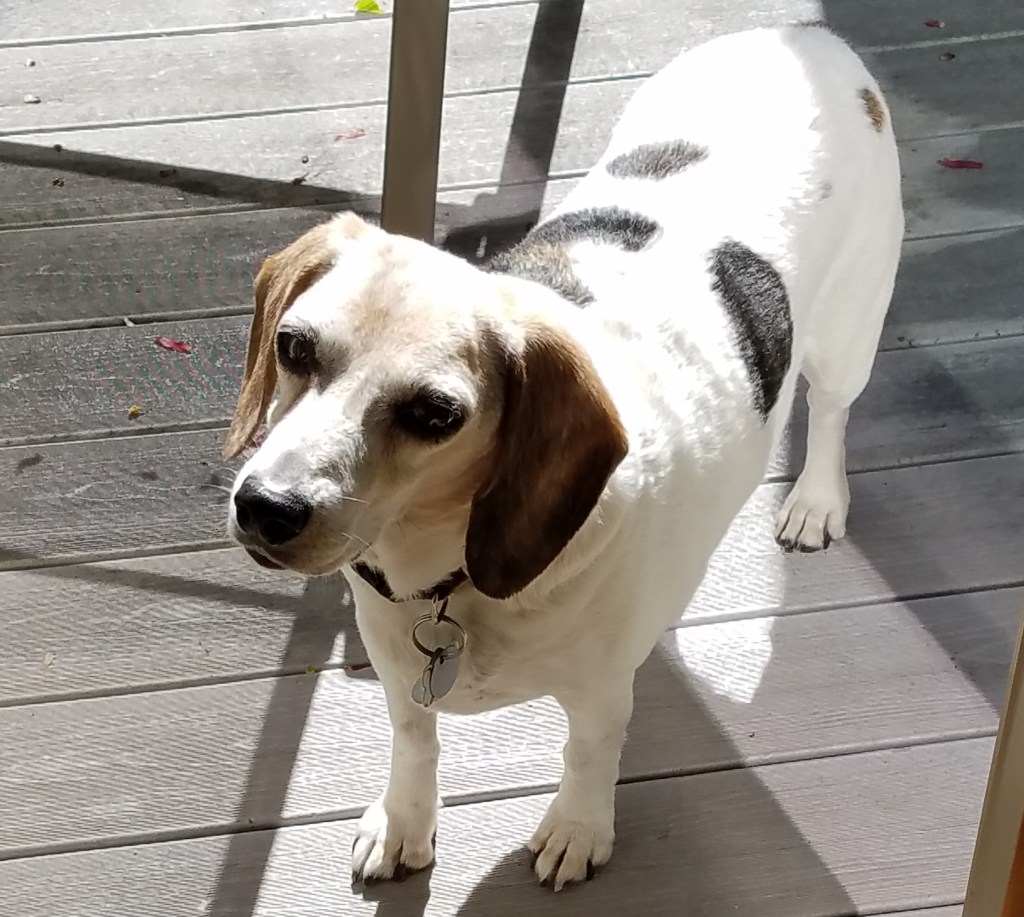
Starting out, Jim and I didn’t have that third thing. We both had our individual families and histories, but nothing we’d created or shared exclusively as a couple. Then along came Eddie, our beagle, who showed up on our deck one afternoon in late September. At the time Jim’s dog, Happi, was dying of oral cancer. She slept peacefully most days on the corner of our couch.

I’d noticed a dog wandering in the thicket behind our house, and wondered what he was doing there, so when he showed up, I let him in, believing he had to be lost. He came in like he owned the place, and gently sniffed Happi, resting on the couch. He then took a drink of her water and settled down on the rug with a sigh. When Jim came home, we walked the neighborhood with the dog, expecting that he belonged to someone nearby. No luck, so Jim took him to our local vet and left him. The vet called later and said that using the dog’s chip, they had found the owner, and the two were reunited. Case closed; Happi died a week later.

Then came November and a call from the vet who told us that the owner didn’t want the dog and was going to take it to the pound, unless we might be interested. We were mourning and didn’t want another dog. We also didn’t want this friendly dog to go to a pound. So we took him. A week later was Thanksgiving, and Eddie—we now knew his name—made a grand entrance to our family by lifting his leg and peeing on the dining room table leg, just as we were about to eat.  An ignominious beginning, to say the least.

Over time Eddie showed his true worth. He was always a stalwart defender of Jim through his illnesses. He sometimes howled in happiness when Jim walked through the door. He also followed me doggedly (pun intended) around the house. Gradually—and finally—we found ourselves with a third thing—our family of pets, which included Thor, whom I brought to the marriage, and Tress, Jim’s cat, and of course, Eddie, with his beagle personality, the obvious linchpin. (Tress later died, and we now have a new cat, Stella.)

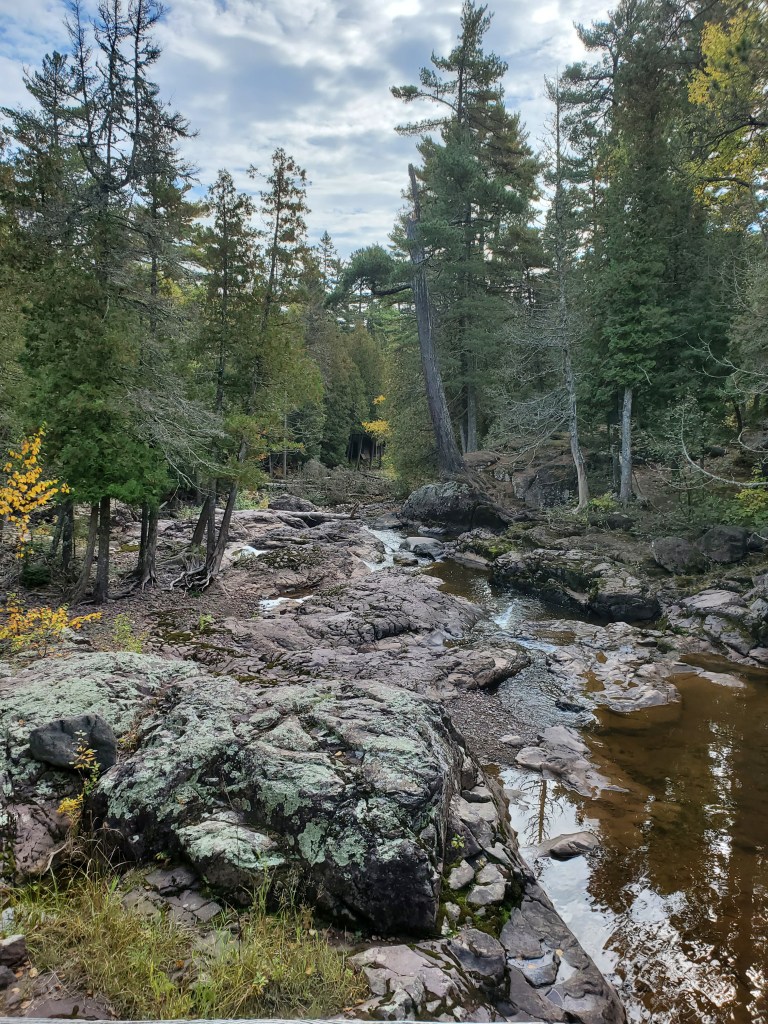
Jumping ahead to this September. . . we went up north to Lake Superior, on the edge of the Superior National Forest, beyond Duluth and almost to the Canadian border. A pristine wilderness, and we would be there at the peak of fall colors.

A Beautiful Fall Day–Up North

It was our first time out after Jim’s illness, finding our way back to the world. Wonderful friends had invited us to a cabin and said, “Of course, bring Eddie.”  And Eddie had been Eddie, kind and loving to everyone, and trusting that this change of venue was fine, jumping onto a red chair and settling for a nap, whenever he could.

The weekend was coming to an end. Jim was already in bed in our little guest cabin. Outside the night was pitch black; it had been raining all evening. As I got ready to climb in bed, I looked for Eddie in his red chair.  No Eddie. I looked all over the cabin, peeked under the beds, opened closet doors that he couldn’t possibly have gotten into, but still no Eddie. I woke Jim to help me search. He suggested that maybe Eddie had gotten outside. The screen door did not latch, although it made an angry retort if you didn’t manually close it.

Eddie was gone. We’d lost him and in a place immense and filled with dangers everywhere. I started thinking about those TV dramas where a child goes missing and someone says, “The first 24 hours are the most important.” So, in my pajamas, I slipped on my hiking shoes, grabbed a rain jacket and flashlight and took off down the dark road calling “Eddie, Eddie,” still traumatized from almost losing Thor only a month ago and thinking dark thoughts about our status in the universe.

Who did we think we were, venturing out when Jim was still recovering? We’d been preoccupied with having everything go well for Jim, so that his legs would not swell and pull us back into the hole of sickness we’d been climbing out of.  And now we’d put Eddie—a big part of the menagerie that made up our third thing—at risk, Eddie, who trusted us and believed in the goodness of the world.

I searched near the steep shoreline and down the two roads near the cabins.  There were a couple of hiking trails along the river, but I didn’t dare take those in the dark though I imagined Eddie sniffing his way down them, following a provocative scent, then trying to find his way back to the cabin. All the while, a wolf watching and waiting to make dinner of him. No Eddie. As I walked back, my eyes filled with tears, overwhelmed with loss—the loss of Eddie along with the loss of Jim’s health.

Imagine This–In the Dark

I walked into the cabin, knowing there’d be no sleep, just as there’d not been much sleep in the weeks before. There was Jim in the kitchen, Eddie at his feet, begging for a bite of toast. I couldn’t believe it. Eddie had found his way back in the murky, threatening darkness. 

But Eddie had never been gone at all. There was a mattress stored under the bed, and although both Jim and I had looked under the bed, we had not been able to see that Eddie had squeezed himself on top of that mattress and directly beneath the bed mattress, with barely enough room to raise his head, like being the filling on a mattress sandwich. He’d finally come out to all the excitement. Crisis averted, our boy, the linchpin of our third thing was safe and sound.

We live in a time rife with threats—to our country, to climate, to the flora and fauna of our earth, and we live with this during a time in our own lives filled with uncertainty. Having a third thing is one way of standing together among that uncertainty. Jim’s and my third thing might not be the stuff of poetry, but it is our third thing, and, like life itself, both ubiquitous and fragile. Will we someday lose Eddie, or Thor or Stella or something else we dearly love? Of course, but meanwhile we have Eddie, who found his way to our doorstep and people who love him. While I was searching for the “lost” Eddie, there he was, wedged between the mattress version of a rock and a hard place, sleeping soundly and trusting that all would turn out okay.