Unknown's avatar

About Karen Martha

I am a searcher and not always sure about what I’m looking for. I’ve lived in thirty-nine houses in four states and changed my name five times. One would think I embrace change, yet I find it discombobulating. My unrest is part of what inspires this blog on retirement. It’s like a last chance to live reflectively, instead of wandering helter-skelter into whatever shows up to keep me occupied. I’m interested in the soul work that presents itself at various times in our lives and in how that changes us. In past lives I taught middle school math and science, raised two children and helped with four grandchildren, finished four degrees, worked as a professor and researcher, and married three times—whew. In my present, retired life, I’m tutoring 4th graders, learning rosemaling, and when I’m not working out—writing—writing about this wonderful, often painful, and fascinating journey.

Welcome to the Club

The Clubhouse

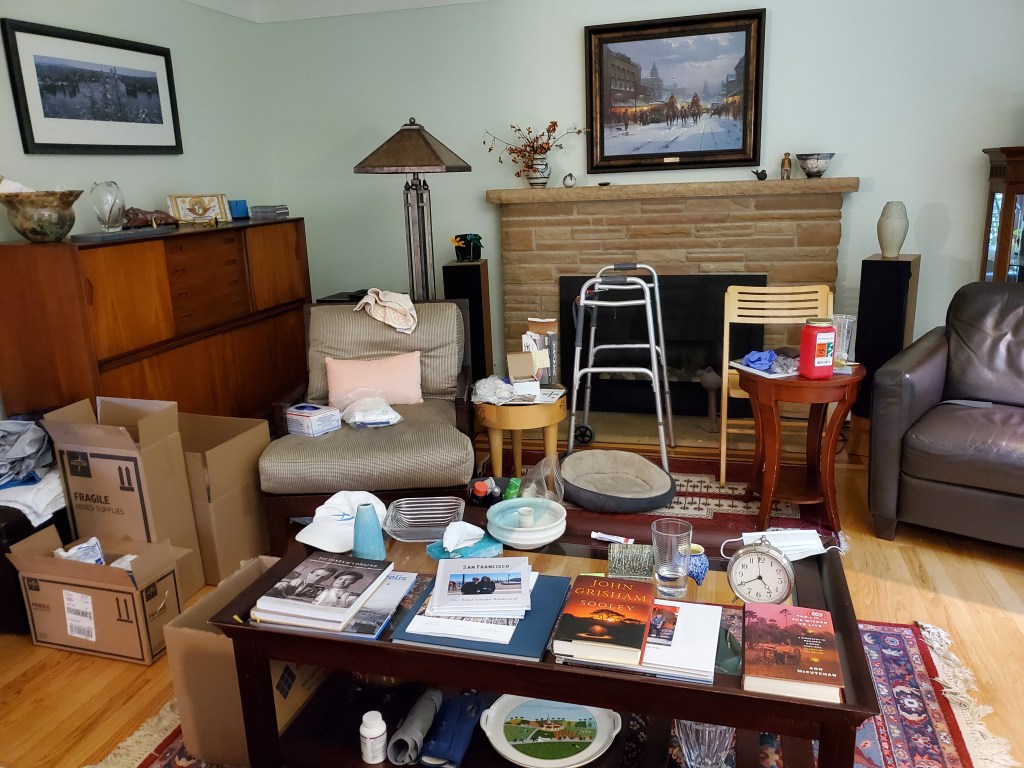
I wake up from pleasant dreams that I can’t remember, but I do know I felt good in them. Slamming awake I realize that it’s still there, the reality of my life. My husband, Jim, has a chronic condition that will require care the rest of his life.  Currently, it’s acute and my days revolve around it. I eat breakfast, not only standing, but taking a bite and then doing something that needs doing before the lymphedema nurse arrives. I haven’t showered, but the dog’s been walked, I’ve tidied, and I’ve thrown a load in the washer. This is the life of a caregiver, disjointed and always on call.

I am not alone in my call to give care, indeed, having joined a club that welcomes all members. Nearly 42 million adults in the US care for elderly parents or friends, with three out of five of these, women. The average age of caregiving recipients is 68.9 while the average age of caregivers is 49. I’m outside the norm on that one. But I’m not outside the norm of a 20 hour work week for caregivers (See https://www.aarp.org/content/dam/aarp/ppi/2020/05/full-report-caregiving-in-the-united-states.doi.10.26419-2Fppi.00103.001.pdf.).

I’ve been thrust in the roll of caregiver four times in my life, and each experience was completely different. Context matters, who you are taking care of matters, your life at the time matters, the malady matters, how long the caregiving will go on matters, and your attitude matters. I suspect this is just a minimal list of all the permutations. For now, let me tell you a little about how caregiving has impacted my life. Maybe others will be inclined to share their experiences.

Two thoughts dominate my internal monologue. The first is how long will this last? Will it consume my entire retirement? There’s anger behind this thought, and I don’t like that in myself. But I’m not only angry. My second prevailing thought is compassion. Someone I love is coping with pain and the knowledge that his life will never be the same, that many of his favorite ways of spending time are gone. Probably toughest of all is watching him cope with the knowledge that this recurring illness is a harbinger of the end of life.

My first introduction to caregiving was when my mother, Margaret, was dying of kidney cancer. My two sisters and I agreed to do two-week stints to help her and our stepfather. I went first. It was heart wrenching to see her in pain all the time. Her cancer had spread to her bones, and she lay, mostly moaning in pain. A strong painkiller patch deadened some of her pain, but she was also in pain about dying. “I’m not ready,” she told me. “I wanted more time.” She never talked about how she would use more time. She knew she wasn’t going to have it.

My mother lived three months from those first two weeks when I cared for her.  I never had a chance to care for her again. When I returned home, my second husband, Gary, was diagnosed with pancreatic cancer. I was to be a caregiver to him instead. Caring for my mother felt like a loving responsibility. I was to quickly learn that caring for a husband whom you love very much is a completely different experience.

Gary lived fourteen months from his diagnosis of cancer. We had a mix of good and bad times, and I never resented caring for him. During the hard times, he was extremely cross from his pain—understandable, but still difficult. During the good times, we mourned the loss of our future together. I was with him every step of the way. A part of my heart was broken when he died. A wise counselor has taught me that within the brokenness is the memory of a man I dearly loved. I can hold that memory and go forward with my own life.

Seventeen years after Gary died, I met Jim, my third husband, whose own wife had died of cancer. We were going along nicely, forgetting how life can turn on a dime. Over one Labor Day weekend, he developed sepsis and went into septic shock, almost dying. We later learned it was from a perforated ulcer. When he came home from the hospital, I was back in the club. What I didn’t expect were the demands of helping someone who’s in great emotional turmoil from the aftermath of the disease itself—depression. We muddled through, not realizing that chronic edema, a consequence of his illness, would create the ideal conditions for another bout of sepsis three years later.  

So here I am again, a fourth time, which I sense will be indeterminate. I must say it feels different. Two days ago, a nurse bluntly said to us “It’s not edema, it’s lymphedema, a different condition. And you’ll have it the rest of your life.”  She kindly didn’t add, “Get used to it,” but it was implied.

Once again, those same two thoughts haunt me—what will happen to my life? Will I be able to do the things I enjoy? Will I ever be able to travel again? And what about my writing? Rosemaling?

Then there’s that second haunting thought about his suffering and fears. I feel challenged to alleviate these and help him go forward. I also feel great sadness for him. Am I up to the challenge?

Susan Allen Toth wrote an excellent memoir, No Saints Around Here: A Caregiver’s Days,  about caring for her husband who died of Parkinson’s disease. She writes:

“So much.” I think that simple phrase could easily be the motto emblazoned on a caregiver’s shield. Love, pain, courage, endurance, loss. So much, so much.

We caregivers are a club. We don’t have to feel isolated because we are in the company of caregivers all over the world, not to mention the circle of help from home nursing services, friends, and family. And we have love, the foundation that helps us go forward no matter how uncertain the future may be. As for me, it’s early, and doggone it, I will do my utmost to take care of both Jim and Karen. If there’s one thing the caregivers club has honed in me, it’s determination!

Losing Thor and Finding Belonging

A picture containing grass, cat, mammal, outdoor

Description automatically generated

The adventure began when I realized at dinner that I’d not seen Thor all day. It was 7pm. I knew he’d come home when he got hungry. After dinner I went outside to water the flowers, expecting him to rub against my leg, as he does when I show up in the garden, his secret domain. No Thor. I checked the closets—he’s notorious for walking out from some place we don’t know exists in our house. Again, not a sign of him.

When I acquired Thor from the Humane Society as a kitten, I’d promised myself that I’d take exceptional care of him. He was the first cat I’d chosen myself, not given to me by someone needing to get rid of a cat. Because of that promise, I had to find Thor before bed. I started walking the neighborhood calling him. My neighbor to the south offered to help, but I worried that he wouldn’t come to her. He was by nature skittish of other humans. 

By bedtime, no Thor. I reluctantly searched the thicket of trees behind our yard, “Thorrrrrr. . . Thorrrrr.” But no Thor embraced my legs, only mosquitos and unidentified bugs.

I was worried. I made one more perusal of the neighborhood, calling softly, so as not to awaken anyone. I went to bed, hoping that he’d be at the door by 1am, and I’d let him in, give him a treat and sleep well. 1am, 2am, 3am—no Thor and no sleep. I was up by six, roaming the neighborhood, calling his name. I knew it was bad. He ALWAYS comes when called, and he doesn’t stay out all night, a patterned behavior I’d reinforced.

Thus began my search. A part of me believed searching was futile. Our neighborhood is defined by a lake. I walked around that lake that first morning at 6am. And I continued to search nearby blocks all day.

I read websites about how to find a missing cat, listed him on the missing pets website, and created a poster, as the sites advised. I printed over 100 posters, bought a stapler at Ace Hardware, and plastered the neighborhood with them.

Then it started, my neighbors, most of whom I don’t know except by sight, sent texts telling me they were sorry and would keep an eye out. A young man who heard me call Thor, said he’d alert his grandparents, retired neighbors whom I’d never met. The next night I met them, and they told me they’d scoured the shoreline for Thor.

The third evening, a woman phoned and said she saw a grey cat at a neighbor’s house. She offered to wait until I could get there. I jumped in the car and raced to the location, a block from Minnehaha Creek Parkway and five blocks from my house. Could he have gone so far, lost, and heading in the wrong direction? 

When I met the woman and her husband, they walked the neighborhood with me, calling Thor’s name. This part of the Diamond Lake neighborhood is filled with traditional, pricey homes with landscaped gardens. I traipsed the alleys, and I saw people enjoying the summer evening with friends. A few acknowledged me and said they’d keep an eye out. No Thor, however.

I was now too tired not to sleep, and I was also racking up mega points on my Fitbit, walking the neighborhoods. South of our house is 60th St., the demarcation between Richfield, a first ring suburb, and Minneapolis. The street also marks a change in the neighborhood, with the Richfield neighborhood peopled with Hispanics and tiny starter houses. I got the same helpful reception in that neighborhood, “Oh, your cat is lost? I’ll keep an eye out. Put some food out and something he likes to cuddle.”

Sunday morning: Day four. Thor was probably gone for good, since I knew he’d come when I called if he heard me. I’d allowed him to be outside, and he had always stayed close to the house, but something had probably scared him, and he’d gotten confused. I sadly took responsibility.

I decided to do laundry, knowing there was nothing else to do. By the laundry room, I heard meowing, and thought it was our other cat, Stella, who’d been following me everywhere since Thor had gone missing. This meow sounded different, soft, more like Thor’s. I walked into my husband’s office, pried open a sticky pocket door to a closet we never use, and guess who ran out? Thor! I screamed, breathless with happiness. I couldn’t believe it. I’d checked that closet the day he went missing, and I’d been downstairs many times. Why hadn’t he made a peep, or come out the first time I checked? Thor went right upstairs to his bowl and commenced eating. Only a cat can be locked in a closet four days and not come out a hopeless neurotic. 

The ending is happy. A few days later as I walked around the neighborhood taking down posters, a little boy I’ve never met asked me, “Has Thor come home yet?”  I told him yes, and I walked on realizing what a remarkable experience of belonging to a neighborhood I’d had. Other neighbors sent texts asking if Thor was back yet. People cared. People offered to help. People walked with me when I was searching. People commiserated when they saw me calling “Thorrrrr.”

Karen has written eloquently about belonging, but losing Thor made me find belonging. I normally feel like an outsider—it’s my personality; I’m more of an observer than a participant. But in this neighborhood, for four days, I was an insider. I felt connected to others by the common experience of loving and losing a pet.

I learned that belonging is two sided and requires effort to engage as much as having others invite you in. I’d been on a quest. I‘d walked the modest neighborhood south of me and the pricey neighborhood to the north, and in both places, people cared. It wasn’t about our differences but about our attachments to what we love. I reached out, engaged and people engaged back. Losing Thor, however briefly, taught me that if I reach out, there’s a world out there that will respond, and I can belong. 

Text, letter

Description automatically generated
No Need for These Anymore

Destination Death

A picture containing indoor

Description automatically generated
    To This Favor by William Michael Harnett, 1879 (Wikipedia)

Sister Theresa Aletheia Noble keeps a skull on her desk, one of many sent her by her followers, and believes that the words ”You are going to die,” can give comfort. These are part of her mission to revive the practice of memento mori, Latin meaning “Remember you will die.” As a practice, a memento mori object reminds us to consider  death daily and that life will end. Thus we learn to value the present as well as the future. Sister Aletheia argues that we tend to think of our lives as continuing and continuing, but confronting the inevitability of death, as opposed to pretending it doesn’t exist, leads us to a deeper understanding of our lives.

Sister Aletheia Noble is forty years old. As I think back to my forties, I don’t remember that I thought excessively about death, although the black colored themes and cards we send on 40th birthdays suggest that forty is a transitional age, when we at least acknowledge our mortality. Now, in my mid-seventies, every day brings me manifestations of aging, from the mundane wrinkles, to the chronic, aching knees and hips, slowing steps, and consciousness about falling. All of which, in their entirety, lead to diminished mobility, the inability to experience life as we once did. For me, the Tiger Tail foam roller on my desk is as good as a skull, because it reminds me of where gradual physical changes lead, that I am mortal, and that death is my ultimate destination. 

Interestingly, I came across the Sister while looking for information about people who maintain exceptional physical fitness into old age. I was back from a week at a cabin on Lake Superior and had done both some easy and quite strenuous hiking, including the seemingly innocent path from the cabin down to the lake shore.

For the first time in my many visits to the cabin, I felt hesitant, even a tad scared. The path starts with a series of steps with a handrail and becomes a long needle-covered slope descending to a rocky barrier with the necessity of almost scooting, legs first, (at least for me) over the rocks to the beach itself.

To my 77-year-old judgment, the path looked doable, but deceptively so, because one wrong step, one foot mistakenly placed or unable to hold its position, would lead to a long slide ending at or on those rocks. And, at my age, that wouldn’t be a pretty ending.

With the help of a hiking stick, something I wouldn’t have used in my younger years, I made it down the path—more than once—and enjoyed the beauty of Lake Superior, the thrill of the icy water on my feet, and basking on rocks in the spring sunshine. But I didn’t attempt the path at night, as much as I wanted to gaze at the spectacular night sky. Instead, I enjoyed it from the driveway. Later, thinking about my hesitancy and realizing that the path will only get more difficult as I get older, I asked myself, how long will you be able to do this, Karen? 

The internet is full of answers to this question and full of examples of elderly people running marathons, swimming the English Channel, lifting enormous weights—you name it. But impressive as these are, my sense is that such achievements require unquestioned and total commitment—24/7 if you will. Which reminded me of our old friend, “purpose.” These people clearly have a sense of purpose and it’s all about the physical challenge, making the infirmities of old age seem optional.

Which leads me to ask how facing death on a daily basis, whether it’s contrived as in the Sister’s revival of memento mori or simply the harbingers of death as we age, affect how we construct our old age. I respect that some people find a big purpose in exceptional physical fitness to which they devote their remaining time (although I sometimes wonder if this is a way of ignoring the reality of destination death), but for me, as much as I treasure all the wonderful activities the body allows us to do, as I age, I want to stay open to new callings that could potentially replace lost abilities. So what if eventually I can’t navigate a difficult trail? I can still mentor my grandchildren and the occasional student. I can learn rosemaling, tutor middle schoolers, enjoy Bridge, enjoy my friends and family, publish an occasional article and read books that make me think. My days balance small purposes, the “little p’s,” that make up a life. As May Sarton says, “I have work to do and a constant response to it that makes me feel that life has meaning.”

When my mother was nearing the end of her life, if we planned something like an all-night wedding reception or party that would keep her up late, we’d ask her if she wanted to attend because we worried she’d get too tired. She was always up for it. She’d say, “I’m going to spend a long time asleep in my grave. I want to be awake for my life.” She didn’t need a skull on her desk to be reminded of her mortality. Part of aging is facing our deaths gradually – very gradually. Aging does slow us down; it incrementally steals once taken-for-granted skills. The challenge is to stay immersed in living while knowing the inevitable ending.

“Both Sides Now?”

Lake Superior Path

When my mother was dying of excruciating kidney cancer that had spread to her bones, even though she was completely bedridden on strong painkillers, she insisted on going over and over her life. She wanted to ask forgiveness for things she saw as mistakes. To Dr. Robert Butler, what she was doing was a life review, a “naturally occurring, universal mental process characterized by the progressive return to consciousness of past experiences, and, particularly, the resurgence of unresolved conflicts.” According to Butler and others, such a review allows the dying to die in peace by reintegrating life events so that they give meaning to a life.

Butler (1927-2010) is a giant in the field of aging and gerontology,  winning a Pulitzer Prize for Why Survive?: Being Old in America (1975), serving as the first director of the National Institute on Aging, and founding the first department of geriatric medicine. But the contribution that has permeated so much of psychology and self-help, is the notion of a “life review,” which has grown into a therapeutic treatment used with adults at all stages of life.

Others have seized on the life review concept as a way of creating a meaningful retirement. Julia Cameron in It’s Never Too Late to Begin Again, advises dividing your life into sections—your age divided by 12—and reviewing a section each week in a memoir. Other retirement gurus like Richard Leider use the idea of life review to promote writing an ethical will in which you distill your life experiences into wisdom and values you have gained. Gene Cohen also advises writing an autobiography that includes unfinished interests and dreams. Even a book written for all ages, Designing Your Life incorporates a version of the life review.

I read all these books, but I mostly ignored the advice to do a life review.  I didn’t have time; I wanted to get on with the new chapter I was writing in retirement. Then came the pandemic and lots of time. Suddenly I found myself looking back. I realized that my life has turned a corner. I no longer have more time ahead than behind me. Life might seem like a circle, childhood, adulthood, elderhood, and circling back to dependent old age, but, chronologically, it’s not a circle, and we don’t get do-overs. We traverse a straight line forward, ending in death. That said, we have the ability to look back and make emotional sense of our lives, to find meaning, and in the language of Erikson, to achieve ego integrity. But am I ready for this?

Last week I visited a cabin on Lake Superior. The weather was abysmal, an occluded gray of mist. I wanted to hike, but the woods near the cabin was a morass of red mud and exposed roots. I decided to walk the paved path in Two Harbors, a community of about 3700 people just south of the cabin on the shore of Lake Superior. The trail was an out-and-back, straight walk, repeating the same path in each direction. On the way north, with my eyes peeled on the lake shore, I passed the city water works, a somewhat rickety old light house at the end of a long pier, an equally long freighter in the harbor, and scrubby wooded areas. It wasn’t particularly scenic, aside from the natural beauty of Lake Superior.

On the way back, over that same path, my focus turned to the side away from the lake. I noticed a wetland, with cattails and grass waking up to spring. As I walked further, a small woods, preserved by the people of Two Harbors, sheltered my walk. I realized that I had not noticed either of these beauties on my way out. It wasn’t until turning around, heading back, looking from another perspective that I saw what I had missed by being so focused on the enormity of the lake. I’d missed the whole of the walk, both sides.

A picture containing water, sky, outdoor, boat

Description automatically generated
Two Harbors, Minnesota

Which brings me to a favorite Joni Mitchell song, Both Sides Now. For me, the last stanza captures precisely what I feel and am afraid to face when I consider doing a life review.

I’ve looked at life from both sides now

From up and down and still somehow

It’s life’s illusions I recall

I really don’t know life at all.

Mitchell herself says that “This is a song that talks about sides to things. In most cases, there are both sides to things and in a lot of cases, there are more than just both.” So am I ready to see not just both but all sides, the whole of my life? To let go of my present narrative of the past for a different one? Or if I do a life review, will I end up feeling, “I really don’t know life at all?” I’m not sure. Perhaps my older self, no longer in such a hurry to get somewhere will make something different of the past. Like most of us, I’ve often imagined what I would do if I could have a do-over of some parts of my life, knowing there is no such thing. But there’s still the think-over, the life review, and I don’t have to wait like my mother did until I’m dying. Now I just need the courage to take the risk of a life review, and do it now, not later!