Unknown's avatar

About Karen Martha

I am a searcher and not always sure about what I’m looking for. I’ve lived in thirty-nine houses in four states and changed my name five times. One would think I embrace change, yet I find it discombobulating. My unrest is part of what inspires this blog on retirement. It’s like a last chance to live reflectively, instead of wandering helter-skelter into whatever shows up to keep me occupied. I’m interested in the soul work that presents itself at various times in our lives and in how that changes us. In past lives I taught middle school math and science, raised two children and helped with four grandchildren, finished four degrees, worked as a professor and researcher, and married three times—whew. In my present, retired life, I’m tutoring 4th graders, learning rosemaling, and when I’m not working out—writing—writing about this wonderful, often painful, and fascinating journey.

Hand It Over!

A chance, that is. . . for a career in whatever drives someone. In my case it was education, being a teacher. When I entered teaching in the early ‘70s, jobs were scarce. I was lucky to get a job at the local school teaching two hours a day—no one wanted a job that breaks up your day and doesn’t pay much. But it allowed me to ease into teaching after being a stay-at-home mom. I was much younger than the teaching staff at my school; I was filled with liberating ideas, too, like having students call me by my first name, and playing rock music during home room. The culture of my school quickly put me in my place, but I persisted with my “new” ideas about how to support learning. When my low group math class out-performed the middle group at the end of the year on standardized tests, I earned a new respect from my colleagues.

I stayed in education my entire career, first as a classroom teacher, then as a professor, next working on a drop-out prevention program, Check & Connect, and finally as an evaluator for something called reflective practice for nurse home visitors. What a span, and from the vantage point of looking back, I loved it all. But as I hit my 70’s, I became increasingly aware that my passion was moderating and changing. I didn’t go to work with the fire I had once had. Let me say that as a teacher, by Friday afternoon, I was spent. I needed two days to recuperate, but by Monday, I was once again ready to take on the challenge. I’d lost that ability to bounce back, but I saw it in others. A young woman, Angie, with whom I worked on Check & Connect; Ann, a new Ph.D. in evaluation, my partner in the reflective practice evaluation; my own daughter who lived and breathed evaluation. It was time. Time to . . . 

Pass the baton to the new professionals. When I first grabbed the baton in that parttime teaching job, it was light, easy to carry. But by retirement, that baton was heavy, made of intractable human problems like babies getting poor nurturing from chronically depressed mothers; homeless kids, kids with great potential who drop out, persistent gaps in learning—I could go on and on. From my vantage, which might be colored by the fact that my “time is more gone than not,” passing the baton was my rite of retirement. I would pass it to the next runner, the Angie’s and Ann’s full of knowledge, training and inspiration, waiting expectantly to grab the baton and run with it.

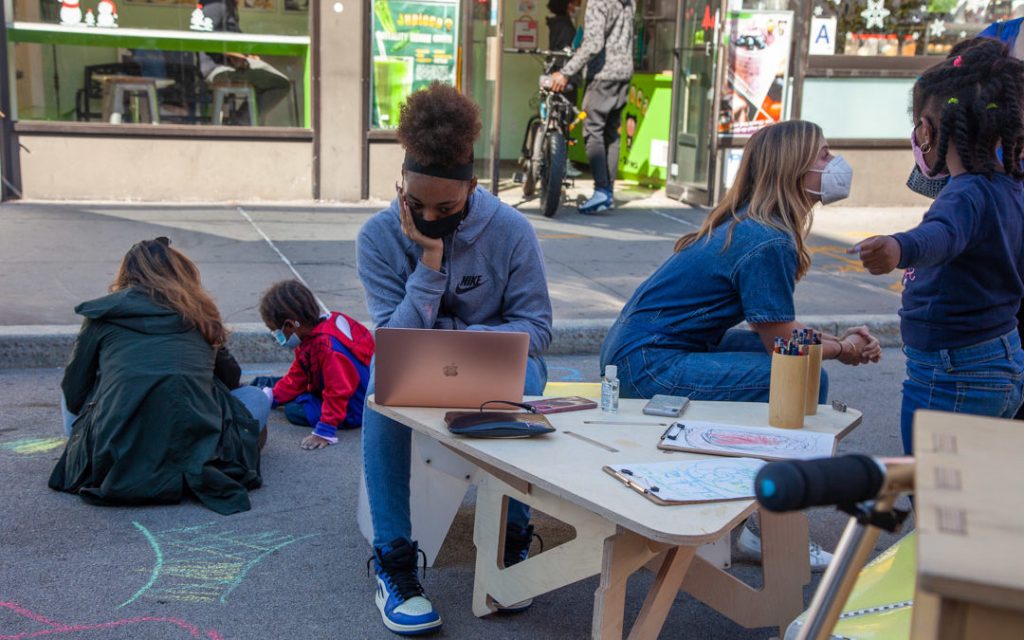
Yet I still want to run at least for a while or maybe as long as I can. I haven’t given up on ameliorating the problems, but I’ve changed how I want to run. My way of running suits where I’m at, mostly retired with new interests. I continue to teach an introductory evaluation class, hoping to inspire others to enter the field, and I tutor fifth and sixth graders in math. In my tutoring I work with great teachers who use smart boards and videos and classroom techniques that are the result of years of educational research. I learn from them. But they learn from me, too, because I have teaching strategies from years of practice and study in the field. We are a team and respectful of the knowledge each brings. 

A picture containing text, person, indoor, group

Description automatically generated

Salient is Cattell’s theory of intelligence. Cattell posited two types of intelligence, fluid and crystallized. Fluid is strong when we’re young. It allows us to problem solve, innovate, and think abstractly. It goes down through age—but doesn’t disappear. Crystallized is our accumulated knowledge that we acquire through life.

Think young teachers with their new approaches working together with the seasoned tutor who has accumulated knowledge about how to teach math to struggling students, a win-win.

Older people do know things the young do not. But if that’s true why did I reach a point that passing the baton seemed the right thing to do? It was a combination of two realizations. First, fluid intelligence does count, at least when you are younger. I saw new Ph.D.s with fresh ideas for solving those wicked problems. Second, in seeing that, I believed that they deserved their chance. I’d had mine. It wasn’t that I couldn’t do the work and that I didn’t have a wealth of experience to bring to the work. Instead it was because I saw an eagerness in them to take on these intractable problems, while I was eager to try my hand at deferred dreams, like writing and rosemaling. 

So, I passed the baton and retired. In passing the baton, I moved on to a different race, one with an accelerated pace but a wide-open track of new adventures. And like most finish lines in life, even in retirement, it’s always shifting. I love the vision of a finish line that keeps changing, moving forward, whatever stage of life one is in, whatever track one is running on. 

A green sign with white text

Description automatically generated with low confidence

Purpose Notwithstanding … Show Up

A picture containing text

Description automatically generated

A deep sigh of contentment, I’m in the world of exploration, ambition, and dreams. Time feels limitless. 

In actuality, I’m doing a Zoom meeting for the first class of OLPD 5501: Principles and Methods of Program Evaluation, the class I’m teaching this semester. Evaluation should be front and center, and it is, but, as the students one-by-one introduce themselves, inside I’m feeling all the positive anticipation of young people. Some describe their purpose for taking the class as exploring a new subject. Others are fulfilling ambitions, finishing their coursework for a degree. All are dreaming of possible futures. It’s incredibly energizing.

Coming back to my real life, I recall Richard Leider’s Annual Purpose Check-up in his book, Something to Live For. He suggests that yearly, retirees, who’ve found that something to live for, do an inventory that assesses how they are doing at living with purpose.

I wonder how my students would respond if I asked them about whether they are living with purpose. Their lives are filled with the a priori purposes of age and circumstance—getting an education, finding a partner, having a family, finding a rewarding career, if possible. They are driven by both internal and biological forces. Though some might be aware of a larger purpose, I suspect most are busy living.

I remember being one of those students—at least four times in my life when I worked on degrees to follow my own ambitions and dreams all while intent on getting married and having children. As far as purpose goes, I didn’t give it much thought beyond living a good life with family and doing something I enjoyed. Life was full of chances to grow—up, hopefully. Like everyone, I had good times, not so good times, new friends, old friends, losses and opportunities, career ups and downs. When something didn’t work out, I latched onto another way to keep going forward. What is salient here, I believe, is that time never seemed to be an obstacle. I didn’t worry about running out of it and there never seemed to be a lack of opportunities 

But it turns out, time does matters. We age. I turned 70. At 72, I retired. I was ready to retire. I was tired of the grind (note the word “tired” in “retired”). Nonetheless, retirement felt new—and as my history demonstrates, the new has a pull on me. 

At first in retirement, time expanded. Retirement removed a huge pile of obligations from my days, months, and years. I read books like Leider’s and Cohen’s The Creative Age.

But one thing was different, that amorphous concept called the future started to feel finite. At first the reminders were physical, a sore knee or hip, that slightly slower pace walking, a diminished desire to run up steps two-at-a-time, all of which reminded me of a changed and aging body, with limitations.

Then came the contextual changes of a smaller life. My world shrank. Colleagues from work no longer included me in after hours parties. I searched for personal interests to replace work interests. The books I read about retirement pushed the idea of having a purpose. Like Karen Rose, in her blog, If I Don’t Know My Purpose, Am I a Retirement Failure?, I worried about finding one. Looking back, I realized my most fervent purpose had always been raising children with career intermingled. The thing about retirement and aging is that those two centering purposes, family and career, diminish in importance, and I had to rethink about what might replace them.

Leider’s emphasis on purpose is grounded in research that says people with purpose live longer, happier lives. If you search Google for “purpose” and “goal setting,” you get the idea that without these, your life is meaningless. However, purpose, with its concordant striving, implies that what’s present is not enough, I am not enough unless I have a purpose for my life complete with short and long term goals. But I am not a program or a business! I am a human being, both faulted and perfect at the same time. 

Purpose also implies always looking ahead, managing what is to come by setting in motion actions that achieve goals, manifest purposes. But life is messier than that. To use a personal and admittedly extreme example, when my second husband and I married, we set in place actions to have a vibrant marriage complete with fulfilling and dynamic careers that would serve others—we had Purpose(s). But then he got terminal cancer, something worse than messy. Coming home from the hospital, after being given his diagnosis, I remember thinking, “I must show up.” Showing up, doing what needed to be done and giving love on a daily basis became my way of being in the world. 

After my husband died, I searched for purpose in my career, almost as a substitute for the purposes that died with his death. I read books about finding your purpose, The Purpose Driven Life. I prayed for a purpose like he and I had had. It seemed like my search became the purpose. During my quest, time inexorably moved forward. I retired with never having found that clear purpose for my career.

Upon retirement, I found myself doing that sort of life review that involves making meaning of the events of one’s life. Then I remembered the showing up commitment. It was one of those light bulb moments—like the truth was always there only I was so busy searching for purpose, I couldn’t see it.

Showing up is how I want to live. One might argue that “showing up” is a purpose, but I believe it’s more a way of being in the world. It means letting go of that driven search for purpose and goals and instead asking yourself, “What gives meaning to my life today?” and then showing up.

Picture by Lisa Congdon.

Circling Back (Way Back….)

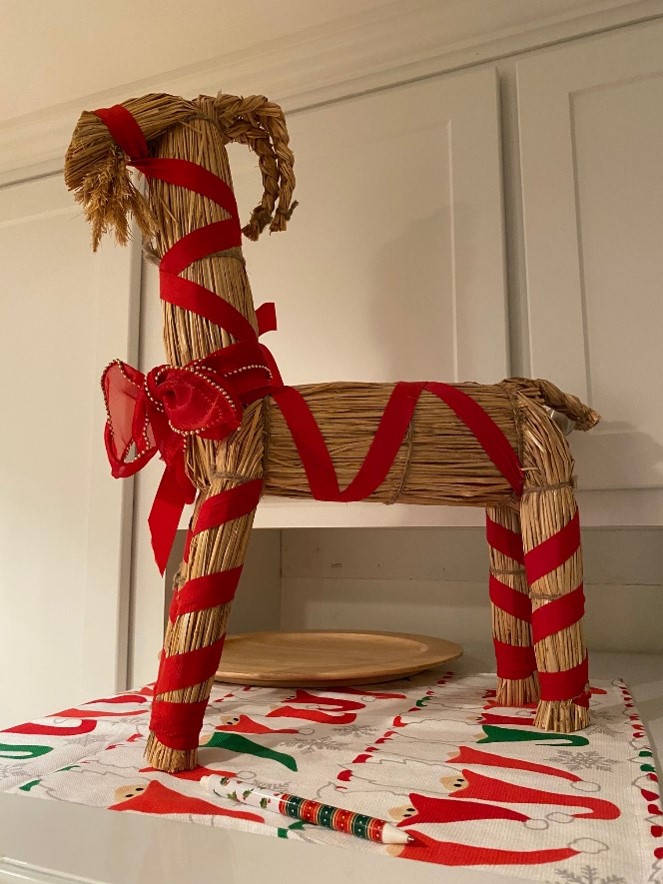
Photo courtesy of cousin Kristen Seashore (Keeper of Tradition)

It makes no sense to talk about Christmas trees or holiday dinners in the middle of January.  But we are doing it anyway because this strange December season made both of us – in different ways – visit our role as “elders” in keeping connections with the past alive, even when nothing was normal….

Holidays as Liminal Space….[Karen Rose]

From the time I was a child in the early 50s, my mother would always remind me that our Christmas Eve dinner “would keep me Swedish for the rest of the year”.  That didn’t make me face the pickled herring, bonddost, lutfisk, potatiskorv, bruna bönar, rödkål, and risgrynsgröt med lingon with delight….The bread and the cookies were ok.

Yet, after my parents died two decades ago (when we were finally free to find substitutes for the dreaded lutfisk), my sister and I maintained the food traditions.  The beans were often crunchy, good korv was hard to find, none of our kids liked pickled herring and my brother-in-law made great julekage with a sourdough starter and extra cardamom!  For all these violations, not much changed. 

But my kids are now in their 40s.  They didn’t like this food much and my grandchildren like it even less.  Nor did they (by that time, American mongrels with a mixed ethnic heritage) feel a need to “keep Swedish for the rest of the year”.

So, as I entered December 2020, it felt as if everything could change because everything had changed.  I vowed that our tiny “family pod” would have a normal American Christmas, putting up the tree before Christmas Eve and maybe baking lots of new kinds of cookies.  I was ready.  Until a week before Christmas, when I started thinking about my parents – both third generation Swedish Americans – who knew only a few words of Swedish but who felt an intense desire to honor all who had come before on this one evening. 

For my parents, it wasn’t really about food – it was about being in a brief liminal space where we could feel close to our ancestors in their small Småland farm houses, acknowledging all that they had given us.  It was like The Day of the Dead transported to Michigan-in-December.

I started feverishly making lists of what we could find (or substitute).  I baked.  I gave Dan a recipe for limpa and asked him to do his best.  Some of the old recipes, in feathery handwriting, were inaccessible.  I researched Swedish websites to duplicate things as best I could.  We produced a meal that would keep me Swedish for the rest of the year – and that prompted daughter Erica to demand that we visit as soon as we could.

Opal (age 3 and, only about 30% Swedish) ate a bit of everything except the herring. It was liminal, seeping into the future, drawing from the deep past.  That is what ancestors are supposed to do, and it is my job, even if I didn’t ask for it.

Karen Martha:

          This year we bought a tree before Thanksgiving (I have never bought a tree before my birthday in early December), thinking we would have an entire month to feel the holiday spirit during a time when spirit seemed needed—the pandemic and ongoing election concerns.

          Nevertheless, isolation loomed over the holidays, no friends or family would be coming over to share in the festivities, so “who cares,” I thought. I couldn’t bring myself to decorate the tree. Then one night, sitting in the living room listening to Radio Deluxe’s Thanksgiving weekend program, I heard Irving Berlin’s I’ve Got Plenty to Be Thankful For” and Let There Be Peace on Earth. I remembered my parents and the trees of my childhood—fighting with my sisters over who got to hang which ornament or to open the new package of tinsel. The wonders of music. I found myself singing and decorating the tree.

No one saw the tree but my husband and me. I walked past it many times a day and soon found myself pausing to say “Namaste,” I bow to you. I wasn’t bowing so much to the tree but to the memories evoked by the ornaments. Even though no one would see the tree, I felt a sense of responsibility for preserving the web of relationships represented by the simple ornaments collected over nearly fifty years of family history. Isolation was not a reason to abandon tradition.

          My ties to the larger world changed with retirement, but that change opened an opportunity to engage in other ways. We older people with our experience in the world, are both keepers of memories and of knowledge, understanding and wisdom. We share these gifts whether by creating a Swedish Christmas in Colorado or by decorating a tree in Minnesota, the little p’s—purposes—that give our lives continuity from generation to generation.

          After Christmas, whenever I greeted the tree with Namaste, I promised it one more day in the spotlight. Soon it started dropping needles, signaling it was running out of the energy it had stored when rooted in the soil. It was time to give it back to the earth and time to put my ornaments away, time to give the past a rest and circle back to that which roots us all, our talents and interests, however expressed in work or retirement, but most of all, our webs of relationships.

And now we welcome the new year, full of things that have never been”
― Rainer Maria Rilke

The Pandemic in Six Word Memoirs

The Pandemic in Six-Word Memoirs As collected by Carla Wilks, guest blogger.

Borrowing from the six word memoir form, our guest blogger, Carla Wilks, asked friends and relatives to send her six word memoirs about the pandemic. These are shown below. Karen Rose notes that anyone of these could be epitaphs on a tombstone marking the end of the pandemic.  Enjoy and then add your own!

Alone time is good, short term. (CM)

Stay home, no vacation, wash hands.  (CS)

2020 Wake-up call: COVID, racism, wildfires.  (KS)

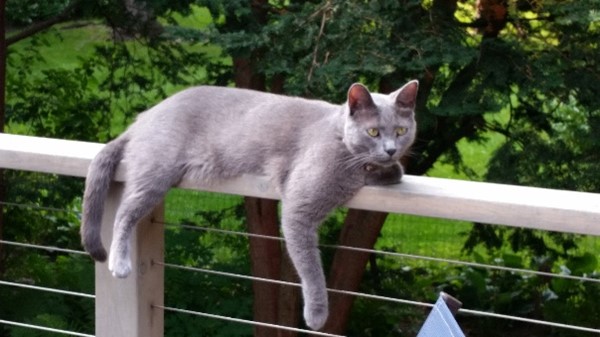
Missing friends but got a cat.  (KR)

The cat wants us to LEAVE.  (JC)

Cooking, cribbage, ponytail, gazebo visits.  (CW)

Time freedom excites, stimulates.  Zoom obligates.  (KU)

Singing to dogs.  We run again.  (JC)

So glad we have a dog.  (MW)

I’d rather not talk about it. (TM )

Missed prom, graduation, friends and Milwaukee.  (MW)

New shovel, new gardens, new plants.  (JW)

Summer of Dave, Fall, Spring, Summer!  (DW)

Coffee, walk, text, pizza, wine, repeat.  (KW)      

Should I be social or responsible?  (AW)

Next door with kiddos and coffee.  (EW)

I met some new, amazing people.  (AW)

Work and play – hours become blurred.  (JW)

Child welfare became even more difficult.  (SW)

My online clinical experience was tedious.  (MR )

Enjoying yoga pants, commute and introversion.  (BW)

New workload-overwhelmed.  New granddaughter-overjoyed.  (JW)

Add your own below