Unknown's avatar

About Karen Martha

I am a searcher and not always sure about what I’m looking for. I’ve lived in thirty-nine houses in four states and changed my name five times. One would think I embrace change, yet I find it discombobulating. My unrest is part of what inspires this blog on retirement. It’s like a last chance to live reflectively, instead of wandering helter-skelter into whatever shows up to keep me occupied. I’m interested in the soul work that presents itself at various times in our lives and in how that changes us. In past lives I taught middle school math and science, raised two children and helped with four grandchildren, finished four degrees, worked as a professor and researcher, and married three times—whew. In my present, retired life, I’m tutoring 4th graders, learning rosemaling, and when I’m not working out—writing—writing about this wonderful, often painful, and fascinating journey.

Reinvention: Take #10

Who knew that every time I’d sit down to write about the notion of reinvention, so strong in the retirement literature, I’d end up more bewildered than I started. That’s why I’m on my tenth try. Here’s what I do know: most articles and books about reinvention describe it as about finding a new career late in life, something novel when compared to a person’s past life, and something that fulfills a dream. There’s also a thread of reinvention tied to greater purpose, reinvention both and in and outside of work, with deeper understanding, definition, and authenticity to one’s self with an emphasis on service. Clearly, there’s enough here for more than one blog and possibly even blogs by some re-inventers (anyone out there hearing the call to share a blog with us?)

The other thing I know with some certainty about reinvention is how riled I get when I think about it for myself. Re-inventing suggests that there was some original, invented self, or, if we limit the definition to reinvention as about career, that my career path was a deliberate invention, not a marvelous amalgam of propensities, opportunities, decisions, life experiences, roads taken and not taken, circumstances beyond and under my control—although I’m less inclined as I get older to believe we have control over much of anything besides our response—and just plain luck. And this sidesteps the whole nature nurture debate, both of which surely influenced the amalgam that is this Karen.

As I sit with the idea of reinvention, I see what it is that pokes at me, scares me, if I’m being honest. It’s the idea that the current rough draft of this self and career was somehow not okay, such that I need to pursue reinvention.  Now I know that’s not the case for many who seek something new. I get it.  There are people who showed up for their lives and did what needed to be done, and now they have a chance to show up for themselves. I am completely in support of anything they decide to do in retirement, whether it’s career reinvention or a total self-reinvention. As for the scary part, well, most new things are, and surely a reinvention at age 76 implies risk.

          I like to believe that there’s something organic about who we become, that it’s neither all purposeful nor chance, rather an unfolding of who we need to be. The reason I hold this belief is that I became a teacher so I could have summers off and play golf, but also because I didn’t know what else I could become. Researchers who study vocation know that people seek vocations for which they have models. I had working class parents who wanted their children to go to college but didn’t have jobs that required college. My models of people who went to college were primarily teachers. Regardless of why I ended up teaching, it was right for me. I was painfully shy; I could barely speak in a social group of friends, I was so shy. As a teacher, I learned to stand up and speak every day, but in front of children, far less threatening, and I practiced my way out of shyness. I also have an altruistic streak, and teaching gave me an opportunity to serve.  Gradually, teaching lost its challenge and I sought more, so I went into academia. My career, as I view it, was not an invention, but an organic unfolding.

          So what does any of this matter. . . especially as I can’t untangle the reinvention question in one blog? It matters because of where I find myself, where we all find ourselves, socially distancing in what was to be a glorious retirement of new interests and ways to engage with the world. Ironically, it feels to me like the one thing I’ve held at bay, reinvention, is what I most need to be doing. Oh, it won’t be reinventing a new career or self as much as reinventing how to use time, how to stay meaningfully engaged while sheltering-in-place, where to find opportunities to serve from a laptop or a telephone. I do believe that for many retirees like myself, purpose does matter, whether it’s Big P or little p. That may even be part of the drive to reinvent, to add greater purpose to life. So how do I find it now?

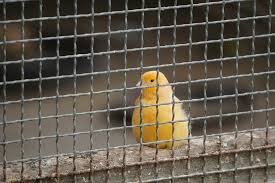
          To reinvent during COVID-19 times is a challenge unlike any other. I think of Jerry Seinfeld’s comment about living with COVID-19: It’s like you’re a bird and suddenly they change your cage. You’re just not sure who you are now. On good days I believe I will find that new direction—reinvention. Words like curiosity, opportunity, and imagination inspire me as do the amazing things I see young people doing. On not-so-good days, I’m terrified I’ll be in this new cage at least two years, consuming what life I have left, searching but finding no new way of living a meaningful life, that retirement I imagined.

For the present, I find myself holding on to interests, looking for ways to keep them alive in this changed environment, e.g., learning rosemaling from YouTube videos, supporting the youth in my life, my grandchildren, which takes the place of tutoring, which I dearly loved. Is there a way to truly reinvent my newly altered retirement? I’m not sure, and I’m running out of the time it takes for an organic evolution. I deplore ending this blog with more questions than answers. . . In front of us is a changed world, and from what I read, we will not be back to normal for some time. My eyes have been opened to reinvention. I wait expectantly to see how and if it comes about. 

Condition: Provisional

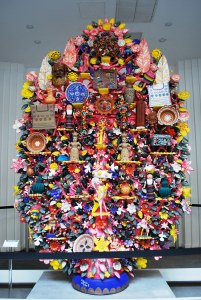
https://www.flickr.com/photos/rayandbee/5915105592
The Wheel of Life
Vigeland Sculpture in Frogner Park, Oslo

As I live through this COVID-19 pandemic, one phrase keeps popping up in my mind: the human condition. To me, the human condition is our imperfection, our inability to escape suffering, and that we live in a natural world indifferent to us. I keep reminding myself and my family that we are experiencing firsthand what can go wrong in a natural world that we thought we had mostly tamed. At the same time, our culture promotes an ethic of personal responsibility, suggesting that we have an influence on what happens to us. So what does it mean to be subject to the human condition but responsible at the same time?

Take my grandfather Nils Jacobsen’s life. In 1917, before the end of World War I and another pandemic, the Spanish flu, he brought his wife, Marthe, and two-year-old son, Alden, my father, from their farm in Norway to Racine, Wisconsin, where they hoped to build a new life. The 1920 census listed them living in a rental in Ward 8. They were still finding their footing. In 1926, Nils sold the family farm in Norway, which he inherited as the eldest son, to his brother.  It appears that life was going well in Wisconsin. Times were good! 

By the 1930 census, Marthe and Nils owned a home, a sweet bungalow that’s still standing, and they listed a second son, my father’s brother. But it was the start of the Great Depression. Soon after, Marthe died at age 51, and by the 1940 census, Nils, my father, my mother, my father’s brother, and my older sister were living in a rental flat. It was World War II, and the fishing on the Great Lakes had dried up.  My father and Nils struggled to find work they could do. Nils died in 1948, a bitter old man, as my mother described him. 

Not an altogether happy tale, but I suspect most families, if they dig, can find similar stories. How much of what happened was Nil’s responsibility? Maybe selling the farm? But surely not Marthe’s death, the loss of their home, and the loss of fishing for a living. I tend not to judge him harshly. Nils and his family lived through World War I, the Spanish Flu pandemic, the Great Depression, and World War II. As for Nils dying a bitter old man, I’d say he succumbed to the human condition

While Nils confronted the human condition writ large, until now, my own experience has been more personal.  After my second husband, Gary, died, I struggled, literally, for years with searching for meaning about his death.  I endured guilt that I had done something to bring this outrage on us, and I believed that if I could identify what I’d done, I could atone for it—I should atone for it. When I wasn’t feeling guilty, I was asking myself about the larger karmic meaning of his death—were the repercussions in our immediate world a way of balancing the scales, so to speak? I found no clear answers. 

Being a church-goer, I decided to take my pain to the minister, Pastor Rob. Pastor Rob didn’t like the idea of karma—that I bore responsibility for Gary’s death and, thus, for my grief.  He thought such thinking was where New Agers go wrong. Instead, he told me that Gary and I, like all humans, were subject to the human condition, which includes suffering. Neither of us had caused his death and I didn’t owe any atonement. Wow! I walked out his office feeling lighter, a new freedom. I still didn’t know the meaning, and in truth, I continued to seek it, but not finding it now felt okay. My search became part of my human condition. 

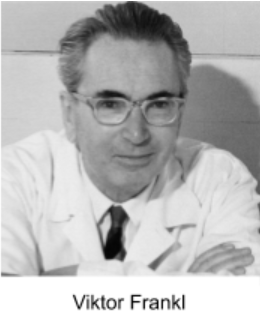
Later I learned about provisional existence. Viktor Frankl wrote that prisoners in concentration camps could not see an end to their suffering.  They could see no future so they lived a “provisional existence.” Pastor Rob had given me such an existence. I found no meaning, but I could live with that, provisionally, and keep looking. Frankl said something else that resonates with me in these times, that rather than me asking for the meaning of Gary’s death, I am being questioned by life and I need to find my own answer in my own terms.  In Frankl’s words: Each man is questioned by life; and he can only answer to life byanswering for his own life

So here I am, living in a world-wide pandemic. This isn’t the retirement I planned, stuck at home, worried about family, friends, and the world more generally. Worried about an uncertain future, are my savings withering so that I’ll be one of the people living solely on Social Security? Will we have a depression? What about my grandchildren, one in college who’s been forced to come home?  The other about to graduate into a precarious world, and there will be no celebration. I am being questioned by life, and how will I answer? 

I have choices. I can weather the pandemic, hopefully stay healthy, and go forward with what is available now.  I can support family and friends as they move forward, too. If my money’s gone . . . well, I’ll deal with that if I must.  My other choice, of course, is, like my grandfather, to grow bitter, that my glorious retirement has been denied me, that my plans have been slayed by a merciless nature. 

 Every day I take advantage of the one freedom still left, the opportunity to take a walk in the unfolding spring, oblivious to the havoc of a virus. It’s Minnesota, so it takes a while for spring to show its color, but because my life has so drastically slowed down, I linger on my walk and look for small signs of the turn towards spring.

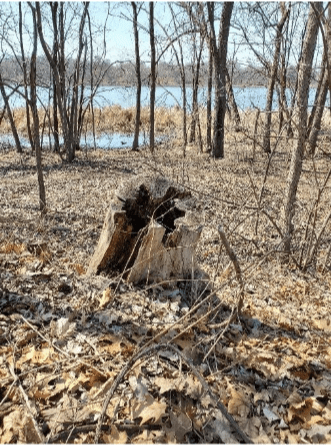
One day I noticed tree stumps, and I walked along eagerly photographing tree stumps, which mind you, are presumed to be dead, cut off. But then I noticed that some tree stumps don’t quit easily. They make the best of things and put out new shoots of life. Now and then there’s a hollowed out-stump that couldn’t regenerate itself. But everywhere in nature there are examples of persistence. Think about those weeds we so fervently pull. 

I have my share of human arrogance, but I’m learning to accept the indifference of our world—some natural and some human behavior—it is the human condition.  But in fact, indifference is a condition all life faces, human, stumps, and otherwise. So I carry on, knowing that as I’m questioned by life, I can keep on putting out shoots, it’s on me to find my own answer. 

A picture containing photo, fence, showing, outdoor

Description automatically generated

Later I learned that coppicing is a traditional method of woodland management that harnesses the ability of many species of trees to put out new shoots from their stump or roots if cut down. 

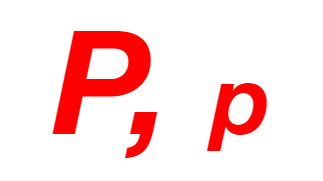
Big P, Little p, or What I Make of It All

The ubiquity of retirement “experts” telling seniors they need a purpose borders on tiresome. Hammering about purpose as necessary for giving meaning to life seems quite male to me, a sort of Big P (and I don’t have to tell you what else begins with p). It’s as though the adjustment to retirement converges on this one construct—Purpose—as a solution. But what if my way of adjusting to retirement is constructed from my web of relationships, interests, opportunities, family, etc? What if it’s not only ONE big purpose that drives me and helps the world, but a series of small day-to-day purposes, little p’s. To me that would be a more female way to consider the idea of purpose.

Trying to scrub the Big P notion out of my mind and come to what gives me meaning led me to recall three women whose careers I’ve followed closely, probably because they are writers, but also because their lives took such different paths where purpose is concerned: Rachel Carson, Carolyn Heilbrun, and May Sarton. I’ve listed them in the order that they entered my life, because recalling them in that order has helped me form my idea of Big P, little p. 

I was an undergraduate at the University of Minnesota when I read Rachel Carson’s book, Silent Spring. I remember reading it during those big lectures of 300 or more students in biology, underlining it frantically; reading it whenever I had a break in my day; carrying it everywhere with me.

Carson, a woman with a Big P, believed that the rampant escalation of chemical use in our environment was harming the biosphere—she called these chemicals biocides. Carson wrote much of Silent Spring while undergoing chemotherapy and radiation for breast cancer.  She kept her illness quiet because she thought if the chemical industry knew, they would claim she had a personal vendetta in writing the book.  In fact, her entire career of nature writing culminated in this book. Sadly, Carson died of her cancer two years after the book was published.

As an idealistic freshman, Carson inspired me to want to do something big that would make the world better; I think we all hold similar aspirations at that point in our lives.  My direction turned out to be marriage, family, and teaching school, most of which kept me busy enough that I didn’t pause often to reflect on whether I was changing the world. I kept putting one foot forward—after all, aren’t raising happy, well-adjusted children and educating the young gifts to the world?

Many life events and years later, I encountered the Kate Fansler mysteries, written by Amanda Cross, a pseudonym for Carolyn Heilbrun, a professor at Columbia, and the first woman tenured in the English department. 

At the time, I was working on my Ph.D. so reading mysteries by a professor had special appeal. Later, during my MFA studies, I ran into Heilbrun again, this time in her book, Writing a Woman’s Life. Then, as I reached my late 60’s I encountered her a third time in The Last Gift of Time: Life Beyond Sixty. This was the book that held my attention. The prologue is essentially an argument for life being over at 70.  She notes, “is it not better to leave at the height of well-being rather than contemplate the inevitable decline and the burden one becomes upon others?” She also states, “I was—and am—one of those for whom work is the essence of life.” And that I think is where she sold short the possibilities life affords. Heilbrun committed suicide at age 77 by taking a sedative and putting a plastic bag over her head. She left a note that read, “The journey is over. Love to all.” 

I read about Heilbrun’s suicide mid stroke on my exercycle—She really did it. She meant what she said. It took me days to process her suicide.  I even wrote about it in my application to the MFA program at the University of Minnesota. Heilbrun had much to live for, a loving husband and family, grandchildren, good health, a successful career, respect, etc. It made no sense to me to define one’s life solely in terms of work, which I presume she did.  Once she anticipated a decline in the Big P of work, she wasn’t willing to construct a life that included both some, though less, Big P and also more of the many little p’s of everyday living. She was and still is for me a cautionary tale about nurturing both curiosity and flexibility.

Which brings me to my last admired female writer, May Sarton. I know Sarton primarily through her journals, which many critics believe to be the best of her 53 books, most of which are novels and books of poetry.

Starting with I Knew a Phoenix, published in 1959 until her last journal, At Eighty-Two, published in 1997, two years after her death, Sarton chronicled aging, isolation, solitude, friendship, building and loving a home, relationships and more. What stands out for me is that although Sarton started out with the Big P of an ambitious writer, she matured into a person who accepted, albeit with regret, that her work was not considered part of the literary canon of her time, and she went on to cultivate the many little p’s of her life. Her journals charm with details of daily life: ordering bulbs for the garden; walks with her beloved dog, Tamas; visits and long talks with lifelong friends; keeping a lively correspondence, sometimes with complete strangers; and following the antics of her various cats and neighborhood critters around her secluded house in Nelson and later on the coast of Maine. These were the small p’s of the solitude she captured in her journals into old age. I keep a Sarton journal next to my bed and read some every night before turning out the light.

I’m not writing to criticize anyone who has a Big P in their life. No way, it’s a gift. I myself will always sustain a passion for teaching and writing, the stuff of Big P. But I am arguing that a web of little p’s has the substance of a Big P and of a life well-lived. A few days ago, I woke up excited to attend my grandson’s senior speech—before the Corona Virus put a lock on outside life.  I had an exciting small p purpose for my day. Now, as I recall the day with my family, the speech, the cheers, the hugs, the brunch after, I realize that while the search for a new Big P to enliven retirement has been, for me, akin to finding a four-leafed clover in my lawn of Creeping Charly, most days I have little p’s everywhere. I walk my dog around a lake that changes with the seasons; I have lively lunches with friends; I enjoy dinners and vacations with family. My latent Big P for writing and teaching will always be part of me, and meanwhile, every day has something to savor, right until the moment when my cat walks across my face before settling at my feet for the night.  

Enjoy, Enjoy. . . Rosemåling

To begin, I need to establish that I am not artistic. I’ve read Drawing on the Right Side of the Brain, and I still can’t draw, even though I sincerely did the exercises in the book. I’m not drawn—ha—to trying to draw either. It’s not something that lies dormant in me (that which I’m constantly excavating in retirement), but I do like making things—I can still picture the Valentines box I made in 5th grade, a shoe box decorated as a bee (“Bee” My Valentine). It won first prize. I love making a fine edge on an apple pie, knitting a scarf that’s a perfect match to my jacket, like none I could buy. I once made nightgowns for my granddaughters and matching ones for their American Girl dolls.

Which brings me to the subject of this blog, rosemåling, a Norwegian folk art that dates to about 1750. Although different regions developed different styles, most of which are still taught and practiced, all emphasize ornamental flowers, structure, and the occasional dramatic flourish. After discovering my Norwegian relatives on the island of Radǿy, in the county of Hordaland, Norway, I wanted a tangible way to remember and honor my Norwegian roots, so I decided to try rosemåling.

Now I must confess that I’m not fond of kitschy stuff, and most of my exposure to rosemåling has been of items that I wouldn’t necessarily want in my home—the flowery cheese board, decorative plates, Velkommen signs, all with an abundance of hearts and sweet birdies that can overwhelm a house. I’m also not particularly drawn to big swirls and Rococo styling, which characterize some types of rosemåling, so I knew it might be a stretch to learn the craft—after all, what would I paint if I don’t like the patterns and objects? I promised myself that I wouldn’t do any borders around the ceilings in my house or force crafts I don’t want on my family and friends as Christmas gifts.

I signed up for a weekend class at the North Folk House in Grand Marais, Minnesota—I’d learn just about anything to spend a weekend in that lovely place. I had to paint something, hopefully not kitschy, so I started with a board and Christmas tree ornaments—who doesn’t like an ornament?

Turns out that even if you’re not artistic, you can learn enough to do a credible job at rosemåling. Its techniques can be taught, practiced, and “mastered.” As Shirley, my rosemåling idol says, “It’s 95% practice and 5% talent.” After the weekend I had two ornaments and some awkward leaves painted on a board. Not much, but I knew I wanted to learn more.


I later discovered ongoing classes at Richfield Community Education, just down the road from me. It’s a large group of women and a few men who all know and support each other in their art. Ages range from teenagers to retirees. I was immediately welcomed to the group, and whenever I balked at something too flowery, they reminded me that it’s my art, and I can do whatever pleases me. We meet on Tuesday evening or Wednesday morning in a dedicated classroom. In the summer, we paint outside at Minnehaha Falls. Although conversation is limited, we know each other well enough to support each other when someone is care-giving a spouse, making items to sell because money is short, or bringing up grandchildren. We always take a break and enjoy strong coffee with Norwegian goodies—lots of brown cheese, mormokake, sandbakelse, and, of course, lefse. It’s a community, of rosemålers, yes, but also of caring people.

Aside from my modest first projects are the many gifts rosemåling has given me. The value of disciplining myself to learning techniques and then practicing them over and over; the quiet in my mind as I work totally absorbed in pulling out a flower petal or doing fine line work on a leaf; the calm I experience hours after the class has ended; and the feeling of accomplishment that comes from learning something new later in life. Best of all, realizing that I don’t need to be an expert to totally immerse and enjoy myself. I leave class every Wednesday carrying two heavy bags of paints, brushes, oils, brush cleaners, carbon paper, tracing paper, practice boards, etc. with a sense of time well-spent.

And then there’s Shirley, my model for the good retirement. She’s a North Dakota school-teacher turned prize winning rosemåler. She keeps the craft alive, passing it to the next generation.  A tiny, compact, Norwegian woman, who brooks no nonsense. For example, even though most of us carry heavy bags of supplies, the school wants us to walk through the building rather than using a door near our classroom.  Shirley says it’s a rule meant to be discreetly broken.  On the other hand, some rules cannot be broken.  I’ll never forget hearing her say to one of my classmates, “Oh no! You can’t use that blue! That’s a Swedish blue. You need to paint over that!”

But where does my experience fit in the larger context of retirement? Retirement gave me permission to try rosemåling. I wouldn’t have had time or the inclination to add something to a busy schedule when I was working. And now, here I am, enjoying the community and discipline of learning something new. I’ll never be a prize winning rosemåler, and I doubt I’ll come to like some of the kitschy stuff I see people painting, but I have a new respect and understanding of what makes art “folk,” the idea that common, minimally talented people can create art of their own for the pure enjoyment of doing it—for themselves!