Unknown's avatar

About Karen Seashore

I am a sociologist, life coach, policy wonk, and tarot reader. Other than reading a book, I always prefer to work with other people. Creating small changes -- in myself and in the world around me -- is my calling. You can find my scholarly publications under Karen Seashore Louis (or Louis, K.S.).

What Lies Below….

I started to think about excavation — and what it means in my life — and then I came across this poem:

Excavation

Emptying cupboards from

the pre-Homeric Classroom era,

through strata thick as Schliemann’s Troy.

I am looking for bedrock and

the world before printing

when we worked with our bare minds

— Hugh McMillan, 2015

Working with our bare minds….what a thought in this digital/technology rich world.  McMillan’s words lead me to think about all of my mental clutter, and where I might find the bedrock if I looked.  It also called me to consider how I am looking below the surface, during a time that is seriously unsettling for everyone…

We jokingly refer to our decision to be in Boulder, CO as “a Minnesotan’s idea of avoiding winter”…. A theme that came up in a previous post. Mostly true.  But, instead of returning to Minneapolis for the heady experience of watching spring emerge in the frozen northland, we knew that it would be easier and safer for us to self-isolate here.  Because of COVID, we find ourselves in Colorado for the long term, and in a rental house with a yard given over to neglect.  Since we can’t go anywhere, making a small difference in our suddenly much smaller world called us.

Dan excavates volunteer trees, sawn off but energetically leafing out due to the increasing size of their root system.  We admire each herculean effort.  Opal, our granddaughter, and I tackle the mass of weeds and grass that have overgrown the terrace.  This becomes an archeological endeavor; complete with surprises….Opal is an explorer with the fresh eye and unencumbered bare mind of a 3-year old, adept at finding little things that are hidden from this task-focused adult gardener – mostly items left in the bushes by children of previous renters.  And a stone that we turned over, with an inscription that predates the previous occupants, to complete her work.
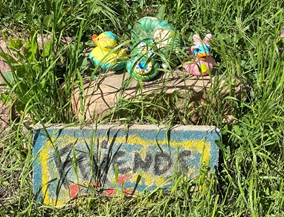
Opal’s treasures

While she is busy, I begin to marvel at the care with which someone built in stepping-stones to the upper level and an environment for creative landscaping.  It takes prodigious effort to clear the deeply rooted weeds and grass – any less resilient but more attractive plantings have long disappeared.  There is something intensely satisfying in finding “the bones” of a once loved garden.  When I see them, I know that our small excavation is one of the things that we must be doing now, although it is much more than a summer’s project….

the old garden hardscape emerges

At the same time, I think about excavation in my other Colorado experiment – Avita Yoga.  It’s not “real yoga” (classic) or “power yoga” (sweaty exercise), but a practice focused on removing obstacles:  “The sequences help resolve limiting patterns that no longer serve us so we can remember a healthier way of being in body, mind and spirit”.  Each pose, held as long as five minutes, reveals all of the impediments that lie under my skin and muscles, and asks me to explore them, to understand rather than fight them, and to heal.  I am a healthy person and have practiced classic yoga, but it was a revelation to uncover the restrictions rather than work around them.  This is not miracle work: it requires steady practice, and I need to go deeply into unexplored places — mentally and emotionally, I am excavating my ligaments and joints.  In the process, my busy and distracting “monkey mind” becomes calm, and I feel a deep love for my physical being, including its impediments.  A bare mind becomes (briefly) almost a reality.

When I use my bare mind (ignoring the cacophony of Facebook and newspapers) the demands for justice and an end to systemic racism exploding in Minneapolis and elsewhere demand a different kind of going deeper.  It is like my first unexpected encounter with a real archeological dig in the Peloponnese, many years ago.  Most of archeologist’s work seemed to involve tediously looking for bits and pieces that, by themselves, appeared inconsequential – but eventually would restore a prehistoric dwelling (or tomb – I don’t remember). 

The call at a national level to consider how our historical injustice has bled into the everyday lives of Black people takes me into what I know of the lives of friends and their families.  Like an archeologist, I am compelled to revisit all of the (usually brief) conversations about “the talk”, “Driving While Black”, and micro and macro-aggressions, along with expressions of outrage when yet another Black person is almost casually killed. I dig up a very old conversation with a Black colleague, who said, “I told my son that if he is going to the mall he can only go with one other person and he has to wear a button down shirt.”  We didn’t need to ask why.  Nor did I need to say that my daughters, also teens, were trooping through the mall in groups of four or five.  Or another Black colleague, with a very slight build, who stated matter-of-factly that White women would often cross to the other side of the street when they saw him walking in their direction.  Closer to the surface was a conversation just a few years ago, when a White acquaintance mentioned that when they bought their South Minneapolis home in the early1960s, it included a clause that prevented them from selling to anyone who was not White.  Even more recently, a Black friend asked, with a smile, if I liked the vibrant North Minneapolis restaurant where we were lunching—she knew, without asking, that I was very aware that I was one of two White customers.  As I haul these and many other bits and pieces out of my memory and reassemble them, my bare mind acknowledges how easy it is to ignore how the pieces fit together– and how keeping the them separate has allowed me to stay mostly comfortable in my privileged life.  Like any dig, when more pieces are connected, the whole begins to emerge.

This image shows the remains of a Mycenaean palace at the archaeological site of Agios Vasileios in the valley of Sparta, Peloponnese. Image credit: Angelos Delivorias / Stavros Vlizos / Greek Ministry of Culture.
Image credit: Angelos Delivorias / Stavros Vlizos / Greek Ministry of Culture.

To some extent, personal excavation is a privilege of age. With our minds bared, we have to decide how to use them. Karen Martha and I have written about calling, purpose, and passion – sometimes sardonically, sometimes with heart.  As I look more deeply, I also have to ask:  What is the simple “next right thing” that I need to do?  If I don’t go deeper now, what will my inattention cover up? As the archeologist of my own life, what bedrock do I need to reach to become an authentic anti-racist?

Hope – Fighting and Screaming?

I have been reading Mary Oliver’s essays.  I don’t remember what was happening in 1999 that would have caused Mary Oliver to write the words that seem so prescient now:

In the winter I am writing about, there was much darkness.  Darkness of nature, darkness of event, darkness of the spirit.  The sprawling darkness of not knowing. We speak of the light of reason.  I would speak here of the darkness of the world, and the light of ______.  But I don’t know what to call it.  Maybe hope….Hope, I know, is a fighter and a screamer 

–Mary Oliver, Winter Hours

Image of Mary Oliver; Poetry Foundation

Although I have confined my interaction with current news to morning coffee with a side of the New York Times, I encounter the dark times every day.  I have not lost a job and none of my family members are ill with the COVID virus, but the feeling of suspended animation has become a challenge.  I am the kind of person who is always careening ahead.  That doesn’t mean that I have a plan (because I have never really had a plan) but my “monkey mind” is full of random fears about what is coming and how I need to get ready for it. 

All of my delighted anticipations for the short-term future are in disarray.  I am not at home in Minneapolis because traveling with a dog and a car full of stuff across Nebraska seems like a truly bad idea. We know that we cannot predict when this will change.  We will cancel summer trips, and it is impossible to say when we will be able to visit our Massachusetts family pod.  Unanticipated online work obligations and ill-fitting roles as home-schooling parents distract my mid-career students from their own writing, but I cannot nag them because Zoom meetings incessantly divert me as well.  Even though there is supposed to be more time because we cannot go out, it feels like less.

These are not serious complaints – we are very fortunate to be nicely housed and fed, as well as (knock on wood) healthy.  I am surprised at how easy it is to “accept the things I cannot change” under these conditions. But, I have to choose between accepting a year of suspended animation and considering, on a day-by-day basis, the offered opportunities. And Mary Oliver’s comment about darkness and a scrappy kind of hope hit home.

 Arundhati Roy’s recent heart stopping article described the current pandemic as a portal:  “the rupture exists….And in the midst of this terrible despair …it is a gateway between one world and the next.”  Portal implies threshold, door, an invitation to change – a topic that I wrote about in lighter times, in the post Close a Door and Begin Again?   What I wrote nine months ago about looking both backward and forward seems like an innocent discernment of subtle rumblings that are as Roy suggests, becoming seismic and obligatory.

Back to hope, which Mary Oliver proposes not as a path but almost as a prayer.  Hope feels so insubstantial – not something that you can hold in your hand and appreciate, and certainly not a plan.  Yet so many others whom I admire see it as essential.  Parker Palmer, who struggled with the darkness of depression, describes it as an asset and “of all the virtues, ‘hope’ is one of the most-needed in our time. When people ask me how I stay hopeful in an era of widespread darkness, I answer simply: ‘Hope keeps me alive and creatively engaged with the world’. ”  There is it – anticipatory engagement with the world that prepares us for walking through the portal.  Like Mary Oliver, he sees hope as an active virtue rather than a personal characteristic. 

Krista Tippet, my go-to practical spiritual director, talks about hope as a muscle – something that must be exercised if it is going to be of any use to us when we really need it.  Hope is more than sunny optimism (a hard sell these days) because, unlike optimism, it is grounded in reality.  However, hope’s reality distinguishes between today’s dramatic headlines and the whole story of the human condition. 

It is easy for me to dismiss hope.  I can be a Debbie Downer, whose character on Saturday Night Live made me laugh uproariously (while cringing a bit inside). I still sometimes watch the YouTube clips of my favorite Thanksgiving skit, which references pandemics along with global inequity and dementia…. my mind drifts to worry a lot.  But, Mary Oliver’s observation about hope being a fighter and a screamer helps, because I have long played those roles too.  Moreover, as we peer at the portal into the unknown, some intensity and focus may be useful.  We can drag the detritus of our old preferences and prejudices with us into the future or, as Roy says, “we can walk through lightly, with little luggage, ready to imagine another world. And ready to fight for it.”  That suggests that hope rests on our capacity to change, even with an incomplete vision of what will be asked of us.

photo by Sarah Rigg

I can rejoice that the natural world heals as we drive less and as we spend more time cementing relationships with those who mean the most to us.  But, are any of us really ready to anticipate what we will do when we walk through the portal into a transformed world?  I need to develop my hope muscle before I leap to purpose and passion. For now, this means (perhaps for the first time), observing the details of each day and the moments in it with care, and finding hope – and joy – in them. Choices are required:  Do I stop and meditate on the clouds, or rush in to make a call to someone who means a lot to me?  Do I focus on the grandeur of the Colorado foothills, or look at the equally awesome iris unfolding in a neighbor’s yard?  Do I choose to play with my granddaughter this morning or extend a deep conversation with my husband?  Any of these choices can bring hope, both in the present and for the future, if I am in the right frame of mind.

My calendar is not full and life seems suspended, but time moves along at the same pace that it did before. If I wish to prepare myself for what cannot be known, my hope muscle exercises need to start with basic training: paying attention to what is most important right now, in this moment that cannot be repeated.

The Chair: A Parable for Our Time?

I have so many friends who have confided that, since self-isolating began, their homes have never been cleaner.  They are also going through the old piles of books, the mess in the bathroom vanity, and all the almost-used-up cleaning products under the kitchen sink.  Hoarding toilet paper has given me new enthusiasm for decreasing waste and insisting on using and washing microfiber cloths rather than discarding paper towels, as well as making our own disinfectant.  Okay, we are all going a little nuts.  My point is that we are really paying attention to how we are living — how we occupy our little space in this world and how we can conserve what we have. 

Which brings me to The Chair.  The story of The Chair is, in some ways, an elaboration of my previous post on decluttering and connects me to ongoing reflections about “stuff” that both contains emotions and occupies physical space.  It raises the dogged and still unanswered question:  What will matter most when my mental fog around the current situation lifts?

To begin: In 1969, I lived in New York, with two graduate student fellowships as my husband’s and my only source of income.  As a friend said about my husband, however, “You could fall into a sewer and come up holding diamonds”.  So, while having NO MONEY AT ALL, we lived in the most luxurious home that I have ever occupied – a sublet in a Columbia University-owned faculty building on Riverside Drive, complete with doorman, polished door handles, three bedrooms-plus-study, and a parking space – a parking space in Manhattan!   But, after all, it was New York.  It was the late 60s-early 70s, and there was lots of good stuff going on for free (or nearly free).

When we moved from our first apartment to the brief Riverside Drive idyll, we brought with us a bed, a sofa (which I reupholstered – my only and not particularly successful effort of that type), a desk/dining table — and The Chair. She was a slightly bulky but stylish piece, whose Peter Max screaming orange velvet upholstery was the probable cause of her deeply discounted price at Maurice Villency (a big step up from the Door Store, which provided our cheap flat surfaces).  It was also the dog days of summer in New York,  and no one in their right mind wanted to sit on orange velvet in a marginally air conditioned pre-war apartment.  The Chair was actually a designer’s effort to make mid-century modern meet American recliner.  It was huge – big enough that we could sit in it together (sort of….).  She was the chair of choice for reading.  She was, even with orange upholstery, much more reflective of who we thought we would become than the very unprofessionally recovered second-hand sofa. 

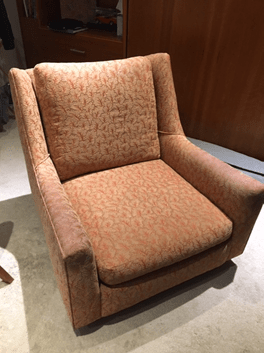
I didn’t know at the time that The Chair would move with me through all of the chapters of my life, including a divorce and a remarriage.  Recovered three times,  her last reincarnation (a rust and gold patterned fabric that cost a lot more than I wanted to spend) ensured that it would fit in with the bold colors that Dan and I chose to set off the ocean of quarter-sawn oak trim in our 1910 “four square” honeymoon house in Minneapolis.  We loved it.  It was the chair of choice for any visitor.  Our dog, Moxie, thought that he should own it (although officially banned from the furniture) and leapt up whenever we turned our backs….

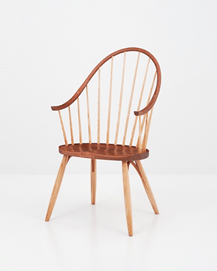
When Dan and I moved from a three-story house to a bright loft-like condominium, it never occurred to me to leave The Chair behind, although full shipping pods went to each daughter and we left a few other good pieces behind for the lucky new owner.  We knew when we moved her that she was in desperate need of another facelift.  For six years, she hung on, increasingly out of place in a loft that was otherwise furnished with Scandinavian antiques, Dan’s exquisite one-of-a-kind “art furniture” that occupied his dreams in the winter and his time in his summer shop, and handmade wood pieces from Thomas Moser’s Maine workshop, one of which I inherited from my father. 

The new dog, Kasper, loved The Chair as much as Moxie, our previous dog did.  Her arms acquired an increasing patina of permanent grime.  I shopped for fabric with our friend Laura, who held out the incentive of her architect’s discount. I couldn’t let The Chair go….and I couldn’t figure out how I could make her fit.

Then, somehow, things changed.  As I hemmed and hawed over The Chair, it became clear that she held too many memories (in addition to being huge and heavy) to carry with me as I moved into retirement.  She embodied too much past without holding a promise of what the future might bring.  And, all of a sudden, Laura said, “I know what you can do – send a picture to OmForme and see whether he could recycle it into a completely different chair”.   Omforme takes good quality old furniture and reimagines it and Laura was so intrigued with the possibilities that she used her deep dive into the online fabric sphere to score enough fabric to seal the deal.  And she loved the result so much that I gave the chair to her (she paid for the redo) – with the stipulation that I could visit.

Now, here I am in Boulder in a tiny rental house that we furnished from Ikea and Craig’s List, unable to get back to our Minneapolis loft until the “don’t travel unless necessary” recommendation is lifted.  I am trying to carve out a different life in retirement, where I live with fewer attachments to “old stuff”, whether it is a physical object or a professional persona that has become almost inseparable from what is just behind it. The world is in a frenzy, where my intense desire to reach out on Zoom to everyone who has ever meant something to me punctuates the relatively silence of our house. We have no way of predicting what will happen in the next few months, and I screen the competing voices seesawing between doom and “back to normal by fall.”

I sometimes think that I have two choices – hang on to what I have (relationships, hopes for the future…) or really try to live day-by-day, curious about what life-with-less will be like tomorrow.  But it is not easy to let go, although hanging on requires a lot of the mental energy that I could put to other uses.   And I am not even sure what is most important to hang on to. 

As for The Chair:  In this new and even more uncertain world, I am glad that you showed me that I could live without you.  So long good friend.  I needed to let you go but I won’t forget you — and I am glad that you are safe

Well Used and a Bit Broken but Beautiful….

I was thinking about our guest blogger Ruthie’s recent post and her reference to the Velveteen Rabbit – one of my top favorite children’s books.  Our granddaughter Opal is approaching three – old enough to be past board books and just at the right age to get the copy that we already bought for her.  Of course, the point of the Velveteen Rabbit is we become more alive because we have been loved, but love has a way of being tough on us.  Toys have their fur rubbed off – we accumulate wrinkles, sags, and rusty body parts.  Since I recently finished sending my grandchildren painstakingly designed and seriously customized digital Valentines, both aging and love are on my mind.  I think, in particular, of the glow in a picture of our somewhat older friends, Belle and Bob, as they held their great grandchild.  And, how just a few years ago, another young child looked at Belle and asked with great seriousness, “why are there so many cracks in your face?” – which caused her to laugh uproariously.  Love and aging, love and aging….

photo from Wikimedia commons

I remembered today that there is a Japanese concept that places greater value on a beautiful piece of pottery that has been broken and repaired than one in its perfect original form.  My Japanese is limited to a few phrases like arigato (thank you) and konichiwa (hello) so I of course had to look it up.  The word is kintsukuroi, and like most Japanese phrases, it thick with meaning.

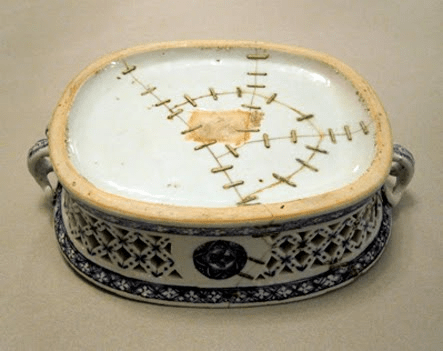
The photo of an old dish shows how skilled artisans repair broken pottery with precious metals that accentuate rather than hide the flaws, an esthetic that is foreign to the increasing value placed on the new, the currently fashionable, and the disposable.

My own feelings about repairing and reusing are mixed, at best.  I like to say that I dress at a combination of finds from resale stores and art fairs where I get one-of-a-kind objects to put on my body.  I never throw or give the artwear away. Instead, if it starts to look dated, I take it to a tailor or just mix it up with something else.  An old secondhand designer jacket goes to Goodwill, however.  I think about the old-fashioned skill of darning a sock.  The last time I did that was probably 50 years ago, in a pair of socks that I knit for my father.  However, as a knitter, I know that the socks that I have lovingly made are cherished by specific feet, but are unlikely to be darned unless I ask for them back at the sign of the first hole (which would be viewed as excessively controlling by some of the recipients….). And I know a store where I can take precious hand knit sweaters to be repaired when the task is beyond my skill. 

Kintsukuroi makes me think about these habits and their limitations.  I never really considered why I cherish some things that are old and worn (for the stories and the memories – or because they are simply beautiful) while considering others to be disposable.  One writer claims “Kintsukuroi is a way of living that embraces every flaw and imperfection.  Every crack is part of the history of the object and it becomes more beautiful, precisely because it had been broken.”  Ahh, there is the Velveteen Rabbit again — and the connection between kintsukuroi and another Japanese concept, wabi-sabi, which sees beauty in transience and imperfection.  The esthetic of wabi-sabi includes an appreciation of “asymmetry, roughness, simplicity, economy, austerity, modesty, intimacy, and appreciation of the ingenuous integrity of natural objects and processes.”

While neither kintsukuroi nor wabi-sabi are immediately accessible to an American, they inspire me to not only “accept the things I cannot change” but to embrace them.  I know that age, brittle bones and wrinkles are part of becoming a real grandmother, as long as they blend with wabi-sabi’s appreciation of modestly, intimacy and the integrity of human life – part of which is aging (and dying).  The esthetic of loving well is not a visible one, but is enhanced by a mandatory shedding of the excessive vanity of my younger adult years.  Moreover, in the last few months, I have learned about repairing some of the injured parts of my right side in Avita yoga, which focuses on gradual healing from the inside out.  The shoulder that ‘froze” and the knee that suffered a bone bruise were treated in physical therapy, but Avita requires me to fully examine each tiny restriction and focus on release rather than a “fix”.  I feel as if I am applying gold to the broken bits in a way that allows me to feel the beauty of the repairs. 

So, armed only with the vague knowledge that the Japanese understand that becoming whole requires both letting go and loving the imperfect, I have been engaging in the process of emotional and physical self-repair.  Of course, I am left with the Western desire for more.  I am not jealous, but know realistically that I may not hold a great grandchild, since my oldest granddaughter is just turning 15 (and by the looks of it now, will take her own sweet time settling down…).  That makes me feel some regret that I didn’t have children until I was in my 30s.  When it comes to my face, I often stand in front of the mirror and pull back at my sagging cheeks, wondering what it would look like if I had a face-lift (which is, in essence, a mechanical “repair” rather than a new face….).  Nevertheless, I remind myself that imperfection, brokenness and aging have their own beauty if I can slow down and let it reveal itself.