Knitting Lessons: Crafting and Life

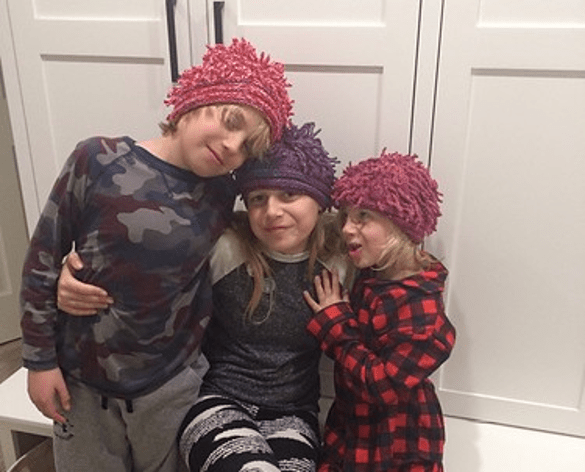
Christmas Anemone Hats 2020

I am a knitter. I first learned while living in Norway in 1955, when knitting was still part of the required national curriculum in Norwegian schools. My first project was a ski hat with a traditional Setesdal cross pattern in the brim. There were clearly no low expectations for 11-year-olds in those days. 

I gave up knitting when my children were young, just as I gave up sewing my own clothes. Both require long periods of concentration — hard to come by when elementary-school children fill your life. I began again when they were older and haven’t stopped since. In other words, knitting has become a significant part of my life.

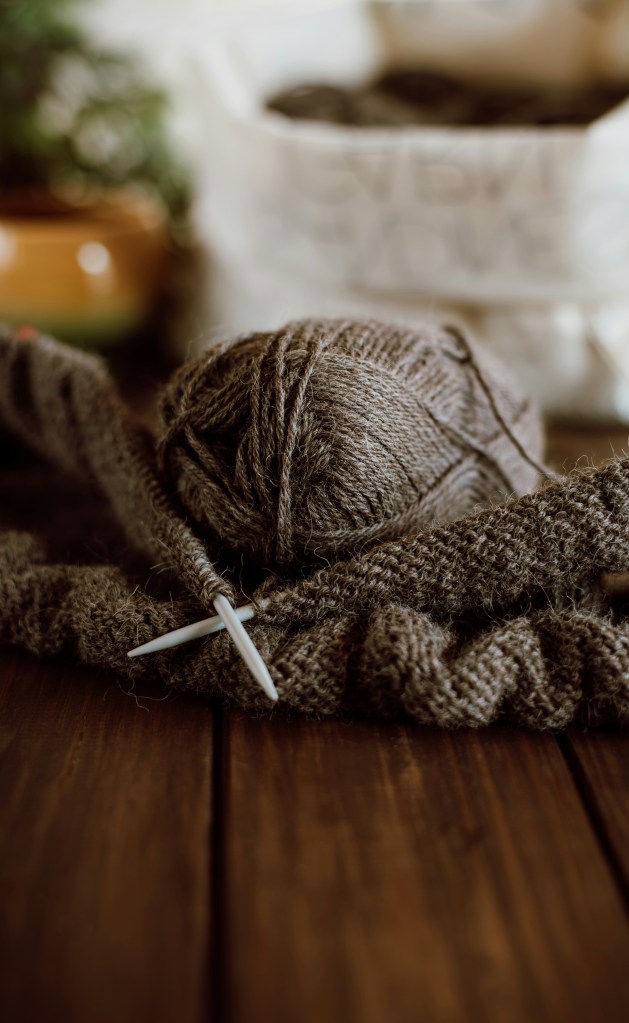
Non-knitters assume we knit because we want the product: the scarf, the hat, the sweater that emerges from all those stitches. But for most knitters, those things are merely a byproduct of the experience itself, which is meditative and soothing — something done in contemplation, letting yarn slide through the fingers while listening to the soft click of needles. It is a Zen-like state that, at least for me, comes close to true meditation. The grocery list disappears; the endless whirl of memories and ideas quiets. The report that needs to be written can wait.

(Photo by Oksana Maselko on Unsplash)
I spend hours in yarn stores, admiring as often as buying. Going through my stash is a sensory experience — even when I decide that I have too much and can donate some.  
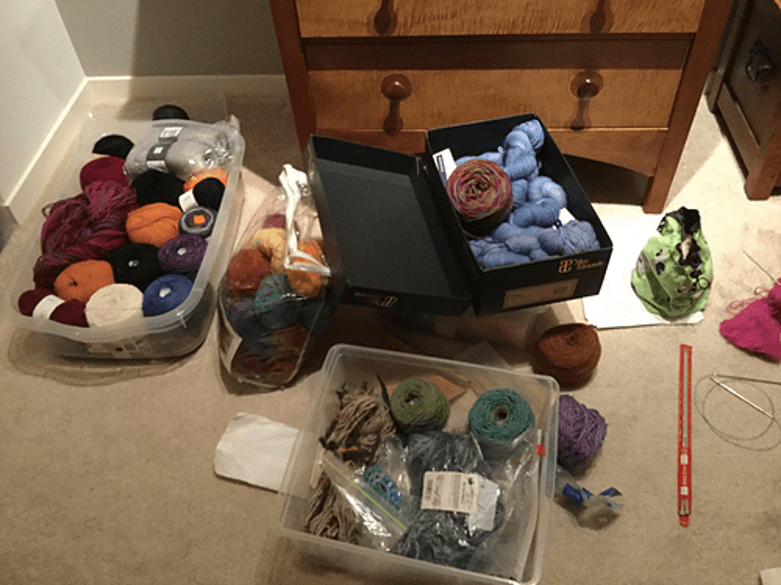
Knitters love yarn…when we have too much, we “destash.”

Of course, knitting can also be social. There are knitting circles, retreats, classes, yarn shop gatherings — dozens of ways to connect around a shared pleasure. But these are not why we knit; they are another happy byproduct. It helps, after all, to know there are others who can read the bizarre language of knitting, who do not blanch when confronted with instructions that begin: p2, skp, *yo, k2 through back loop, yo, rep from *. Others who understand your delight in a yarn that is half silk, half alpaca because their own hands remember that softness slipping through them. Others who want to be part of a “knit-a-long” where people from many countries knit the same pattern at the same time and discuss their progress online.
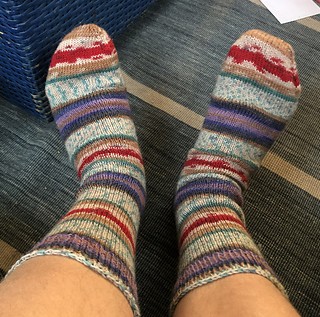
But knitting teaches other things as well — especially now that knitting socks is an expensive pleasure for gift-giving rather than a necessity…      

If I am not a perfectionist, it is because knitting taught me that most mistakes are invisible in the finished piece. If I am patient, it is because I learned not to swear — more than once, anyway — when encountering an error too serious to ignore. There is the inevitable acceptance that I must tink (knit backward to undo a row) or even frog (rip out substantial portions, sometimes the entire thing) because it simply is not right.

What would frustrate me enormously if it involved hosting a dinner party, causes only a moment of regret in knitting, because I never knit to a deadline. The process is what matters.

And yet the finished objects matter too. If a purchased sweater is attacked by moths, I mend it and donate it. If the same thing happens to a sweater I knit myself, I mend it carefully and continue wearing it for years. Hand-knit sweaters are passed down. I own one that belonged to my mother and is now 60 years old. My eight-year-old granddaughter wears one I first knit for her mother, later worn by a grandson now in college, and — invisibly mended — treasured by a third owner.
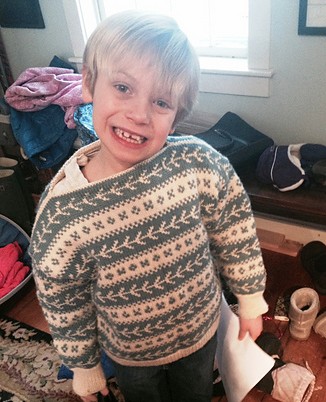
2018 and 2026
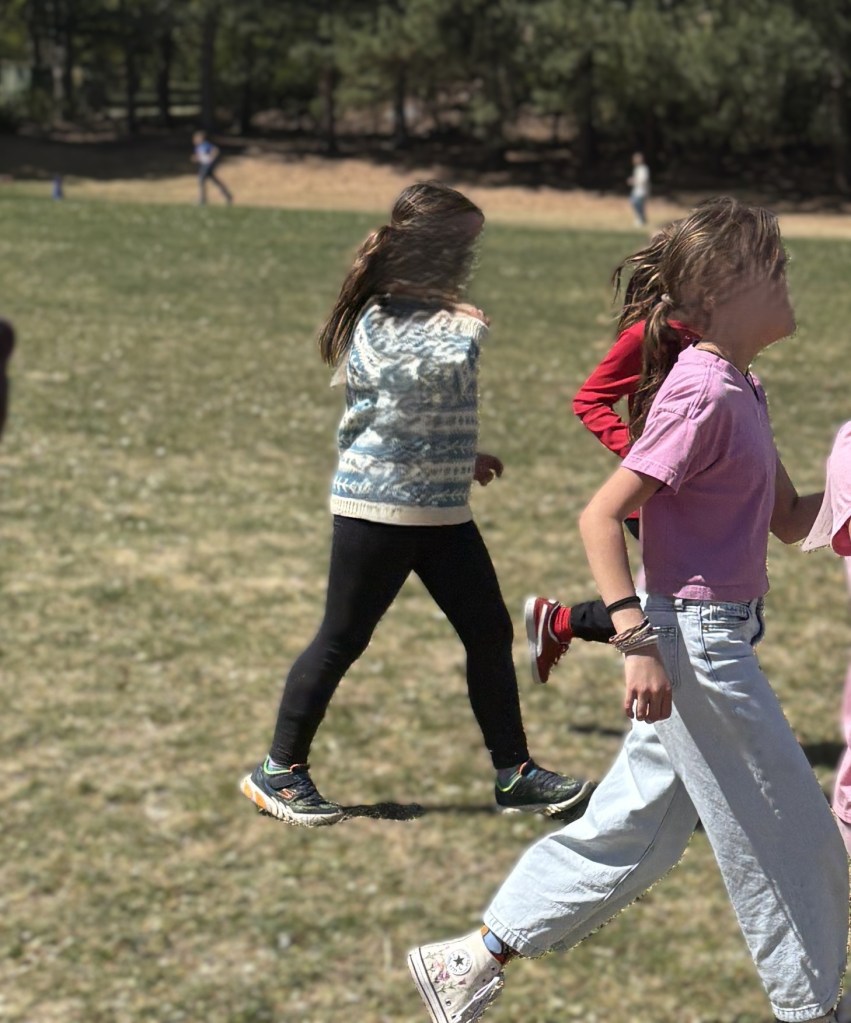
Vintage is cool; vintage made by someone you loved is even cooler.

But knitting is also a metaphor.

In relationships, when do we overlook the small flaws, invisible to others?  Mend the holes? Can we knit back to the point where things first began to strain and begin again? What happens when one person decides to rip it all out — declaring that the sweater in progress is no longer the right color, no longer the right style, no longer wanted at all?

And perhaps the deepest lesson knitting teaches is this: even after unraveling, the yarn itself remains. Something new can still be made from it.
WE ARE WAITING….

photo by Adam Tinworth

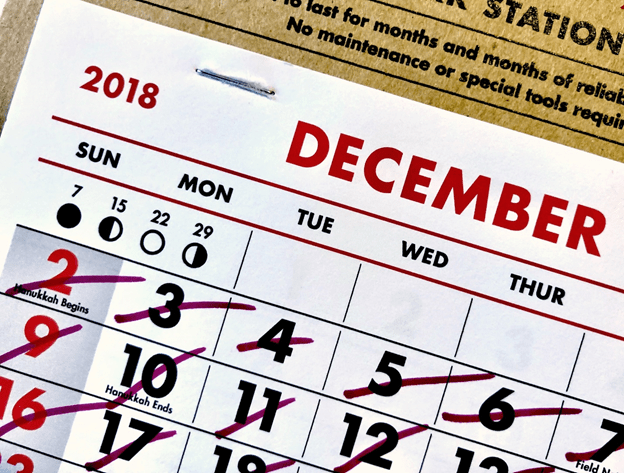
There is a December season of waiting every year – waiting for Christmas, waiting through eight days of Hanukah to commemorate the oil that lasted, waiting for the New Year.  My Viking ancestors, along with most northern European tribes, waited for Yuletide and the return of light, as I am sure that Romans anticipated Saturnalia’s (December 17-23rd) gifting and respite.  The waiting season reminds us to slow down, reflect and be grateful.

But this year is different:  We are waiting for the end of drawn-out ordeals — COVID isolation, closed schools, the U.S. election farce, and Brexit.  We are not waiting with delighted anticipation, but for a concrete end to crazy-making uncertainty.  Oh, what fools we mortals be….

Personally, I am reacting with impatience and a persistent stream of random desires…Lawrence Ferlinghetti’s poem, I am waiting, made me laugh by capturing the preposterous and trivial hopes that populate my mind during this year’s waiting period:

I am waiting for my case to come up

and I am waiting for a rebirth of wonder

and I am waiting for someone to really discover America

and wail…

and I am waiting for the Age of Anxiety

to drop dead…

and I am awaiting perpetually and forever

a renaissance of wonder.

That’s where Ferlinghetti got me – a rebirth and a renaissance of wonder!  I cannot change the world or make people discover the real America.  I can (returning to themes in earlier blogs) make an effort to calm my “monkey mind” and reflect on the underlying message of hope that infuses both the pagan and modern December days.

Waiting implies that something is coming.  In my least reflective periods, that means waiting for the bus to arrive or a planned vacation. But what are we all waiting for post-COVID?  After the current political turmoil runs its course?  Neither I nor anyone else really knows – and all of the predictions offered in the newspapers seem like misplaced flailing against a brick wall of existential uncertainty.  So what can waiting mean now, when my only conviction is that the future won’t be the same?  

Waiting without impatience, to prepare for the unknown — that’s hard.  It means slowing down.  Really slowing down.  Not taking time in the big chunks of weeks or days, but focusing on each hour’s potential. Dan Albergotti’s evocative poem about waiting points to the same lesson:  enforced waiting requires attention to life’s details and distractions, but also to moments of quiet grace and awakening, in preparation for the time that will come.

Things to Do in the Belly of the Whale

Measure the walls. Count the ribs. Notch the long days.
Look up for blue sky through the spout. Make small fires
with the broken hulls of fishing boats. Practice smoke signals.
Call old friends, and listen for echoes of distant voices.
Organize your calendar. Dream of the beach. Look each way
for the dim glow of light. Work on your reports. Review
each of your life’s ten million choices. Endure moments
of self-loathing. Find the evidence of those before you.
Destroy it. Try to be very quiet, and listen for the sound
of gears and moving water. Listen for the sound of your heart.
Be thankful that you are here, swallowed with all hope,
where you can rest and wait. Be nostalgic. Think of all
the things you did and could have done. Remember
treading water in the center of the still night sea, your toes
pointing again and again down, down into the black depths.

But I still find myself bound to an electronic datebook that defines the somewhat arbitrary landscape of my week — ignoring this, as Albergotti urges, is a tough call.  John O’Donahue, asks me to think about what it would mean if I abandoned futile hopes of domesticating everything I touch.  Both remind me that the gift of uncertainty (that we encounter in the belly of the COVID whale) is that a disorientation invites becoming more awake – if I allow it.  And, O’Donahue assures me that “Once you start to awaken, no one can ever claim you again for the old patterns.”  Not sure that I buy that as a certainty either, but it is a starting place…..

One thing that I know is that it is hard to relinquish my efforts to domesticate everything – make it manageable on my terms – without relying on others.  I am astonished at the degree to which acknowledging mutual vulnerability has become part of my routines:  Call someone who is floundering.  Reach out to grasp the certainty that I care for someone and that they care for me.  Be honest about how hard the little things are, and get my friends to laugh with me at my human imperfections.  And I am reminded, when I berate myself at night for all of the unaccomplished things on my list, that I wake up every morning feeling disoriented, but that disorientation slowly shifts to a sense of awe when I face the immovable mountain outside my door, which then eases me into morning’s hope and curiosity (along with two cups of coffee). 

I have a friend whose name is Patience, who has spent a great deal of effort over her more than 70 years to live up to her name.  She lives alone and has had the same year of cumulative perplexing loss that we are all experiencing.  However, her patience is not inert but is sustained by daily attention to well-honed practices that induce attentiveness and keep her awake to hope and joy. I learn from her practices, the most accessible of which are PAUSE. LISTEN. FREQUENTLY. Patience, along with all the poets, urge me to just pay attention during and after this season of anxious waiting.

The Chair: A Parable for Our Time?

I have so many friends who have confided that, since self-isolating began, their homes have never been cleaner.  They are also going through the old piles of books, the mess in the bathroom vanity, and all the almost-used-up cleaning products under the kitchen sink.  Hoarding toilet paper has given me new enthusiasm for decreasing waste and insisting on using and washing microfiber cloths rather than discarding paper towels, as well as making our own disinfectant.  Okay, we are all going a little nuts.  My point is that we are really paying attention to how we are living — how we occupy our little space in this world and how we can conserve what we have. 

Which brings me to The Chair.  The story of The Chair is, in some ways, an elaboration of my previous post on decluttering and connects me to ongoing reflections about “stuff” that both contains emotions and occupies physical space.  It raises the dogged and still unanswered question:  What will matter most when my mental fog around the current situation lifts?

To begin: In 1969, I lived in New York, with two graduate student fellowships as my husband’s and my only source of income.  As a friend said about my husband, however, “You could fall into a sewer and come up holding diamonds”.  So, while having NO MONEY AT ALL, we lived in the most luxurious home that I have ever occupied – a sublet in a Columbia University-owned faculty building on Riverside Drive, complete with doorman, polished door handles, three bedrooms-plus-study, and a parking space – a parking space in Manhattan!   But, after all, it was New York.  It was the late 60s-early 70s, and there was lots of good stuff going on for free (or nearly free).

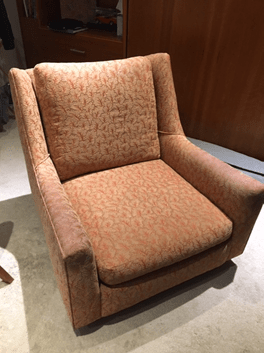
When we moved from our first apartment to the brief Riverside Drive idyll, we brought with us a bed, a sofa (which I reupholstered – my only and not particularly successful effort of that type), a desk/dining table — and The Chair. She was a slightly bulky but stylish piece, whose Peter Max screaming orange velvet upholstery was the probable cause of her deeply discounted price at Maurice Villency (a big step up from the Door Store, which provided our cheap flat surfaces).  It was also the dog days of summer in New York,  and no one in their right mind wanted to sit on orange velvet in a marginally air conditioned pre-war apartment.  The Chair was actually a designer’s effort to make mid-century modern meet American recliner.  It was huge – big enough that we could sit in it together (sort of….).  She was the chair of choice for reading.  She was, even with orange upholstery, much more reflective of who we thought we would become than the very unprofessionally recovered second-hand sofa. 

I didn’t know at the time that The Chair would move with me through all of the chapters of my life, including a divorce and a remarriage.  Recovered three times,  her last reincarnation (a rust and gold patterned fabric that cost a lot more than I wanted to spend) ensured that it would fit in with the bold colors that Dan and I chose to set off the ocean of quarter-sawn oak trim in our 1910 “four square” honeymoon house in Minneapolis.  We loved it.  It was the chair of choice for any visitor.  Our dog, Moxie, thought that he should own it (although officially banned from the furniture) and leapt up whenever we turned our backs….

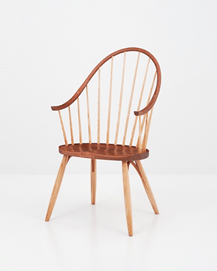
When Dan and I moved from a three-story house to a bright loft-like condominium, it never occurred to me to leave The Chair behind, although full shipping pods went to each daughter and we left a few other good pieces behind for the lucky new owner.  We knew when we moved her that she was in desperate need of another facelift.  For six years, she hung on, increasingly out of place in a loft that was otherwise furnished with Scandinavian antiques, Dan’s exquisite one-of-a-kind “art furniture” that occupied his dreams in the winter and his time in his summer shop, and handmade wood pieces from Thomas Moser’s Maine workshop, one of which I inherited from my father. 

The new dog, Kasper, loved The Chair as much as Moxie, our previous dog did.  Her arms acquired an increasing patina of permanent grime.  I shopped for fabric with our friend Laura, who held out the incentive of her architect’s discount. I couldn’t let The Chair go….and I couldn’t figure out how I could make her fit.

Then, somehow, things changed.  As I hemmed and hawed over The Chair, it became clear that she held too many memories (in addition to being huge and heavy) to carry with me as I moved into retirement.  She embodied too much past without holding a promise of what the future might bring.  And, all of a sudden, Laura said, “I know what you can do – send a picture to OmForme and see whether he could recycle it into a completely different chair”.   Omforme takes good quality old furniture and reimagines it and Laura was so intrigued with the possibilities that she used her deep dive into the online fabric sphere to score enough fabric to seal the deal.  And she loved the result so much that I gave the chair to her (she paid for the redo) – with the stipulation that I could visit.

Now, here I am in Boulder in a tiny rental house that we furnished from Ikea and Craig’s List, unable to get back to our Minneapolis loft until the “don’t travel unless necessary” recommendation is lifted.  I am trying to carve out a different life in retirement, where I live with fewer attachments to “old stuff”, whether it is a physical object or a professional persona that has become almost inseparable from what is just behind it. The world is in a frenzy, where my intense desire to reach out on Zoom to everyone who has ever meant something to me punctuates the relatively silence of our house. We have no way of predicting what will happen in the next few months, and I screen the competing voices seesawing between doom and “back to normal by fall.”

I sometimes think that I have two choices – hang on to what I have (relationships, hopes for the future…) or really try to live day-by-day, curious about what life-with-less will be like tomorrow.  But it is not easy to let go, although hanging on requires a lot of the mental energy that I could put to other uses.   And I am not even sure what is most important to hang on to. 

As for The Chair:  In this new and even more uncertain world, I am glad that you showed me that I could live without you.  So long good friend.  I needed to let you go but I won’t forget you — and I am glad that you are safe