Unknown's avatar

About Karen Seashore

I am a sociologist, life coach, policy wonk, and tarot reader. Other than reading a book, I always prefer to work with other people. Creating small changes -- in myself and in the world around me -- is my calling. You can find my scholarly publications under Karen Seashore Louis (or Louis, K.S.).

It Started as a Chat Between Friends…..

Two years ago, Dan and I took a grandparent trip to Paris and Normandy organized by Road Scholar. Aside from the pleasure of experiencing the world through 14-year old eyes, I became curious about the origins of Road Scholar, a non-profit organization committed to “knowledge seekers and explorers, united in the belief that lifelong learning is a vital part of overall well being..” Clicking on the Our Story tab in their website reveals that it started with a random conversation when two people at the University of New Hampshire were musing about the Scandinavian folketshusen that provide community-based adult learning and the value-for-money of youth hostels. Although it has evolved from its bare bones, learning-focused approach to travel for older people, it is still a non-profit that incorporates scholarships for those whose finances don’t accommodate much travel. 

This got me thinking about social entrepreneurs, or people who come up with new ideas whose purpose is making a difference rather than making money.

Last year I had the chance to catch up with my old friend Jan Hively, as she reappeared in Minnesota after giving a workshop at the Saging International Conference.  We were at a reception in a restaurant where I knew almost no one, although I felt as if I ought to know almost everyone because they were all roughly my age, long-time residents of the Twin Cities, and were in education or the helping professions.  Hmm…. Is this more evidence that my life is littered with missed opportunities for networking with interesting people?  Almost everyone that I talked to (once I managed to scrape myself out of my modest introversion) were (1) semi-retired or retired from a first career and (2) starting something new – often with others in the room – where doing good rather than making money was the goal.  In other words, I was in a crowd of what I could only call social entrepreneurs.

When you google social entrepreneur, however, you get a different view….the first links are degree programs in business schools and lists of successful social entrepreneurs who are also making money.  Now I have nothing against making money while doing good, but when you click on Forbes articles, you get a prominent definition that adds something new:  someone who uses business skills to solve social problems.  Those were not the people I met, few of whom had a background in business or were particularly interested in commodifying social good. 

It was not hard to find nuance when I probed my Google search more deeply.  The deep thinkers at Stanford University have come up with the insight that entrepreneurship “connotes a special, innate ability to sense and act on opportunity, combining out-of-the-box thinking with a unique brand of determination to create or bring about something new to the world.”   They go on, noting that entrepreneurs attempt to ““shift economic resources out of an area of lower and into an area of higher productivity and greater yield.”  What comes to mind are, of course, microloans to women starting small businesses in developing countries (which have proven remarkably effective in promoting gender equity)l  or the Global Soap Project that recycles semi-used bars of hotel soap to improve health in underdeveloped areas.

But what are economic resources?  Like most people, my first thought goes to money.  Then I quickly channeled Jan Hively again…

I have known Jan, an exuberant role model for successful aging, since the 1990s, when we worked together on programming and outreach for the College of Education and Human Development at the University of Minnesota. At that time, Jan, who was in her late-60s, was completing a doctorate looking at the contribution of older people to the well-being of rural communities.  Her work, which demonstrated that the unreimbursed labor of older people was critical to maintaining villages and small towns, whether as volunteers in school or at the library or babysitting for grandchildren so that their parents could hold down several jobs.  Jan drew on her work to create a Minnesota Vital Aging Network – which is now an international movement dedicated to grassroots engagement of older people in their communities.  Almost as if she were addicted to staring new initiatives, Jan went on to found SHIFT! , (an organization that provides support to boomers who are seeking employment, looking at retirement, or finding community), the Pass It On network, which is focused on peer learning for older people, and the Life Planning Network, which links professionals who support vital aging and provides professional learning opportunities to them.

Each of these organizations is non-profit, most operating on volunteers; none seem to genuinely meet Stanford’s definition because there is no significant monetary financial “yield”.  They are grassroots, locally organized and maintained, and are committed to growing interpersonal community as well as “doing good” and measurable economic value.  They are distinct from the business skills driven model and “yield” because they are, at their core, part of a challenge to redefine aging from inevitable but increasing diminishment (the current dominant and ageist perspective).  She, and other social entrepreneur “of a certain age” focus on how shared wisdom promotes a common good. 

Not everyone can be an older social entrepreneur with global impact (like Jan) but everyone can find a way to contribute to grassroots social cohesion. The premise – than small local actions can lead to large consequences – is particularly relevant for people who have more time than money.  People like me. Who knows how many new initiatives began at that reception, where everyone these was drawn to the vision of being part of that entrepreneurial social movement? 

‘Tis the Season

For some reason, I feel surrounded by people who love Christmas and revel in cookie exchanges, lights, and special dinnerware with seasonal themes.  They might as well have “it’s the most wonderful time of the year” tattooed on their foreheads.  I have a more ambivalent relationship with everything that commences after Thanksgiving and lasts until the holiday ornaments are stowed away in their special boxes…..

I should start at the beginning.  I grew up, as I noted in my decluttering blog, in a Swedish-American family where Christmas was elevated to the critical role of proving that the American had not crowded out the Swedish.  Unlike every other family that I knew growing up, Christmas Eve was the big event – the day when we brought in the tree and decorated it, where the “adult beverage” was glögg that my father made from a family tested (and highly alcoholic) recipe several weeks before. My mother worked all day to bake two kinds of Swedish bread (julekage and limpa), in addition to making a Julbord with Swedish cheese (no cheddar allowed!),  lutefisk (look it up – ugh), potatiskorv (a bland Swedish sausage), and a miscellany of other things to keep the traditions alive.  We made the four kinds of Swedish Christmas cookies (absolutely no red and green sprinkles) well ahead of time, of course, and served them up with a baked rice pudding.  NOTHING COULD EVER BE CHANGED or SUBSTITUTED – and as others have noted, all the foods seemed to have been subjected to a “whitening agent” so that no color deeper than beige was visible.  The American part was that Santa Claus came and the presents opened on Christmas Day. 

When I had my own family, my parents were always part of my holidays, and the Christmas Eve traditions continued unabated (much to my children’s dismay).  It was only after my mother died that, after a long consultation, we deleted the detested lutefisk and substituted fresh torsk (cod). I add, however, that because we lived in Minnesota we were able to get my father a takeout serving of lutefisk from a local restaurant…

Although I didn’t like the food very much, I always felt sorry for families who lacked the set-in-stone traditions that solidified their family identity. But life changes when the kids leave home, and they are able to make their own choices….And, with each year I “declutter” my holiday life by becoming temporarily willing to give up another tradition.  Try to buy potatiskorv in Boston or Boulder (although if we were genuinely serious, we could have made our own, Instead, my sister and brother-in-law created a kind of pork burger-with-potato that almost passed). 

Last week I was with a group of “women of a certain age” when the topic of “making it through the holidays” came up.  The person who raised it felt rather anxious, because she was traveling “home” to a family gathering that included both frail parents and alcoholic relatives who had, in the past, behaved badly.  She had already made a backup motel reservation…..

What an unexpected Pandora’s Box!  As each woman spoke about their upcoming holiday plans, there was a consistent theme:  Stress, low-level conflict, fatigue – and a sense that perhaps even the most vivid childhood memories of the perfect Christmas were less than truthful.  One chimed in that she had always disliked Christmas, but her husband loved it.  Recently married, they were traveling to another state to be with his parents in a retirement community.  She looked hesitant when she described the trip.  A third noted that, as an adult, she experienced Christmas as a time when people drank too much and were not always able to participate in the joyfulness that young children have when they see the lights and a stocking from Santa.  But it was Sue, whose quiet story put me into alert mode:  “My mother wanted everything to be perfect.  Our tree was decorated to the teeth, with every matching ornament perfectly placed.  The food was lovely, served on those special Christmas plates.  Her wrapped packages were works of art before we tore in to them.  And then, as soon as the packages were opened, she collapsed….”  What I recall from my later adolescence was the same:  My mother would go to bed starting around noon on Christmas Day, and we would not see her until late evening, as we munched on leftovers.  While I never went quite as far in trying to create the perfect Swedish-American Christmas, as she said that, I remember vividly how quickly my Christmas Eve fun melted into fatigue….

Sue has found a new approach:  Her husband makes a list of every Christmas light tour, pageant, special concert, etc. – and wants to do it all with her.  They experience joyfulness because they have removed the work to get ready, the travel, the strained family relationships – by sequencing experiences that are fun, but not exhausting—while staying home.  And whatever Christmas cookies they bake are ones that they like, and not those prescribed by tradition.

Part of my heart wants to cheer “Let’s try it – get rid of all of it except presents for the younger kids!  Eat Thai takeout on Christmas Eve if we want to!  Give the money we would spend on presents to the food shelf – or use it to take a real vacation!  Maybe if we did less we might even be awake enough to go to a midnight candlelight service (isn’t that what we should be thinking about?)”  But the other part (and I am split down the middle) screams “No!  Family is cemented when the holiday traditions are strong but a little flexible!  I really LOVE making stockings for everyone, and don’t want to stop!  We already have given up on making only Swedish cookies—isn’t that enough?” 

If I think Marie Kondo, I have to ask:  Which of the traditions makes me smile and brings me joy?  And, which could be adapted to a new generation – my grandchildren – for whom we all want to create a sense of being part of a special family time.  And who will tell the stories about the takeout lutefisk unless there is the smell of julekage to elicit it?

Decluttering – But Be Sure Not to Cut Too Deeply

From Richard Leider through Marie Kondo, it is all about getting rid of stuff.  Stuff is not just STUFF (physical things) but includes sorting through memories, photos on your computer, etc.  It is also getting rid of assumptions that draw us into exclusionary thinking, such as examining the invisible knapsack of White Privilege (or any other kind of privilege).  Many of the references to decluttering are aimed specifically at US, older people who have never done anything other than randomly box stuff up and put it in the (literal or metaphorical) attic or basement.  According to Margareta Magnusson, who popularized the Swedish practice of döstädning, every person over 50 should get started because we are getting older and will otherwise leave a mess for the next generation.

And oh, the side benefit:  All of the above assume that if you do this, you will be happier.  Not just content, but even joyful, as your decluttered work life (or busy volunteer life) takes on a new sense of meaning, and your sentimental life becomes serene, as you chuck (or donate) unused bits-and-pieces of physical or emotional stuff that belonged to your dead grandparents. 

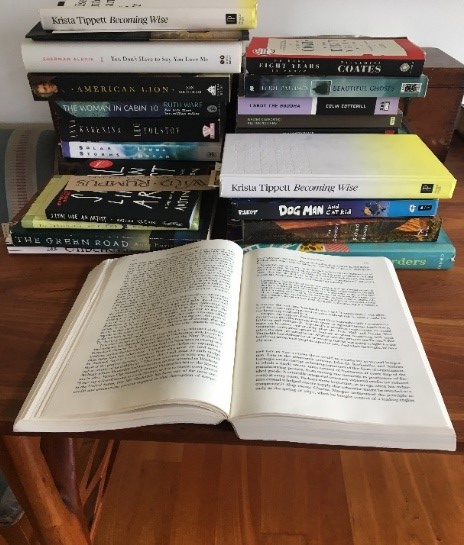
It took Dan and me six months to sort out the miscellany in the basement and attic of our house before we moved to a condo.  The stuff was unbearable, ranging from old toys to photography equipment from a distant hobby.  After moving, we did feel joyful and free as we surveyed our minimalist and light-filled new space.  We have not decluttered in the sense that any of the popular authors suggest, however.  We are influenced by our depression-raised parents, for whom reusing every bit of string was a virtue – and today’s ecological focus, which says “don’t throw and reuse”.  Books may go to the Little Free Library, but we are also liberal in borrowing from the same….as is visible in the pile of last summer’s planned summer reads.

But decluttering is about more than that.  Leider says, when repacking our bags for life’s journey, we should decide “what’s essential for the road ahead—what to let go of and what to keep, how to lighten your load, both tangible and intangible, for the new way that is opening up.”

However, If you google unpacking and repacking, the first things that come up are illustrated instructions on what to do when you get a package filled with complicated “stuff” that you need to put together – and possibly repack because it wasn’t what you wanted.  The first instruction is “Be sure to not cut too deeply”.  I kept looking for a googly way to keep that post from coming up first, but it stayed there.  I kept reading it.

Marie Kondo emphasizes the importance of finding joy in those things that we decide not to get rid of.  And, on All Saints Day (aka Halloween) I was reminded again that there are small things that we keep in our lives because they have become totems that store the memories of people who have been important to us – or even people who we never knew but who were important to another person who is dear. Maybe they are in a closet or on a shelf, largely ignored removed and dusted off once a year.  Is it the homely and old-fashioned candy dish that graced a great aunt’s Thanksgiving table?  Or the deteriorating butter box that is the only item to survive my great-great grandmother’s frightening and exhilarating journey from a rocky farm in Småland to a new life in Minnesota in the 1860s?   Neither belong in a curated/decluttered loft-like condo, but getting rid of them would require a cut too deep, even though it is not possible to say that they give me joy.  Fortunately, they are small, and can be kept without feeling like much of a burden, still carrying the deep past.  And they carry simple stories about where “we” came from.

But back to the larger “stuff” that contains emotions and occupies physical and mental space.  I just sent out a last call to my cousins to see if anyone wants our great grandfather’s rather homely and cumbersome late 19th century desk.  It no longer fits in any space in my daughter’s soon-to-be-renovated house, but everyone in my generation is down sizing.  The next generation is already in their 40s and each of them has accumulated too much stuff to accommodate it.  They are the ones who really need Kondo/Leider/Magnussen! 

I am (after much agonizing) at peace with the fact that the desk will probably go to another family — and I will survive without knowing where it is.  But the stories that come with the desk (and the candy dish and butter box) will survive because whenever the desk was moved the dates, locations, and mover’s names were recorded in a non-visible place.  They form a bare bones record of the dispersal of my father’s family from its roots in a village in Minnesota to New York, Massachusetts, Michigan….A photographic record of “The History of Great Grandpa Rose’s Desk” can become another easily stored totem of family history – if we remember to tell the stories.  

“I’m 64, Should I Give Up Trying To Be Successful?”

Believe it or not, this is a real question, posted to the Quora feed.  What followed in a response was a post by a young woman about her father.  The upshot of her comments was:

He taught me that you can always succeed if you believe you’ll succeed.

So believe in yourself. I know that’s cheesy, but I’m currently in class with a 74-year-old woman who’s getting her psychology degree after being a housewife for 45 years. My dad was five years from retirement, and then worked an entry level job. People start over at all stages of life. If they can be a success after so long, then anyone can.

This was apparently a hit with the readers, garnering 2,700 likes and 64 shares when it appeared in my inbox.  But, if you read through the heartwarming story, her father “started over” when he was 50.  Life looks different at 64.  Or 74.  

But back to the question:  What does it mean “to be successful” much less “giving up” on trying to be successful? 

“To be, or not to be?  There is consensus that Hamlet is talking about enduring the pain of his life versus the calm of death.  But (for me) “being” is more than merely “living” and one of our biggest jobs in moving from living to being is to consider success more deeply.  I like to use the Tarot to understand this work – and to remind myself of the stories that I want to tell myself and others.

Juggling with Joy in Early Adulthood — When I was in my 30s, what I wanted most from my life was to experience my young children’s development and maintain a modest professional profile (which meant a job doing something that I liked).  In other words, success was measured primarily by short-term joyfulness and maintaining a do-able balance between family and work.  It was all about balance….and dancing a little while doing it.

Fast-Forward to My Mid-Forties: Craftsmanship…The kids’ needs were less immediate and they were busy with friends and school.  I, on the other hand, was experiencing external “success” at work, with increased ego-stroking responsibilities and annual reviews that placed me among the “exceeds expectations” group in all of the areas associated with being an academic (the three-legged stool of teaching-research-service).  I focused on skill and artisanship at work.  At the same time, my life was not in balance.  I traveled a lot, focused on my own learning, and believed (incorrectly) that my family needed me (or even wanted me) less.  Without thinking too much about it, these external markers increased in importance over the next decade.  While the focus on skillful work resulted in lots of tokens to hand on the walls of my office, this card does not exude joyfulness….

image

A Slow Crush..My success contained the seeds of failure. While busily crafting at work, I gradually became accustomed to before-and-during dinner drinks, which allowed me to relax and avoid thinking about my marriage or the daily challenges of parenting teenagers.  Work was challenging but manageable, but not the emotions and preferences of other human beings.  I managed to hold on to the external trappings of success but lost personal direction and Shakespeare’s “not to be” became an increasingly attractive option.

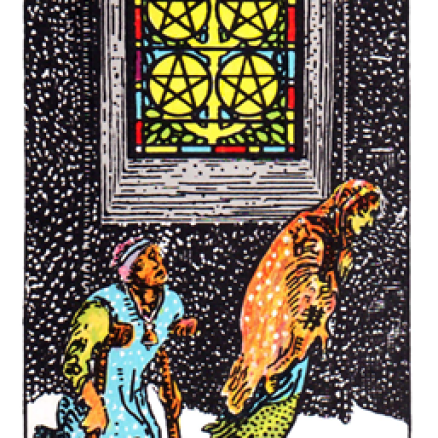
One of the consequences of depression is a generalized sense of meaninglessness — what better a definition of being unsuccessful?  I looked OK on the outside, but the image captures the way life felt on the inside.

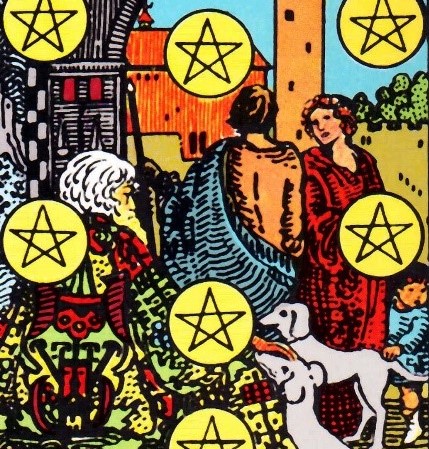
Comfort and a Different Success? Twenty years later, my life had changed radically again, with a new (and peaceful) marriage, a position within my work as an “elder stateswoman” whose job was to nurture the development of others, and grandchildren.  This Tarot card represents the abundant fruition of success and a life finally almost back in balance.  I think that in this image I am both the older person on the left and the woman on the right, in conversation (with a student? My husband?).  Bridget, my oldest grandchild, is tugging on my dress, while beloved dogs wait to be petted.  Who could ask for more in this life?

This redemptive card is part of the story of dancing while juggling, honing a craft, and ignoring relationships and self.  But, in my mid-60s, much life remained. 

Becoming New Again? So success (or failure) has meant very different things to me over the last 40 years.  Of course I cannot know what further success might look like – it is easy to tell a story after the fact, but predicting anything is a challenge.  And rather than hoping for “success” I have to keep reminding myself that I am likely to find a gift if I am willing to accept the mystery and not try to force the future. 

To return to the Quora post, what appealed to me about the story that the young woman told was not that her father founded a successful business in his 50s.  Rather, it was that he was willing to take a risk:

He said ‘I don’t think I can make this work anymore. I might have a chance if we move….Within a month, we left New York and drove 16 hours down to Georgia.

I am not sure where I will find my psychological or physical equivalent of Moving-to-Georgia.  But, I hope that I will wake up one day, and have a similar insight.  And be willing to act on it – with abandon and “wise innocence”, like my favorite Tarot card. 

The Fool has found something lasting – a “successful” understanding of joy that emerges from deep inside, seemingly for no reason at all. But he is also embracing adventure — more than willing to take a new risk.