Unknown's avatar

About Karen Seashore

I am a sociologist, life coach, policy wonk, and tarot reader. Other than reading a book, I always prefer to work with other people. Creating small changes -- in myself and in the world around me -- is my calling. You can find my scholarly publications under Karen Seashore Louis (or Louis, K.S.).

The Chair: A Parable for Our Time?

I have so many friends who have confided that, since self-isolating began, their homes have never been cleaner.  They are also going through the old piles of books, the mess in the bathroom vanity, and all the almost-used-up cleaning products under the kitchen sink.  Hoarding toilet paper has given me new enthusiasm for decreasing waste and insisting on using and washing microfiber cloths rather than discarding paper towels, as well as making our own disinfectant.  Okay, we are all going a little nuts.  My point is that we are really paying attention to how we are living — how we occupy our little space in this world and how we can conserve what we have. 

Which brings me to The Chair.  The story of The Chair is, in some ways, an elaboration of my previous post on decluttering and connects me to ongoing reflections about “stuff” that both contains emotions and occupies physical space.  It raises the dogged and still unanswered question:  What will matter most when my mental fog around the current situation lifts?

To begin: In 1969, I lived in New York, with two graduate student fellowships as my husband’s and my only source of income.  As a friend said about my husband, however, “You could fall into a sewer and come up holding diamonds”.  So, while having NO MONEY AT ALL, we lived in the most luxurious home that I have ever occupied – a sublet in a Columbia University-owned faculty building on Riverside Drive, complete with doorman, polished door handles, three bedrooms-plus-study, and a parking space – a parking space in Manhattan!   But, after all, it was New York.  It was the late 60s-early 70s, and there was lots of good stuff going on for free (or nearly free).

When we moved from our first apartment to the brief Riverside Drive idyll, we brought with us a bed, a sofa (which I reupholstered – my only and not particularly successful effort of that type), a desk/dining table — and The Chair. She was a slightly bulky but stylish piece, whose Peter Max screaming orange velvet upholstery was the probable cause of her deeply discounted price at Maurice Villency (a big step up from the Door Store, which provided our cheap flat surfaces).  It was also the dog days of summer in New York,  and no one in their right mind wanted to sit on orange velvet in a marginally air conditioned pre-war apartment.  The Chair was actually a designer’s effort to make mid-century modern meet American recliner.  It was huge – big enough that we could sit in it together (sort of….).  She was the chair of choice for reading.  She was, even with orange upholstery, much more reflective of who we thought we would become than the very unprofessionally recovered second-hand sofa. 

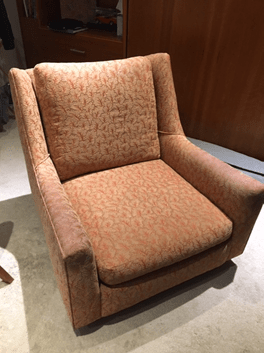
I didn’t know at the time that The Chair would move with me through all of the chapters of my life, including a divorce and a remarriage.  Recovered three times,  her last reincarnation (a rust and gold patterned fabric that cost a lot more than I wanted to spend) ensured that it would fit in with the bold colors that Dan and I chose to set off the ocean of quarter-sawn oak trim in our 1910 “four square” honeymoon house in Minneapolis.  We loved it.  It was the chair of choice for any visitor.  Our dog, Moxie, thought that he should own it (although officially banned from the furniture) and leapt up whenever we turned our backs….

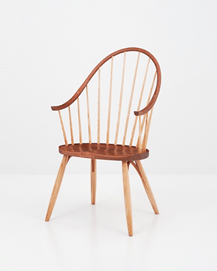
When Dan and I moved from a three-story house to a bright loft-like condominium, it never occurred to me to leave The Chair behind, although full shipping pods went to each daughter and we left a few other good pieces behind for the lucky new owner.  We knew when we moved her that she was in desperate need of another facelift.  For six years, she hung on, increasingly out of place in a loft that was otherwise furnished with Scandinavian antiques, Dan’s exquisite one-of-a-kind “art furniture” that occupied his dreams in the winter and his time in his summer shop, and handmade wood pieces from Thomas Moser’s Maine workshop, one of which I inherited from my father. 

The new dog, Kasper, loved The Chair as much as Moxie, our previous dog did.  Her arms acquired an increasing patina of permanent grime.  I shopped for fabric with our friend Laura, who held out the incentive of her architect’s discount. I couldn’t let The Chair go….and I couldn’t figure out how I could make her fit.

Then, somehow, things changed.  As I hemmed and hawed over The Chair, it became clear that she held too many memories (in addition to being huge and heavy) to carry with me as I moved into retirement.  She embodied too much past without holding a promise of what the future might bring.  And, all of a sudden, Laura said, “I know what you can do – send a picture to OmForme and see whether he could recycle it into a completely different chair”.   Omforme takes good quality old furniture and reimagines it and Laura was so intrigued with the possibilities that she used her deep dive into the online fabric sphere to score enough fabric to seal the deal.  And she loved the result so much that I gave the chair to her (she paid for the redo) – with the stipulation that I could visit.

Now, here I am in Boulder in a tiny rental house that we furnished from Ikea and Craig’s List, unable to get back to our Minneapolis loft until the “don’t travel unless necessary” recommendation is lifted.  I am trying to carve out a different life in retirement, where I live with fewer attachments to “old stuff”, whether it is a physical object or a professional persona that has become almost inseparable from what is just behind it. The world is in a frenzy, where my intense desire to reach out on Zoom to everyone who has ever meant something to me punctuates the relatively silence of our house. We have no way of predicting what will happen in the next few months, and I screen the competing voices seesawing between doom and “back to normal by fall.”

I sometimes think that I have two choices – hang on to what I have (relationships, hopes for the future…) or really try to live day-by-day, curious about what life-with-less will be like tomorrow.  But it is not easy to let go, although hanging on requires a lot of the mental energy that I could put to other uses.   And I am not even sure what is most important to hang on to. 

As for The Chair:  In this new and even more uncertain world, I am glad that you showed me that I could live without you.  So long good friend.  I needed to let you go but I won’t forget you — and I am glad that you are safe

Well Used and a Bit Broken but Beautiful….

I was thinking about our guest blogger Ruthie’s recent post and her reference to the Velveteen Rabbit – one of my top favorite children’s books.  Our granddaughter Opal is approaching three – old enough to be past board books and just at the right age to get the copy that we already bought for her.  Of course, the point of the Velveteen Rabbit is we become more alive because we have been loved, but love has a way of being tough on us.  Toys have their fur rubbed off – we accumulate wrinkles, sags, and rusty body parts.  Since I recently finished sending my grandchildren painstakingly designed and seriously customized digital Valentines, both aging and love are on my mind.  I think, in particular, of the glow in a picture of our somewhat older friends, Belle and Bob, as they held their great grandchild.  And, how just a few years ago, another young child looked at Belle and asked with great seriousness, “why are there so many cracks in your face?” – which caused her to laugh uproariously.  Love and aging, love and aging….

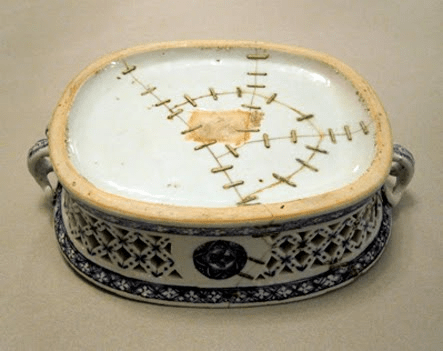
photo from Wikimedia commons

I remembered today that there is a Japanese concept that places greater value on a beautiful piece of pottery that has been broken and repaired than one in its perfect original form.  My Japanese is limited to a few phrases like arigato (thank you) and konichiwa (hello) so I of course had to look it up.  The word is kintsukuroi, and like most Japanese phrases, it thick with meaning.

The photo of an old dish shows how skilled artisans repair broken pottery with precious metals that accentuate rather than hide the flaws, an esthetic that is foreign to the increasing value placed on the new, the currently fashionable, and the disposable.

My own feelings about repairing and reusing are mixed, at best.  I like to say that I dress at a combination of finds from resale stores and art fairs where I get one-of-a-kind objects to put on my body.  I never throw or give the artwear away. Instead, if it starts to look dated, I take it to a tailor or just mix it up with something else.  An old secondhand designer jacket goes to Goodwill, however.  I think about the old-fashioned skill of darning a sock.  The last time I did that was probably 50 years ago, in a pair of socks that I knit for my father.  However, as a knitter, I know that the socks that I have lovingly made are cherished by specific feet, but are unlikely to be darned unless I ask for them back at the sign of the first hole (which would be viewed as excessively controlling by some of the recipients….). And I know a store where I can take precious hand knit sweaters to be repaired when the task is beyond my skill. 

Kintsukuroi makes me think about these habits and their limitations.  I never really considered why I cherish some things that are old and worn (for the stories and the memories – or because they are simply beautiful) while considering others to be disposable.  One writer claims “Kintsukuroi is a way of living that embraces every flaw and imperfection.  Every crack is part of the history of the object and it becomes more beautiful, precisely because it had been broken.”  Ahh, there is the Velveteen Rabbit again — and the connection between kintsukuroi and another Japanese concept, wabi-sabi, which sees beauty in transience and imperfection.  The esthetic of wabi-sabi includes an appreciation of “asymmetry, roughness, simplicity, economy, austerity, modesty, intimacy, and appreciation of the ingenuous integrity of natural objects and processes.”

While neither kintsukuroi nor wabi-sabi are immediately accessible to an American, they inspire me to not only “accept the things I cannot change” but to embrace them.  I know that age, brittle bones and wrinkles are part of becoming a real grandmother, as long as they blend with wabi-sabi’s appreciation of modestly, intimacy and the integrity of human life – part of which is aging (and dying).  The esthetic of loving well is not a visible one, but is enhanced by a mandatory shedding of the excessive vanity of my younger adult years.  Moreover, in the last few months, I have learned about repairing some of the injured parts of my right side in Avita yoga, which focuses on gradual healing from the inside out.  The shoulder that ‘froze” and the knee that suffered a bone bruise were treated in physical therapy, but Avita requires me to fully examine each tiny restriction and focus on release rather than a “fix”.  I feel as if I am applying gold to the broken bits in a way that allows me to feel the beauty of the repairs. 

So, armed only with the vague knowledge that the Japanese understand that becoming whole requires both letting go and loving the imperfect, I have been engaging in the process of emotional and physical self-repair.  Of course, I am left with the Western desire for more.  I am not jealous, but know realistically that I may not hold a great grandchild, since my oldest granddaughter is just turning 15 (and by the looks of it now, will take her own sweet time settling down…).  That makes me feel some regret that I didn’t have children until I was in my 30s.  When it comes to my face, I often stand in front of the mirror and pull back at my sagging cheeks, wondering what it would look like if I had a face-lift (which is, in essence, a mechanical “repair” rather than a new face….).  Nevertheless, I remind myself that imperfection, brokenness and aging have their own beauty if I can slow down and let it reveal itself.  

It Started as a Chat Between Friends…..

Two years ago, Dan and I took a grandparent trip to Paris and Normandy organized by Road Scholar. Aside from the pleasure of experiencing the world through 14-year old eyes, I became curious about the origins of Road Scholar, a non-profit organization committed to “knowledge seekers and explorers, united in the belief that lifelong learning is a vital part of overall well being..” Clicking on the Our Story tab in their website reveals that it started with a random conversation when two people at the University of New Hampshire were musing about the Scandinavian folketshusen that provide community-based adult learning and the value-for-money of youth hostels. Although it has evolved from its bare bones, learning-focused approach to travel for older people, it is still a non-profit that incorporates scholarships for those whose finances don’t accommodate much travel. 

This got me thinking about social entrepreneurs, or people who come up with new ideas whose purpose is making a difference rather than making money.

Last year I had the chance to catch up with my old friend Jan Hively, as she reappeared in Minnesota after giving a workshop at the Saging International Conference.  We were at a reception in a restaurant where I knew almost no one, although I felt as if I ought to know almost everyone because they were all roughly my age, long-time residents of the Twin Cities, and were in education or the helping professions.  Hmm…. Is this more evidence that my life is littered with missed opportunities for networking with interesting people?  Almost everyone that I talked to (once I managed to scrape myself out of my modest introversion) were (1) semi-retired or retired from a first career and (2) starting something new – often with others in the room – where doing good rather than making money was the goal.  In other words, I was in a crowd of what I could only call social entrepreneurs.

When you google social entrepreneur, however, you get a different view….the first links are degree programs in business schools and lists of successful social entrepreneurs who are also making money.  Now I have nothing against making money while doing good, but when you click on Forbes articles, you get a prominent definition that adds something new:  someone who uses business skills to solve social problems.  Those were not the people I met, few of whom had a background in business or were particularly interested in commodifying social good. 

It was not hard to find nuance when I probed my Google search more deeply.  The deep thinkers at Stanford University have come up with the insight that entrepreneurship “connotes a special, innate ability to sense and act on opportunity, combining out-of-the-box thinking with a unique brand of determination to create or bring about something new to the world.”   They go on, noting that entrepreneurs attempt to ““shift economic resources out of an area of lower and into an area of higher productivity and greater yield.”  What comes to mind are, of course, microloans to women starting small businesses in developing countries (which have proven remarkably effective in promoting gender equity)l  or the Global Soap Project that recycles semi-used bars of hotel soap to improve health in underdeveloped areas.

But what are economic resources?  Like most people, my first thought goes to money.  Then I quickly channeled Jan Hively again…

I have known Jan, an exuberant role model for successful aging, since the 1990s, when we worked together on programming and outreach for the College of Education and Human Development at the University of Minnesota. At that time, Jan, who was in her late-60s, was completing a doctorate looking at the contribution of older people to the well-being of rural communities.  Her work, which demonstrated that the unreimbursed labor of older people was critical to maintaining villages and small towns, whether as volunteers in school or at the library or babysitting for grandchildren so that their parents could hold down several jobs.  Jan drew on her work to create a Minnesota Vital Aging Network – which is now an international movement dedicated to grassroots engagement of older people in their communities.  Almost as if she were addicted to staring new initiatives, Jan went on to found SHIFT! , (an organization that provides support to boomers who are seeking employment, looking at retirement, or finding community), the Pass It On network, which is focused on peer learning for older people, and the Life Planning Network, which links professionals who support vital aging and provides professional learning opportunities to them.

Each of these organizations is non-profit, most operating on volunteers; none seem to genuinely meet Stanford’s definition because there is no significant monetary financial “yield”.  They are grassroots, locally organized and maintained, and are committed to growing interpersonal community as well as “doing good” and measurable economic value.  They are distinct from the business skills driven model and “yield” because they are, at their core, part of a challenge to redefine aging from inevitable but increasing diminishment (the current dominant and ageist perspective).  She, and other social entrepreneur “of a certain age” focus on how shared wisdom promotes a common good. 

Not everyone can be an older social entrepreneur with global impact (like Jan) but everyone can find a way to contribute to grassroots social cohesion. The premise – than small local actions can lead to large consequences – is particularly relevant for people who have more time than money.  People like me. Who knows how many new initiatives began at that reception, where everyone these was drawn to the vision of being part of that entrepreneurial social movement? 

‘Tis the Season

For some reason, I feel surrounded by people who love Christmas and revel in cookie exchanges, lights, and special dinnerware with seasonal themes.  They might as well have “it’s the most wonderful time of the year” tattooed on their foreheads.  I have a more ambivalent relationship with everything that commences after Thanksgiving and lasts until the holiday ornaments are stowed away in their special boxes…..

I should start at the beginning.  I grew up, as I noted in my decluttering blog, in a Swedish-American family where Christmas was elevated to the critical role of proving that the American had not crowded out the Swedish.  Unlike every other family that I knew growing up, Christmas Eve was the big event – the day when we brought in the tree and decorated it, where the “adult beverage” was glögg that my father made from a family tested (and highly alcoholic) recipe several weeks before. My mother worked all day to bake two kinds of Swedish bread (julekage and limpa), in addition to making a Julbord with Swedish cheese (no cheddar allowed!),  lutefisk (look it up – ugh), potatiskorv (a bland Swedish sausage), and a miscellany of other things to keep the traditions alive.  We made the four kinds of Swedish Christmas cookies (absolutely no red and green sprinkles) well ahead of time, of course, and served them up with a baked rice pudding.  NOTHING COULD EVER BE CHANGED or SUBSTITUTED – and as others have noted, all the foods seemed to have been subjected to a “whitening agent” so that no color deeper than beige was visible.  The American part was that Santa Claus came and the presents opened on Christmas Day. 

When I had my own family, my parents were always part of my holidays, and the Christmas Eve traditions continued unabated (much to my children’s dismay).  It was only after my mother died that, after a long consultation, we deleted the detested lutefisk and substituted fresh torsk (cod). I add, however, that because we lived in Minnesota we were able to get my father a takeout serving of lutefisk from a local restaurant…

Although I didn’t like the food very much, I always felt sorry for families who lacked the set-in-stone traditions that solidified their family identity. But life changes when the kids leave home, and they are able to make their own choices….And, with each year I “declutter” my holiday life by becoming temporarily willing to give up another tradition.  Try to buy potatiskorv in Boston or Boulder (although if we were genuinely serious, we could have made our own, Instead, my sister and brother-in-law created a kind of pork burger-with-potato that almost passed). 

Last week I was with a group of “women of a certain age” when the topic of “making it through the holidays” came up.  The person who raised it felt rather anxious, because she was traveling “home” to a family gathering that included both frail parents and alcoholic relatives who had, in the past, behaved badly.  She had already made a backup motel reservation…..

What an unexpected Pandora’s Box!  As each woman spoke about their upcoming holiday plans, there was a consistent theme:  Stress, low-level conflict, fatigue – and a sense that perhaps even the most vivid childhood memories of the perfect Christmas were less than truthful.  One chimed in that she had always disliked Christmas, but her husband loved it.  Recently married, they were traveling to another state to be with his parents in a retirement community.  She looked hesitant when she described the trip.  A third noted that, as an adult, she experienced Christmas as a time when people drank too much and were not always able to participate in the joyfulness that young children have when they see the lights and a stocking from Santa.  But it was Sue, whose quiet story put me into alert mode:  “My mother wanted everything to be perfect.  Our tree was decorated to the teeth, with every matching ornament perfectly placed.  The food was lovely, served on those special Christmas plates.  Her wrapped packages were works of art before we tore in to them.  And then, as soon as the packages were opened, she collapsed….”  What I recall from my later adolescence was the same:  My mother would go to bed starting around noon on Christmas Day, and we would not see her until late evening, as we munched on leftovers.  While I never went quite as far in trying to create the perfect Swedish-American Christmas, as she said that, I remember vividly how quickly my Christmas Eve fun melted into fatigue….

Sue has found a new approach:  Her husband makes a list of every Christmas light tour, pageant, special concert, etc. – and wants to do it all with her.  They experience joyfulness because they have removed the work to get ready, the travel, the strained family relationships – by sequencing experiences that are fun, but not exhausting—while staying home.  And whatever Christmas cookies they bake are ones that they like, and not those prescribed by tradition.

Part of my heart wants to cheer “Let’s try it – get rid of all of it except presents for the younger kids!  Eat Thai takeout on Christmas Eve if we want to!  Give the money we would spend on presents to the food shelf – or use it to take a real vacation!  Maybe if we did less we might even be awake enough to go to a midnight candlelight service (isn’t that what we should be thinking about?)”  But the other part (and I am split down the middle) screams “No!  Family is cemented when the holiday traditions are strong but a little flexible!  I really LOVE making stockings for everyone, and don’t want to stop!  We already have given up on making only Swedish cookies—isn’t that enough?” 

If I think Marie Kondo, I have to ask:  Which of the traditions makes me smile and brings me joy?  And, which could be adapted to a new generation – my grandchildren – for whom we all want to create a sense of being part of a special family time.  And who will tell the stories about the takeout lutefisk unless there is the smell of julekage to elicit it?