What is My Footprint?

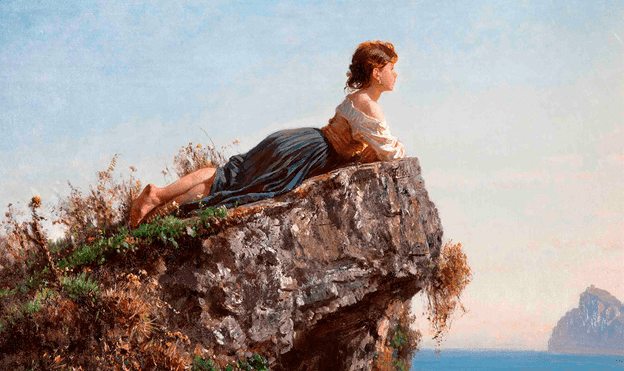
Fillipo Pallizi, Franciulla sulla roccia

Lives of great men all remind us
We can make our lives sublime,
And, departing, leave behind us
Footprints on the sands of tim
e

Henry Wadsworth Longfellow — A Song of Life

Geert Hofstede’s research suggests that striving for a life that will be noticed is fundamental to the American psyche.  And, in a big country, the longing is often equally big and broad.  From Patrick Henry to John Wayne, large and swaggering (and male) is what is noticed.  I saw myself in the narrative, but identified as a thoughtful visionary seeking a bigger world – like Pallizi’s romantic 19th c. portrait.  As I noted previously, my husband called this “International Karen” who, as frequently as possible, moved beyond contemplation to collaboration with people in other countries who also wanted to make their schools better. But, between Covid travel restrictions and a dwindling passion for experiences far from home, International Karen is coming to terms with the obvious:  the past will not be the future.  What is emerging is a different longing—to figure out how to leave smaller but still meaningful footprints.

Several years ago, some friends and I – (aka, The Retirement Biddies Workgroup) — read Sarah Susanka’s reflections on living a “not so big life”.    A well-known architect, she urges us to think about what really matters through analogies between designing a smaller home and designing a smaller life.  Some of her questions are relevant to anyone at any age:  How is what we are purchasing fitting in with what we need?  How are we using our resources?  When do we have enough?  But then, her zinger:  How have you wanted to change the world and how are you looking for related changes in yourself?  Her challenge suggests beginning with our biggest aspirations (do they come much bigger than changing the world?) and then look internally to see as if we are up to the task. 

But that question needs reframing in a life that has become radically smaller during Covid, while I am also busy considering a future that will inevitably be different from my expectations of a few years ago.  As I look at “international Karen” and cringe at the carbon offsets that I owe the world, I know that I could not go back, even if it were possible.  I pulled Susanka out of my bookshelf….

At a personal level, I have already made a commitment to a smaller life. A decade ago, Dan and I made a radical move from a rather large house to a condo, which was about the size of Susanka’s designs for a “not so big house”.  When The Retirement Biddies were contemplating the “not so big life”, Dan and I had given away many of our possessions, including furniture, books that we finished reading many years ago, and appliances that we rarely used.  We felt lighter and patted ourselves on the back, while filling every nook of our new walk-in closets.

But I was still working.  Although my home office was small, I had a bigger office at work for all the professional stuff.  The only question “not so big” question that had immediate resonance was a more thoughtful consideration of what we were buying. It was all about “the stuff.”

But now retirement-during-Covid is a reality, along with the unanticipated consequence of our decision to stay in Boulder, CO where we are engaged in a noble experiment: two people living peaceably in a 1000 square foot 1960s ranch that has only two interior doors that don’t lead to a toilet.  But this requires a different kind of decluttering.  The grand project of moving and starting over – just like those who are part of “the great resignation” or who have otherwise changed their lives in the last few years – requires a decluttering of the spirit and heart. 

The challenges are huge.  I have always been BUSY, largely with activities that are not essential. I  am easily distracted by emails or random thoughts.  I have never meditated, and have been totally unsuccessful at journaling because it requires discipline.  Since childhood, I have been unable to cope with boredom and have a long list of attractive projects that I can turn to if that awful feeling appears.  But these habits, some of which were functional when I was “busy working”, are now impediments.  In Susanka’s terms, I am unable to turn away from alluring “time clutter”. 


Clearing out the heart requires stillness – so different from concentration —  that does not come naturally.  I have taken a course on contemplative prayer.  I have read poetry out loud.  I have worked on a skill that never came naturally to me – listening to what other people are really saying rather than immediately generating a stimulating conversation.  I am even weaning myself off the computerized calendar that beeps too often, and writing out to-dos and appointments using a fountain pen.  More importantly, I am tracking a new habit – explicitly noticing, contemplating, and being grateful for something that is exquisitely beautiful, whether in nature (frost covered ornamental grass or snow on the Flatirons outside our house) or when making faces with a four-and-a-half-year-old.  And writing down a few of those things in turquoise ink.  I really love the turquoise ink. 

But what about changing the world?   I take heart in reading aloud Mary Oliver, who suggests that, at least for a poet, a large life can be inscribed through small acts: 

I don’t want to live a small life. Open your eyes,

open your hands. I have just come

from the berry fields, the sun

kissing me with its golden mouth all the way

(open your hands) and the wind-winged clouds

following along thinking perhaps I might

feed them, but no I carry these heart-shapes

only to you. Look how many small

but so sweet and maybe the last gift

I will bring to anyone in this

world of hope and risk, so do

Look at me. Open your life, open your hands.

Mary Oliver – I Don’t Want to Live a Small Life, Red Bird

To live a more open and intentional life, I need to consistently remind myself that small efforts, expanded over many committed people can make a difference in this world of hope and risk. I think of the years when I hauled dozens of yogurt containers to my office before my city started recycling – only to find out now that the containers were not actually recycled.  So, my Instant Pot and I now have a bi-weekly routine that involves yogurt making.  I find local issues that are pressing – affordable housing, unjust judicial practices, and the continued exclusion of the Native people who once owned this land – and find others who want to change them.  Goodbye International Karen:  You did good work and had fun.  Now I want to bring small gifts to the place where I live and to those I am with – and I also remind myself that large footprints in sand will be washed away.  

Is There Something Wild and Precious in All of Us?

Mary Oliver’s line, Tell me, what is it you plan to do with your one wild and precious life? seems to be quoted everywhere of late. It speaks of living a life of one’s own design, a design that unleashes the wild and precious rather than the banality of slugging through our days intent on keeping a roof over our heads and food in our bellies. It speaks of something wondrous that’s out there if we only let go of our need to conform and live from our true center, our spirit. 

Not too far into retirement I found myself often wondering what was wild and precious but dormant in me. My life was not exciting.  I moved between my own home, the library, the health club, my children’s homes, and the homes of friends, with an occasional trip out of town.  Not the stuff of wild and precious, of that I was certain. And here I was, free to find the wild and precious and live it.  

But how do I find that which lies dormant in me, that which yearns for expression in my life? Or perhaps I already have it, perhaps in the routine I’ve pressed upon my days. I suspect, however, that routine, while affording stability, suppresses experimentation about what might be dormant. . . and yet “a girl can dream.”

The dream went something like this. . .

She spent the entire summer dreaming of Wales. It made no sense, this yearning to leave her settled life, her children, her easy routine. Yet in her fantasies, it made all the sense in the world. She could start over, no, not start over but be born anew, without memory in a lush, beautiful place, where people speak in a language that she would have to learn—as a baby learns language from birth.

In August she booked her ticket.  She bought an enormous suitcase and packed it with her clothes. She told her children she was taking a long trip—how could she tell them her truth, that she sought a new land, a new beginning? How long will you stay, they asked, but she avoided the question. I’ll be back when I’m ready. . . 

The plane landed in Heathrow, not Wales. Wandering a bit felt right. Like Odysseus seeking his home, she sought a new home and an adventure on the way. Why had she brought such a big suitcase, she thought as she pulled it outside to find a taxi to the train station. What had she been thinking? But wasn’t that the point? To not think but to wander and live on the way?

The taxi driver left her suitcase on the curb, and she dragged it inside. The train timetable clicked with suggestions. Where in Wales should she go?  She settled on Llangollen—how many words have four “l’s”—“l” for living. She pulled the suitcase to the platform. She would need to drag it through two train changes, if she was reading the itinerary correctly. Maybe she should just leave the suitcase here. It was still baggage from her old life.  She could buy new clothes in Wales—Welsh clothes. But still, money was money, and she wasn’t sure how far hers would go in her new life.

The train ride was exhausting. For each of the two changes, she bounced the suitcase down to the platform and dragged it up and onto the next train. She slept when she could and stopped counting stations, staying awake just enough so as not to miss her stop. 

And the dream of a wild and precious life stops somewhere about here. . . 

Is this what it would be like? Is it real or an escape? What I wonder is whether and how we lose the will to live that which is wild and precious in service to work, family, security, and whatever else haunts us. Then, suddenly—and it seems sudden—we are retired, free but with baggage that we are reluctant to leave on the train platform, baggage that must be hauled up and down with every new step we take. And how do we reconcile baggage with possibility?

Image result for old woman with big suitcase

What Is A Death Café – And Who Would Want To Go Anyway?

A few weeks ago, Dan and I went to a Death Café – it was on a whim, because I saw it in a Barnes and Noble e-mail that I was in the process of deleting.  Also because I have been trying to live into Julia Cameron’s advice to have an artist’s date every week.  Planning anything a week ahead when I am trying to spend as much time as possible with Opal (our 20 month-old granddaughter) seems almost impossible.  She-Who-Rules has not figured out that adults are happier when the children in their lives have a regular nap schedule…in any case, why not go on the spur of the moment?

photo credit: Death Cafe

We had no idea what to expect, but showed up along with eight other people at the “Solarium” (a space with lots of windows next to the Pets section) in the back of the Boulder, Colorado B&N. Our volunteer facilitator introduced herself as someone with experience with both hospice and midwifery.  Beginnings and endings, her specialty.  We started with a brief introduction to the Death Café – who knew that this was an international movement, and that all over the globe there were other people participating in discussions about death on a regular basis.  If you don’t believe me, Google it yourself (https://deathcafe.com)– the first thing that pops up is “Welcome to Death” followed by an invitation:  “At a Death Cafe people drink tea, eat cake and discuss death. Our aim is to increase awareness of death to help people make the most of their (finite) lives.”  Today, as I write this, I could attend one in St Luis Obispo or Quezon City in the Philippines.

How odd – my first thought – how can this be so popular?  Why does the idea of meeting with strangers to talk about death have meaning from Lake Forest, New York to Goteborg, Sweden (oddly, as we entered, I passed by the popular book, The Gentle Art of Swedish Death Cleaning, by Margareta Magnusson).  So I sat feeling intrigued but somewhat detached, observing the people sitting in the circle with Dan and me with interest.  Across from me were three older women (in other words people roughly my age!) all looking very Boulder.  That means middle class with tiny efforts to be a bit offbeat – a purple streak through gray hair or an embroidered vest.  There was a couple who appeared to be about 50, and next to me a very large man of about the same age, who made it clear that he had come only because he was asked by the facilitator.  A rather sad looking woman in her sixties arrived late, and positioned herself slightly outside the circle, although we made every effort to rearrange the chairs. 

So why had they come?  We began by offering up our reasons, some of which (like mine) were curiosity, others because they had recently experienced a death.  One was still trying to make sense of a loss many years ago of a beloved brother; another because the passing of her sister made her aware that there was no one left in the world who knew her as a child. No one there was ill or recovering from a serious illness.  In fact, we all looked rather vital….

I opened, saying that I was coming from curiosity – wanting to try new things – and because the last year had been full of deaths and skirmishes with death for multiple friends.  By the time we finished with our offerings – what drew us, what our experiences were with death –it felt as if we were part of an intimate circle.  The feeling of instant membership was odd—I can’t think of another time when I have entered a group of strangers and felt so quickly as if I belonged.  Also, the often-noisy Judge in my head – the one that edits what other people are saying while they are just beginning to formulate their thoughts — was surprisingly quiet.  What people talked about silenced The Judge – it was as if the topic of death encouraged a level of intimacy that you would never find in other settings. 

The 50-year old man talked (at great length) about the paradox of watching his brother suffer over several years and the joy of seeing him become increasingly spiritual and at one with his life.  We talked about acceptance – one of my mantras – we talked about the experiences of being present with someone who was dying.  We talked about whether we wanted a death surrounded by loving relatives or whether, in our deepest heart, we wanted to be alone on the journey.  One woman – the only one with any apparent attachment to an image of afterlife – was very positive that she would be reincarnated – and that she would retain a great deal of the knowledge and experience that she already possessed.  No one else seemed to be certain of anything except that the idea that dying filled him or her with awe.  Only Cat, the 50-ish wife of the man whose brother had dies some years ago, said little.

So we were there for well over an hour.  Dan and I left feeling that it had been a remarkable experience.  Why can’t we find this level of connection without having to confront death?  What is it about a Death Café that promotes connections when other conversational opportunities do not?

Photo credit: Death Cafe

Postscript:  I drafted this early last spring when I was in Boulder, Colorado – escaping harsh Minnesota winter for a milder version. Looking back after six months, community seemed to surface from a collective experience that was simultaneously anonymous and intimate.  We were there for remembrance as well as being open about both the wounds and healing that we experienced individually.  If you want to be part of this, you can:  The website says, “People who adopt the model set out in our guide are welcome to set up their own Death Cafes. So far we’ve held Death Cafes in 65 countries.”  I think that I will take them up on the invitation….

Stumbling onto My Calling

I always envied my second husband, Gary, and my sister, Marylyn, because they each had a clear vocational calling. In eighth grade, Gary had to write a report about a career. As he loved to tell it, “I chose city planner because it had the word ‘city’ in it, and I wanted out of Danville, Iowa so badly.” He went on to a successful and driven career in city planning and urban development. Marylyn’s first job was shelving books at the Racine Public Library.  Within a few months of starting the job, she announced that she wanted to be a librarian. She worked summers full time at Western Printing, saving her money to go to the University of Wisconsin and become a librarian.  She reluctantly retired at age 76 from her job as head librarian at the veteran’s hospital in Florida.

          When I read Karen Rose’s piece If I Don’t Know My Purpose, Am I a Retirement Failure?I began sorting for myself the difference between purpose and calling, words that are bandied about in the retirement literature along with reinvention—all of which I believe are related. Purpose has always been nebulous to me. It’s some big thing out there that others have but I don’t.  I always wonder when I try to ascertain my purpose, isn’t it enough to keep living? But a calling is quite like it sounds, a sense, an intuition, or voice—you know, that call from the great beyond—that compels us to do something, like be a city planner or librarian or take quiche to a friend (A Soul on the Move). It might compel us to be something, more compassionate, more frugal, more generous. A call might move us towards something or away; it might ask us to commit.  A calling can also evoke a feeling of being led, being drawn ahead in some way.

I must admit that I’ve never felt a vocational calling, I definitely stumbled into becoming a teacher. After changing majors every semester in college, all the while playing as much golf as possible, I realized that if I wanted to spend my summers golfing, then being a teacher was the way to go. So I became a teacher almost by default, but the minute I stepped into a classroom, I knew I was where I belonged. You might say I “stumbled” into where I belonged.

I didn’t worry too much about having a calling after that, but when I became an assistant professor, that’s when I really wanted a calling, what the associate and full professors, who’d arrived in my estimation, said was a “research agenda,” something every professor needed to be successful. I wanted to be like them and like Gary and Marylyn. But I could never fix on either a calling or research agenda that carried me more than a few months, even though I prayed, searched, journaled about finding one, and read everything I could about careers and callings. Then I remembered advice that Gary used to give me: “When you’re stuck, throw stuff out, and see what sticks.” He had a talent for “throwing stuff out and seeing what stuck.” I eventually stopped searching and went with what showed up and seemed to stick. Stumbling along but still listening for that big voice from the sky. Looking back, I landed on meaningful projects, projects that “stuck,” with passion growing along the way.

          Then, as I’ve keened and wailed about before in this blog, along came retirement and what I call its stages:

Karen Martha’s Retirement Stages

  • Panic;   What have I done?
  • Denial     As in get re-involved in work, be a consultant;
  • Flight    There’s always travel;
  • Acceptance    See it with a new lens, and . . . dare I say;
  • Transformation   Away I go!

Right now I’m in the acceptance stage, looking at the days ahead with a new lens, a different lens than that of work, a lens that focuses on what’s going on inside me. Nevertheless, even with my new lens, I’ve not experienced a “calling” for how to use this incredible gift of time, reasonable security, and health.

In response to Karen Rose’s blog about purpose, one of the respondents wrote: we can think not just of ourselves and what gives us pleasure in retirement, but of what the world demands of us.  Many of us have the luxury of time—and perhaps we can use this luxury on behalf of something larger than personal satisfaction in retirement. She’s talking about calling with a capital C—the big call to change the world. Most of our calls, however, are as Greg Levoy notes: the daily calls to pay attention to our intuitions, to be authentic, to live by our own codes of honor (p.5). I believe Levoy is right, at least in my case, most callings are in the everyday of my life. I tutor math at the local middle school. No one asked me, I sought it out because it seemed I might be helpful—it came from within. I am learning rosemaling—I’ve always liked to make things. Now I have time, and I’m writing, this blog and other pieces. Not the big C, but it all feels right.

In a way it goes to purpose, because I’ve come to see purpose, at least for me, about living as authentically as I can and doing the soul work that supports an authentic life. Purpose notwithstanding, I’ll never stop hoping for a big C calling. Meanwhile, I’m stumbling—no, that’s not fair—lightly tripping along in the acceptance stage, seeing my days and life with a new lens, open to “what shows up.”

I don’t ask for the full ringing of the bell. I don’t ask for a clap of thunder. A scrawny cry will do. —Wallace Stevens