My Perfect ‘Little p’

Lake Harriet Community School

If you’re someone who’s followed this blog, you know that ‘little p’ refers to one of those small purposes that each of us carries out daily, purposes that make families run smoother, make people feel loved, and spread kindness. Things like volunteering at a book sale to raise money for scholarships, preparing and serving lunch at church after a funeral, and making sure family members have a good day. These are not grand purposes, but incrementally, they make life better.

A common ‘little p’ is volunteering. Although it’s almost a cliché to say that when we volunteer, we get more than we give, I have to indulge that cliché when I talk about tutoring, my ‘little p.’ I definitely get more than I give.

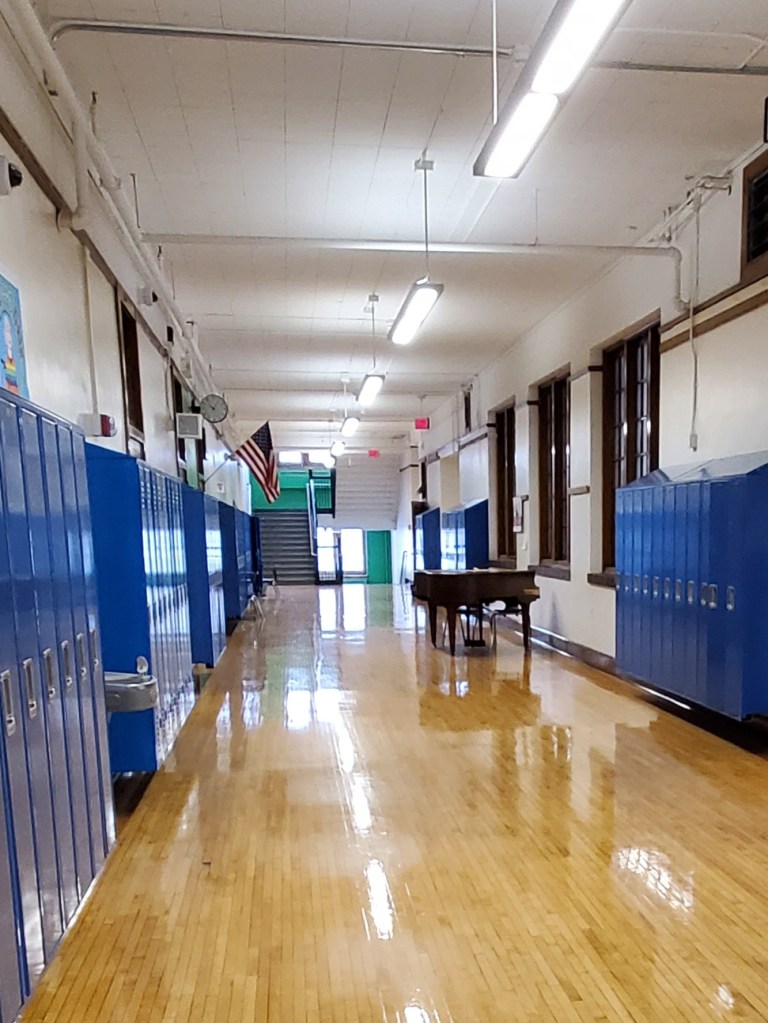
I have the perfect tutoring gig—four mornings a week at a nearby school in Minneapolis where my son is the principal, Lake Harriet Community School. It’s a small school, grades 3-5, and a highly successful school—a Minneapolis Public School that ranks 4th in the state. It’s also over a hundred years old, with shiny wood floors, heavy oak doors, windows, and woodwork, and tired classrooms, even though they’ve been kept up well. Like many districts, currently, it has children who were in primary school during the COVID shutdowns, and some are not ready for grade level work (we are avoiding calling them “behind.”). One way schools are addressing the needs of these children is through tutoring. That’s one reason I’m tutoring, specifically in math. The gift to me is that I AM NEEDED.
I tutor three small groups and then I help in a classroom. I’m on my feet for three hours, and on my toes mentally, even though it’s basic mathematics—in my day we called it arithmetic. Mathematics is not being taught the way you and I learned it or the way I taught thirty years ago. Now arrays are used to teach multiplication; children learn properties like commutative and identity; and algebraic thinking is introduced in first grade, etc. Clearly I must stretch mentally and find ways to teach new ways of doing arithmetic. That’s my second gift—keeping my brain challenged.

Then there are the obvious benefits, tutoring gets me out of bed and cleaned up early in the day; it gets me moving in natural ways rather than going to a gym; and my favorite, tutoring gives a purpose to my days.

Like other things we do in our mostly small lives, tutoring, at first, felt insignificant. I initially labeled it a feel-good way to spend some of my time in retirement. (By now you know I’m a hopeless cynic). I mean, how much difference can 2-4 hours a week make in a child’s mathematical growth? But to be an educator—which I am—is to believe fervently in small steps, small miracles of understanding. So, cynicism notwithstanding, a part of me believes what I do matters. I’m a caring adult in these children’s school experience who believes in them and supports them.

Yesterday, the impart of tutoring was resoundingly brought home to me. It occurred in the 4th grade class where my role is to hang out and help as needed. I’m the right hand “woman” to the teacher, who is especially creative and commanding when she teaches. She often starts the class period with a video that gives an example of kindness. Here’s a link to the video she showed yesterday. I urge you to watch it before you read further.

Please Enjoy before You Read On!

After viewing the video, the teacher asked students what was going on, what was the video about. Why were some residents in the nursing home tearing up? It took some time for these ten-year-olds to stop focusing on the gifts and to think about what was really going on for the residents. But they got there. As one little girl put it, “She showed that she cared about them.” That led to a discussion about loneliness. I’m not sure that all the children understood, but it was one of those small steps of learning.

For the remainder of the class we studied what to do with a remainder in division. That was fun and equally challenging. In my car on the way home, I reflected on the class in the context of the video. And suddenly I felt it, the biggest reason I tutor—I feel like I belong! I belong to this one classroom, to the other teachers I support with small groups, and in this small school. Best of all, I belong in a world that I care for because I know what individual children need.  I am doing my part to make this place and their lives better in small, incremental ways. 

If you want to find out more about Ruby, here’s her website:

https://3wishesproject.org/who-we-are/

Pause?

Photo by Ashim D’Silva on Unsplash

Several weeks ago, I attended a contemplative writing session with Reverend Karen Hering, whose skill at eliciting new thinking always amazes me.  That evening, however, I  found myself befuddled by her first question:  When have you paused? . 


It took me several minutes to think of any time when I have paused in a memorable way.  During most of my life, I embraced the ideal of being busy, being of concrete use to other people, and, above all, being productive in a way that could be counted.  Like many (most?) women, I found it hard to say no, which meant that both at work and in my personal life, I was often overloaded, constantly prioritizing which obligation would get the most attention at any given moment. 

Vincenzo Campi, Christ in the House of Mary and Martha, c.1580

I

I reveled in the research suggesting that multi-tasking is a female superpower…. 

In other words, there were few pauses.  As I scrolled through my past life, my first hit responding to Karen Hering’s question was the last month of my first pregnancy:  It was a torrid August in Massachusetts, and I was not working, largely immobile, and waited on by my husband.  However, it was less a pause than a period of intense anticipation.

A few days later,  I smacked my head and remembered that, as an academic, I had regular long sabbaticals, whose purpose is, in theory, a time for renewal and reflection, to live fully in the ideal of the Torah:  “…in the seventh year shall be a sabbath of rest unto the land, a sabbath for the LORD: thou shalt neither sow thy field, nor prune thy vineyard “ (Leviticus (25:4-5).  But in the modern university, that ideal is as far from reality as the typical observance of the Sabbath as a day of rest.  Instead, when I  filed my sabbatical plans with the university, they included writing, data collection, and a projection of the usual output of publications, research proposals, and  new course syllabi. 

It is obvious that the usual American vacation – one or two weeks, crowded with delightful activities – may provide novel adventures but hardly qualifies as a pause….

The expectation that we should be doing something useful barely shifts when we retire, as we are urged make and then to work down our “bucket list” of experiences that we have been putting off.  And don’t forget the podcasts and books urging us to find a new purpose that will keep us sufficiently busy that we don’t sink into a Laz-e-Boy with a TV remote and a glass of wine.  But there are equally pervasive expectations that we should build yoga and meditation into our schedules.  Pausing has become a big business, especially for we retirees, who are also urged to remember that aging is expected to bring sagacity and spiritual growth

Photo by Amanda Jones on Unsplash

But these mixed cultural messages beg the real question that has nagged me since my disquieting evening with Karen Hering:  Why pause?  And, in my case, how to recognize “pause opportunities” rather than additional programmed obligations?

I thought about my recent efforts to do anything that might lead to meditating.  Long ago I read a book about different forms of meditation – I can’t remember much except that it gave permission to apply the label to almost any practice that clears out incessant to-do messages.  It remains my goal rather than a scheduled event most days, and when I decide to take a break, I try something.  Most of the time I successfully reduce my creeping anxiety about the to-do list, but I am also occasionally startled by an insight or a feeling that emerges not out of thinking, but out of emptiness.  I am willing to call those insights accumulating wisdom, even if I can’t easily name them.

Then there is the unanticipated stop-in-your-tracks that occurs as I practice reading slowly,  a skill that atrophied during the years of skimming piles of student papers with red pen in hand.  When I encounter an unexpectedly beautiful sentence, or a poem that just appears when I pick up a book, I sometimes feel my heart beating faster.

And there’s the  benefit of having a young child in my life who has  not digested the ideal of productivity.  To walk around the block with a four-year-old can take an hour, because it is in her nature to pause.  New flowers (or weeds) blooming (“What is that one called?  Smell it!”),  A bug eating a leaf (“it’s so blue!”).  Yards with intriguing ornaments, whether kitschy or real art, that are always worth re-examining.  When I feel today’s time ticking away, I remember how quickly four-year-olds turn in to teenagers and adjust my adult cadence to her desire to observe intently, with no real purpose in mind. 

— Jimsonweed, Bandelier National Monument

Sometimes I think that my granddaughter is channeling Georgia O’Keefe:

Nobody sees a flower really; it is so small. We haven’t time, and to see takes time – like to have a friend takes time.

So, if pausing is a value that I am starting to savor, what knot does it unravel other than being, for a moment, less engaged with busy-ness?  Yannis Ritsos suggests that these encounters with the intangible may be fundamental to my evolving consciousness:

I hide behind simple things so you will find me….

Every word is a doorway
to a meeting, one often cancelled,
and that’s when a word is true: when it insists on the meeting.

As I read this, I am aware that it is not big planned or anticipated pauses that give me the greatest joy, but the small ones that knock on my door—and then ask me to change. Ordinary time is suspended in wonder and, as Ritsos claims, becomes an opening to the “thin places” where I am able to experience life beyond that which I can touch.  When I meet a sense of communion with a granddaughter or friend, a feeling, a nascent idea, or a burgeoning of love, perhaps I am simply experiencing a flow that cannot be programmed.  The real problem solved is the (re)cognition that much of what I value most at this stage in my life is not planned, but experienced – often as a pause.

BEGIN AT THE END?

Planning is only the ego’s decision to be anxious now. ~Hugh Prather, Notes to Myself

Beginning with the end in mind is, for many people, the 13th commandment.  It is the second of Franklin Covey’s “7 habits of highly effective people”  and assumes that we need to be goal directed.  One business consulting website, for example, argues that each person needs to be able to articulate what they want but also:  What is the purpose of what I’m trying to achieve? What outcomes do I want? Why are these outcomes important/valuable?  While it appears that we are being asked about our principles, the underlying message is that effective people lead their lives according to one or more value-driven plans. But I don’t have such a plan and I never have had one.  So where does that leave me? 

Of course my assertion that I lived a goal-free life is an overstatement.  One example:  I knew early – before college — that I wanted to work with people in other countries.  I had no firm idea of what that would do for me but felt a persistent curiosity about places where assumptions about “how we do things around here” were different.  So I worked tirelessly to find opportunities, especially those where someone else might foot part of the cost.  My efforts worked out well:  I met many people who are still important to me and never felt that my time in strange airports and out-of-the-way countries was wasted.  But the goal of becoming what my husband calls “International Karen” was vague, guided by questions about what I might learn and how that might change me.  It required instinctive rather than logical responses to opportunities. Being curious helped when I accepted (for instance) an out-of-the-blue invitation to review a teacher education program in Azerbaijan, a country about which I knew almost nothing (another “I work for airfare” opportunity).   Paul Coelho asserts in The Alchemist, “When you want something, all the universe conspires in helping you to achieving it”.  But every encounter increased my questions and my longing rather than a sense of closing in on a goal. 

Longing for something (like becoming  International Karen) is not the same as having a goal.   A defined “end in mind” has some clarity, but longing is, for me, often shapeless and imprecise, shifting with accumulating experiences.  And that has become more so as I get older. 

I still long to live in another country (again) but need to balance that against the fact that Dan, whose company consistently grounds and delights me, does not share that longing.  I have a persistent fantasy about a tiny home in Georgia O’Keefe’s scrubby New Mexico landscape, with its unique amalgam of Gringo, Spanish, and Indigenous cultures, but am reminded that living hours from good medical care is unwise, much less coping with the an off-the-grid lifestyle and the lack of neighbors.  I play with more realistic versions of one aspect of this longing–silence and a particular kind of nature–in a glamping version of Nomadland.  Then I remember that I want to spend more time with my grandchildren, who are neither silent nor located in New Mexico. 

In other words, the inherent dilemmas between the experiences and relationships that I want are increasingly apparent.  As my wise older friend Larry often said, “I can do almost anything I really want, but not everything I really want.”  Longing is an element of my primal need to keep reshaping my life, balanced against other realities. I must keep examining my longing and what it is telling me….it is a voice speaking to me rather than having an end in mind.  I may long for multiple, incompatible futures, knowing that they express something of my heart’s desire.  But I only need to think about the more near-term future, which may mean trading off Nomadland in New Mexico for Christmas with family in Boston.  But longing is also never satisfied; there is no end to most of my dreams.  When I published my first book, I didn’t achieve an end – instead I peered into a whole new world in which I could think about and use words in ways that would give me pleasure (and maybe do something for others as well).

There is another, but decidedly non-Covey approach that is increasingly appealing as I (finally) exit an intellectually and spiritually engaging career.  I hinted at this when I wrote about my friend Barb’s work on choosing joy as a key to successfully negotiating the last 1/3 of life.  In my mid-70s, I am aware that realizing longing—turning it into a goal and a plan–is constrained by the unknowability of what the future holds and how that might reshape what I long for.  But I can choose which emotions I want to experience regularly.  Joy may be a bit exaggerated for someone who is Swedish-American to the core, but I can consider the meanings that the word evokes in me:  Happiness.  Flourishing. Engaged. Useful and not used up.

The past two years made it apparent that the next step is often revealed by unanticipated (and even unwanted) “opportunities”.  Most of us existed with a simple hope that a year-and-a-half of chaos and inability to plan for anything, including dinner with friends, would end. But it is complicated. In the waning phases of my paid work, someone recommended that I become a life coach.  Intrigued, I did my homework and consulted with friends who combined coaching with their research and teaching.  Seemed like a no-brainer and clearly a plan:  I could develop a small life coaching “business” as part of my retirement.  But I have not, in part because of COVID, in part because we moved away from my networks, and in part because I found opportunities to use what I learned in ways that that I did not anticipate.  I am not interested in being an entrepreneur.  Do I feel that I have been unable to achieve something I wanted?  Absolutely not:  Instead, I see the many ways in which coaching has just become part of how I live in relationship with others.  It changed me without becoming a goal.

I am beginning to understand that my inchoate and often unarticulated curiosity, imbricated with  longing and constraints,  conspire to help me to define “opportunity” more nimbly and make choices guided by something that is more instinct than intellect.  I admit that my mostly goal-free and mostly “successful” life has been a gift – and  try to appreciate the last lines of Robert Frost’s poem, Acceptance (which I will never fully live into):  

Let the night be too dark for me to see
Into the future. Let what will be, be.

iStock Photo

Who Is the Old Lady Directing This Circus?

vintage photo

A week ago, I sat in a zoom circle organized by Jenny Antolak to reflect on a problem endemic to almost anyone over the age of 30:  We have been so busy growing up that we have often forgotten how to fall in love with our lives.  Jenny directed us to Shel Silverstein’s remarkable poem, “Growing Down”, which starts with a description of Mr. Brown, “the grumpiest man in town” who constantly hectors children to grow up, but ends up learning from them:

He got his trousers torn and stained,

He ran out barefoot in the rain,

Shouting to all the folks in town,

“It’s much more fun, this growin’ down.”

As we shared about the rules we followed in order to become successful adults, I confronted my carefully nurtured self-image as a bit of a rebel and a rule-breaker.  Sure, I made some career choices that were “risky”, leaving a plum job at Tufts University to go to a soft-money research institute, and later making a decision to detour from an obvious path to higher administrative positions in order to become a “regular” faculty member – but those were within a game where I knew all the rules and which ones I could break with no consequences.  More often I made careful and conventional choices that were “adult” and “responsible”, in marriage, in work, in friendships and other commitments.

But, while recovering from a divorce that my then-husband and I had avoided for years (those rules– “until death do us part”), I fell in love with someone who, before we were even sure that we were an item, asked me to join him in a spitting contest on the porch!  The silliness of it blew me away – as well as the utter charm of being childlike in my mid-50s.  When we married, I included in our vows his obligation to make me laugh every day.  No problem there, but on the outside, I still held on to the persona of someone who had been handed the playbook of life and had memorized it.  And I wanted to look it.  I colored my hair.  I wore eyeliner.  I bought my clothes at the American Craft Council shows, not at Macys.  And of course I had the black dress (or pants and top) to show them off.

Fast forward to retirement…when all the rules could change because we had played by the careful financial planning rules for middle-income professionals. But then there is a new script – the script for aging gracefully from the New York Times. Horrifyingly, it starts not with social skills or running barefoot in the rain, but with buying a hearing aid sooner rather than later and making sure to give up your driver’s license before, rather than after, an accident. 

Another article also triggered me, reporting that The Villages, a retirement community in Florida, has grown to more than 150,000 residents–with a 10 page list of rules governing residents.  Could Mr. Brown learn to “grow down” there, or would he be tied to an art class at 10, golf at 1, and cocktails at 5?  The behavioral rules of aging tell us where we want to live, what we should wear (read any woman’s magazine, which has hair and clothing suggestions tailored to age….), what to eat, how much to exercise, and repeatedly urge us to stay socially connected (once we get the hearing aids that allow us to…)

What happened to “When I Grow Old, I Will Wear Purple”, and Jenny Joseph’s 1992 warning that,

I shall sit down on the pavement when I’m tired
And gobble up samples in shops and press alarm bells
And run my stick along the public railings
And make up for the sobriety of my youth.
I shall go out in my slippers in the rain
And pick flowers in other people’s gardens
And learn to spit.

Jenny argues for joyful silliness and breaking rules precisely because we are old enough to realize that we could always have gotten away with it – but were too cautious (or forgot).

Karen Martha laughed when I mentioned this, recalling that, when she recently complained about loud music in a coffee shop, her granddaughter (who happens to be our blog’s technical assistant) looked at her and said, “you usually don’t act like a grandma, but just now you did.”  Ooph – a 2X4 to the side of the head to remind us that it’s ok to ask for a quiet table in a restaurant when we are out with our 70+ year old friends, but not ok when we make it into a rule.

Which also reminds me that my 16-year-old granddaughter was invited to see Chicago by a friend’s grandmother.  The kids assumed that they were going to see a local production of the musical.  When they got there, it turned out to be the band  by the same name—at least some of whom are septuagenarians.  They had a blast listening to the songs that rocked our world when we were in our 20s!  Now that’s an astute grandma.

We are still part of the circus of life. So, every circus has lots of rules – they are there to govern the safety of the performers.  However, the performance needs to ensure that the audience is only aware of the magic and not what keeps the circus functioning behind the scenes.  The behind-the-scenes rules for those of us who wish to age well while “not acting like a grandma” is to pay attention only to new rules that keep us safe (if your knee suggests that a cane will keep you from falling, use it!), while ignoring the rules governing old people’s behavior that are designed to keep us invisible.  Even more, can we celebrate everyday events that suggest that we, like Mr. Brown, are growing down rather than growing up in the way that modern memes of aging expect?

I remind myself that the circus—especially Cirque du Soleil and its more modest spinoffs –  is magical because it pushes us to think about our humanity beyond our usual imagination.  For me, that will translate into more humble efforts: Getting down on the floor to play with a 4-year-old (my knees remind me that it was a lot easier with the oldest grandchild, but I can still do it).  Or remembering to have another spitting context.  Or sometimes just doing whatever equivalent of running in the rain strikes me.  I am reminded of the last lines of Brittany Spears’ song – prescient as the voice of someone who was forced to play by other people’s rules for much of her life:

Don’t stand there watching me, follow me, show me what you can do
Everybody let go, we can make a dance floor just like a circus

I guess that I am the ringmaster here….

–photo of t-shirt from The Old Ladies Rebellion