In Praise of Postmenopausal Women

There are lots of jokes about menopause. 
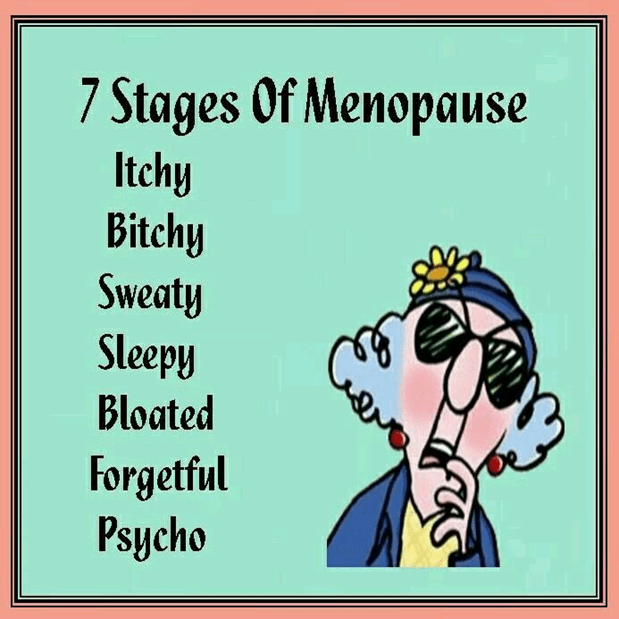
There are no jokes about post menopause. 

Is that because we have internalized scientific reports summarizing the negative consequences of losing estrogen?  Weight gain, bone loss, heart disease, depression, and desiccated vaginas…How can you make that funny?  Recent debates about “childless cat ladies” suggest that the social consequences of not being able to procreate may be even more severe:  isolation and invisibility coupled with a lack of usefulness. 

Men, on the other hand, are still producing sperm when they die.  

Social science tells a different story, emphasizing the role of older women in supporting the next generation, as well as caring for family and community members.  Older women are willing to translate emotional caring into action on a daily basis, an image that even the most traditional sexist male can support.  But let me take this in a different direction: Society NEEDS us, and not just for the most traditional roles. 

Start with my friend Jan Hively, whose Ph.D., finished when she was almost 70, investigated the productivity of older people who lived in rural areas.  Asking what they did in their communities allowed her to estimate what it would cost to replace them with workers.  The answer was: A LOT.  Meaning that most rural communities would wither if it were not for the unpaid (or underpaid) work of older people, from volunteering in the library, driving school busses, and taking care of even older relatives. And older women are more likely to work and donate unpaid work than men. 

Jan’s mantra was “meaningful work, paid or unpaid, through the last breath,” and she lived up to it. She was an activist and social entrepreneur. In the early 2000s, as we boomers started to retire, she urged us to think of our last decades as an opportunity to make a difference and not a time to drink martinis, watch TV and play golf.  In her 70s and 80s, after finding her tribe of co-conspirators, she went on to incubate or co-organize many non-profit organizations to increase the opportunities for older people to improve their own and their neighbor’s lives.  New and existing organizations drew on her never-ending flow of ideas about positive aging; two that she co-founded have grown into national and international initiatives: The Vital Aging Network, and the Pass It On Network

And her second admonition was to have fun working with others! She knew that her strongest skills were imagination and starting things so she collaborated with people who love making the engines of a new enterprise run fast and smoothly.  Another wisdom of age:  we often are more aware of who we are – and are happy to turn over control for the work that suits us less well.

At 90, Jan wrote long notes to the people who were important in her life and work, including me – I was humbled because I always thought of her as my mentor – I was a youngster in my mid-50s when I served on Jan’s doctoral committee!  Like many who knew her, when I find myself “sitting on the dock of the bay, wasting time” I hear Jan’s voice urging me to make those reflective moments pay off, either for my own development or someone else’s. 

But Jan, although personally inspiring, is not the only one with creative suggestions.  I am taken with the idea of the “granny cloud,” which emerged from Sugata Mitra’s efforts to educate children in places where there are no teachers (or not enough of them).  The role of the grannies (real ones and people trained to think like them) was to admire and encourage children in learning – which turns out to be critical.  The powerful effect of being a granny is to reinforce curiosity and motivation.  The international granny cloud volunteer network was derailed by the global pandemic – but grannies will be there in force as we continue to re-imagine social networks in the post-Covid future.  I think that men can learn to be grannies, but they usually need some immersion training….

How about the League of Women Voters, founded in the exuberance that accompanied the passage of Amendment 18 in the US?  Relying almost exclusively on volunteers, the League continues to see its primary purpose as protecting democracy through policy advocacy and direct efforts to increase voter registration and participation.  Its membership, which declined with the increase in working women, is soaring again as the gray tsunami looks for ways to work – paid or unpaid – as long as possible. If you attend a League meeting, you will see that post-menopausal women are at the forefront of promoting non-partisan policy debates – including sponsoring events like Bad Ass Grandmas for Democracy.

Contributed / BadAss Grandmas for Democracy

But the role of post-menopausal females in sustaining community and providing intergenerational continuity is not just for humans.  Recent research claims that “Post Menopausal Killer Whales are Family Leaders,” who support the pod’s health by finding food sources.  And who can help but watch, with fascination, the video of the 60-year old Orca, Sophia, taking down a Great White Shark, top predator of the ocean, who was probably threatening a member of her community.  No jokes needed – just attention to the evidence that the world needs postmenopausal women warriors.  Who cares about a few weak, old sperm – lots of those to go around – in contrast to keeping us all safe, fed, cared for, protected, on the right bus, and registered to vote?

Photo by Valeria Nikitina on Unsplash
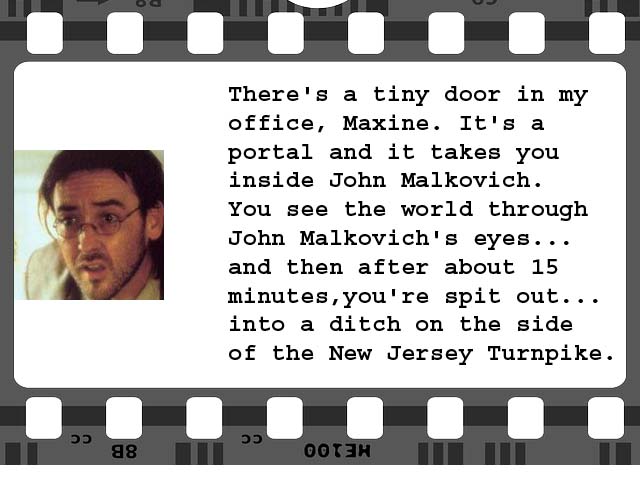
Through a Tiny Door….

https://www.whatascript.com/image-files/movie-quote-being-john-malkovich.jpg

My children and I disappeared down the rabbit hole with Alice and into a parallel world through a closet in The Lion, the Witch and the Wardrobe, while in the surrealist comedy, Being John Malkovich, a door leads John Cusack’s character into the eponymous actor’s mind.  But not all portals are doors: Peggy Noonan claims that, when she read War and Peace, she “entered another world”.  According to Arundhati Roy, the Covid pandemic should be viewed as a portal to a changed reality. In all of these, a portal is metaphor for an insistent call to experience the world differently.  Most people have had at least a brief glimpse of déjà vu, where you know, absolutely, that you are in a situation that you have lived through before…a portal. 

We can hunt for portals, but they usually appear by chance. I had that experience this week as I dropped a small pen and ink drawing off at a framer’s shop.

East Heath Road–Google Maps

The drawing is of a street in Hampstead, London where my parents and sister lived in 1965-66, and where I joined them during the spring of my junior year of college.  I bought it several years later when I was again living in London and wanted to get my mother something special.  Then I didn’t  think about it until it ended up in my possession after she died.

But when the door of the fame shop clicked closed, I panicked.  No picture of the drawing?  Had I left it with a perfect stranger who would be holding it for two months? Racing to my next stop (which I distractedly drove past), I was struck:  the drawing was an unacknowledged portal to accumulated experiences that shaped my life. 

My excuse for leaving college was to research a senior thesis – on the improbable (invented) topic of the influence of the Spanish Civil War on the British Communist Party. I managed to secure access to the old British Museum Reading Room where, like all the “real scholars”, I could order my well-kept books and have them delivered to me on a daily basis. When I went to the more obscure Marx Memorial Library, guarded by a single elderly gentleman and embedded with decades of dust, I encountered for the first time the excitement of not only consuming knowledge, but also discovering it…a life-changing event, whose significance was revealed several years later when I decided to get a PhD in Sociology.

Somehow my parents agreed to let me travel by myself to Greece during that summer. Other than briefly meeting two friends in Athens, I took boats, busses and donkeys for three weeks, choosing where next to go based on the Guide Bleu (I hoped that it would improve my French).  I hitched rides with local young men on their motorbikes in Crete and shared retsina with elderly families on boats between the islands.  I left feeling adventuresome, brave, and that I could probably do whatever I wanted.  This was a new feeling for me and stirred my development into real adulthood.

I also fell in love with another undergraduate working in the British Museum Reading Room.  He introduced me to Cambridge, Indian food, and his London, ranging from Soho to Golders Green, and including most of the museums and bookstores.  At 20, to experience another country with a person who knew it inside-out, it was a revelation.  Since then, I have rarely wanted to be a tourist but instead to know another place through the eyes of people for whom it is just daily life.  That urge shaped a lot of the choices that I have made.in work, friendships, and what I like to read. 

I have relived these familiar stories many times, but until I dropped off the drawing I did not connect the dots.   Yet their linked temporal proximity clearly fashioned much of what I became:  I chose a life of discovery. International Karen (as my husband calls that side of me) became purpose rather than play.  I sought every opportunity to do research with colleagues in other countries, to discover what our cultures share and how they are  different.  I lived in other countries when I could, celebrating the small adventures of daily life more than the great sights.

Ok, I wasn’t spit out into a ditch in New Jersey like the John Cusak character.  But to take my insights from the Hampstead portal seriously, I must acknowledge that that my emergent purpose shut out other opportunities– like feeling rooted or having a home place, and exploring the fascinations of my own country.  What I need to consider now, without regret, is what I need to let go of.  A trip into a portal should be a stimulus to see the world differently and cannot be allowed to become a drag on whatever “future me” is emerging….

I am reframing the Hampstead drawing for my sister, who has always liked it.  My recent experience of it as a portal makes me even happier to give it to her: It has served its door-opening purpose for me. She will have her own version of the stories evoked by our flat in East Heath Road…or maybe she will be presented with a different portal.

BEGIN AT THE END?

Planning is only the ego’s decision to be anxious now. ~Hugh Prather, Notes to Myself

Beginning with the end in mind is, for many people, the 13th commandment.  It is the second of Franklin Covey’s “7 habits of highly effective people”  and assumes that we need to be goal directed.  One business consulting website, for example, argues that each person needs to be able to articulate what they want but also:  What is the purpose of what I’m trying to achieve? What outcomes do I want? Why are these outcomes important/valuable?  While it appears that we are being asked about our principles, the underlying message is that effective people lead their lives according to one or more value-driven plans. But I don’t have such a plan and I never have had one.  So where does that leave me? 

Of course my assertion that I lived a goal-free life is an overstatement.  One example:  I knew early – before college — that I wanted to work with people in other countries.  I had no firm idea of what that would do for me but felt a persistent curiosity about places where assumptions about “how we do things around here” were different.  So I worked tirelessly to find opportunities, especially those where someone else might foot part of the cost.  My efforts worked out well:  I met many people who are still important to me and never felt that my time in strange airports and out-of-the-way countries was wasted.  But the goal of becoming what my husband calls “International Karen” was vague, guided by questions about what I might learn and how that might change me.  It required instinctive rather than logical responses to opportunities. Being curious helped when I accepted (for instance) an out-of-the-blue invitation to review a teacher education program in Azerbaijan, a country about which I knew almost nothing (another “I work for airfare” opportunity).   Paul Coelho asserts in The Alchemist, “When you want something, all the universe conspires in helping you to achieving it”.  But every encounter increased my questions and my longing rather than a sense of closing in on a goal. 

Longing for something (like becoming  International Karen) is not the same as having a goal.   A defined “end in mind” has some clarity, but longing is, for me, often shapeless and imprecise, shifting with accumulating experiences.  And that has become more so as I get older. 

I still long to live in another country (again) but need to balance that against the fact that Dan, whose company consistently grounds and delights me, does not share that longing.  I have a persistent fantasy about a tiny home in Georgia O’Keefe’s scrubby New Mexico landscape, with its unique amalgam of Gringo, Spanish, and Indigenous cultures, but am reminded that living hours from good medical care is unwise, much less coping with the an off-the-grid lifestyle and the lack of neighbors.  I play with more realistic versions of one aspect of this longing–silence and a particular kind of nature–in a glamping version of Nomadland.  Then I remember that I want to spend more time with my grandchildren, who are neither silent nor located in New Mexico. 

In other words, the inherent dilemmas between the experiences and relationships that I want are increasingly apparent.  As my wise older friend Larry often said, “I can do almost anything I really want, but not everything I really want.”  Longing is an element of my primal need to keep reshaping my life, balanced against other realities. I must keep examining my longing and what it is telling me….it is a voice speaking to me rather than having an end in mind.  I may long for multiple, incompatible futures, knowing that they express something of my heart’s desire.  But I only need to think about the more near-term future, which may mean trading off Nomadland in New Mexico for Christmas with family in Boston.  But longing is also never satisfied; there is no end to most of my dreams.  When I published my first book, I didn’t achieve an end – instead I peered into a whole new world in which I could think about and use words in ways that would give me pleasure (and maybe do something for others as well).

There is another, but decidedly non-Covey approach that is increasingly appealing as I (finally) exit an intellectually and spiritually engaging career.  I hinted at this when I wrote about my friend Barb’s work on choosing joy as a key to successfully negotiating the last 1/3 of life.  In my mid-70s, I am aware that realizing longing—turning it into a goal and a plan–is constrained by the unknowability of what the future holds and how that might reshape what I long for.  But I can choose which emotions I want to experience regularly.  Joy may be a bit exaggerated for someone who is Swedish-American to the core, but I can consider the meanings that the word evokes in me:  Happiness.  Flourishing. Engaged. Useful and not used up.

The past two years made it apparent that the next step is often revealed by unanticipated (and even unwanted) “opportunities”.  Most of us existed with a simple hope that a year-and-a-half of chaos and inability to plan for anything, including dinner with friends, would end. But it is complicated. In the waning phases of my paid work, someone recommended that I become a life coach.  Intrigued, I did my homework and consulted with friends who combined coaching with their research and teaching.  Seemed like a no-brainer and clearly a plan:  I could develop a small life coaching “business” as part of my retirement.  But I have not, in part because of COVID, in part because we moved away from my networks, and in part because I found opportunities to use what I learned in ways that that I did not anticipate.  I am not interested in being an entrepreneur.  Do I feel that I have been unable to achieve something I wanted?  Absolutely not:  Instead, I see the many ways in which coaching has just become part of how I live in relationship with others.  It changed me without becoming a goal.

I am beginning to understand that my inchoate and often unarticulated curiosity, imbricated with  longing and constraints,  conspire to help me to define “opportunity” more nimbly and make choices guided by something that is more instinct than intellect.  I admit that my mostly goal-free and mostly “successful” life has been a gift – and  try to appreciate the last lines of Robert Frost’s poem, Acceptance (which I will never fully live into):  

Let the night be too dark for me to see
Into the future. Let what will be, be.

iStock Photo

How Did I Ever Get Here?

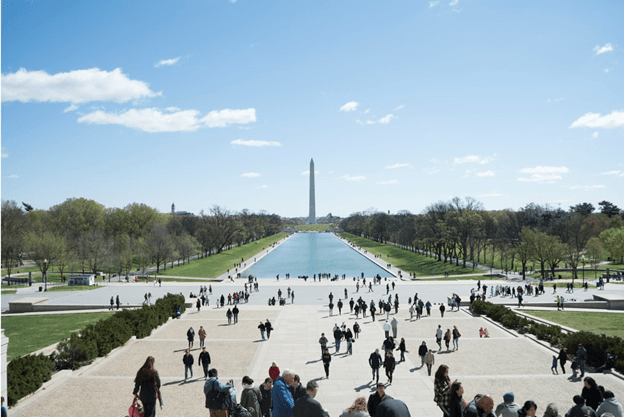
Photo of our national secular church….and public square — by Jacob Creswick

I was recently asked to talk about my experience with church and the public square, and I immediately said yes – I am always up for talking.  But then I panicked and could not imagine what I would say.  After several days of muddled thinking, I realized that I need to start with where I have been before I can talk about where I am.  For me, that is increasingly a response to questions about what I think, and I wonder if that is part of getting older….

As a child and young adult, I was unchurched.  My parents, who were both raised as Lutherans – one grandfather was a Lutheran minister – had me baptized. Their story goes “we walked out of church, looked at each other, and said ‘why did we ever do that’”.  I have no memory of attending a church with them, either as a child or an adult.  In other words, church was not an embedded experience, apart from episodically attending a Methodist Sunday school with my elementary school friend, Mary Lou. I had nothing to rebel against.

Photo by Duanu00e9 Viljoen on Pexels.com

I was also anxious because I have always considered myself a lackluster participant in the public square.I went to a small liberal arts college in the 1960s, and activism was part of the social and educational experience. About 10% of my peers were arrested in a civil rights demonstration when I was a freshman – I was not among them because I had stayed back to study. After graduation, I was humbled by the ways in which so many of my classmates figured out how to continue that activism to visible acclaim. Among my peers were a well-known environmentalist, a defendant in the anti-draft “Dr. Spock Trial”, and the founder of a non-profit litigating cases in support of women’s rights. Still others obtained top positions in national journalism.

By those criteria, a decision to become a sociologist who focused on education for the less advantaged seemed small potatoes in terms of being active in the public square.

Back to church….

When my children were young, I attended a Unitarian church in Lexington, MA, which was acceptable to my un-synagogued but Jewish husband.  It was less a spiritual than a socio-historical experience because I loved just being in a 200-year-old building whose first minister was Ralph Waldo Emerson.  And I liked the people. I began seeking a different relationship with church only as I entered recovery from alcoholism, where I encountered my spiritual self with a group who shared their experience, strength and hope on a weekly basis. 

I was impressed with an old-timer’s anecdote: When he whined ”I don’t know what my Higher Power wants me to do”’, he got a simple answer: “All your Higher Power wants from you is to not drink and be a decent person”.  Recovery gave me a space to seriously consider Teilhard Du Chardin’s statement that we are all spiritual being who are having – or suffering – a human experience.  I also met Dan, raised casual Congregational, who was with me on my path.  So, in my late 50s I started attending a liberal church. There are many ways in which in which the “spiritual but not religious” seek self-understanding and value-based action in a world that often seems meaningless.  For me, all my disparate efforts to enact those – yoga, meditation, volunteering, recovery meetings – gave me a taste for something that church has fulfilled. 

For me, church is the one institution that consistently brings together three important threads of my human experience: developing an inner spiritual life that helps me to challenge instinctively self-centered reactions, creating a supportive and caring community of thoughtful seekers, and carrying the wisdom of spirit and my values into the world in order to make a difference.  The latter is important to me because it means thinking about the public square based on collective reflection rather than individual preference – in other words, taking others into account.  The balance between these three elements of my church experience has varied over time, and I know that the weight different people bring to those basic human human challenges varies a great deal.  But, for me, a church must be all three to feel that I really belong – I could get reflection and community in my 12 step groups and finding places that need extra hands to help solve the world’s problems is easy, but nowhere else do I find a dynamic connection among them.

But what about the public square – making a difference in the world, aka purpose?   I have learned as a member of the churches that I have belonged to that (a) it is ok not to be an elected official, the founder of an organization, or a trailblazer in visible social equity initiatives; (b) I am obligated to look behind the invisible curtain that hides the possibility of something new, and (c) showing up where I am needed is often enough.      

I can admire the Jimmy Carters of this world without feeling inadequate, but I do have a responsibility to use my time and talents as an advocate and support to those who are more visibly out there.  In other words, now that I am almost retired, I can show up when showing up is important.  Dan found a quote by Wendell Berry that summarizes how I think about what I need to do to bring my values into the public square:

We have lived our lives by the assumption that what was good for us would be good for the world.  We have been wrong.  We must change our lives so that it will be possible to live by the contrary assumption:  that what is good for the world will be good for us.  And that requires that we make the effort to know the world and learn what is good for it.

― Wendell Berry, The Art of the Commonplace

And I am also reminded that what I think of myself is not always what others see in me.  A decade ago, I was at a retirement event for a seasoned administrative assistant.  We were joking about what we wanted on our tombstones (good retirement party conversation…) and I claimed, “Tart of Tongue and Heart of Gold”.  The retiree looked at me and said, “Oh no – it should be ‘She Supported Women’”.  All I did was show up and advocate when I was needed. But  I also reflect on Richard Rohr’s observation that we show up when we are called to do so – and that is nothing to boast about, but simply listening for the voice that calls.