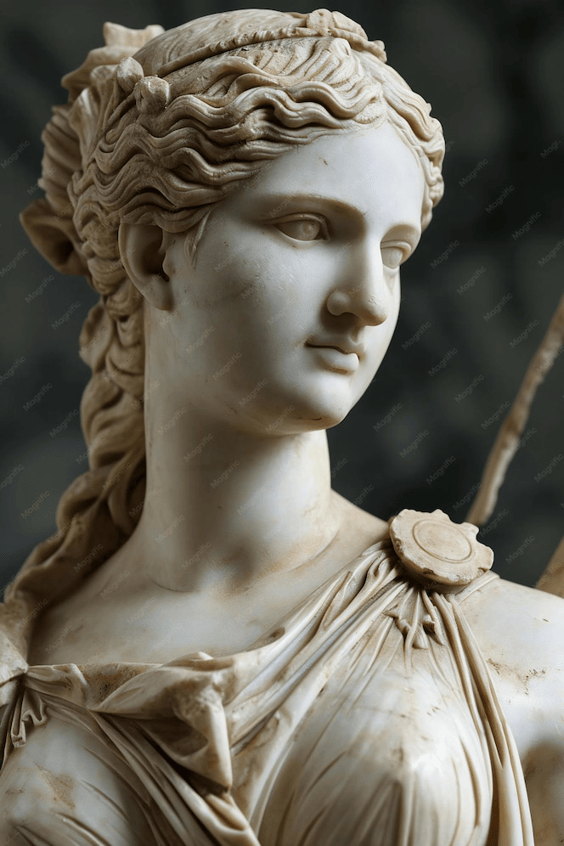
Vatican Museums. Image: Freepik.com
Sixty years ago, I sat in a café in Crete, pondering the myths I had encountered up close. They seemed less like artifacts of the past and more like powerful stories begging to be reclaimed. At twenty, on a solo adventure, I came from a young country where 100-year-old things were considered ancient and history was all about men. So it struck me hard: There were goddesses everywhere—in ruined temples, in the Mary Renault novels I was reading, and on the pots and artifacts I gawked at.
And that’s when I claimed Aphrodite as a muse.
I can’t say I spent much time in the years that followed investigating the goddesses, but I saw their competing messages. Hera, wife of Zeus, whispered of marriage, a predictable life, and the need to tolerate men’s excesses. Athena, goddess of wisdom, called me to my chosen work, to a feminine form of leadership in a chaotic, conflict-filled world. Both urged me to “settle down,” make plans, and create routines. But Aphrodite seemed the most complex, claiming beauty, pleasure, and mischief. Her sacred animal may be the gentle dove, but she is also a trickster, playing with humans, challenging other gods and goddesses, and meddling in the male worlds of war and love.
It was the beginning of “second-wave feminism,” which called women to expand their horizons and aspirations and consider different ways of being. I felt Aphrodite’s power as an embodiment of something clearly female yet not subservient.
It was an era when noisy, accomplished women were newly celebrated as beautiful—Gloria Steinem, Simone de Beauvoir—and they also claimed the right to choose love without letting love define them. Women hung on their words, marveling that they were so accomplished and also sexy, desirable, and desiring. They cultivated distinctive words and a distinctive look—hairstyle, clothing choices—as if it were easy to be exciting and powerful at the same time.
It was what I wanted.
And Aphrodite, along with Gloria and Simone, taught me to love my body, whether slim or pregnant. I didn’t like the little pad of fat on my knees, but otherwise I saw that my muscular calves, wide feet, and prominent collarbones did not deter the male gaze or women’s appreciative looks. I could be both physically attractive and interesting in a group of men and women while we engaged with bigger ideas.
But all of this reflects the superficial Aphrodite, captured by Botticelli as Venus on the half shell.
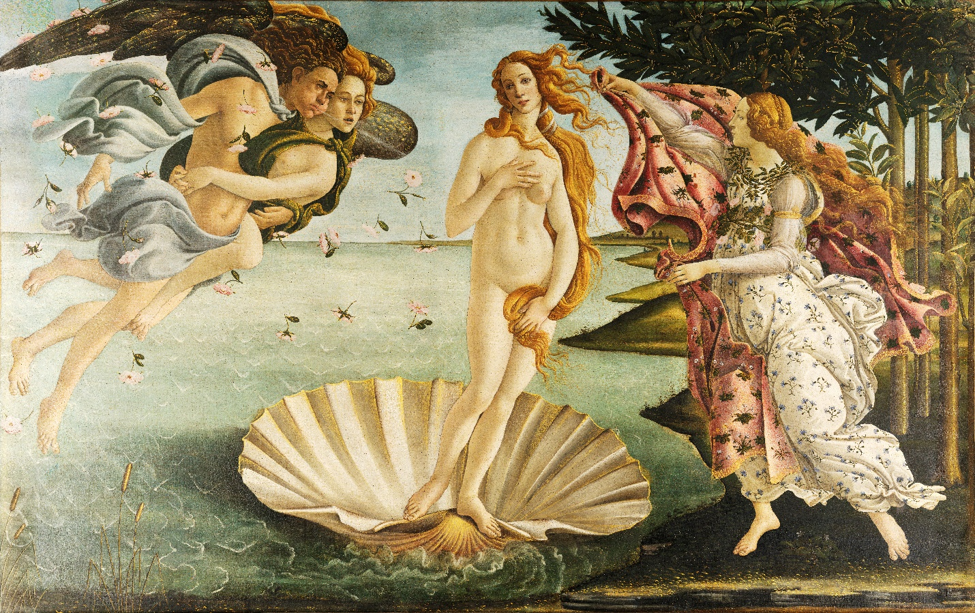
Sandro Botticelli, The Birth of Venus, Uffizi Gallery. Image: Wikimedia Commons
Oh yeah, beautiful but superficial. And goddesses don’t age: They have no stretch marks, wrinkles, or hip replacements. I now have all of these…and I am retired. Why, then, haven’t I put Aphrodite on the back burner, influential in my early life but irrelevant to an 80-year-old?
Because she gives me different guidance than when I was 20.
Because we also often use “superficial” for sensuality, pleasant conversation, and the quick attention we give an idea or image, storing it for later contemplation. But that is part of how I still try to live: not obsessed with one person or one passion, but open to the fleeting – and curious. Aphrodite meddles because she sees interesting details, wants to know more, and wants to see what happens if her touch changes the course of the wind or the meeting of eyes. I often need to remind myself to stay observant, to stay sensitive to life’s nuances. In those details, I find the most joy. Rushing toward a goal, I may miss a beautiful flower, someone else’s kindness, a sky more beautiful than any painting.
Aphrodite is nothing if not social, weaving together the small and large details of others’ lives and bringing people together. Of course, I wouldn’t mind being called to solitary greatness, like Athena on the Acropolis, looking out over the world. But in the last years of my professional life, I really wanted to be Aphrodite, someone who brought all kinds of people together and encouraged them to create something new that would endure after I left. I love the story of Theseus establishing the cult and temple of Aphrodite Pandemos (Aphrodite of the people), where people celebrated her each year for fostering civic unity.
Relying on her mattered as my husband Dan and I, drawn by family, moved from Minneapolis, where we had lived for decades, to Boulder. Aphrodite encourages me, when I meet someone new for coffee, to say, “I think we can be friends,” an explicit gesture that invites relationships and connection beyond the superficial and seems to speed the dance of creating meaningful connection. The joy I feel from creating new bonds that matter—not displacing but adding to dense relationships that have grown over decades—is one way she works on me.
Her mischievous side—including her willingness to intervene in the lives of gods and mortals—is part of the story of my old age: no longer an elegant temptress but an everyday oldster who has adopted the credo “stir the pot and see what happens.” It doesn’t always work as I hoped—Aphrodite’s intrusions can sow chaos—but being playful still pleases me. These days, however, I am much more comfortable apologizing if my playfulness misfires.
She still meddles with me. It just looks different at 80. More tender, more relaxed, but still pointing toward love, beauty, and relationships. She is always calling me to slow down, pay attention, experiment, and have fun. Aphrodite may be ageless, but she understands women’s aging with a fully female compassion.