Through a Tiny Door….

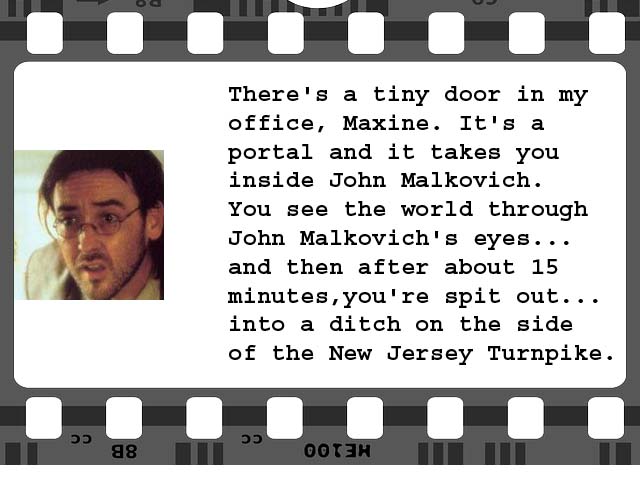
https://www.whatascript.com/image-files/movie-quote-being-john-malkovich.jpg

My children and I disappeared down the rabbit hole with Alice and into a parallel world through a closet in The Lion, the Witch and the Wardrobe, while in the surrealist comedy, Being John Malkovich, a door leads John Cusack’s character into the eponymous actor’s mind.  But not all portals are doors: Peggy Noonan claims that, when she read War and Peace, she “entered another world”.  According to Arundhati Roy, the Covid pandemic should be viewed as a portal to a changed reality. In all of these, a portal is metaphor for an insistent call to experience the world differently.  Most people have had at least a brief glimpse of déjà vu, where you know, absolutely, that you are in a situation that you have lived through before…a portal. 

We can hunt for portals, but they usually appear by chance. I had that experience this week as I dropped a small pen and ink drawing off at a framer’s shop.

East Heath Road–Google Maps

The drawing is of a street in Hampstead, London where my parents and sister lived in 1965-66, and where I joined them during the spring of my junior year of college.  I bought it several years later when I was again living in London and wanted to get my mother something special.  Then I didn’t  think about it until it ended up in my possession after she died.

But when the door of the fame shop clicked closed, I panicked.  No picture of the drawing?  Had I left it with a perfect stranger who would be holding it for two months? Racing to my next stop (which I distractedly drove past), I was struck:  the drawing was an unacknowledged portal to accumulated experiences that shaped my life. 

My excuse for leaving college was to research a senior thesis – on the improbable (invented) topic of the influence of the Spanish Civil War on the British Communist Party. I managed to secure access to the old British Museum Reading Room where, like all the “real scholars”, I could order my well-kept books and have them delivered to me on a daily basis. When I went to the more obscure Marx Memorial Library, guarded by a single elderly gentleman and embedded with decades of dust, I encountered for the first time the excitement of not only consuming knowledge, but also discovering it…a life-changing event, whose significance was revealed several years later when I decided to get a PhD in Sociology.

Somehow my parents agreed to let me travel by myself to Greece during that summer. Other than briefly meeting two friends in Athens, I took boats, busses and donkeys for three weeks, choosing where next to go based on the Guide Bleu (I hoped that it would improve my French).  I hitched rides with local young men on their motorbikes in Crete and shared retsina with elderly families on boats between the islands.  I left feeling adventuresome, brave, and that I could probably do whatever I wanted.  This was a new feeling for me and stirred my development into real adulthood.

I also fell in love with another undergraduate working in the British Museum Reading Room.  He introduced me to Cambridge, Indian food, and his London, ranging from Soho to Golders Green, and including most of the museums and bookstores.  At 20, to experience another country with a person who knew it inside-out, it was a revelation.  Since then, I have rarely wanted to be a tourist but instead to know another place through the eyes of people for whom it is just daily life.  That urge shaped a lot of the choices that I have made.in work, friendships, and what I like to read. 

I have relived these familiar stories many times, but until I dropped off the drawing I did not connect the dots.   Yet their linked temporal proximity clearly fashioned much of what I became:  I chose a life of discovery. International Karen (as my husband calls that side of me) became purpose rather than play.  I sought every opportunity to do research with colleagues in other countries, to discover what our cultures share and how they are  different.  I lived in other countries when I could, celebrating the small adventures of daily life more than the great sights.

Ok, I wasn’t spit out into a ditch in New Jersey like the John Cusak character.  But to take my insights from the Hampstead portal seriously, I must acknowledge that that my emergent purpose shut out other opportunities– like feeling rooted or having a home place, and exploring the fascinations of my own country.  What I need to consider now, without regret, is what I need to let go of.  A trip into a portal should be a stimulus to see the world differently and cannot be allowed to become a drag on whatever “future me” is emerging….

I am reframing the Hampstead drawing for my sister, who has always liked it.  My recent experience of it as a portal makes me even happier to give it to her: It has served its door-opening purpose for me. She will have her own version of the stories evoked by our flat in East Heath Road…or maybe she will be presented with a different portal.

Not Just a Car

Racine bus by the train depot where I used to transfer to go to Sunday school. I loved the smell of stale cigars, with a hint of pee.

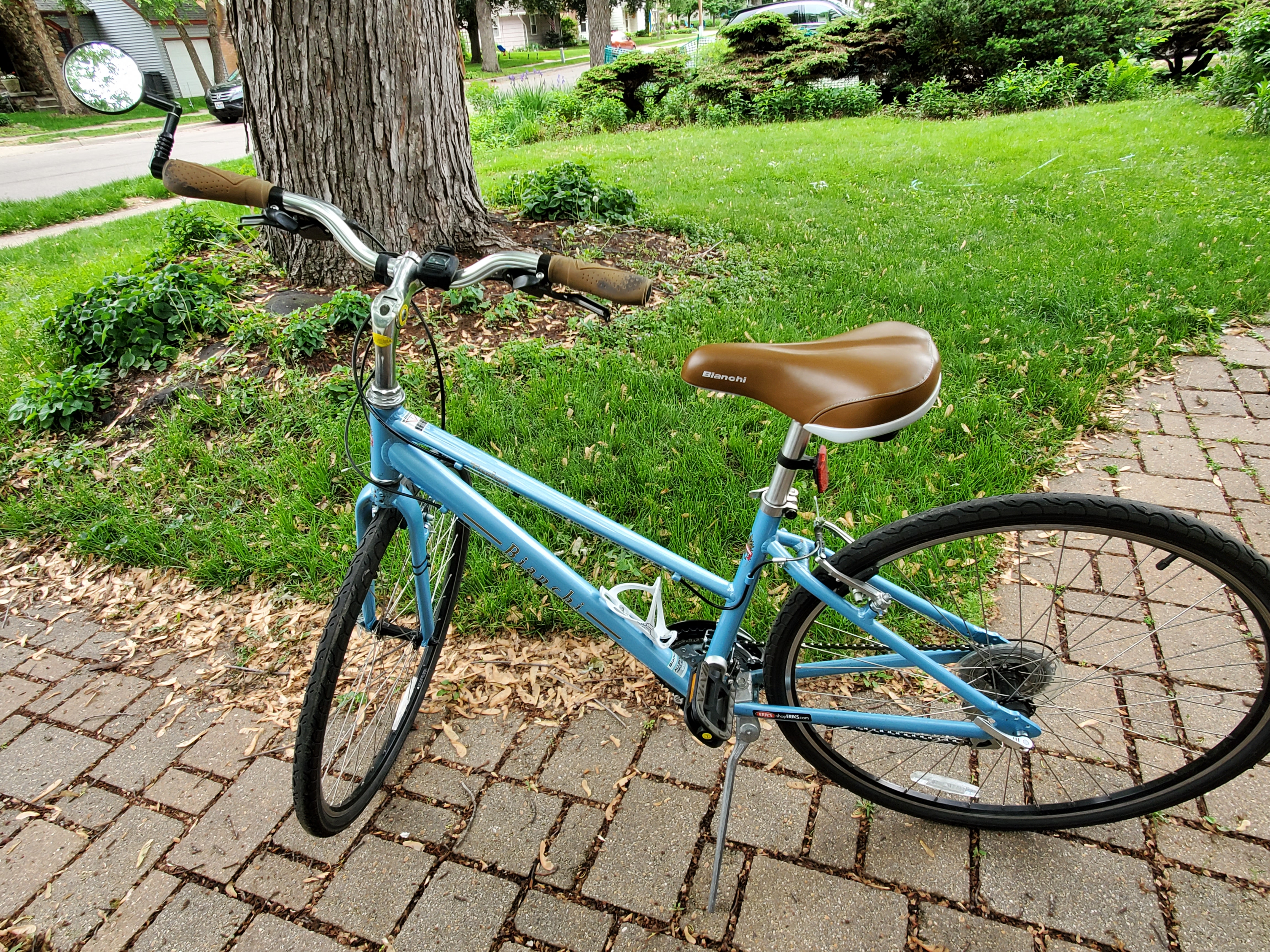
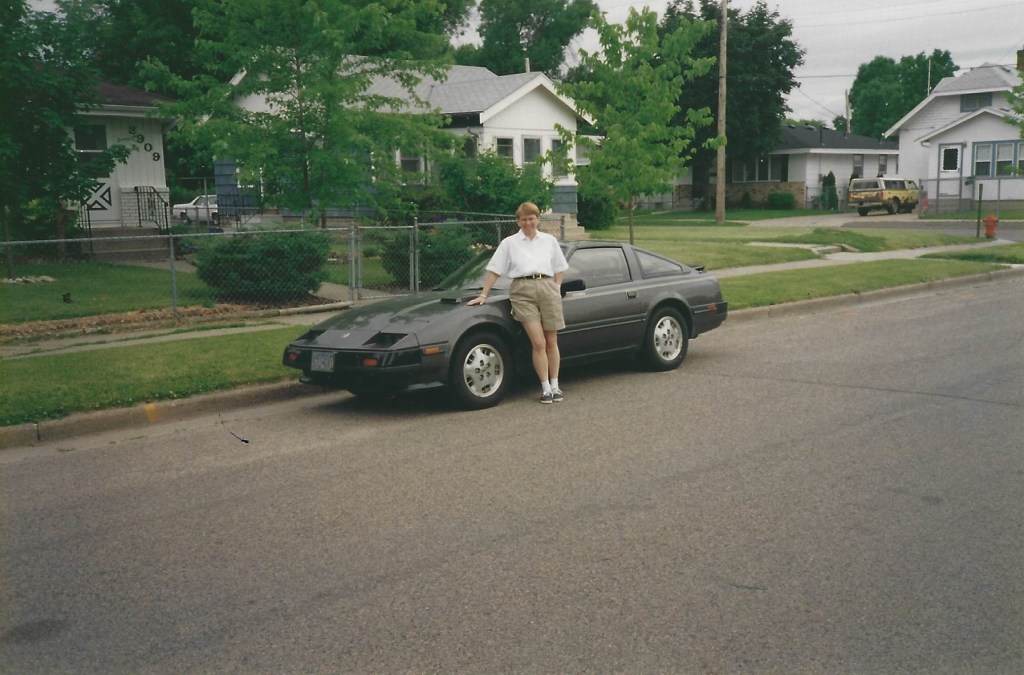
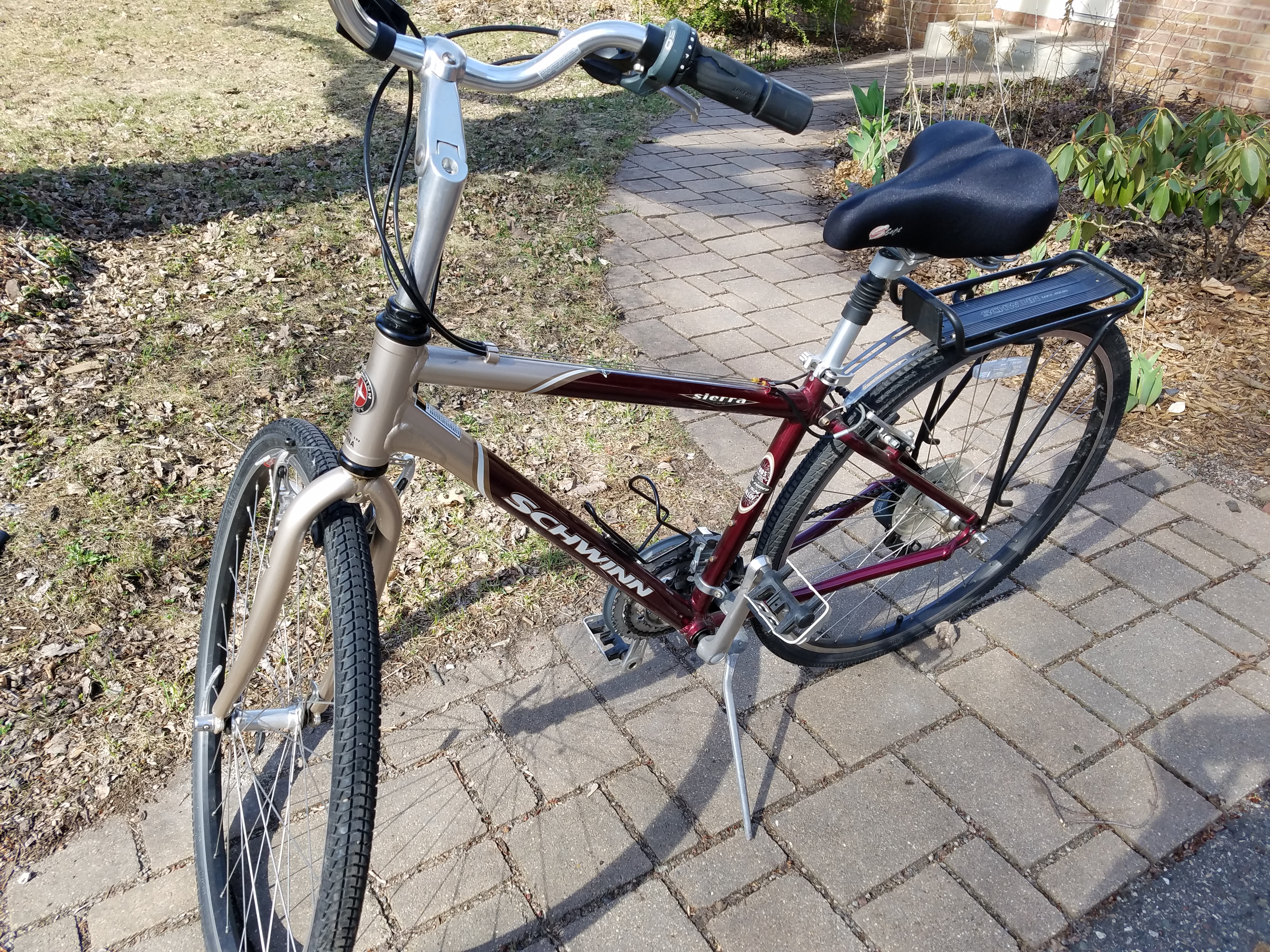
When is a 1992 Ford Tempo the grandest car on the road? When you are 48, and it’s the first car you’ve ever owned. Mine was black, and I was convinced it passed for a BMW with its plain grill, sleek lines, faux black leather interior, and silver trim. Every Saturday I’d drive it through the gas station car wash, then dry and shine every inch of it. I also didn’t drive it much because I was in graduate school and my bicycle was easier for getting around the U of Minnesota campus.

Growing up in Racine, Wisconsin during the 50’s, I never got a ride anywhere. If I asked my stepfather to take me someplace, he’d say, “No,” followed by, “If you want to go bad enough, you’ll figure it out.”

I did. I took the bus, rode my bike, or walked. Once a week, I’d travel by bus uptown for my music lesson at Gosieski’s Music Store. I had to transfer, and to deal with the boredom of waiting for that second bus, I memorized all the car makes, models, and years, so when I grew up and could buy a car, I’d know which one I wanted—a Chevy Bel Air or a Packard Patrician or maybe a Ford Fairlane? Someday I’d have a car of my own, and I’d drive everywhere—no more waiting at bus stops, bicycling, or walking home late at night, scared. And I’d give people rides, too!  I would not be stingy with my beautiful car.

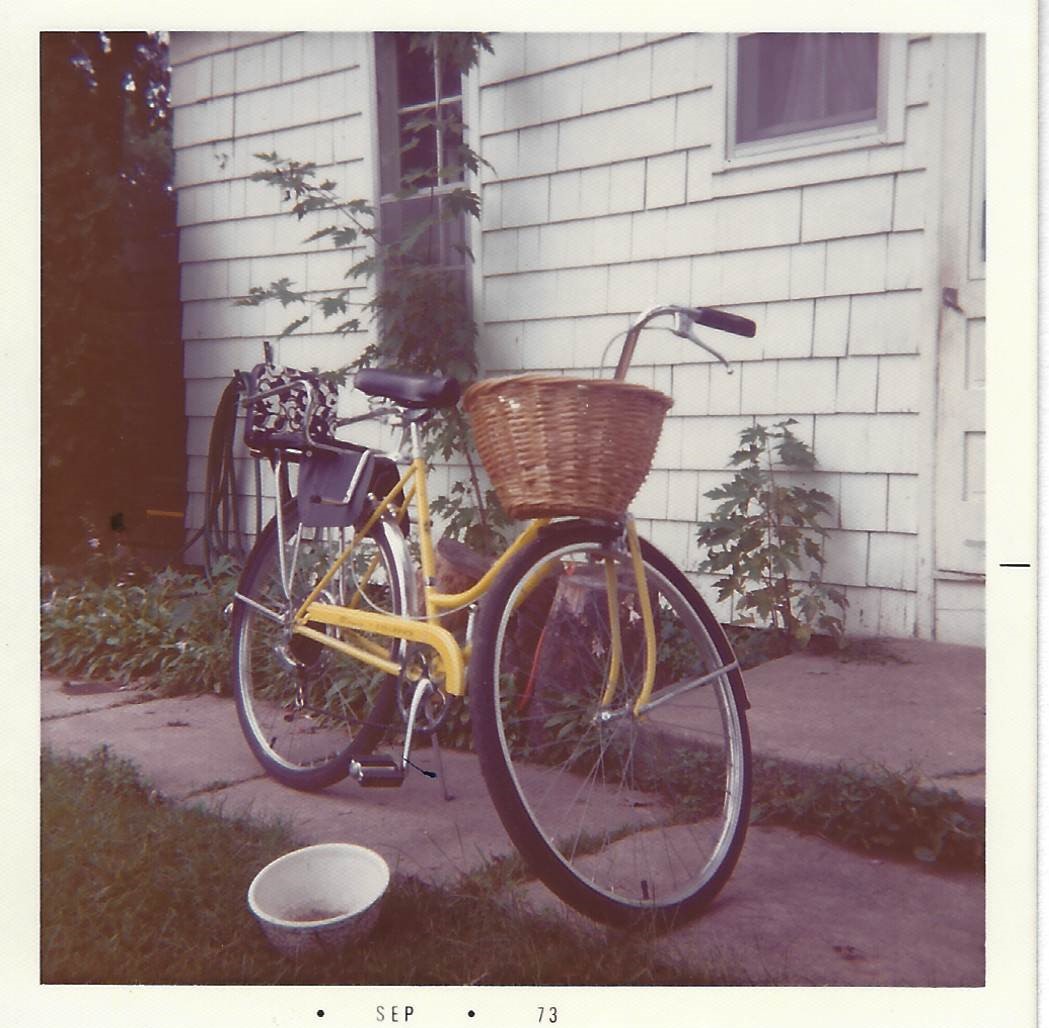
As it turned out, I waited a long time to achieve my dream. In my undergraduate years, my main transportation was a Dunelt three speed (that precursor to Raleigh bikes now lists on eBay for $2600).  Then marriage. Though I finally learned to drive, I was usually at home with two young children because my husband needed our only car for work. But I wasn’t easily deterred. I quickly initiated my children into cycling, walking, or taking the bus. I remember standing on the side of the highway in Minnetonka Beach (exurban Minneapolis), next to the lake and across from St. Martin’s church with two young children to take the bus into Wayzata (a closer-in suburb) or the city. I never let a lack of transportation stop me from doing what I wanted to do.

We divorced in 1991, and in January 1992 I bought my first car, that snappy Ford Tempo. It spoke freedom to me, not having to wait interminably for a bus, not being dependent on someone else’s availability for a ride, or riding my bicycle after a long day. I could go where I wanted when I wanted. The American dream, finally accomplished.

My years of waiting and wishing and that Ford Tempo planted the seeds of a love for cars. Shortly after I bought the Tempo, I met my second husband, who convinced me to trade it in for a Mazda RX7—something sportier. I was off on my journey of newer, better cars—as often as I wanted. Now it’s the latest technology and design that catch my fancy—don’t you love the new powdery colors on the 2024 models—like “Cosmic Blue Pearl?”

So here I am at seventy-nine. When my husband suggests making do with one car or using the bus more, I am adamant: I spent nearly forty years riding the bus, walking, bicycling, or sharing a car. I want my car and the freedom it gives me.

But that fierce position is threatened—I am aging.  Although I feel sharp with good reaction times, I know I’m not the person I was in my 40’s—the age group with the lowest accident rate. Weaving in and out on a freeway often feels treacherous to me—more so since I was rear-ended by a semi a few years ago. So I stay in the right or middle lane and accept that I’ve slowed down.

When I looked up the average age that older people stop driving, I was astonished when one website claims that it’s 75! (The National Institute on Ageing states that is not possible to calculate this number). I read on to find out all the reasons people stop driving—arthritis, making it difficult to grip the wheel, eyesight issues, diseases and medications. I suddenly felt extremely lucky not to have these issues.

For all the hype about dangerous older drivers, The National Institute on Aging states that “Therefore, we must be careful not to judge the safety of one’s driving solely based on their age;”  it’s the millennial drivers who have the most accidents. The 75+ group has the fewest, although they are more likely to die from an accident because of other underlying conditions (remember Covid?).

So when should I stop my ongoing love affair with cars? I haven’t experienced the behavioral indicators, like stopping when there’s no stop sign, not following traffic signals, side swiping, etc., but it’s helpful to know these. Yet, contemplating not driving is almost as scary as being told I’ll have to stay home and watch TV the rest of my life—which is the nightmare I conjure up when I imagine what would happen if I stop driving.

All this aside, I don’t think society does much to help older drivers. Right now the push in Minneapolis is to get us all on bicycles – like the Dutch, who give up their bicycles only when they are consigned to a nursing home. I ride my bike recreationally, and I’ve started doing short errands on it. I want to be part of the solution, but I’m not sure that bicycling to the grocery store when I am 90 is realistic. As one of my friends put it, “It’s not if you fall, it’s when.” For now I’m happy that I’m driving and can still ride a bicycle— and walking, well, my knees don’t love it, but I subscribe to my stepfather’s words, “If I want to get there bad enough, I’ll figure out a way.”

Memory and Story

Photo by Jon Tyson on Unsplash

When to the sessions of sweet silent thought
I summon up remembrance of things past
(William Shakespeare)

A man needs such a narrative, a continuous inner narrative, to maintain his identity…(Oliver Sacks)

Much is made of the way in which memory erodes among the elderly – a group to which I am beginning to concede that I belong. Memory loss is considered normal, and it is true that my ability to recall information – the name of a restaurant that I loved in New York in 1970 or even the names of some of my childhood friends – is not immediate.  Now, my husband and I say that we are lucky to have two brains, which allows us to come up with a missing piece of information sooner.  Sometimes I kick myself when it is some simple, common word that has, slipped my mind.  Slipped my mind – memory is such a slippery thing indeed.

Recent research suggests that the slipperiness that I (and most of my friends) are experiencing is not the whole story.  We may have mild forgetfulness, but we are actually wiser:

“Some brain areas, including the hippocampus, shrink in size. …These changes can affect your ability to encode new information into your memory and retrieve information that’s already in storage. On the other hand… connections between distant brain areas strengthen. These changes enable the aging brain to become better at detecting relationships between diverse sources of information, capturing the big picture, and understanding the global implications of specific issues.” Harvard Health Newsletter

https://unsplash.com/plus/license

This may be comforting to some people, but memory is still important to me —  Not the name of a restaurant, but the people who were there, the conversations we had that made us laugh, and how the evening created a friendship and endured for years.  I want to be able to summon up not just the grief that I felt at my mother’s funeral and any wisdom that I may have acquired about how to anticipate and live within grief (wisdom?), but also to remember that my cousin Butch played “When the Saints Go Marching In”, what words were spoken by whom, and even what I wore.  I want both to feel it very specifically AND to connect it to other events of loss in my life.  But I can’t remember what I wore….yet. 

The older I am, the more memories I carry and the more I need to make sense of these past events, feelings and images in the context of my life today.  This is what the practice of telling our story, whether orally, by journaling, or in a memoir, is about.  Oliver Sacks argues that “Every act of perception, is to some degree an act of creation, and every act of memory is to some degree an act of imagination.” But given my capacity to invent a past out of whole cloth, I have to work hard to prevent my story from being fiction!  In addition to reconnecting with past feelings – anger, grief, lust, joy – I want to give them additional color, and come closer to something real, with specifics. 

Recently, Karen Storm and I attended a writer’s retreat, where we planned to spent a chunk of our writing time working on the Karensdescant blog.  Instead, I woke up before the workshop feeling unnerved and vaguely remembering events from decades ago. By the time I got to our idyllic hermitage, I knew that I had to write about it – but my memories were fuzzy and still unsettling.  Karen Storm came with a less clear idea of what she might want to noodle on in addition to the blog, but was struck on the first evening with two old memories of her own that called her. 

In the end, we never talked about Karensdescant.  But we both happened on something more important – something that those increasing, branching, interlinked dendrites in our brains – the privilege of being old – demanded we attend to.  We wrote like maniacs, multiple pages infused with both tender and crushing details about important events falling into our computers,  connecting past events and people and finding new links with our present lives.  We were recalling information, pulling out succulent details that were not immediately at our fingertips, and making new stories out of past circumstances. 

In my case, it was clear that my memory of a very old relationship was encapsulated in a very short story that that I repeated so often, both to myself and others, that it seemed to be as real as the door to a room or a book on a shelf:  “We met and loved in wonderful places.  But it was too complicated.  It ended.”  But there’s the rub:  when I open the door to a room in my mind, I am amazed at what lies behind it that is unexpected – or what isn’t there that I was sure that I put away a short time ago.  When I open a book to reread it, there are sections that I don’t remember, while others that I starred on the first reading no longer seem as important as they did.  Anna Karenina is like that for me – it has a different meaning in every decade of my life.

It is not that my memories about that particular relationship are especially elusive – it’s the details that I have left out because they were (deliberately?) buried, or seemed trivial, that demanded some major rewriting. The editing included dredging up more information, but also a desire to make sense of old, lost relationships in the context of the life that I have subsequently woven, together with many others who I did not know or were not yet born, in the decades since.

Photo by Daniel Schludi on Unsplash

During the retreat, I wrote a different narrative that is much longer and has changed the way that I think, not only about that relationship, but all of my relationships with people  I have loved. This was not the Shakespeare of Sonnet 30, who descends into rather weepy nostalgia, but an urge to reorder my house to see that old things that still intrigue me are put into places where they connect with others parts of my life.  I can almost feel the dendrites communicating with each other. 

Friends who have worked with hospice patients talk about how they observe people holding on for a few more days to make sense of some aspect of their life that feel unfinished.  When I ask myself (or am asked) to remember more details, I find connections that I did not make in the past.  Or, I remember something that was said that changes the way I need to tell the story. What is different for many of us as we age is feeling a need to make sense of our lives more deliberately, with more care, whether we are writers, talkers, or scrapbookers.  When it comes down to it, we are all just trying to make a little more sense of this very non-linear project that is life.

‘Tis the Season: Graduation

Last Saturday my granddaughter, Luisa, graduated from high school. She’s the youngest of my grandchildren, which reminded me of the passage of time, starting out as babies and now one out of college, two in college, and Luisa soon off to college. Thinking about graduation makes me realize what a shared rite of passage it is. Karen and I have skirted around the notion of rituals, probably because there are no well-defined rituals as we age—some people have retirement parties, but it’s not a given, and certainly a funeral is a ritual for the living, not the departed. Reflecting on the joyful event later, I noted the. . .

Changes in Our City and Schools      

Luisa is the only one who attended school in Minneapolis, so it was my first big urban school event. As we took our seats in the large auditorium, the first thing I noticed was the diversity. In fact, the school is 60.4% white, 21.3% African American, 9.7% Hispanic, 3.9% are of two or more races, 3.7% Asian, with 0.8% American Indian, and 0.2% Pacific Islander. The Somali families immediately stood out because of their colorful dress and larger families — grandparents, siblings including children and babies, and moms and dads. Minnesota has the largest Somali population in the US, with most of them living in Minneapolis. The women wore the traditional head scarf and the baati, a long overdress, and many men wore the macaawiis, a sarong, and the benadiri kufia, a cap. But that doesn’t do justice to the gold jewelry, glittering fabrics, sculpted make-up, and spectrum of colors. The women seemed to glisten with their beauty, and the men stood tall.

The Graduation

Once we were settled, the graduates marched in with the band playing Pomp and Circumstance. I teared up as I watched the students walking down the aisle and parents standing on seats to get a picture—aren’t smart phones wonderful! The trappings were all there — the school band’s terrific rendition of the National Anthem, the choir singing Stephen Paulus’s The Road Home, and the articulate student speaker, who was a young Somali woman.

Before awarding the 441 diplomas, the principal practically begged us not to make a lot of noise or to be in the aisles as each graduate’s name was announced. The silence lasted very briefly.  Somali names like Abdi and Ali clustered at the beginning, and the families were so excited to see their students walk across that stage that they went wild, jumping and cheering and blowing vuvuzelas—so much for quiet. I suspect that in some families these may have been the first high school graduates.  

I loved the excitement, though not everyone loved the ruckus, possibly because we live in a newly multicultural city, originally dominated by less effusive Scandinavians. I believe in honoring the different ways in which we celebrate. I also noticed that the cheering settled quickly and we could still hear the names. By the time Luisa crossed the stage, her brothers decided that it was okay to make some noise. Sitting on either side of me, they jumped and shouted. Ironically, on my video, you can only hear her first name being called; their celebratory noise blotted out the rest.

Intergenerational

After the graduation, the auditorium lobby was filled with families and graduates, everyone taking pictures. It felt like family because many of the graduates knew my son because he’d been their principal in middle school. It was joyful to see former students reconnect with him.  I was not left out: a former student of mine recognized me and gave me a big hug, telling me that his daughter had just graduated. The father and I also overlapped at the U of MN, when I was in graduate school, and he was an undergraduate.  When we met, walking across campus, he would say “You’re my inspiration!” What a circle; what an intergenerational experience!

Which brings me back to the roles that we play as young and old. Yesterday, struggling out of a store with a heavy box of kitty litter, my other granddaughter, Maggie, grabbed it, insisting that. “I can do things to help you, and you listen to me and give me advice and help me.” There it was, from the mouth of the next generation, how the generations support each other when we are not celebrating rituals. Sometimes I am sad about growing older, but her words reminded me that I would experience none of this without growing older. My older self is also a bundle of memories going back to post WWII, the 50’s, 60’s, etc. I have a perspective to share that can enrich everyone my life touches.

Through the entire graduation, I was awed by the stretch of generations, from grandparents in wheelchairs to babies crying during the ceremony—how we are all one, especially in the rituals that celebrate life passages. Luisa, too, reminded me of how generations stretch across the planet, because she was born in Guatemala. As her grandmother and a former teacher at the graduation, I represented all the grandmothers, parents, and educators throughout the world who love and support the next generation. We are all connected; we are all family.