Unknown's avatar

About Karen Seashore

I am a sociologist, life coach, policy wonk, and tarot reader. Other than reading a book, I always prefer to work with other people. Creating small changes -- in myself and in the world around me -- is my calling. You can find my scholarly publications under Karen Seashore Louis (or Louis, K.S.).

What is My Footprint?

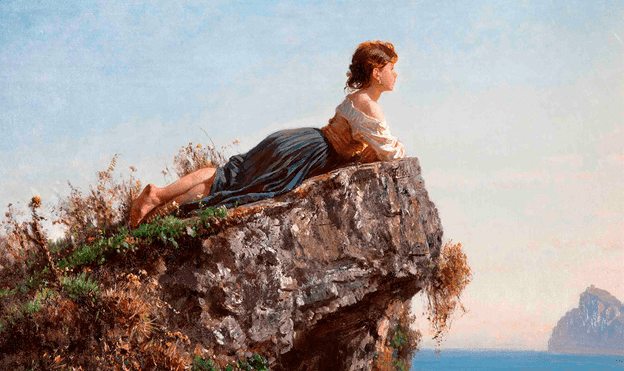
Fillipo Pallizi, Franciulla sulla roccia

Lives of great men all remind us
We can make our lives sublime,
And, departing, leave behind us
Footprints on the sands of tim
e

Henry Wadsworth Longfellow — A Song of Life

Geert Hofstede’s research suggests that striving for a life that will be noticed is fundamental to the American psyche.  And, in a big country, the longing is often equally big and broad.  From Patrick Henry to John Wayne, large and swaggering (and male) is what is noticed.  I saw myself in the narrative, but identified as a thoughtful visionary seeking a bigger world – like Pallizi’s romantic 19th c. portrait.  As I noted previously, my husband called this “International Karen” who, as frequently as possible, moved beyond contemplation to collaboration with people in other countries who also wanted to make their schools better. But, between Covid travel restrictions and a dwindling passion for experiences far from home, International Karen is coming to terms with the obvious:  the past will not be the future.  What is emerging is a different longing—to figure out how to leave smaller but still meaningful footprints.

Several years ago, some friends and I – (aka, The Retirement Biddies Workgroup) — read Sarah Susanka’s reflections on living a “not so big life”.    A well-known architect, she urges us to think about what really matters through analogies between designing a smaller home and designing a smaller life.  Some of her questions are relevant to anyone at any age:  How is what we are purchasing fitting in with what we need?  How are we using our resources?  When do we have enough?  But then, her zinger:  How have you wanted to change the world and how are you looking for related changes in yourself?  Her challenge suggests beginning with our biggest aspirations (do they come much bigger than changing the world?) and then look internally to see as if we are up to the task. 

But that question needs reframing in a life that has become radically smaller during Covid, while I am also busy considering a future that will inevitably be different from my expectations of a few years ago.  As I look at “international Karen” and cringe at the carbon offsets that I owe the world, I know that I could not go back, even if it were possible.  I pulled Susanka out of my bookshelf….

At a personal level, I have already made a commitment to a smaller life. A decade ago, Dan and I made a radical move from a rather large house to a condo, which was about the size of Susanka’s designs for a “not so big house”.  When The Retirement Biddies were contemplating the “not so big life”, Dan and I had given away many of our possessions, including furniture, books that we finished reading many years ago, and appliances that we rarely used.  We felt lighter and patted ourselves on the back, while filling every nook of our new walk-in closets.

But I was still working.  Although my home office was small, I had a bigger office at work for all the professional stuff.  The only question “not so big” question that had immediate resonance was a more thoughtful consideration of what we were buying. It was all about “the stuff.”

But now retirement-during-Covid is a reality, along with the unanticipated consequence of our decision to stay in Boulder, CO where we are engaged in a noble experiment: two people living peaceably in a 1000 square foot 1960s ranch that has only two interior doors that don’t lead to a toilet.  But this requires a different kind of decluttering.  The grand project of moving and starting over – just like those who are part of “the great resignation” or who have otherwise changed their lives in the last few years – requires a decluttering of the spirit and heart. 

The challenges are huge.  I have always been BUSY, largely with activities that are not essential. I  am easily distracted by emails or random thoughts.  I have never meditated, and have been totally unsuccessful at journaling because it requires discipline.  Since childhood, I have been unable to cope with boredom and have a long list of attractive projects that I can turn to if that awful feeling appears.  But these habits, some of which were functional when I was “busy working”, are now impediments.  In Susanka’s terms, I am unable to turn away from alluring “time clutter”. 


Clearing out the heart requires stillness – so different from concentration —  that does not come naturally.  I have taken a course on contemplative prayer.  I have read poetry out loud.  I have worked on a skill that never came naturally to me – listening to what other people are really saying rather than immediately generating a stimulating conversation.  I am even weaning myself off the computerized calendar that beeps too often, and writing out to-dos and appointments using a fountain pen.  More importantly, I am tracking a new habit – explicitly noticing, contemplating, and being grateful for something that is exquisitely beautiful, whether in nature (frost covered ornamental grass or snow on the Flatirons outside our house) or when making faces with a four-and-a-half-year-old.  And writing down a few of those things in turquoise ink.  I really love the turquoise ink. 

But what about changing the world?   I take heart in reading aloud Mary Oliver, who suggests that, at least for a poet, a large life can be inscribed through small acts: 

I don’t want to live a small life. Open your eyes,

open your hands. I have just come

from the berry fields, the sun

kissing me with its golden mouth all the way

(open your hands) and the wind-winged clouds

following along thinking perhaps I might

feed them, but no I carry these heart-shapes

only to you. Look how many small

but so sweet and maybe the last gift

I will bring to anyone in this

world of hope and risk, so do

Look at me. Open your life, open your hands.

Mary Oliver – I Don’t Want to Live a Small Life, Red Bird

To live a more open and intentional life, I need to consistently remind myself that small efforts, expanded over many committed people can make a difference in this world of hope and risk. I think of the years when I hauled dozens of yogurt containers to my office before my city started recycling – only to find out now that the containers were not actually recycled.  So, my Instant Pot and I now have a bi-weekly routine that involves yogurt making.  I find local issues that are pressing – affordable housing, unjust judicial practices, and the continued exclusion of the Native people who once owned this land – and find others who want to change them.  Goodbye International Karen:  You did good work and had fun.  Now I want to bring small gifts to the place where I live and to those I am with – and I also remind myself that large footprints in sand will be washed away.  

Doubt and Reflections

In this short Life that only lasts an hour

How much – how little – is within our power

-Emily Dickenson

Almost a year ago I asked Fran Vavrus if I could have a copy of her new book, Schooling as Uncertainty, and I would write a review in return.  I finished reading it some time ago, but pulling my thoughts together to prepare a review for a scholarly journal – something I am usually able to do easily – has been challenging.  As I texted Fran ( and have repeated to many other people), her work gob smacked me:  I thought I had signed up for an exegesis of her ethnographic experience studying women’s education in Tanzania – a country about which I know so little that I was sure that it would be an intriguing read.  Instead, what I encountered was a book that is equal parts scholarship, personal memoir, and a timeless story. 

Fran’s big message is that the accepted mantra, “get more education to get ahead and have a good life,”, may be accurate for some populations, but it obscures the circumstances that disrupt the narrative’s accuracy for individuals.  She recounts in loving and sometimes intimate details the histories of talented rural Tanzanian children, whose life paths she has followed for years.  Their journeys  through secondary or higher education – some successful, some not – often depended less on their own effort and more on the appearance (or disappearance) of family members or mentors who could afford school fees, or their family’s geographic location at  a convenient distance from schools for which they were qualified.  As she wrote searingly about those whose chances were permanently derailed by the AIDS crisis, which orphaned or impoverished many, I was struck less by the foreignness of their stories than by their congruence with my experience.    

I read Jonathan Kozol’s Death at an Early Age, when I was in graduate school in New York City.  It was the late 60s – a peak period of street crime and also the “great school wars”, where poor parents in Ocean Hill-Brownsville rallied for more say in their children’s schools and teachers called for more professional determination.  The conflict was a true dilemma – both sides had a point.  Those experiences led to my 40-year obsession with studying urban schools.  But, in the end, it is still often the children who have lost.  Big visions, like the Great Society or Eugene Lang’s I have a Dream, did not dent the immediate realities of family economics, under-resourced and segregated schools, and the distraction of immediate opportunities that promised survival.

Ok, so those are the facts, backed up by solid analysis.  But what about all the other unseen stories of uncertainty that are deeply painful although not associated with dramatic, newsworthy failure?  Even for my friends who are not impoverished, life has a way of interfering with the dream that education is easily available and can open all doors.  Just as in Tanzania, early marriage or unplanned pregnancy, a parent’s death, or temporary homelessness throw careful plans into disarray:  the hope for something big “out there” is abandoned (or delayed).  For my mother, being orphaned in the Great Depression meant that the generous uncle who paid her tuition at the University of Minnesota thoughtfully added a requirement that she become a teacher (sure employment) rather than a biologist (risky, especially for a woman). Karen Martha waved her sister off to college, but had to confront her parents’ financial collapse when it was her turn.

Uncertainty is always close to the surface as Fran interweaves her own life experiences in the U.S. with those of friends and colleagues in Tanzania.  Her personal stories make me cringe with recognition.  Fran’s dissertation was viewed as “theoretically inadequate” by a single faculty member, which required her to spend vast amounts of energy and time in revisions and prevented her from graduating on time; my experience was similar, although my advisor bulldozed the less powerful member of my committee.  Fran’s critical promotion to a tenured position was almost derailed, again by a single faculty member.  In my friend Doug’s case, an erratic committee in one of the U.S.’s most prestigious institutions sent his five years of post-graduate work into a black hole, to be resuscitated much later at a different institution.  I stepped off the tenure track for a decade to avoid the tenuous assistant professor role while I was a young mother (no, you can’t have it all….) and managed, largely through unanticipated opportunities, to get back on track. Those are happy accidents.  But I have seen other colleagues sidelined because they didn’t follow all the unwritten rules on the way to tenure – or had a dean who disliked them.  Conformity is required, but it does not eliminate uncertainty.

Speaking from my own vantage point, the timeless story in Fran’s book is more than a cautionary tale about the certainty of financial and personal payoff from education.  Instead, her narrative leads me to consider each of the uncertainties I have encountered and how my struggle and occasional despair remains within me but disappears from the abbreviated public arc of a life that looks seamlessly successful (my close friends know better).  As with Fran, thinking about my personal encounters with uncertainty at this juncture in my life has affected how I retell my story, not only to myself but to others.  Perhaps that is why I do not run out of things to write about for Karens’ Descant….

A final reaction to Fran’s description of the effects of Tanzania’s post-colonial turmoil on educational careers requires me to consider how individual experiences are situated in their larger context.  When and where we are born – in times of affluence, war, or environmental crisis – adds an existential uncertainty that we cannot escape.  Like most people, I have intense reactions to social unrest as it happens but often become aware of its long-term impact only much later.  I grew up aware of the magnetic evil of McCarthyism in the 1950s because academics were among those he targeted, and my father was at the beginning of his own career as a professor.  A lasting consequence is that I do not trust the wisdom of crowds and popular opinion. I grew into early adulthood in the 60’s and early 70s, when it felt as if the foundations of the country were at risk, so aptly captured in the last few months by Ken Burns’ probing visual chronicle of Mohammed Ali, and the (for me) very personal movie about the Boys Who Said No! to the Vietnam War.  Now, as the country feels, once again, as if it has lost its collective mind, I am pricked again by the menacing prescience of William Butler Yeats’ Second Coming, written in 1919, just after World War I:

Turning and turning in the widening gyre   

The falcon cannot hear the falconer;

Things fall apart; the centre cannot hold;

Mere anarchy is loosed upon the world,

The blood-dimmed tide is loosed, and everywhere   

The ceremony of innocence is drowned

Fran’s depiction of the larger conditions over which we have no control echoes throughout her story, initially set in one of the poorest countries in Africa, but also situated in her own experiences.  I am humbled by the resilience that accepting uncertainty brings to those who live with it as a fact of their own and other’s lives. The art of muddling through life’s inevitable ambiguities and failures is not a skill that we usually promote to our children (or grandchildren), but as I view events through the rear-view mirror, it feels like one of the most important lessons.  Fran has reminded me that, when I cling too closely to something, the universe is laughing. 

BEGIN AT THE END?

Planning is only the ego’s decision to be anxious now. ~Hugh Prather, Notes to Myself

Beginning with the end in mind is, for many people, the 13th commandment.  It is the second of Franklin Covey’s “7 habits of highly effective people”  and assumes that we need to be goal directed.  One business consulting website, for example, argues that each person needs to be able to articulate what they want but also:  What is the purpose of what I’m trying to achieve? What outcomes do I want? Why are these outcomes important/valuable?  While it appears that we are being asked about our principles, the underlying message is that effective people lead their lives according to one or more value-driven plans. But I don’t have such a plan and I never have had one.  So where does that leave me? 

Of course my assertion that I lived a goal-free life is an overstatement.  One example:  I knew early – before college — that I wanted to work with people in other countries.  I had no firm idea of what that would do for me but felt a persistent curiosity about places where assumptions about “how we do things around here” were different.  So I worked tirelessly to find opportunities, especially those where someone else might foot part of the cost.  My efforts worked out well:  I met many people who are still important to me and never felt that my time in strange airports and out-of-the-way countries was wasted.  But the goal of becoming what my husband calls “International Karen” was vague, guided by questions about what I might learn and how that might change me.  It required instinctive rather than logical responses to opportunities. Being curious helped when I accepted (for instance) an out-of-the-blue invitation to review a teacher education program in Azerbaijan, a country about which I knew almost nothing (another “I work for airfare” opportunity).   Paul Coelho asserts in The Alchemist, “When you want something, all the universe conspires in helping you to achieving it”.  But every encounter increased my questions and my longing rather than a sense of closing in on a goal. 

Longing for something (like becoming  International Karen) is not the same as having a goal.   A defined “end in mind” has some clarity, but longing is, for me, often shapeless and imprecise, shifting with accumulating experiences.  And that has become more so as I get older. 

I still long to live in another country (again) but need to balance that against the fact that Dan, whose company consistently grounds and delights me, does not share that longing.  I have a persistent fantasy about a tiny home in Georgia O’Keefe’s scrubby New Mexico landscape, with its unique amalgam of Gringo, Spanish, and Indigenous cultures, but am reminded that living hours from good medical care is unwise, much less coping with the an off-the-grid lifestyle and the lack of neighbors.  I play with more realistic versions of one aspect of this longing–silence and a particular kind of nature–in a glamping version of Nomadland.  Then I remember that I want to spend more time with my grandchildren, who are neither silent nor located in New Mexico. 

In other words, the inherent dilemmas between the experiences and relationships that I want are increasingly apparent.  As my wise older friend Larry often said, “I can do almost anything I really want, but not everything I really want.”  Longing is an element of my primal need to keep reshaping my life, balanced against other realities. I must keep examining my longing and what it is telling me….it is a voice speaking to me rather than having an end in mind.  I may long for multiple, incompatible futures, knowing that they express something of my heart’s desire.  But I only need to think about the more near-term future, which may mean trading off Nomadland in New Mexico for Christmas with family in Boston.  But longing is also never satisfied; there is no end to most of my dreams.  When I published my first book, I didn’t achieve an end – instead I peered into a whole new world in which I could think about and use words in ways that would give me pleasure (and maybe do something for others as well).

There is another, but decidedly non-Covey approach that is increasingly appealing as I (finally) exit an intellectually and spiritually engaging career.  I hinted at this when I wrote about my friend Barb’s work on choosing joy as a key to successfully negotiating the last 1/3 of life.  In my mid-70s, I am aware that realizing longing—turning it into a goal and a plan–is constrained by the unknowability of what the future holds and how that might reshape what I long for.  But I can choose which emotions I want to experience regularly.  Joy may be a bit exaggerated for someone who is Swedish-American to the core, but I can consider the meanings that the word evokes in me:  Happiness.  Flourishing. Engaged. Useful and not used up.

The past two years made it apparent that the next step is often revealed by unanticipated (and even unwanted) “opportunities”.  Most of us existed with a simple hope that a year-and-a-half of chaos and inability to plan for anything, including dinner with friends, would end. But it is complicated. In the waning phases of my paid work, someone recommended that I become a life coach.  Intrigued, I did my homework and consulted with friends who combined coaching with their research and teaching.  Seemed like a no-brainer and clearly a plan:  I could develop a small life coaching “business” as part of my retirement.  But I have not, in part because of COVID, in part because we moved away from my networks, and in part because I found opportunities to use what I learned in ways that that I did not anticipate.  I am not interested in being an entrepreneur.  Do I feel that I have been unable to achieve something I wanted?  Absolutely not:  Instead, I see the many ways in which coaching has just become part of how I live in relationship with others.  It changed me without becoming a goal.

I am beginning to understand that my inchoate and often unarticulated curiosity, imbricated with  longing and constraints,  conspire to help me to define “opportunity” more nimbly and make choices guided by something that is more instinct than intellect.  I admit that my mostly goal-free and mostly “successful” life has been a gift – and  try to appreciate the last lines of Robert Frost’s poem, Acceptance (which I will never fully live into):  

Let the night be too dark for me to see
Into the future. Let what will be, be.

iStock Photo

Who Is the Old Lady Directing This Circus?

vintage photo

A week ago, I sat in a zoom circle organized by Jenny Antolak to reflect on a problem endemic to almost anyone over the age of 30:  We have been so busy growing up that we have often forgotten how to fall in love with our lives.  Jenny directed us to Shel Silverstein’s remarkable poem, “Growing Down”, which starts with a description of Mr. Brown, “the grumpiest man in town” who constantly hectors children to grow up, but ends up learning from them:

He got his trousers torn and stained,

He ran out barefoot in the rain,

Shouting to all the folks in town,

“It’s much more fun, this growin’ down.”

As we shared about the rules we followed in order to become successful adults, I confronted my carefully nurtured self-image as a bit of a rebel and a rule-breaker.  Sure, I made some career choices that were “risky”, leaving a plum job at Tufts University to go to a soft-money research institute, and later making a decision to detour from an obvious path to higher administrative positions in order to become a “regular” faculty member – but those were within a game where I knew all the rules and which ones I could break with no consequences.  More often I made careful and conventional choices that were “adult” and “responsible”, in marriage, in work, in friendships and other commitments.

But, while recovering from a divorce that my then-husband and I had avoided for years (those rules– “until death do us part”), I fell in love with someone who, before we were even sure that we were an item, asked me to join him in a spitting contest on the porch!  The silliness of it blew me away – as well as the utter charm of being childlike in my mid-50s.  When we married, I included in our vows his obligation to make me laugh every day.  No problem there, but on the outside, I still held on to the persona of someone who had been handed the playbook of life and had memorized it.  And I wanted to look it.  I colored my hair.  I wore eyeliner.  I bought my clothes at the American Craft Council shows, not at Macys.  And of course I had the black dress (or pants and top) to show them off.

Fast forward to retirement…when all the rules could change because we had played by the careful financial planning rules for middle-income professionals. But then there is a new script – the script for aging gracefully from the New York Times. Horrifyingly, it starts not with social skills or running barefoot in the rain, but with buying a hearing aid sooner rather than later and making sure to give up your driver’s license before, rather than after, an accident. 

Another article also triggered me, reporting that The Villages, a retirement community in Florida, has grown to more than 150,000 residents–with a 10 page list of rules governing residents.  Could Mr. Brown learn to “grow down” there, or would he be tied to an art class at 10, golf at 1, and cocktails at 5?  The behavioral rules of aging tell us where we want to live, what we should wear (read any woman’s magazine, which has hair and clothing suggestions tailored to age….), what to eat, how much to exercise, and repeatedly urge us to stay socially connected (once we get the hearing aids that allow us to…)

What happened to “When I Grow Old, I Will Wear Purple”, and Jenny Joseph’s 1992 warning that,

I shall sit down on the pavement when I’m tired
And gobble up samples in shops and press alarm bells
And run my stick along the public railings
And make up for the sobriety of my youth.
I shall go out in my slippers in the rain
And pick flowers in other people’s gardens
And learn to spit.

Jenny argues for joyful silliness and breaking rules precisely because we are old enough to realize that we could always have gotten away with it – but were too cautious (or forgot).

Karen Martha laughed when I mentioned this, recalling that, when she recently complained about loud music in a coffee shop, her granddaughter (who happens to be our blog’s technical assistant) looked at her and said, “you usually don’t act like a grandma, but just now you did.”  Ooph – a 2X4 to the side of the head to remind us that it’s ok to ask for a quiet table in a restaurant when we are out with our 70+ year old friends, but not ok when we make it into a rule.

Which also reminds me that my 16-year-old granddaughter was invited to see Chicago by a friend’s grandmother.  The kids assumed that they were going to see a local production of the musical.  When they got there, it turned out to be the band  by the same name—at least some of whom are septuagenarians.  They had a blast listening to the songs that rocked our world when we were in our 20s!  Now that’s an astute grandma.

We are still part of the circus of life. So, every circus has lots of rules – they are there to govern the safety of the performers.  However, the performance needs to ensure that the audience is only aware of the magic and not what keeps the circus functioning behind the scenes.  The behind-the-scenes rules for those of us who wish to age well while “not acting like a grandma” is to pay attention only to new rules that keep us safe (if your knee suggests that a cane will keep you from falling, use it!), while ignoring the rules governing old people’s behavior that are designed to keep us invisible.  Even more, can we celebrate everyday events that suggest that we, like Mr. Brown, are growing down rather than growing up in the way that modern memes of aging expect?

I remind myself that the circus—especially Cirque du Soleil and its more modest spinoffs –  is magical because it pushes us to think about our humanity beyond our usual imagination.  For me, that will translate into more humble efforts: Getting down on the floor to play with a 4-year-old (my knees remind me that it was a lot easier with the oldest grandchild, but I can still do it).  Or remembering to have another spitting context.  Or sometimes just doing whatever equivalent of running in the rain strikes me.  I am reminded of the last lines of Brittany Spears’ song – prescient as the voice of someone who was forced to play by other people’s rules for much of her life:

Don’t stand there watching me, follow me, show me what you can do
Everybody let go, we can make a dance floor just like a circus

I guess that I am the ringmaster here….

–photo of t-shirt from The Old Ladies Rebellion