Resolution…Or A Nudge?

Photo by Devon Janse van Rensburg on Unsplash

For the past few years, the Washington Post has provided an alternative to New Year’s Resolutions.  Instead of articulating the characteristics of a “good” resolution, it suggests that we adopt a nudge

I had to think about that for a while: What is a nudge, and how is it different from an intention?  As a devotee of Monty Python’s Flying Circus, I am first struck by how it has leaked into our vernacular as a short-hand for sexual  innuendo (the “nudge, nudge, wink, wink”  episode).  Moving on, one self-help coach, opines that “”If a stick is floating down a river and gets stuck… It just needs a little nudge and then it will get back into the flow of the river.”  Nudges are small but can have big effects. Chetan Bhagat adds that a nudge can be commonplace but “because it connects with you it holds meaning for you.”  So, if nudges are both commonplace and sometimes unpredictable, why try to adopt one? 

Well, having abandoned New Year’s Resolutions in my 20s (because they never lasted for more than a month), I discovered the nudge without anticipating it. 

A few decades ago, I slowly became aware that judgments infused almost every interaction.  Conversing with a colleague, my mind would remark, “he is a wonderful person, and his shoes are really great.”  Why is that a problem?  Because more often the automatic reaction was, “She is so smart, but I wonder why she can’t seem to get a flattering haircut.”  Routinely grasping for negative observations was accompanied by my ubiquitous irritation with people who didn’t act to make my world better: the person in line at the drug store who wanted to discuss their medications at length while I needed to get out of there ASAP, the jerk in the car that pulled in ahead of me to enter the freeway without a signal.  The list was endless. 

photo by Rashid on UnSplash

That year, in the middle of a yoga class where I was, as usual, assessing the quality of everyone else’s Warrior II pose, I came to an instant insight: my unkind thoughts harmed me, but not the other person.  The antidote came as a nudge: don’t resolve to stop thinking harshly – but instead embrace compassion.  I held the nudge of compassion through yoga and other moments of calm for most of that year and it changed me.  No, I am not perfect, but the judgment that colored my life gradually lifted with my nudge word. 

There we are: insights and subsequent nudges may be unpredictable, but they are not random.  We may not feel the nudge because we are not paying attention.  Nudges come and go every day, but when I carefully read a poem, I sometimes gasp because it says something that I have not been able to articulate – almost any Mary Oliver poem can do that.  Who is not nudged by her “What is it you plan to do with your one wild and precious life?”   But I can also look for a nudge when I sense that need one – or, if New Year’s Day rolls around and I cannot resist the idea that every year brings something new.  If I am lucky, a word or image appears, and when I am paying attention, I can hold it and keep it as mine.

But as I contemplate how a spontaneous nudge can change me, I am also leery of how human beings invariably try to tame the ephemeral.  If you Google “nudge word”, you quickly come to social science, which tries to turn the expansive human experience into a solution for what ails us: “Nudge theory is a concept in behavioral economics, decision making, behavioral policy, social psychology, consumer behavior, and related behavioral sciences that proposes adaptive designs of the decision environment as ways to influence the behavior…of groups or individuals.” (Wikipedia)

Ouch — The social scientist’s nudge theory is designed to deliberately select small inputs to change people’s behavior in predictable ways.  This does not sound like Mary Oliver, who invariably directs our attention to surprise! 

In any case, my first experience of a nudge word, decades before it became “a thing”, suggests that when I am at a turning point, whether temporal, psychological, or spiritual, a word, phrase, or image can point a direction.  This year, the Washington Post’s article led me to the word Journey.  It feels like an appropriate invitation as I make deliberate choices to do less. 

Focus on what is now in my wild and precious life rather than plans, goals, or anything else that causes striving.  Chop wood, carry water.  Do the next best thing.  Take time to think about the journey and pay attention to what I can see right in front of me.  Take time to look back and ponder what I have learned.  Move, but not so fast that I don’t take time to observe…

Of course that is only a nudge….

Pause?

Photo by Ashim D’Silva on Unsplash

Several weeks ago, I attended a contemplative writing session with Reverend Karen Hering, whose skill at eliciting new thinking always amazes me.  That evening, however, I  found myself befuddled by her first question:  When have you paused? . 


It took me several minutes to think of any time when I have paused in a memorable way.  During most of my life, I embraced the ideal of being busy, being of concrete use to other people, and, above all, being productive in a way that could be counted.  Like many (most?) women, I found it hard to say no, which meant that both at work and in my personal life, I was often overloaded, constantly prioritizing which obligation would get the most attention at any given moment. 

Vincenzo Campi, Christ in the House of Mary and Martha, c.1580

I

I reveled in the research suggesting that multi-tasking is a female superpower…. 

In other words, there were few pauses.  As I scrolled through my past life, my first hit responding to Karen Hering’s question was the last month of my first pregnancy:  It was a torrid August in Massachusetts, and I was not working, largely immobile, and waited on by my husband.  However, it was less a pause than a period of intense anticipation.

A few days later,  I smacked my head and remembered that, as an academic, I had regular long sabbaticals, whose purpose is, in theory, a time for renewal and reflection, to live fully in the ideal of the Torah:  “…in the seventh year shall be a sabbath of rest unto the land, a sabbath for the LORD: thou shalt neither sow thy field, nor prune thy vineyard “ (Leviticus (25:4-5).  But in the modern university, that ideal is as far from reality as the typical observance of the Sabbath as a day of rest.  Instead, when I  filed my sabbatical plans with the university, they included writing, data collection, and a projection of the usual output of publications, research proposals, and  new course syllabi. 

It is obvious that the usual American vacation – one or two weeks, crowded with delightful activities – may provide novel adventures but hardly qualifies as a pause….

The expectation that we should be doing something useful barely shifts when we retire, as we are urged make and then to work down our “bucket list” of experiences that we have been putting off.  And don’t forget the podcasts and books urging us to find a new purpose that will keep us sufficiently busy that we don’t sink into a Laz-e-Boy with a TV remote and a glass of wine.  But there are equally pervasive expectations that we should build yoga and meditation into our schedules.  Pausing has become a big business, especially for we retirees, who are also urged to remember that aging is expected to bring sagacity and spiritual growth

Photo by Amanda Jones on Unsplash

But these mixed cultural messages beg the real question that has nagged me since my disquieting evening with Karen Hering:  Why pause?  And, in my case, how to recognize “pause opportunities” rather than additional programmed obligations?

I thought about my recent efforts to do anything that might lead to meditating.  Long ago I read a book about different forms of meditation – I can’t remember much except that it gave permission to apply the label to almost any practice that clears out incessant to-do messages.  It remains my goal rather than a scheduled event most days, and when I decide to take a break, I try something.  Most of the time I successfully reduce my creeping anxiety about the to-do list, but I am also occasionally startled by an insight or a feeling that emerges not out of thinking, but out of emptiness.  I am willing to call those insights accumulating wisdom, even if I can’t easily name them.

Then there is the unanticipated stop-in-your-tracks that occurs as I practice reading slowly,  a skill that atrophied during the years of skimming piles of student papers with red pen in hand.  When I encounter an unexpectedly beautiful sentence, or a poem that just appears when I pick up a book, I sometimes feel my heart beating faster.

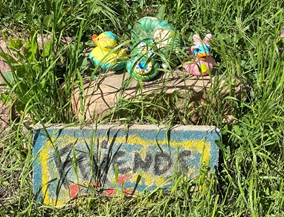
And there’s the  benefit of having a young child in my life who has  not digested the ideal of productivity.  To walk around the block with a four-year-old can take an hour, because it is in her nature to pause.  New flowers (or weeds) blooming (“What is that one called?  Smell it!”),  A bug eating a leaf (“it’s so blue!”).  Yards with intriguing ornaments, whether kitschy or real art, that are always worth re-examining.  When I feel today’s time ticking away, I remember how quickly four-year-olds turn in to teenagers and adjust my adult cadence to her desire to observe intently, with no real purpose in mind. 

— Jimsonweed, Bandelier National Monument

Sometimes I think that my granddaughter is channeling Georgia O’Keefe:

Nobody sees a flower really; it is so small. We haven’t time, and to see takes time – like to have a friend takes time.

So, if pausing is a value that I am starting to savor, what knot does it unravel other than being, for a moment, less engaged with busy-ness?  Yannis Ritsos suggests that these encounters with the intangible may be fundamental to my evolving consciousness:

I hide behind simple things so you will find me….

Every word is a doorway
to a meeting, one often cancelled,
and that’s when a word is true: when it insists on the meeting.

As I read this, I am aware that it is not big planned or anticipated pauses that give me the greatest joy, but the small ones that knock on my door—and then ask me to change. Ordinary time is suspended in wonder and, as Ritsos claims, becomes an opening to the “thin places” where I am able to experience life beyond that which I can touch.  When I meet a sense of communion with a granddaughter or friend, a feeling, a nascent idea, or a burgeoning of love, perhaps I am simply experiencing a flow that cannot be programmed.  The real problem solved is the (re)cognition that much of what I value most at this stage in my life is not planned, but experienced – often as a pause.

What Lies Below….

I started to think about excavation — and what it means in my life — and then I came across this poem:

Excavation

Emptying cupboards from

the pre-Homeric Classroom era,

through strata thick as Schliemann’s Troy.

I am looking for bedrock and

the world before printing

when we worked with our bare minds

— Hugh McMillan, 2015

Working with our bare minds….what a thought in this digital/technology rich world.  McMillan’s words lead me to think about all of my mental clutter, and where I might find the bedrock if I looked.  It also called me to consider how I am looking below the surface, during a time that is seriously unsettling for everyone…

We jokingly refer to our decision to be in Boulder, CO as “a Minnesotan’s idea of avoiding winter”…. A theme that came up in a previous post. Mostly true.  But, instead of returning to Minneapolis for the heady experience of watching spring emerge in the frozen northland, we knew that it would be easier and safer for us to self-isolate here.  Because of COVID, we find ourselves in Colorado for the long term, and in a rental house with a yard given over to neglect.  Since we can’t go anywhere, making a small difference in our suddenly much smaller world called us.

Dan excavates volunteer trees, sawn off but energetically leafing out due to the increasing size of their root system.  We admire each herculean effort.  Opal, our granddaughter, and I tackle the mass of weeds and grass that have overgrown the terrace.  This becomes an archeological endeavor; complete with surprises….Opal is an explorer with the fresh eye and unencumbered bare mind of a 3-year old, adept at finding little things that are hidden from this task-focused adult gardener – mostly items left in the bushes by children of previous renters.  And a stone that we turned over, with an inscription that predates the previous occupants, to complete her work.

Opal’s treasures

While she is busy, I begin to marvel at the care with which someone built in stepping-stones to the upper level and an environment for creative landscaping.  It takes prodigious effort to clear the deeply rooted weeds and grass – any less resilient but more attractive plantings have long disappeared.  There is something intensely satisfying in finding “the bones” of a once loved garden.  When I see them, I know that our small excavation is one of the things that we must be doing now, although it is much more than a summer’s project….

the old garden hardscape emerges

At the same time, I think about excavation in my other Colorado experiment – Avita Yoga.  It’s not “real yoga” (classic) or “power yoga” (sweaty exercise), but a practice focused on removing obstacles:  “The sequences help resolve limiting patterns that no longer serve us so we can remember a healthier way of being in body, mind and spirit”.  Each pose, held as long as five minutes, reveals all of the impediments that lie under my skin and muscles, and asks me to explore them, to understand rather than fight them, and to heal.  I am a healthy person and have practiced classic yoga, but it was a revelation to uncover the restrictions rather than work around them.  This is not miracle work: it requires steady practice, and I need to go deeply into unexplored places — mentally and emotionally, I am excavating my ligaments and joints.  In the process, my busy and distracting “monkey mind” becomes calm, and I feel a deep love for my physical being, including its impediments.  A bare mind becomes (briefly) almost a reality.

When I use my bare mind (ignoring the cacophony of Facebook and newspapers) the demands for justice and an end to systemic racism exploding in Minneapolis and elsewhere demand a different kind of going deeper.  It is like my first unexpected encounter with a real archeological dig in the Peloponnese, many years ago.  Most of archeologist’s work seemed to involve tediously looking for bits and pieces that, by themselves, appeared inconsequential – but eventually would restore a prehistoric dwelling (or tomb – I don’t remember). 

The call at a national level to consider how our historical injustice has bled into the everyday lives of Black people takes me into what I know of the lives of friends and their families.  Like an archeologist, I am compelled to revisit all of the (usually brief) conversations about “the talk”, “Driving While Black”, and micro and macro-aggressions, along with expressions of outrage when yet another Black person is almost casually killed. I dig up a very old conversation with a Black colleague, who said, “I told my son that if he is going to the mall he can only go with one other person and he has to wear a button down shirt.”  We didn’t need to ask why.  Nor did I need to say that my daughters, also teens, were trooping through the mall in groups of four or five.  Or another Black colleague, with a very slight build, who stated matter-of-factly that White women would often cross to the other side of the street when they saw him walking in their direction.  Closer to the surface was a conversation just a few years ago, when a White acquaintance mentioned that when they bought their South Minneapolis home in the early1960s, it included a clause that prevented them from selling to anyone who was not White.  Even more recently, a Black friend asked, with a smile, if I liked the vibrant North Minneapolis restaurant where we were lunching—she knew, without asking, that I was very aware that I was one of two White customers.  As I haul these and many other bits and pieces out of my memory and reassemble them, my bare mind acknowledges how easy it is to ignore how the pieces fit together– and how keeping the them separate has allowed me to stay mostly comfortable in my privileged life.  Like any dig, when more pieces are connected, the whole begins to emerge.

This image shows the remains of a Mycenaean palace at the archaeological site of Agios Vasileios in the valley of Sparta, Peloponnese. Image credit: Angelos Delivorias / Stavros Vlizos / Greek Ministry of Culture.
Image credit: Angelos Delivorias / Stavros Vlizos / Greek Ministry of Culture.

To some extent, personal excavation is a privilege of age. With our minds bared, we have to decide how to use them. Karen Martha and I have written about calling, purpose, and passion – sometimes sardonically, sometimes with heart.  As I look more deeply, I also have to ask:  What is the simple “next right thing” that I need to do?  If I don’t go deeper now, what will my inattention cover up? As the archeologist of my own life, what bedrock do I need to reach to become an authentic anti-racist?