Telling and Retelling the Story

A few weeks ago, I went with a small group on a pilgrimage  to visit Selma, Montgomery and Birmingham.  According to Wikipedia, “A pilgrimage is a journey to a holy place, which can lead to a personal transformation, after which the pilgrim returns to their daily life”.  We are called to a pilgrimage, whether it is to Mecca, Santiago de Compostela, or a 10-day silent retreat in the wilderness,  because it is connected to our spiritual beliefs and commitments.  A pilgrimage is not expected to be fun because transformation is challenging, even when the pilgrim experiences joy – and this was my first.

It is a stretch to think of Alabama as a holy place, but I was called to learn from sites where social and personal transformation occurred during one of the darkest times in American history. I expected that the weight of what I would see would be too difficult to bear alone, and I knew that I would depend on the group.  I anticipated visceral and emotional experiences while immersed in places and events that I experienced, as a white, northern adolescent of the 1960s, only on a small black-and-white TV.   

–National Memorial for Peace and Justice

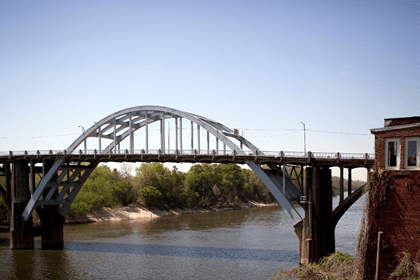
Some of these challenges were obvious, as we silently crossed the heavily traveled Edmund Pettus Bridge, caught in the horror of Bloody Sunday.   Or while I mourned, in overwhelmed silence, in the National Memorial for Peace and Justice, built as a sacred space to honor over 4000 people who were documented Black victims of lynching between 1877 and 1955.    Each experience was painful, and each day exhausting, but they left me with a desire to go on, to understand more.

 But there were cracks in the darkness, reminding me that a pilgrimage is about being open to something new….So, unexpectedly, I found hope, even while contemplating the vast evidence of the “whitewashing” of my country’s history that began shortly after the end of slavery and continues, only minimally disrupted, in the national collective conscience.  I found hope –in the stories of people who participated in the boycotts and the marches, whose message was less words than the continuing display of commitment, persistence, and the capacity to overcome fear for a wider goal.   And I also came across younger people who are working in new ways.

I found hope at The Mothers of Gynecology Monument, a small, privately conceived and owned enterprise, whose development was the vision of Michelle Browder.  I use the term enterprise carefully, because the small lot in an inauspicious area of Montgomery did not announce its radical message on the outside.  Only when we parked our van and entered did I realize that Michelle, the artist who conceived it, did far more than create monumental sculptures memorializing three slave women whose bodies were subjected to a variety of experiments by Dr. J. Marion Sims, who became famous as the Father of Modern Gynecology.

The sculptures are magnificent, evoking both the dignity and the pain that Anarcha, Betsy and Lucy endured.  And they are technically beautiful, taking welding (not a common art form for women) and use of materials to a level than I have not previously experienced.  Unlike a Calder mobile, with its distinctive simplicity of form and movement, Anarcha, Betsy and Lucy are vividly ornate, surprisingly fleshy given their metallic glow, and terrifying in their portrayal of the consequences of involuntary, unanesthetized surgery.  They are also queenly and stoic, survivors in the face of slavery and savagery.  If anything, I thought of them as contemporary versions of the Greek kourai – the monumental females whose bodies hold up the Acropolis.

Michelle uses art as a starting point for social action – Artist as Change Agent.  Also within the Monument is a modern van, outfitted as a traveling gynecological clinic that she and her staff take out to women who do not have access to quality care.  After purchasing Dr. J Marion Sims former downtown Montgomery office, she removed a plaque lauding his accomplishments — and installed it as part of an sly artistic reimagining of what the experiments might have been like if their subject was a middle-aged White man.  His office is being re-purposed as a women’s health clinic.  Not content to limit herself to Montgomery, Michelle and her collaborators are developing educational centers and annual conferences to examine racial disparities in women’s health. If Michelle – artist, activist, and social entrepreneur – is not cause for hope, I can’t imagine where I will find it.

My pilgrimage added to my old story — that the civil rights movement’s non-violent challenge to oppression nudged the needle of justice toward freedom but left oppressive structures largely untroubled. But it also revealed new stories of subversive and novel ways of upending the story that nothing has changed or is changing.  Knowing the story.  Looking for more within the story.  Re-telling the story in new ways.  Taking the story inside and into the world to speak to our hearts.  That is what spiritual development is about.  My transformations from the pilgrimage continue to emerge.  What I did not expect was hope, yet that is what stands out.

Curiouser and Curiouser….

–          Alice in Wonderland illustration by Arthur Rackham (1907) [Public Domain

Grown-ups never understand anything or themselves, and it is tiresome for children to be always and forever explaining things to them (Antoine de St. Exupery, The Little Prince)

A few weeks ago, someone quoted from Brene Brown’s Atlas of the Heart: “Choosing to be curious is choosing to be vulnerable because it requires us to surrender to uncertainty”.  Brown goes on to associate curiosity with discomfort:  “We have to admit to not knowing, risk being told that we shouldn’t be asking.” Later, Brown links curiosity with the perception of an information gap that we commit to closing.   I immediately bristled – internally, since it would have been inappropriate to react to the nodding of heads and pervasive affirmation in the group. 

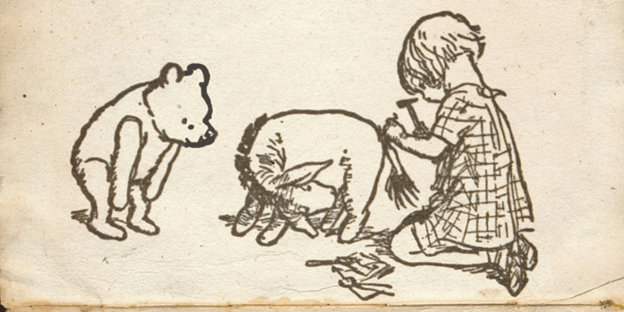
When I was a young child – and even when I was old enough to read them myself – two of my most beloved books were Alice in Wonderland and The House at Pooh Corner.  I read them joyfully to my children – and later to my grandchildren.  What I cherish about both of them is their exploration of simple, uncomplicated curiosity.  Alice hesitates only briefly before biting, although she knows that “one side will make you smaller, the other will make you large”, while the doorknob says “nothing’s impossible.”  Pooh looks at every day as a fresh adventure, whether it is confronting the loss of Eeyore’s tail or stalking the mysterious Heffalump.  While Alice sometimes bemoans a choice she has made, she quickly picks herself up and asks another impertinent question.  Pooh, on each day’s adventure, only hopes that there will be honey involved.

Curiosity may involve a risk, but it is not something that holds either Alice or Pooh back – more than momentarily.  Eeyore reminds us that worrying about not knowing – at least more than briefly – can be a path to cynicism and depression.  I took this lesson to heart:  Be curious.  Move on with the adventures.  Don’t do anything potentially life-threatening, but assume that the jams that you get in to will be temporary.  Don’t think about the “information gap” but move toward the unknown.  In other words, nurture the impulse to try stuff, and a full range of emotions that encompasses trepidation, but also the delight that comes with doing or learning about something new.

It turns out that Brown is talking to people who feel “stuck” in a comfort zone.  She covers all the research that says that we will be happier and freer if we respond to “I don’t really know” with curiosity. We all get stuck sometimes….certainly, retirement for someone like me, who loved going to work, meant that I had to allow myself to drive past the exit for my office without feeling lost and uncomfortable!  And although many routines nurture us (brushing our teeth, eating lunch, going to bed at roughly the same time on most days), it is easy to slip into ways of thinking and habits that constrain.  But getting stuck seems to be something that we choose more and more often as we exit adolescence.  With Alice, Pooh, and Thich Nhat Han as guides, however, we see that embracing vulnerability (which Brown endorses) is not a conscious decision to endure discomfort, but a practice of anticipating novelty and adventure – of embracing childish wonder and a Beginner’s Mind.  

And then there is the spiritual side.  One version of Genesis situates our humanness in “original curiosity”:  “And when the woman saw that the tree was good for food and that it was pleasant to the eyes, and a tree to be desired to make one wise, she took of the fruit…”  Albert Einstein echoes this, suggesting that “curiosity has its own reason for existing.  One cannot help but be in awe when one contemplates the mysteries of eternity, of life, of the marvelous structure of reality…Never lose a holy curiosity.”  Julia Cameron also argues that curiosity is a spiritual path rather than a cognitive decision, and that it requires habits – she suggests random writing in “morning pages”, scheduled “artist dates” to explore a new esthetic, and regular walks that have no purpose other than to look deeply at whatever is in one’s path. 

Photo by petr sidorov on Unsplash

I admit that I don’t do these as consistently as I once anticipated, but I have other habits that invoke the same opportunity to approach the world with a Pooh-like sense of wonderment.  Meditation – something that for years I thought that was beyond my capacities – clears my brain of monkey-mind, and creates space for hope that goes beyond ticking off items on the incessant to-do list.  Connecting every week with someone (or several people) who are willing to engage in authentic and vulnerable conversations about “big stuff” never fails to make me curious.

Of course, I take Brene Brown’s assertions about the benefits of curiosity to heart because it is particularly important as we age.  According to Henry Emmons and David Alter’s 9 Keys To Staying Sharp, curiosity comes only a few steps behind the basics of moving, eating well, and getting enough sleep in warding off mental decline.  Nor do I want to ignore Brown’s s admonitions against getting too comfortable and avoiding vulnerability.  If I am always afraid of falling, will I ever learn how to skip again?  However, I also note that as we age we can more easily choose to embrace vulnerability and become more playful, as long as we are willing to follow Shel Silverstein and  “grow down” (along with giving away our business attire and our mother’s china):

He got his trousers torn and stained,

He ran out barefoot in the rain,

Shouting to all the folks in town,

“It’s much more fun, this growin’ down.

 — Shel Silverstein

How Did I Ever Get Here?

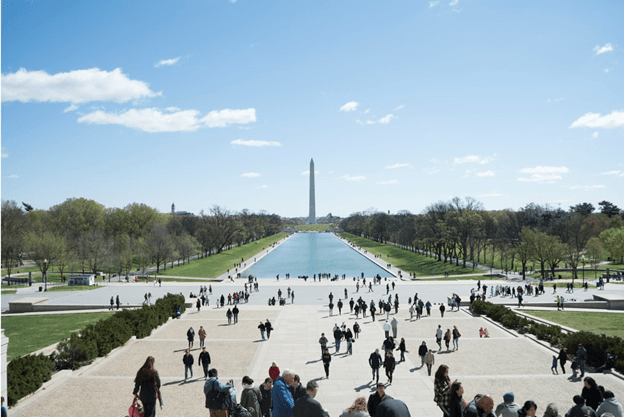
Photo of our national secular church….and public square — by Jacob Creswick

I was recently asked to talk about my experience with church and the public square, and I immediately said yes – I am always up for talking.  But then I panicked and could not imagine what I would say.  After several days of muddled thinking, I realized that I need to start with where I have been before I can talk about where I am.  For me, that is increasingly a response to questions about what I think, and I wonder if that is part of getting older….

As a child and young adult, I was unchurched.  My parents, who were both raised as Lutherans – one grandfather was a Lutheran minister – had me baptized. Their story goes “we walked out of church, looked at each other, and said ‘why did we ever do that’”.  I have no memory of attending a church with them, either as a child or an adult.  In other words, church was not an embedded experience, apart from episodically attending a Methodist Sunday school with my elementary school friend, Mary Lou. I had nothing to rebel against.

Photo by Duanu00e9 Viljoen on Pexels.com

I was also anxious because I have always considered myself a lackluster participant in the public square.I went to a small liberal arts college in the 1960s, and activism was part of the social and educational experience. About 10% of my peers were arrested in a civil rights demonstration when I was a freshman – I was not among them because I had stayed back to study. After graduation, I was humbled by the ways in which so many of my classmates figured out how to continue that activism to visible acclaim. Among my peers were a well-known environmentalist, a defendant in the anti-draft “Dr. Spock Trial”, and the founder of a non-profit litigating cases in support of women’s rights. Still others obtained top positions in national journalism.

By those criteria, a decision to become a sociologist who focused on education for the less advantaged seemed small potatoes in terms of being active in the public square.

Back to church….

When my children were young, I attended a Unitarian church in Lexington, MA, which was acceptable to my un-synagogued but Jewish husband.  It was less a spiritual than a socio-historical experience because I loved just being in a 200-year-old building whose first minister was Ralph Waldo Emerson.  And I liked the people. I began seeking a different relationship with church only as I entered recovery from alcoholism, where I encountered my spiritual self with a group who shared their experience, strength and hope on a weekly basis. 

I was impressed with an old-timer’s anecdote: When he whined ”I don’t know what my Higher Power wants me to do”’, he got a simple answer: “All your Higher Power wants from you is to not drink and be a decent person”.  Recovery gave me a space to seriously consider Teilhard Du Chardin’s statement that we are all spiritual being who are having – or suffering – a human experience.  I also met Dan, raised casual Congregational, who was with me on my path.  So, in my late 50s I started attending a liberal church. There are many ways in which in which the “spiritual but not religious” seek self-understanding and value-based action in a world that often seems meaningless.  For me, all my disparate efforts to enact those – yoga, meditation, volunteering, recovery meetings – gave me a taste for something that church has fulfilled. 

For me, church is the one institution that consistently brings together three important threads of my human experience: developing an inner spiritual life that helps me to challenge instinctively self-centered reactions, creating a supportive and caring community of thoughtful seekers, and carrying the wisdom of spirit and my values into the world in order to make a difference.  The latter is important to me because it means thinking about the public square based on collective reflection rather than individual preference – in other words, taking others into account.  The balance between these three elements of my church experience has varied over time, and I know that the weight different people bring to those basic human human challenges varies a great deal.  But, for me, a church must be all three to feel that I really belong – I could get reflection and community in my 12 step groups and finding places that need extra hands to help solve the world’s problems is easy, but nowhere else do I find a dynamic connection among them.

But what about the public square – making a difference in the world, aka purpose?   I have learned as a member of the churches that I have belonged to that (a) it is ok not to be an elected official, the founder of an organization, or a trailblazer in visible social equity initiatives; (b) I am obligated to look behind the invisible curtain that hides the possibility of something new, and (c) showing up where I am needed is often enough.      

I can admire the Jimmy Carters of this world without feeling inadequate, but I do have a responsibility to use my time and talents as an advocate and support to those who are more visibly out there.  In other words, now that I am almost retired, I can show up when showing up is important.  Dan found a quote by Wendell Berry that summarizes how I think about what I need to do to bring my values into the public square:

We have lived our lives by the assumption that what was good for us would be good for the world.  We have been wrong.  We must change our lives so that it will be possible to live by the contrary assumption:  that what is good for the world will be good for us.  And that requires that we make the effort to know the world and learn what is good for it.

― Wendell Berry, The Art of the Commonplace

And I am also reminded that what I think of myself is not always what others see in me.  A decade ago, I was at a retirement event for a seasoned administrative assistant.  We were joking about what we wanted on our tombstones (good retirement party conversation…) and I claimed, “Tart of Tongue and Heart of Gold”.  The retiree looked at me and said, “Oh no – it should be ‘She Supported Women’”.  All I did was show up and advocate when I was needed. But  I also reflect on Richard Rohr’s observation that we show up when we are called to do so – and that is nothing to boast about, but simply listening for the voice that calls.