Condition: Provisional

https://www.flickr.com/photos/rayandbee/5915105592
The Wheel of Life
Vigeland Sculpture in Frogner Park, Oslo

As I live through this COVID-19 pandemic, one phrase keeps popping up in my mind: the human condition. To me, the human condition is our imperfection, our inability to escape suffering, and that we live in a natural world indifferent to us. I keep reminding myself and my family that we are experiencing firsthand what can go wrong in a natural world that we thought we had mostly tamed. At the same time, our culture promotes an ethic of personal responsibility, suggesting that we have an influence on what happens to us. So what does it mean to be subject to the human condition but responsible at the same time?

Take my grandfather Nils Jacobsen’s life. In 1917, before the end of World War I and another pandemic, the Spanish flu, he brought his wife, Marthe, and two-year-old son, Alden, my father, from their farm in Norway to Racine, Wisconsin, where they hoped to build a new life. The 1920 census listed them living in a rental in Ward 8. They were still finding their footing. In 1926, Nils sold the family farm in Norway, which he inherited as the eldest son, to his brother.  It appears that life was going well in Wisconsin. Times were good! 

By the 1930 census, Marthe and Nils owned a home, a sweet bungalow that’s still standing, and they listed a second son, my father’s brother. But it was the start of the Great Depression. Soon after, Marthe died at age 51, and by the 1940 census, Nils, my father, my mother, my father’s brother, and my older sister were living in a rental flat. It was World War II, and the fishing on the Great Lakes had dried up.  My father and Nils struggled to find work they could do. Nils died in 1948, a bitter old man, as my mother described him. 

Not an altogether happy tale, but I suspect most families, if they dig, can find similar stories. How much of what happened was Nil’s responsibility? Maybe selling the farm? But surely not Marthe’s death, the loss of their home, and the loss of fishing for a living. I tend not to judge him harshly. Nils and his family lived through World War I, the Spanish Flu pandemic, the Great Depression, and World War II. As for Nils dying a bitter old man, I’d say he succumbed to the human condition

While Nils confronted the human condition writ large, until now, my own experience has been more personal.  After my second husband, Gary, died, I struggled, literally, for years with searching for meaning about his death.  I endured guilt that I had done something to bring this outrage on us, and I believed that if I could identify what I’d done, I could atone for it—I should atone for it. When I wasn’t feeling guilty, I was asking myself about the larger karmic meaning of his death—were the repercussions in our immediate world a way of balancing the scales, so to speak? I found no clear answers. 

Being a church-goer, I decided to take my pain to the minister, Pastor Rob. Pastor Rob didn’t like the idea of karma—that I bore responsibility for Gary’s death and, thus, for my grief.  He thought such thinking was where New Agers go wrong. Instead, he told me that Gary and I, like all humans, were subject to the human condition, which includes suffering. Neither of us had caused his death and I didn’t owe any atonement. Wow! I walked out his office feeling lighter, a new freedom. I still didn’t know the meaning, and in truth, I continued to seek it, but not finding it now felt okay. My search became part of my human condition. 

Later I learned about provisional existence. Viktor Frankl wrote that prisoners in concentration camps could not see an end to their suffering.  They could see no future so they lived a “provisional existence.” Pastor Rob had given me such an existence. I found no meaning, but I could live with that, provisionally, and keep looking. Frankl said something else that resonates with me in these times, that rather than me asking for the meaning of Gary’s death, I am being questioned by life and I need to find my own answer in my own terms.  In Frankl’s words: Each man is questioned by life; and he can only answer to life byanswering for his own life

So here I am, living in a world-wide pandemic. This isn’t the retirement I planned, stuck at home, worried about family, friends, and the world more generally. Worried about an uncertain future, are my savings withering so that I’ll be one of the people living solely on Social Security? Will we have a depression? What about my grandchildren, one in college who’s been forced to come home?  The other about to graduate into a precarious world, and there will be no celebration. I am being questioned by life, and how will I answer? 

I have choices. I can weather the pandemic, hopefully stay healthy, and go forward with what is available now.  I can support family and friends as they move forward, too. If my money’s gone . . . well, I’ll deal with that if I must.  My other choice, of course, is, like my grandfather, to grow bitter, that my glorious retirement has been denied me, that my plans have been slayed by a merciless nature. 

 Every day I take advantage of the one freedom still left, the opportunity to take a walk in the unfolding spring, oblivious to the havoc of a virus. It’s Minnesota, so it takes a while for spring to show its color, but because my life has so drastically slowed down, I linger on my walk and look for small signs of the turn towards spring.
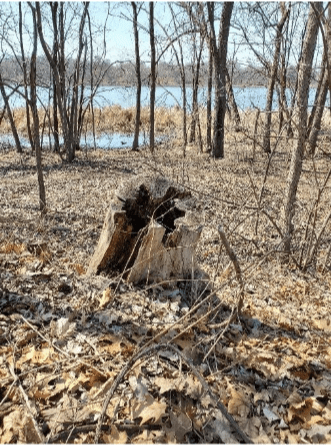
One day I noticed tree stumps, and I walked along eagerly photographing tree stumps, which mind you, are presumed to be dead, cut off. But then I noticed that some tree stumps don’t quit easily. They make the best of things and put out new shoots of life. Now and then there’s a hollowed out-stump that couldn’t regenerate itself. But everywhere in nature there are examples of persistence. Think about those weeds we so fervently pull. 

I have my share of human arrogance, but I’m learning to accept the indifference of our world—some natural and some human behavior—it is the human condition.  But in fact, indifference is a condition all life faces, human, stumps, and otherwise. So I carry on, knowing that as I’m questioned by life, I can keep on putting out shoots, it’s on me to find my own answer. 

A picture containing photo, fence, showing, outdoor

Description automatically generated

Later I learned that coppicing is a traditional method of woodland management that harnesses the ability of many species of trees to put out new shoots from their stump or roots if cut down. 
Resolved. . . to Be Kinder to Myself

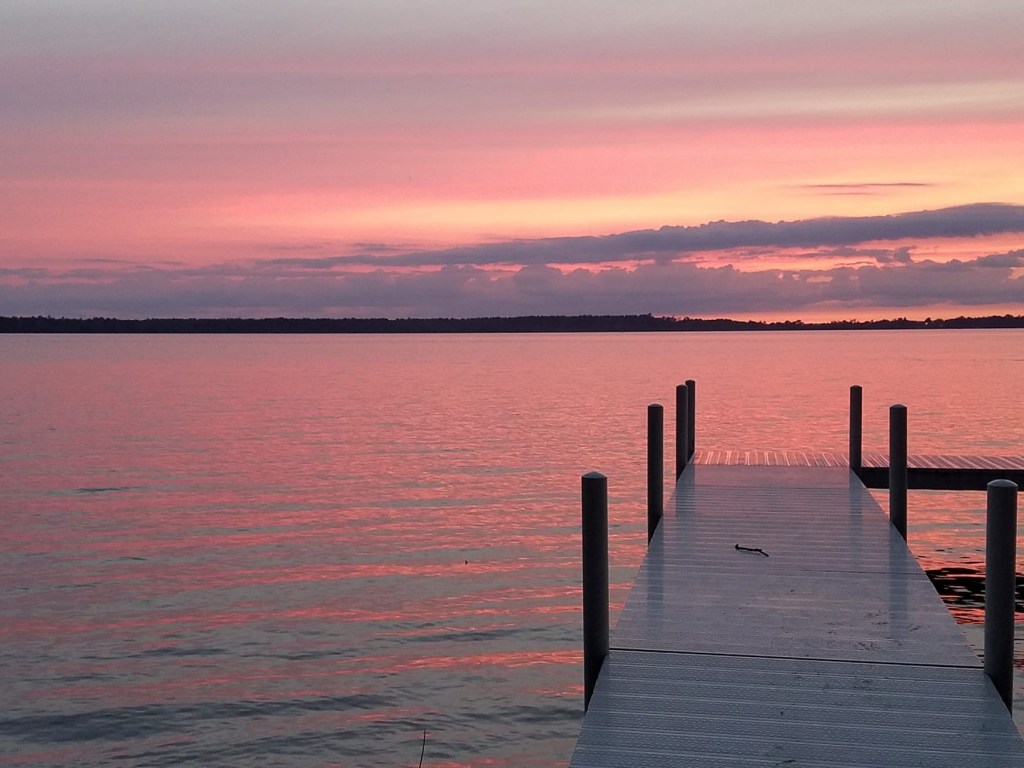
Sunset at Round Lake, Nisswa, MN

“What convictions survive into dotage?” asks the main character in Jane Gardam’s book, Old Filth, surely a question worthy of a blog devoted to retirement and aging. When I ask myself this question, I hear my stepfather expounding on one of his own favorite convictions—that most people are afraid and lack the courage to look hard at themselves, to admit their failures. On the face of it, this appears a wise and reasonable caution, and as a young idealistic girl who wanted to be a person of courage, I grabbed on and internalized this notion, not realizing how harmful constant self-criticism would be.

Focusing on my failures assumed the negative, that I had failed in some way, even when a different perspective might have pointed out that I had also succeeded in another way, thereby polarizing the outcome. It was either a success or a failure; there was nothing in between or a mix of results.

Casting a critical eye, which I took to be a brave me facing my deficiencies, led to many dark nights of looking back with regrets. But Parker Palmer points out “the past isn’t fixed and frozen the way we think it is. Its meaning can change as time unfolds, if we pay attention.”

My second husband, Gary Stout, loved to go to the burning bowl service at Unity church on New Year’s Eve. If you are not familiar with a burning bowl ceremony, what happens is that you write something that you want to let go of on a piece of paper and put it into a bowl where it gets burned—presto, you are done with it, ready to move on and stop fretting—notice how fretting rhymes with regretting? Gary and I also freely told each other what we thought the other person ought to let go of—ouch! It made for a lively New Year’s Eve.

So, should we face our regrets about our failures and flagellate ourselves endlessly, as my step-father maintained; let go and burn them away in a burning bowl ceremony; or, as Palmer suggests—reframe them? In the spirit of growing older and wiser, as a start, I suggest we reframe them.

My choice to reframe leads me to a highly personal story, one that I hesitate to share, but acknowledging that one way to reframe regrets is to take their power away by telling their story.

A regret I’ve struggled with for years is that I was a failure in my professorial career. I started out, as a new professor at age 50 at the University of Utah, filled with ambition, ready to set the world on fire. Instead, about a year after I arrived, my world was set on fire when my new husband, Gary Stout, was diagnosed with pancreatic cancer and given about a year to live. I supported him, loved him with all I had, and watched him die over the next year.

His death flattened me, crushed me, rendered my ambition lifeless. The belief that I could do work that would improve schooling for the children I so had wanted to serve decayed into a hopeless cynicism. Except for a couple of bright moments, I never really got going in the traditional professor role.

In addition to being flattened, I had my stepfather’s voice, my “conviction” that I had to tell myself the truth, that I was a big fat failure. As you can guess, this truth did not have the effect of lifting me out of my despair, it only deepened it.

Then one day, another voice clamored to be heard, asking me what else I had done in my twenty years of failure. I believe I was reading Elizabeth Gilbert’s book Big Magic, when I had this breakthrough. I made a list of all the other things I had done in the twenty years, deciding I would subtract my failures from this list. It was a long list—I now have it posted near my desk. It includes such things as reading great books, hanging out with loved friends, seeing my children grow into fine adults, grandchildren, a couple of flings, travel, commitment to teaching, helping students achieve their dreams. . . and so on.

Not a bad way to spend twenty years, I realized. Better yet, I had told myself the truth, looked hard at myself. Palmer says, “regret shuts life down.” I would add that it also shuts memory down, freezes it on what didn’t work instead of opening us to what did.

Ocean Vuong, in his magnificent book, On Earth We’re Briefly Gorgeous, says:

History moves in a spiral, not the line we’ve come to expect. . . the past never a fixed and dormant landscape but one that is reseen. Whether we want to or not, we are traveling in a spiral, we are creating something new from what is gone (pgs. 27-28).

I’ve come to believe that to make sense of my life and my past I need to ignore the harsh voice I adopted from my stepfather and instead to not only reframe but to look again with new eyes, eyes that refuse to label good or bad, success or failure, eyes that are willing to “create something new from what is gone” by seeing the nuance and looking anew over and over.  I don’t mean the cliched “Everything happens for a reason,” but rather a willingness to be kind to myself and my past.

Which brings me to New Year’s resolutions, which I love—and I’m not talking about diet and exercise. I’m talking about resolutions that open life up, refresh it, if you will. This year I’m resolving to get passionate about making time to be at peace—maybe twenty minutes a day of meditating, doing a full body scan, deep breathing, or something like that.  All this, of course, is about living in gentle kindness with myself, seeing those spiraling memories that can dominate growing older with kind and gentle eyes. So, be it resolved—Karen Storm will make time for peace and be kinder to herself in 2020. May such kindness last forever. Happy New Year!

Everyday Artistry

Karen Rose and I were exchanging emails about the focus of the blog—she was reminding me that we promised not to give advice or promote any product.  I don’t want to promote a product, but I do tend to be preachy—it’s the teacher in me. Karen Rose stated that she wants to explore and support creativity and the arts. As I thought about her comments, I decided to make a list of everyone in my immediate circle and what artistic endeavor they might be engaged in—I even included grandchildren who by necessity should be mostly engaged in school.  Of about 21 people, 14 are engaged in some type of identifiable art. I included cooking, gardening, knitting, as well as the more obvious painting, writing, and making music.  That’s better than half, allowing for a convenience sample and the fact that any of those who aren’t observably engaged in art are perhaps doing something I don’t know about.  For example, my grandson, Henrik, a senior in high school, designs and collects shoes—is that art?

          Of those not obviously engaged in an artistic pursuit, does commitment to a sport or working towards an academic or career goal count as art? I didn’t interview my sample, and I also wonder what they might tell me if I did.  Perhaps they have an artistic interest that they would pursue if they “had more time.” At any rate, I’m led to conclude that Karen is onto something, the human draw towards artistry is quite strong. On the other hand, limiting my definition of art as something that manifests a product—a great meal, a lovely garden, a poem, a picture, etc., might miss the real artist in all of us.  As the cartoon at the top of this blog suggests, we are always creating our lives, and yes, sometimes our creative efforts go up in flames with lots of black smoke.  As Iris Dement so perfectly puts it:

          An’ my life, it’s tangled in wishes

And so many things that just never turned out right.

          As many times as I’ve heard this song, live on stage at the Guthrie for the first time, and on her CD many times after, I am stopped in my tracks by that line.  I think about all the things that “never turned out right.”  My perfect second marriage that was derailed by cancer.  My not so perfect first marriage that ended but left us with two marvelous offspring and many good memories. My ambitious career plans that never quite materialized. The fact that I told my children to never go into education, and they did, but they are doing work they value and love.  The essence of life is that we plan and plan, and then life does its thing.  There are numerous clichés about this Truth. I won’t recite them here.

What keeps us going in the face of setbacks, though, is that we always have a chance to create something new from that which never turned out right. The way in which love can prevail in spite of the mishaps of life. I am calling this Everyday Artistry.  It takes immense creativity to live.  One thing I loved about being a teacher was that I was always problem solving on my feet.  Well, I maintain we mostly live that way, too.  Some of our plans work out nicely, but mostly there are perturbations, and we work out ways to adjust. 

So how does all this inform a blog about retirement and aging?  Well, for me it means nostalgia might feel good, but moving forward and creating is essential to living.  And there’s an opportunity for artistry in everything we do.  Finding a new sport when you can no longer run; playing pickle ball instead of tennis; learning rosemaling although you’ve never been “artistic,” trying new recipes based on new knowledge of nutrition, sitting on a chair when you garden because your back can’t take it. Finding ways to show love when it seems like it’s left the room.  Some new acts are adjustments and some are exploration. It doesn’t matter, that’s what Everyday Artistry is all about and we never lose the chance to practice it.

And. . .

Karen Rose reminded me that some of us love the charred marshmallow—me included—with its middle that isn’t quite melted all the way through—the marshmallow that goes up in flames.  I say, put another one on the stick and try again. It’s all artistry.

Is There Something Wild and Precious in All of Us?

Mary Oliver’s line, Tell me, what is it you plan to do with your one wild and precious life? seems to be quoted everywhere of late. It speaks of living a life of one’s own design, a design that unleashes the wild and precious rather than the banality of slugging through our days intent on keeping a roof over our heads and food in our bellies. It speaks of something wondrous that’s out there if we only let go of our need to conform and live from our true center, our spirit. 

Not too far into retirement I found myself often wondering what was wild and precious but dormant in me. My life was not exciting.  I moved between my own home, the library, the health club, my children’s homes, and the homes of friends, with an occasional trip out of town.  Not the stuff of wild and precious, of that I was certain. And here I was, free to find the wild and precious and live it.  

But how do I find that which lies dormant in me, that which yearns for expression in my life? Or perhaps I already have it, perhaps in the routine I’ve pressed upon my days. I suspect, however, that routine, while affording stability, suppresses experimentation about what might be dormant. . . and yet “a girl can dream.”

The dream went something like this. . .

She spent the entire summer dreaming of Wales. It made no sense, this yearning to leave her settled life, her children, her easy routine. Yet in her fantasies, it made all the sense in the world. She could start over, no, not start over but be born anew, without memory in a lush, beautiful place, where people speak in a language that she would have to learn—as a baby learns language from birth.

In August she booked her ticket.  She bought an enormous suitcase and packed it with her clothes. She told her children she was taking a long trip—how could she tell them her truth, that she sought a new land, a new beginning? How long will you stay, they asked, but she avoided the question. I’ll be back when I’m ready. . . 

The plane landed in Heathrow, not Wales. Wandering a bit felt right. Like Odysseus seeking his home, she sought a new home and an adventure on the way. Why had she brought such a big suitcase, she thought as she pulled it outside to find a taxi to the train station. What had she been thinking? But wasn’t that the point? To not think but to wander and live on the way?

The taxi driver left her suitcase on the curb, and she dragged it inside. The train timetable clicked with suggestions. Where in Wales should she go?  She settled on Llangollen—how many words have four “l’s”—“l” for living. She pulled the suitcase to the platform. She would need to drag it through two train changes, if she was reading the itinerary correctly. Maybe she should just leave the suitcase here. It was still baggage from her old life.  She could buy new clothes in Wales—Welsh clothes. But still, money was money, and she wasn’t sure how far hers would go in her new life.

The train ride was exhausting. For each of the two changes, she bounced the suitcase down to the platform and dragged it up and onto the next train. She slept when she could and stopped counting stations, staying awake just enough so as not to miss her stop. 

And the dream of a wild and precious life stops somewhere about here. . . 

Is this what it would be like? Is it real or an escape? What I wonder is whether and how we lose the will to live that which is wild and precious in service to work, family, security, and whatever else haunts us. Then, suddenly—and it seems sudden—we are retired, free but with baggage that we are reluctant to leave on the train platform, baggage that must be hauled up and down with every new step we take. And how do we reconcile baggage with possibility?

Image result for old woman with big suitcase