In Praise of Postmenopausal Women

There are lots of jokes about menopause. 
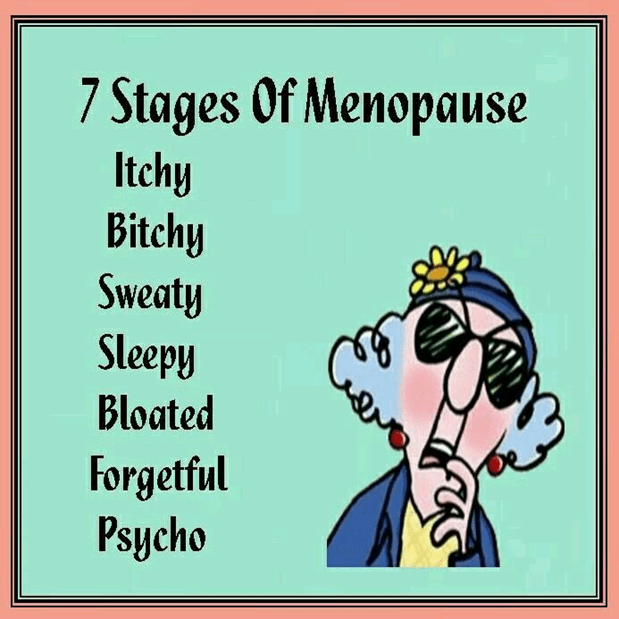
There are no jokes about post menopause. 

Is that because we have internalized scientific reports summarizing the negative consequences of losing estrogen?  Weight gain, bone loss, heart disease, depression, and desiccated vaginas…How can you make that funny?  Recent debates about “childless cat ladies” suggest that the social consequences of not being able to procreate may be even more severe:  isolation and invisibility coupled with a lack of usefulness. 

Men, on the other hand, are still producing sperm when they die.  

Social science tells a different story, emphasizing the role of older women in supporting the next generation, as well as caring for family and community members.  Older women are willing to translate emotional caring into action on a daily basis, an image that even the most traditional sexist male can support.  But let me take this in a different direction: Society NEEDS us, and not just for the most traditional roles. 

Start with my friend Jan Hively, whose Ph.D., finished when she was almost 70, investigated the productivity of older people who lived in rural areas.  Asking what they did in their communities allowed her to estimate what it would cost to replace them with workers.  The answer was: A LOT.  Meaning that most rural communities would wither if it were not for the unpaid (or underpaid) work of older people, from volunteering in the library, driving school busses, and taking care of even older relatives. And older women are more likely to work and donate unpaid work than men. 

Jan’s mantra was “meaningful work, paid or unpaid, through the last breath,” and she lived up to it. She was an activist and social entrepreneur. In the early 2000s, as we boomers started to retire, she urged us to think of our last decades as an opportunity to make a difference and not a time to drink martinis, watch TV and play golf.  In her 70s and 80s, after finding her tribe of co-conspirators, she went on to incubate or co-organize many non-profit organizations to increase the opportunities for older people to improve their own and their neighbor’s lives.  New and existing organizations drew on her never-ending flow of ideas about positive aging; two that she co-founded have grown into national and international initiatives: The Vital Aging Network, and the Pass It On Network

And her second admonition was to have fun working with others! She knew that her strongest skills were imagination and starting things so she collaborated with people who love making the engines of a new enterprise run fast and smoothly.  Another wisdom of age:  we often are more aware of who we are – and are happy to turn over control for the work that suits us less well.

At 90, Jan wrote long notes to the people who were important in her life and work, including me – I was humbled because I always thought of her as my mentor – I was a youngster in my mid-50s when I served on Jan’s doctoral committee!  Like many who knew her, when I find myself “sitting on the dock of the bay, wasting time” I hear Jan’s voice urging me to make those reflective moments pay off, either for my own development or someone else’s. 

But Jan, although personally inspiring, is not the only one with creative suggestions.  I am taken with the idea of the “granny cloud,” which emerged from Sugata Mitra’s efforts to educate children in places where there are no teachers (or not enough of them).  The role of the grannies (real ones and people trained to think like them) was to admire and encourage children in learning – which turns out to be critical.  The powerful effect of being a granny is to reinforce curiosity and motivation.  The international granny cloud volunteer network was derailed by the global pandemic – but grannies will be there in force as we continue to re-imagine social networks in the post-Covid future.  I think that men can learn to be grannies, but they usually need some immersion training….

How about the League of Women Voters, founded in the exuberance that accompanied the passage of Amendment 18 in the US?  Relying almost exclusively on volunteers, the League continues to see its primary purpose as protecting democracy through policy advocacy and direct efforts to increase voter registration and participation.  Its membership, which declined with the increase in working women, is soaring again as the gray tsunami looks for ways to work – paid or unpaid – as long as possible. If you attend a League meeting, you will see that post-menopausal women are at the forefront of promoting non-partisan policy debates – including sponsoring events like Bad Ass Grandmas for Democracy.

Contributed / BadAss Grandmas for Democracy

But the role of post-menopausal females in sustaining community and providing intergenerational continuity is not just for humans.  Recent research claims that “Post Menopausal Killer Whales are Family Leaders,” who support the pod’s health by finding food sources.  And who can help but watch, with fascination, the video of the 60-year old Orca, Sophia, taking down a Great White Shark, top predator of the ocean, who was probably threatening a member of her community.  No jokes needed – just attention to the evidence that the world needs postmenopausal women warriors.  Who cares about a few weak, old sperm – lots of those to go around – in contrast to keeping us all safe, fed, cared for, protected, on the right bus, and registered to vote?

Photo by Valeria Nikitina on Unsplash

Circle of Friends

Getty Images, courtesy of Unsplash

A few weeks ago, I read an email from my friend Gary, part of regular, long-ish musings that he sends to a select few.  He was stimulated by the observation that people typically have no more than 150 friends and, true to his reflective nature, he dove in and found Robin Dunbar’s observations on friendship.  I mentioned this “fact” to my husband, who quickly noted that it was close to Harari’s observation in Sapiens that human societies change when their membership increases above 150, becoming more complex and often hierarchical.  Enter the blacksmith and the mayor….

Well, Gary is an extrovert who has lived in the same part of Minneapolis for almost his whole life.  He also worked for over 30 years in a position that thrust him into conversational spaces with faculty members from a more diverse group of departments than any other person at the University of Minnesota.  In other words, Gary is a social anomaly in our modern, mobile world. Many of the thousands of faculty and professional staff at the knew Gary, directly or indirectly and, coupled with his rootedness in the community,  I am sure he would recognize well over 150 people as pleasant acquaintances with whom he has shared conversations and food. As a thoughtful and interesting person, he could converse equally well with those immersed in Veterinary Medicine, Classics, or the Registrar’s office. His Christmas card list is long.  Distilled out of his hundreds of acquaintances is a core of 11 close friends who he has treasured for over 30 years.

As I reflected on his email, I felt small and a bit lonely!  I counted up my close friends (people I see or am in regular zoom contact and have known for 30+ years), and I could come up with only 3, or at a stretch, 4. I have no obvious social anxiety or deficiencies, so I had to starting thinking about why….

Unlike Gary, I have lived in four countries, 5 states and 16 distinct places. I graduated from high school and college at a time when a long-distance call cost real money.  My friends from those days are all highly mobile – none live where I grew up, and after college we all scattered across the globe.  And I more recently moved across several states.

When I think of a circle of friends, I go all the way back to junior high school and a a group that I had a 60th reunion with last year – that is me in the green sweater.  We live in different places, see each other every decade or so,  but we can start up a conversation as if no time had passed.  This means a lot: I feel joyful when I think of our shared adolescence and the interesting and fun people they continue to be.  I have not had a “circle of friends” like that since.

My friendships don’t fit neatly into a set of concentric circles that reflect differential “closeness” with me at the center.  As a member of overlapping national and international associations, I have a long-standing web of personal-professional relationships – people with whom I have regularly broken bread or shared coffee that that may be as large as Gary’s.  Whew – even though I am not a true extrovert, I seem to have a natural preference for connecting,  and when I think of the joy of finding someone who I really like in the lobby of a soulless hotel in a major city or another country, I smile. 

But I am retired, as are many of them. I am unlikely to travel to Florida just to see Joe or to Sweden to visit Olof and Helene, and we no longer have conferences that ensure meeting several times a year.  Still, looking back on the jokes, the work chatter interspersed with family life, the occasional sharing of hard stuff, music preferences, and furry companions, I know that they are much more than “acquaintances”.  It lightens my heart to know that I worked, over many years, in the company of people who mean much more to me than what they do or produce. 

A web is not a circle.  When I think of my “close friends” whom I have known for decades (and will get on an airplane to see) the list of expands a bit.  In this, I am in a community that ebbs and flows, a web where everyone is connected to others, directly or through me, and where we share the same feelings of care and concerns for each other.  I am not at the center and not at the edge, but our lives are intertwined even as they are separate. 

I am drawn to ask what we mean by friendship, beyond the obvious indicators of caring, trust, a sense of mutual intimacy and a shared sense of humor.  I have been  a mentor to many students, I have kept in regular touch with around 7, many of whom I have known for decades. Is that friendship, or something else?  Or the colleagues with whom I have shared years where we collaborated on projects that engaged us deeply?  They are so much more than acquaintances, yet not people who I would invite to a barbecue. I am grateful for each of them.  Karen Hering says that I  can claim them as companions on life’s journey.

Image courtesy of Nina Cvijo, on Unsplash

And what do I say about people with whom I have shared intense relationships – old loves, sponsors, mentors, co-conspirators of one kind or another – who are in my life for a shorter period, but who think of me as often as I think of them and who are forever sewn into my heart.  I can I can touch base with any of them when it feels right.  Claim them again….

In the end, I have decided that I can’t place people I have known within circles.  I want to remember them in the web of relationships that have meaning for me and for them – and that can be activated after many years with an email or a phone call to evoke a mutual burst of warmth and gratitude. 

The RMD Blues….Or, What Happens When A Frugal Person Retires?

Photo by micheile henderson on Unsplash

I hope to tell you we were shocked

At the 80-year-old man found dead

$180,000 in grimy envelopes scattered

Everywhere like old hopes, old sin.

RegretMichael Riley

I was touched by Michael Riley’s poem, which conflates the misery of the miser and the equally meaningless life of a rich retiree with handmade shoes.  But, in a way, I relate to both unattractive images.  I managed not to squander today’s pleasures in fear of having too little tomorrow – but barely.  Retiring “comfortably” caused discomfort because there was something “wrong” about having a monthly income without working.

That disquiet began when I became aware of the dreaded RMD – the required minimum distribution from tax deferred retirement savings accounts….I spent hours in my late 60s using IRS tables to see whether I would have enough to live on until, in total frustration, I called Darla, who manages our money.  Her response:  “Yes, if you keep living the way you are.  In fact, because you are retiring late, you should spend what you want now, and travel where you want to go.  When you are 80, one or the other of you probably won’t want to do that anymore.”  Darla is blunt. 

When Karen Martha and I started this blog, we resolved to reflect on what we were thinking about (confronting?  agonizing over?) as we moved from satisfying mid-life and work to something less well defined.  We were also clear about what we wanted to avoid.  So many retirement blogs emphasize issues of money – how much you need to have to retire, how to manage it once you have retired, and how financial decisions should affect others, such as whether to work part time or to move to a less costly city/state.  We wanted, in contrast, to focus on what was in our hearts. But, money becomes unavoidable at some point.

We have much in common, but over our many years of friendship we never really delved into our unrealistic but unmanaged fear of poverty.  Karen Martha grew up with a single mother in her early years, and experienced financial hardship until her mother remarried; my father went back to graduate school in his 30s and, although not poor, my parents had to watch their finances carefully.  However, the Karens agree that our lessons — NEVER have any credit card debt and ALWAYS save more than necessary — were not particularly logical since we worked in education – not highly paid, but also a profession with employment security and good pensions.

Fast forward to my middle 70s:  Dan and I have Social Security, and we have enough from retirement accounts to live more comfortably than anticipated.  What a blessing!  I have the luxury of blogging, traveling, volunteering and playing with grandchildren, and don’t anticipate much paid work.  The same is true of most of my friends. 

But “you worked hard for it” feels self-satisfied when newspapers report weekly that most Americans are unable to save for retirement, and others are chronically under-insured and a step away from a health-induced financial disaster.  Then there is the annual “windfall” of RMD from those pre-tax retirement accounts which will, apparently, never run out. In other words, I feel guilty and even (sometimes) unworthy of being one of the “advantaged older population”. 

When I was working, I adhered to my family’s legacy of prioritizing charitable donations, but there was an upper bound set by the NEVER credit card debt and ALWAYS save rules.  Now, enter the late fall specter of the RMD windfall…the old messages argue in one ear that anything that I do not need this year should be reinvested so that I won’t be eating dog food when I turn 100.  An equally insistent message to give away what I can afford speaks in the other ear.  Then there is a new rumbling note that floats above:  I was fortunate to live during a period of unprecedented economic growth and to be financially secure; my grandchildren are unlikely to have the same experience.  How much should I be saving for them? 

Peter Singer has one answer in Famine, Affluence, and Morality: We all, within our means, have a moral obligation to reduce suffering, and owe this to all people and places because of our common humanity.  But his argument ignores every parent’s obligation to protect our loved ones from realistically anticipated harms.  The Native American 7th generation principle also requires me to attend to the suffering of the planet and all of the creatures and plants that make our home livable.  And what about the international movements to create peace and stability in our fragile social systems? Or initiatives that support flourishing as well as alleviating suffering (e.g., youth programs)?  Oh, the causes that I feel drawn to – and the guilt that I feel when deleting requests for contributions from groups that “do good” and are highly rated by Charity Navigator….

RMD sits there in the middle:  I have to take it and pay incomes taxes according to the government.  Then – SAVE for Dan and me, SAVE for the coming disasters that will occur in 50 years, SAVE for unaffordable college tuition for the next generation, or DONATE now. 

So, although I said that I would never, never be one of those retired people who perseverate about money even though they have more than enough, I find that I cannot avoid the subject.

And lifelong frugality kicks in…should we take that long-postponed Viking River Cruise? (Yikes!  Have you seen what they cost for a room that has a view?)  Should I feel depraved because we bought an upscale (used) car when the food bank sends me letters every month?  And what about my alma mater, which has a decent endowment but would like more for scholarships?

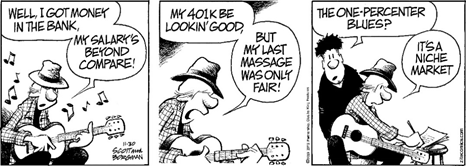
The gift of being affluent and older – definitely not in the 1% — is a niche market.  Until now, I have not had to think about the sardonic message of the cartoon below but it makes me uncomfortable.  When I was saving and young/middle aged, I would have viewed the message as political.  Now I have to ask if it is personal….

Life Connections

Photo by Alina Grubnyak on Unsplash

Retirement has put me in a stock-taking mood, less a search for meaning than simply an understanding of my past and present.  I often turn to internal story-telling….

My narratives change with new insights and reedits. These days, I have moved away from event-based stories (the college years; the productive 50s…). Julia Cameron, in her follow-up to The Artist’s Way focusing on the over-60 crowd, urges us to take our chronological age, divided it by 7, and write about the years included in each span.  As Dan and I watched the 7-Up series, which every 7 years revisits the lives of a randomly assembled set of English children, I thought of how powerful it is to break away from the constraints of decades or major events as chapter markers in our stories…

But in the past few months my internal storytelling has focused less on chronology and more on the way in which people intersect with each other and with loosely defined periods in my life.  Much of this happens when someone from my past seems to pop in to my mind for several days, causing me to rethink how and where they belong in the threads braided into my experience.

Last week a personal message on LinkedIn told me of the death of someone with whom I had lost contact.  That loose connection, between continents (my friend who died was Dutch) and across generations (the messenger is at least 20 years younger than I am), activated memories of a wider network of people who were meaningful to me over more than a decade, even though they did not constitute an identifiable social group.  What I was struck with again is the how this nebulous collection of colleagues, friends, acquaintances has provided meaning to my life, even though its members do not cohere into a usual life-story format.  They represent, collectively as well as individually, an extended period in which I felts as if I was learning about the world, other people, and professionally every day. 

Photo by Moritz Kindler on Unsplash

Thich Nhat Hanh’s idea of interbeing – the dependence of all beings and things upon one another captures this nostalgic gratitude:   

… I was looking for an English word to describe our deep interconnection with everything else. I liked the word “togetherness,” but I finally came up with the word “interbeing.” The verb “to be” can be misleading, because we cannot be by ourselves, alone … the action of interbeing reflects reality more accurately. We inter-are with one another and with all life…. Whether we’re at work or at home, we can practice to see all our ancestors and teachers present in our actions… We can experience profound connection and free ourselves from the idea that we are a separate self ( from The Art of Living)

While this way of thinking is still a bit mind boggling to a Westerner raised with Descartes’ individualistic claim that “I think therefore I am”, it leads me to pay attention to human connections beyond the people I love with all my heart.  Facebook, LinkedIn and Twitter can be a rabbit hole and a space to post the least interesting things that happen in my life (yes, I admit to occasionally bragging about Wordle), but they also allow me to contemplate the loose linkages that are part of my direct experience of interbeing.  

I smile when I read the words of adult children of friends whom I haven’t seen in years, and I am filled with awe as I look at them sending their own babies to college. At one level this seems trivial, but at another it reminds me that networks are never lost, even if they are not currently active.  And, as the miracle of Facebook informs me that a friend who meant the world to me from 7th through 12th grade had visited her childhood home, I became instantly reconnected to her parents, whose escape from Nazi Germany created the opportunity for hosting a gaggle of very ordinary American teenage girls, which in turn opened up other doors of connections, known and unknown.

Photo by Joshua Hoehne on Unsplash

I am also in awe of how my own (middle aged) “kids”, who grew up in a world of cheap phone calls, cheap flights, and the internet, keep consistent contact with beloved friends from high school as well as college.  I, however, grew up in an era when a long-distance call home to my parents from college was short because it was costly, and visits to relatives who lived a few states away were rare because they involved several days of driving.  Constant connection is a habit I never developed, and my life is littered with people—friends, relatives, mentors– with whom I lost touch with completely.  And now, increasingly, I think about those who died before I could reconnect and share the unspoken gratitude for what we meant to each other.

I regret these lapses as a byproduct of the dismal period when the art of letter writing had died but the internet was not yet born. However, I am persistently struck by the way in which inactive connections become potent with even a few exchanges.  During Covid, Google provided me with the email of someone who I knew in both college and grad school — I thought she would be amused that I had cited her 1972 dissertation in a paper.  We have been exchanging episodic emails with personal, professional and family news – almost as if there were not a 50-year gap in our shared experiences. Facebook and loose connections allowed my own adolescent gang of “cool nerds” to commit to our 50-year high school reunion and, more surprisingly, to two additional get togethers with some (including me) traveling long distances.  Our parents are gone, none of us live near where we grew up, and we are the only ones other than siblings who can tell stories about our teenage years that stir a sense of connection not only with each other but with place and time. 

I know that taking interbeing seriously requires more sustained spiritual practice.  But perhaps it is the enforced isolation from our closest friends and family during Covid that supports the deeper significance of our looser human connections, whether one-off conversations, attentive participation in group events, or the spontaneous reconnecting that seems to be happening in my life.  As I get older, the significance of loose ties that are filled with caring and compassion has never seemed more important.  I am committed to contacting at least one “loose” connection regularly, only to remind ourselves of how we fit into each other’s stories….