What Makes Me Me and You You

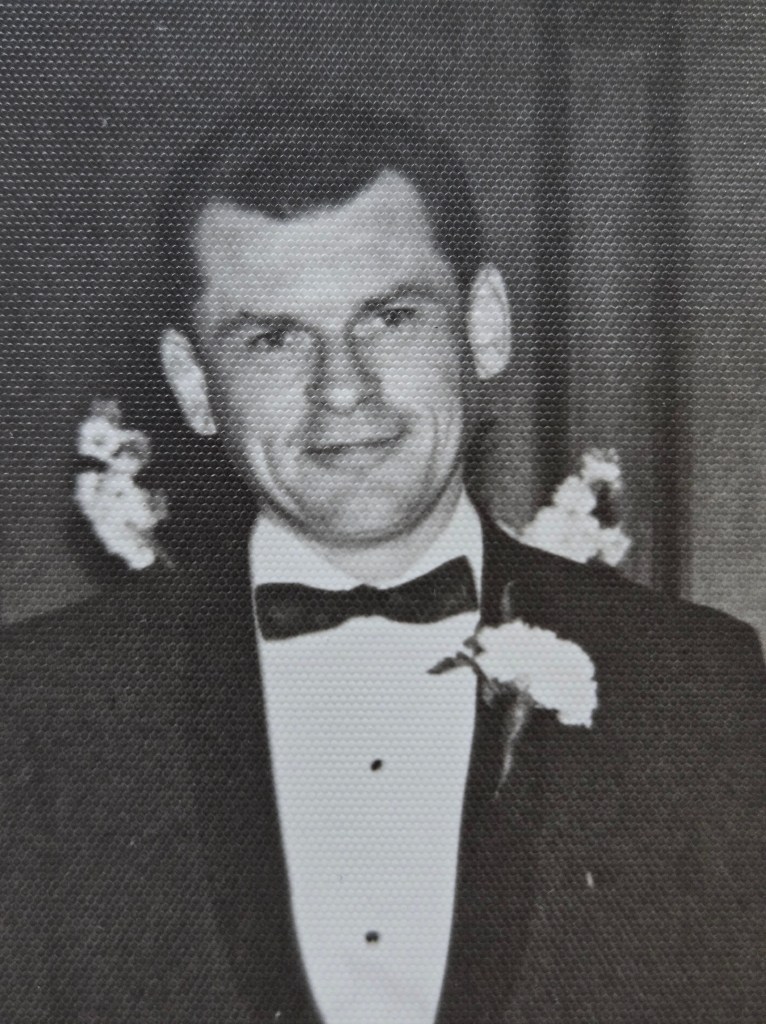
Donald Earl Evans 1926 – 2012

My stepfather, Don, loved three things in this life: my mother, fishing, and tinkering, especially under a car. Don adopted my two sisters and me when I was ten. He was boyish, enthusiastic, deeply in love with our mother, home from WWII (He’d joined the army at 17.), and excited to start his life. He always had a project going. Take the worm farm he built outside our front door. What ten-year-old isn’t fascinated with a worm farm? It was my job to carry out the scraps from dinner and to turn over the dirt. When it came time to go fishing, I got to fill a can with squirmy night crawlers.

Don always planted a vegetable garden. He’d give me a packet of radish seeds to sow because radishes come up fast. I witnessed the marvel of seeds. He put me in charge of weeding. After pulling weeds a few times in the hot sun, I suspected he had tricked me into doing the hard part of gardening. But I didn’t mind. I felt important.

He built new stairs for our house. I watched him saw pieces of plywood in a stair shape and then lay planks across the cuts. He leaned them against the garage where we could climb up and down. Next he added a picket fence to our yard, drilling the post holes, another curiosity for me to see. It seemed as if he could do anything.

Don bought a Webcor turntable, and Bozo the clown records that I listened to over and over.  

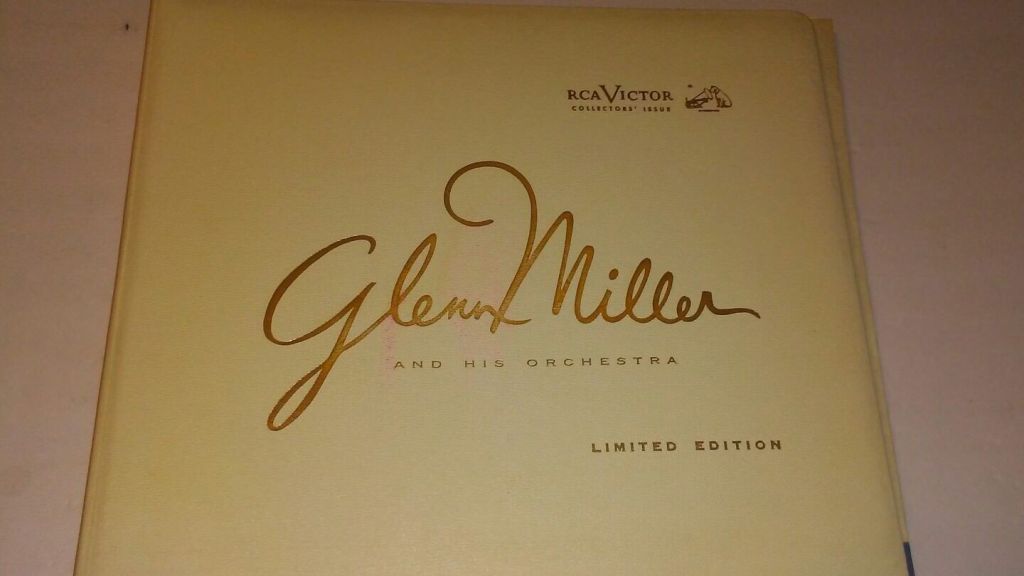
He loved Glen Miller, and gave our mother a gold embossed, white leather album of Miller’s greatest hits. Music filled our house in the evening. Don also loved cars. I once got to go with him to Cicero Avenue in Chicago to buy a Packard, his favorite automobile after the Olds.
I was the one Don took fishing. He taught me, by example, to sit in a boat or on the Lake Michigan pier, not talk, and fish all day. He once took me muskie fishing. We didn’t catch a thing, but a muskie followed the lure to our boat. These experiences were magic.

North Pier, Racine, Wisconsin

But over the course of my teen years, Don changed. He stopped making things, fixing his car, and fishing. Instead, he went to night school and worked his way from a tool and die maker to an engineer. He and my mother bought a bigger house; my mother took a fulltime job to finance their American dream. The new life was stressful, and instead of tinkering with something to offset that stress, he relied on a cocktail (and maybe two or three) at night. He developed an edge, and we three sisters avoided him. More than once, I heard our mother say,” I wish we could go back to where we started. He was happiest lying under a car fixing it. We don’t need all this.”

I can’t reliably pinpoint why, but Don lost his essential self, the things that made him Don, his unique creativity. My mother died, and Don lived to be 86. He spent his last few years at the VA hospital, where gradually I watched the curious side of Don return. For him, it was too late for fishing and tinkering, but for me, it was not too late to see the cost of pursuits that deny one’s essential self.

To me, Don is everyman, especially of his generation and veterans of WWII. He’s also a cautionary tale about losing yourself and straying from the things you love. I had the lesson of seeing the changes in Don, from creative young man, to striving type A, and back to a resigned acceptance of what is. Seeing these changes taught me to seek what is authentic in myself. I remember the first time I went to a counselor in my 60’s, and she asked me what my goal was. I told her I wanted to live an authentic life (I wasn’t sure I was, and I wanted to change before it was too late.).

In retirement, I’ve aspired to live authentically. Two books that have supported me are The Creative Age: Awakening Human Potential in the Second Half of Life by Gene D. Cohen, and The Not So Big Life: Making Room for What Really Mattersby Susan Susanka. They both argue that it’s never too late to find what you love and do it. Cohen says that creativity is built into us, not reserved for the young. Karen’s recent blog about the talents and contributions of older women highlights the ways we “elders” can manifest our creativity.

Susanka is more aligned with my personal focus, finding your essential self. I had the cautionary tale of Don in mind in early retirement, when I identified that as a child and a young married adult, I had loved to make things. At the time I was exploring my Norwegian roots, so I thought, why not rosemaling? A door opened to a latent artistic flare and to new friends.

The poet Maggie Smith has a writer’s perspective on creativity and authenticity. She advises staying “elastic” and open to surprise. When I sold our house and moved, I set Smith’s book, You Could Make This Place Beautiful front and center in my new apartment. I didn’t want to dwell on what I’d lost but rather on making my place beautiful and affirming what makes me me.

I believe Smith’s advice can be extended to our lives in retirement or at any time of life. We can make our lives beautiful in our own way. Accessing our essential selves, the things we love to do, our lifelong interests and talents outside of work, can be the foundation for surprising ourselves in retirement. What makes you you? I invite you to explore and enjoy.
Use It or Lose It?

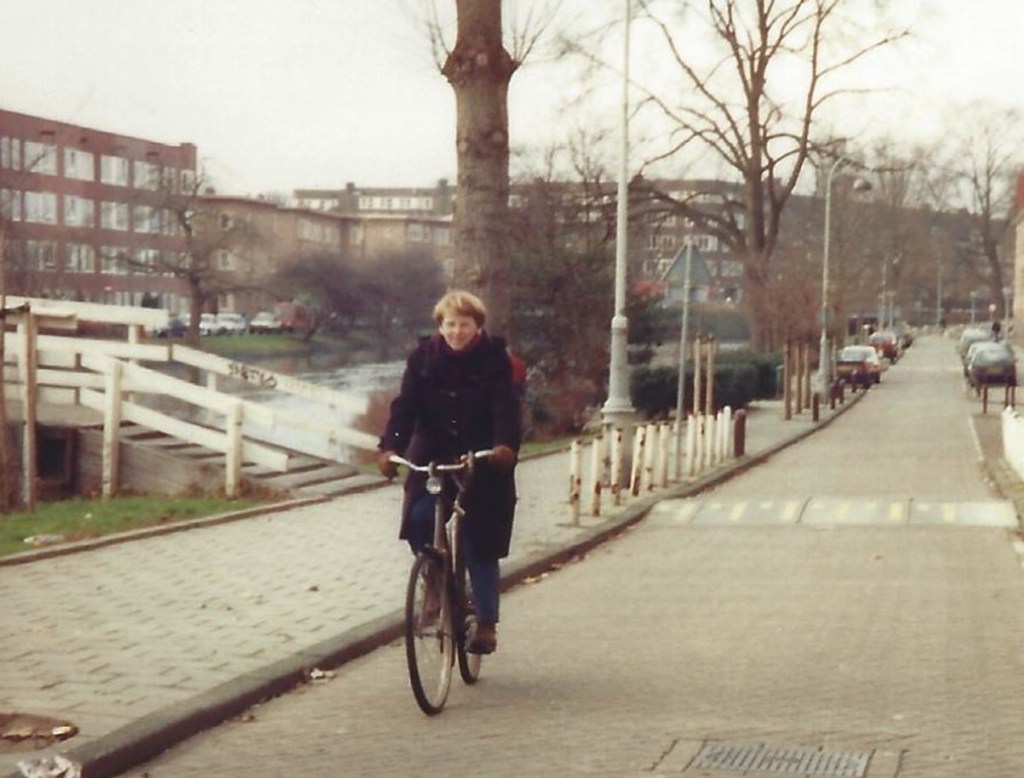
Amsterdam 1991

If you’ve followed this blog, you know that bike riding is my happy place. I’ve even posted a collage of some of my bicycles through the years. So, when I moved this summer, I, of course, took my latest bike—a step-through to accommodate my stiffening hip, no more throwing that leg over the seat, or standing on a curb to get on the bike. This new bike was a year old, gave a nice ride, but lacked the cachet of my Bianchi. I locked the it in the parking garage in my new apartment. As I wrapped the kryptonite lock around the bike, I promised it, “Don’t worry, we’ll go out for a spin as soon as I get settled.”

Two weeks later, mid-summer, I went to my parking spot and no bike. Someone had cut the lock and taken it! They also cut off the handlebar bag and threw it on the floor. DARN! That’s not exactly what I said. . . I felt violated. I examined the bikes locked by other parking stalls. Some had three locks, while others had wimpy locks. I had a kryptonite one! It wasn’t fair.

July came and went. I took a wonderful vacation and went to a retreat. In August I started the real work of moving into a new apartment, unpacking boxes and finding places for ten years of stuff.

Meanwhile, the cut cable from my bike lock hung in the garage. Every time I went to drive my car, there it was, a reminder that I had no bike, that I hadn’t been on a bike all summer, and someone had stolen from me. At the same time, I struggled with heavy boxes filled with books, slid furniture into place, and often waited for help. I just wasn’t as strong as I’d been ten years ago, when Jim and I had moved into our house.

That worried me. Would I be as strong on my bike as I’ve been in the past? “Use it or lose it,” came to mind – a saying that any older person can, perhaps reluctantly, recognize as true. I asked myself, “Karen, remember when you dropped cross-legged to the floor to sit? Or lifted that leg over the seat of the bicycle? Remember when you were more powerful than a locomotive and could leap tall buildings in a single bound?” 

“Karen, if you don’t get on a bicycle SOON, you’ll lose that, too—balance, proprioception, agility, quickness.” I set a goal of getting back in that saddle VERY SOON.

But I needed a bicycle.

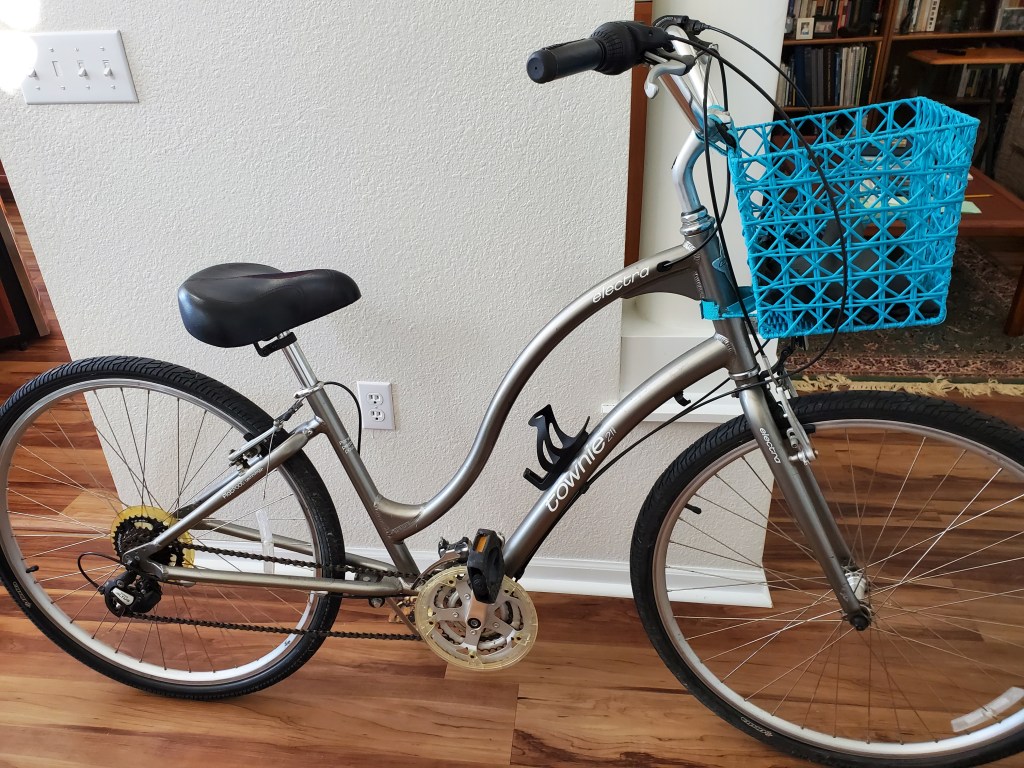
Then my son-in-law showed up with one, a step through, designed to cruise the neighborhood. He’d bought it to lure my daughter into biking with him— but she detests bicycling, and this bike hung in their garage with the other four that he’s given her through the years. It’s a Townie, made by Electra, with nothing electric about it. Big and bulky, with an ample seat, and high handlebars. This bike was clearly for an older person. A grandma bike. Was he trying to tell me something?

I moved it into my apartment. I wasn’t taking any chances of having it stolen again. There it sits, an old lady bike taunting me. “Slow down, Karen, you can’t get on or off easily. You could fall.”

I wonder just how wise that goal of getting back to riding is. “Practice makes perfect,” I told myself last year when I had a hard time stopping and putting that leg down without pain in my knee and a sense that I might pitch forward. One friend said, “Karen, it’s not if you fall, it’s when you fall.”  Sobering words. But then I heard Karen Rose’s voice: “In the Netherlands, people ride until they die.” So why not me?  And this bike looks a lot like the one I rode in Amsterdam in 1983 (except for the basket…which has negative pizazz). 

Complicating everything is the advice about transitions. “When you leave something behind, that makes space for something new to come in.” Like what? A scooter? Nah, too fast. Tricycle? Heaven forbid, a wheelchair?  And I wonder “Is this true at age 80?” There are lots of losses, family homes, meaningful work, work friends, lifelong friends, spouses, grandchildren who grow up and fly the nest, stuff you treasured but no longer have room for, lifestyles. . . not to mention sitting cross-legged. Or riding a bicycle.

Lots of us are waiting for something new to come in — and getting older in the meantime. And there’s an increasing bond with others who are navigating the territory of aging. At a recent outdoor concert, I sat in a row of six women my age who’d either lost their spouse or were living with one who was ailing. Our conversations reflected our age: “Don’t put your chair there, it’ll tip and you don’t want to fall;” “I brought some grapes so we don’t have to eat that salty fatty food they’re selling;” “I have to leave by nine, I don’t like to drive when it gets dark.” That’s bonding—we’re in the same tippy boat, waiting for something new to flow in on the next tide.

Where does that leave me? I haven’t given up the dream—another happy place has to be out there. I could always buy a new bicycle, maybe an electric one or definitely one with some zip.  Or maybe I could learn to accept a free granny bicycle.  For the time being, though, I’ve found another happy place, my new deck and coffee with a piece of almond bread from the Black Walnut Bakery. For now, happy is right here.

What’s It All About

As I reflected on turning 80, I remembered some milestones along the journey, which started when I was a pre-teen, realizing that I would die someday. I    saw a table in the Racine Journal Times that predicted how long you would live based on your age.

“I’m going to live to be 69,” I told my stepfather, Don, waving the paper in front of him. 69 sounded like forever.

          “That’s based on probability,” Don said. “And the war probably affected the calculations. I wouldn’t put too much stock in it. No one knows how long they’ll live.

          I shelved my predicted use-by-date and proceeded to live my life, although I never forgot that number. I wanted to pass it, to live to 100, at least. I once told my grandson that someone has to be the first person to live forever, and why shouldn’t that someone be me. Then, in my 69th year, as I approached my 70th birthday, about to move past my milestone, almost to taunt me, I came down with the flu, and I was SICK. I felt that if I could somehow get to my birthday, I’d get well, be okay. Whew! 70. I made it, and I felt better almost immediately. I’d dodged my first longevity bullet.

          My next bullet was 74, the age at which my mother died. I didn’t think about it—well, maybe a little. I did notice that after seventy, I developed a consciousness about age. Time seemed to speed up, too. I was no longer in those long years of childhood, sitting on the front porch in August thinking school would never start.

Friends started to die, much too young. Seventy-four came and went. But then, suddenly, I was 79, soon to be eighty…and here I am, an 80-year-old. I suspect that after 80, I should take these age goals in smaller bites—I think I’ll try for 82, the age that my husband, Jim, died.

It strikes me that there’s something competitive in setting age goals and then celebrating when I pass them. I tell myself, “Karen, it’s not a race.” And yet it feels like an accomplishment that says to the world, “She ate her broccoli; She didn’t smoke; She got 8 hours of sleep at night”. . . and so on. We are fed a daily diet of strategies to lengthen our lives.

I think about my husband, watching him struggle up the stairs, stop and catch his breath, walk to the car, where he’d hang over the door to catch his breath once again before sitting down, and then drive to LA Fitness where he walked the treadmill. Watching someone work so hard at staying alive while dying, suggests that my time could be better spent doing the things I love rather than things that might help me live longer. Maybe I’ll throw the race and have a leisurely run instead.

Not only does turning 80 make me think about what growing older means for me, it also really scares me. I can’t remember a time in my life when the future felt so ominous. My fears are larger than my own death, which is quite enough to contemplate. I worry about the world that my grandchildren will navigate: climate change and unrest throughout the world. I push these worries from my mind because my time to solve the problems of the world has passed.

In my 20’s, 30’s, 40’s, 50’s, 60’s and even 70’s, I was always planning the next steps in my life. But at 80, my world grows smaller, I feel myself move inward and worry about my own death. I won’t get to choose whether I die from disease or old age.  I’d like to be “one who wraps the drapery of his couch about him, and lies down to pleasant dreams”,  but I have watched death up close and it can be hard.

I recently saw a condo that I thought would be a good place for me to live more simply and freely – where I could stay for a long time. I couldn’t sleep because I was so excited thinking how I would update it, where I’d put my furniture, and how I’d afford owning two domiciles while my house—where I have lived with Jim for over a decade—was sold. It was classic Karen—when life gets stressful—leave it behind—MOVE on. . . and out. Then I realized that that has never really worked.  There is no moving away from what scares me this time.

And so here I am, 80, healthy, riding my bike around the beautiful Minneapolis lakes, renovating my lower-level living space, planning trips, curious about the future — but reluctant to plan too much. What does that leave me? Something plenty big. Life, life itself, the basics.

Winter is here in Minnesota, the wind cuts, the roads and sidewalks are slippery, we retreat indoors. Walking with my daughter outside today we started on the “I hate winter” mantra. “Stop!” I said. “I promised myself to stop saying that all winter long. It doesn’t make winter any easier, and it keeps me from seeing the beauty in winter.”

And I want to see the beauty in all that is around me, in a way I have never wanted to before. I want to revel in the humdrum of daily life, a good book, my annoying cats who hound me when I’m at the computer, a broken valve on the boiler, Apple TV when I’m tired, and a hot water bottle on my feet at night—all of which happened this first week of being 80, all of which I’m grateful for having lived.

When Will I Be Ready to Shift into Shrink?

My husband was in one of his “move everything around” moods, so I had to clear some shelving in the master bedroom. He was moving it into his man-cave. I can’t believe at 79 I’m married to a man-cave sort of man. I thought that was a younger generation affliction.

I also couldn’t believe all the things I’d stashed away in that shelving unit. Besides two shelves of cookbooks, there were assorted threads with needles, several sanding sponges, knitting needles and yarn, workout descriptions ripped from magazines (which I’ve never done), two cameras, charging cords for whatever—I won’t bore you with the rest of the list. Take my word for it, I’ve used that shelving as an “out of sight, out of mind” receptacle.

Having no where to go with the junk, I moved it into my office, thinking I could transfer it to the shelving there—which, when I apprised it, was already full. This wasn’t going to be an easy relocation chore. And I haven’t read—nor do I want to—Marie Kondo’s The Life-changing Magic of Tidying Up. Unlike Karen Rose, who has downsized and confronted clutter twice in the last decade, my moves did not require ditching anything more significant than a dining room table that was too large for our current house.

Just as I was looking for another place to stash my junk—rather than dealing with it—what showed up on Facebook but an article by Ann Patchett called “How to Practice,” which is about clearing out her stuff in response to contemplating death. Was the universe trying to tell me something? I sat down to write this blog—anything to avoid dealing with the mess on my office floor.

*****

After taking a break, I came back to the mess. What could I possibly get rid of to make room for the things I want to keep? And what are the things I actually want to keep, surely not all those sanding sponges? Then I remembered my Aunt Selma (she was a reluctant step-grandmother who preferred to be an aunt). Selma and her husband, Uncle Earl, had a tiny duplex in my hometown of Racine. They lived on the main floor in a fortress of mahogany furniture trimmed in brass. Two pictures I loved adorned the living room walls, peacocks made from feathers in different poses. Their son, Don, my stepfather brought them from Japan after WWII.

As I grew up and as an adult, I watched Earl and Selma age. First they moved to a smaller apartment—gone was the mahogany dining room set. Earl died from Parkinson’s, and Selma moved to another small apartment. She gave my husband and me the mahogany bedroom set. She eventually landed in a Lutheran Home (for the elderly) with only those two pictures, a bed, and a couch. When she died at 99, she had a bed in a nursing home with one of the peacock pictures hanging over the head of the bed. Selma’s life kept shrinking. She knew it, she’d rationalize it, telling me that she no longer liked caring for a house.

So here I was, wondering what to get rid of and whether my life was also shrinking. When do we shift to reverse and instead of accumulating, start donating? When is it time to start shrinking our lives?  I pondered the stuff on my office floor; I noted how crowded my office is, and the books I no longer read (mostly about Piaget or other child development theories – along with and the various – previous and sometimes forgotten — crises in education).

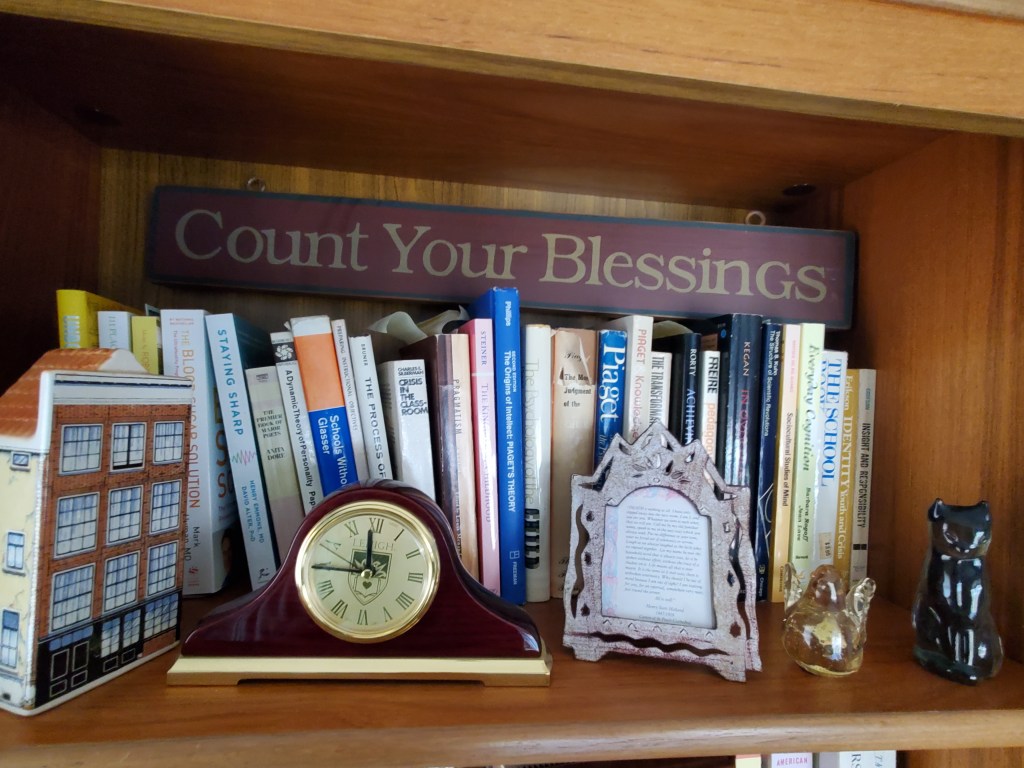
Then I perused the stuff on my shelves. Among them, a replica of the Anne Frank house, which I bought on my first trip to Europe; the clock my colleagues at Lehigh University gave me when I moved back to the Twin Cities; a crystal bird I won for scoring a birdie in the golf league I belonged to as a stay-at-home-mom; a framed card about death that I found in the last book my husband Gary read before he died (It was about J. Edgar Hoover. I kept telling him to read something more uplifting.); and a cut crystal cat that belonged to my mother, my children and I picked it out together for her. These items weren’t just stuff!  They were symbols, memories of life stages, places, and relationships—these were the stuff of love

How could I possibly let any of these items go? Karen’s life in stuff! I thought about our last blog—which apparently didn’t inspire our readers all that much—about legacy. These were part of my story, my legacy, and I wasn’t ready to let go.  Well, maybe I could ditch some of the books and a couple of the sanding sponges.

Taking stock of all I’ve accumulated reminded me of the many conversations my husband and I have about moving some place smaller—I’d have to deal with these things. That brought me back to Aunt Selma and the shrinking life. My life would and will shrink. These thoughts led inevitably to death, knowing that I, too, will die, and it’s coming sooner than I expected when I was in my 40’s and 50’s. I used to tell my grandchildren that someone has to be the first person to live forever, why not me? But I’ve stopped saying that.

For a brief minute I pictured my children sitting around cleaning out my office after I die.

 “Why do you suppose she saved this?” they would wonder, holding the Lehigh clock that no longer works or the cheap crystal birdie. I don’t know what they’d say about the sanding sponges. Maybe I should put a little label under each item describing its importance—might help me, too, if I go senile.

I thought of something Karen Rose’s husband says, “if it is smaller than a brick and has sentimental value, keep it. Otherwise, seriously consider giving it away.” Whew, I was off the hook. Most of my mementoes are smaller than a brick, although the embodied meanings are more than sentimental. I’m not ready to let go. For the time being, I won’t do anything until I get tired of walking around the mess on my office floor. I’m not dying yet, which leaves me wondering how long will it take until I reckon with death and move one more iota towards acceptance? For now, I’ll continue to treasure my artifacts of memories. I’m just not ready to shift into shrink.

Used by permission of the white board it was posted on.