How to Retire During a Pandemic. . . or Any Other Time

A group of people on a stage

Description automatically generated
Rolling Stones, 2018

Karen Rose and I promised not to give advice, so don’t think of this as advice, rather encouragement.

First of all, why not retire? There’s nothing that says you shouldn’t. It’s completely your own decision. Retirement right now could make you part of the Great Resignation—and who doesn’t want to be a trend-setter? So, in the spirit of all the self-help gurus who have gone before me, here’s my list of how-to’s.

  1. Tell your friends, family, and colleagues how you want to celebrate.  You could have a bonfire or even a Zoom meeting (I’m kidding). Restaurants and bars are starting to open. It’s not impossible anymore. I like cake, so that’d be my go-to, a Danish layer cake from a bakery in Racine, my hometown, or if not available, a big white cake with white frosting from Whole Foods with vanilla flavor—you might be trying a lot of new foods when you retire, that’s one way to pass time—eat. 

If you retire in summer, you can always have an outdoor party. In fact I went to a couple last summer, and the retirees didn’t seem intimidated by the pandemic at all. And there was lots to eat—even cake.

There’s always the person that wants to go quietly. The one who rather slides into retirement; some even take it year by year, never really announcing it until they’ve completely left the playing field (E.g., KRS?) It’s not a bad way during a pandemic, or during any hard times, as everyone is busy watching CNN, the CDC, NBC, OSHA, SCOTUS, ETC.

  1. Let those feelings come forward. Maybe you’ll be relieved—you’ve had enough of working for a lifetime. You might be discombobulated—I certainly was. That first Monday morning after my drinks at the bar party—no, I didn’t get cake—left me unmoored. Should I wear jeans?  Jeans are for weekends. What time should I have breakfast? Lunch? What am I going to work on? Does my spouse have to be near me all the time? I can hear him rattling around the house. Is he always like this? When do I get to “quit” for the day—oh, I never started.  

You will have feelings. I promise!  Let them all hang out!

  1. If you live with someone, warn them. They may have had the house all to themselves, but that’s changing. Someone new will be sitting on the couch reading the morning paper, playing the stereo during the day, making lunch right when they like to make lunch. Maybe you’ll start to clean closets, throwing things out. Someone else might not be ready for this.  And are you ready?  Your close relationships will change, hopefully for the better.
  1. Don’t sweat having a purpose. This is a biggie!  I know, you’ve read all those books about the importance of having a purpose when you retire, Something to Live For, Retirement Reinvention, Purposeful Retirement, and Encore Adulthoodamong the many—but I’m here to tell you retirement is all about the unknown, and that’s what makes it both interesting and challenging. In the world of work, you needed goals. The idea was to get ahead, to strive (more about this from Karen Rose), to seek, to find. . .  to make a name for yourself, do better than meeting quotas, etc. You are done with all that. New paradigm coming your way! And you get to create it.

The Purpose experts argue that having a purpose is linked with better outcomes for aging, living longer, etc. But you’re not an outcome, a statistic. You are you, and if you don’t have a purpose, that’s just fine.  I’ve written about Big P and Little p, arguing that Big Purpose is a male oriented way to live and that there are lots of Little purposes in our daily lives—relationships, family, great books, helping out in the community, that can evolve daily. By letting go of the need to find some big, all encompassing Purpose, you can let the day’s own offerings be sufficient—and you’ll be more inclined to show up for them, because you won’t be busy searching for that big Purpose. 

If you have a big Purpose for your retirement, by all means, go for it. My take is because so many of us love our lives but probably can’t identify some big Purpose in how we live them. But then living a moral and kind life is rather a big Purpose.

Instead of worrying about purpose, resolve to be CURIOUS–like the Torstein Hagen advertising for Viking Cruise Ships. When the pandemic first hit, and we were all scared, staying home, isolating, I started daily walks—like everyone else—around the little lake by our house. After several of these walks, I noticed stumps, which had been cut off in the prime of life, had branches growing out of them; they were putting out shoots of hopefulness. I photographed these stumps and shoots and followed them throughout the spring. I saw them turn green and produce leaves. Later a friend told me about something called coppicing, a process used to manage forests by taking advantage of these persistent trees. What astonished me about this discovery was how I’d walked by it most of my life! (https://karensdescant.com/2020/04/20/condition-provisional/0)

So be easy on yourself about purpose. Maybe you’ll find one, maybe you won’t, but retirement allows you time to be with the unknown, to pay attention to the details, or, as a friend once advised me—to smell the roses.

  1. Let go of expectations! I absolutely believe that we would all live happier lives if we could let go of expectations. In the dictionary, 1) expectation is defined as the state of looking forward to or waiting for something. 2) A belief that someone will or should achieve something. Until the pandemic, retirements were full of expectations—“I’m going to travel.” “I plan on spending more time volunteering.” “Maybe I’ll take some classes.” All worthwhile endeavors, but this pandemic has certainly put us on pause.

So what recourse do we have? We could approach our new retirement lives without those expectations, instead curious and willing to engage with what shows up. You now have time to explore who you are inside and act from within rather than without, based on expectations set by others, the society, and eventually by ourselves. 

If you’re planning on retiring, go ahead. You will have a chance to approach life with curiosity, seeing what unfolds, and maybe, with that curiosity, learn more about yourself and the world around you. I wouldn’t normally turn to the Rolling Stones to talk about retirement, but their song, No Expectations perfectly sums up my idea for approaching retirement:

Take me to the station
And put me on a train
I’ve got no expectations
To pass through here again.

A retired Keith Richards

What is My Footprint?

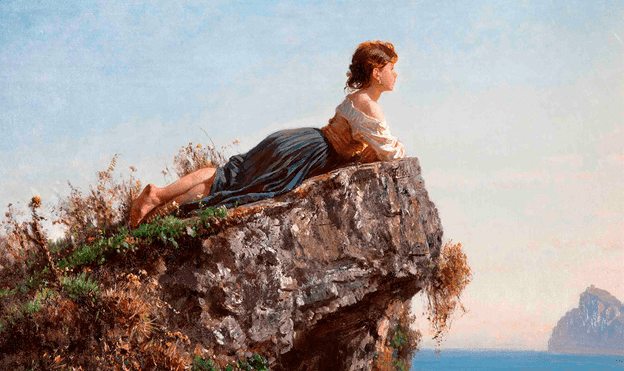
Fillipo Pallizi, Franciulla sulla roccia

Lives of great men all remind us
We can make our lives sublime,
And, departing, leave behind us
Footprints on the sands of tim
e

Henry Wadsworth Longfellow — A Song of Life

Geert Hofstede’s research suggests that striving for a life that will be noticed is fundamental to the American psyche.  And, in a big country, the longing is often equally big and broad.  From Patrick Henry to John Wayne, large and swaggering (and male) is what is noticed.  I saw myself in the narrative, but identified as a thoughtful visionary seeking a bigger world – like Pallizi’s romantic 19th c. portrait.  As I noted previously, my husband called this “International Karen” who, as frequently as possible, moved beyond contemplation to collaboration with people in other countries who also wanted to make their schools better. But, between Covid travel restrictions and a dwindling passion for experiences far from home, International Karen is coming to terms with the obvious:  the past will not be the future.  What is emerging is a different longing—to figure out how to leave smaller but still meaningful footprints.

Several years ago, some friends and I – (aka, The Retirement Biddies Workgroup) — read Sarah Susanka’s reflections on living a “not so big life”.    A well-known architect, she urges us to think about what really matters through analogies between designing a smaller home and designing a smaller life.  Some of her questions are relevant to anyone at any age:  How is what we are purchasing fitting in with what we need?  How are we using our resources?  When do we have enough?  But then, her zinger:  How have you wanted to change the world and how are you looking for related changes in yourself?  Her challenge suggests beginning with our biggest aspirations (do they come much bigger than changing the world?) and then look internally to see as if we are up to the task. 

But that question needs reframing in a life that has become radically smaller during Covid, while I am also busy considering a future that will inevitably be different from my expectations of a few years ago.  As I look at “international Karen” and cringe at the carbon offsets that I owe the world, I know that I could not go back, even if it were possible.  I pulled Susanka out of my bookshelf….

At a personal level, I have already made a commitment to a smaller life. A decade ago, Dan and I made a radical move from a rather large house to a condo, which was about the size of Susanka’s designs for a “not so big house”.  When The Retirement Biddies were contemplating the “not so big life”, Dan and I had given away many of our possessions, including furniture, books that we finished reading many years ago, and appliances that we rarely used.  We felt lighter and patted ourselves on the back, while filling every nook of our new walk-in closets.

But I was still working.  Although my home office was small, I had a bigger office at work for all the professional stuff.  The only question “not so big” question that had immediate resonance was a more thoughtful consideration of what we were buying. It was all about “the stuff.”

But now retirement-during-Covid is a reality, along with the unanticipated consequence of our decision to stay in Boulder, CO where we are engaged in a noble experiment: two people living peaceably in a 1000 square foot 1960s ranch that has only two interior doors that don’t lead to a toilet.  But this requires a different kind of decluttering.  The grand project of moving and starting over – just like those who are part of “the great resignation” or who have otherwise changed their lives in the last few years – requires a decluttering of the spirit and heart. 

The challenges are huge.  I have always been BUSY, largely with activities that are not essential. I  am easily distracted by emails or random thoughts.  I have never meditated, and have been totally unsuccessful at journaling because it requires discipline.  Since childhood, I have been unable to cope with boredom and have a long list of attractive projects that I can turn to if that awful feeling appears.  But these habits, some of which were functional when I was “busy working”, are now impediments.  In Susanka’s terms, I am unable to turn away from alluring “time clutter”. 


Clearing out the heart requires stillness – so different from concentration —  that does not come naturally.  I have taken a course on contemplative prayer.  I have read poetry out loud.  I have worked on a skill that never came naturally to me – listening to what other people are really saying rather than immediately generating a stimulating conversation.  I am even weaning myself off the computerized calendar that beeps too often, and writing out to-dos and appointments using a fountain pen.  More importantly, I am tracking a new habit – explicitly noticing, contemplating, and being grateful for something that is exquisitely beautiful, whether in nature (frost covered ornamental grass or snow on the Flatirons outside our house) or when making faces with a four-and-a-half-year-old.  And writing down a few of those things in turquoise ink.  I really love the turquoise ink. 

But what about changing the world?   I take heart in reading aloud Mary Oliver, who suggests that, at least for a poet, a large life can be inscribed through small acts: 

I don’t want to live a small life. Open your eyes,

open your hands. I have just come

from the berry fields, the sun

kissing me with its golden mouth all the way

(open your hands) and the wind-winged clouds

following along thinking perhaps I might

feed them, but no I carry these heart-shapes

only to you. Look how many small

but so sweet and maybe the last gift

I will bring to anyone in this

world of hope and risk, so do

Look at me. Open your life, open your hands.

Mary Oliver – I Don’t Want to Live a Small Life, Red Bird

To live a more open and intentional life, I need to consistently remind myself that small efforts, expanded over many committed people can make a difference in this world of hope and risk. I think of the years when I hauled dozens of yogurt containers to my office before my city started recycling – only to find out now that the containers were not actually recycled.  So, my Instant Pot and I now have a bi-weekly routine that involves yogurt making.  I find local issues that are pressing – affordable housing, unjust judicial practices, and the continued exclusion of the Native people who once owned this land – and find others who want to change them.  Goodbye International Karen:  You did good work and had fun.  Now I want to bring small gifts to the place where I live and to those I am with – and I also remind myself that large footprints in sand will be washed away.  

Lost and Found: That “Third Thing”

My third husband, Jim, was already retired when I met him, both of us in our 60’s. We had lost spouses to cancer and were living as singles—for me, nearly seventeen years, but not so long for Jim. We had much in common and didn’t want to date for years to get to know each other, so we decided to jump right into the complexity of marriage.  “Uff da,” as we Norwegians say.

We believed we were old hands at marriage—especially me—but quickly realized that marriage later in life, like all marriages, has plenty of challenges.  They are just different ones. I began to understand, too, the importance of what the poet, Donald Hall, calls a “third thing.”

Third things are essential to marriages, objects or practices or habits or arts or institutions or games or human beings that provide a site of joint rapture or contentment.

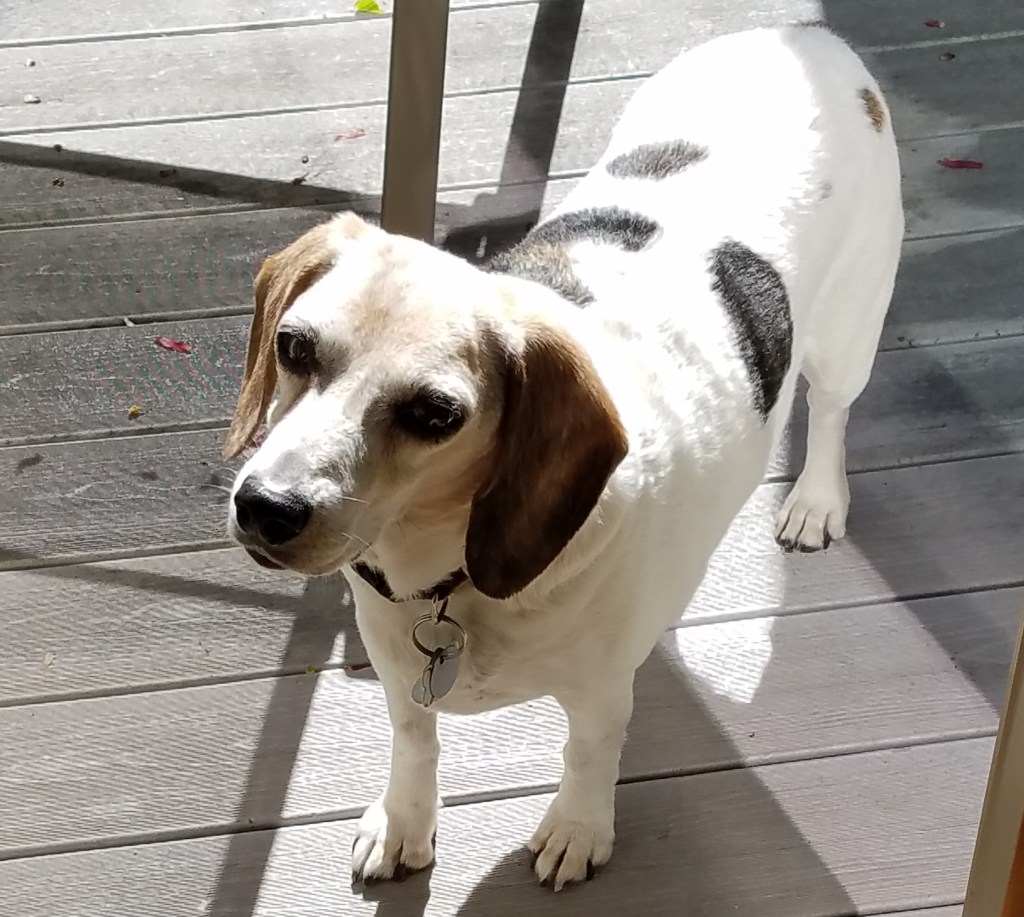
Starting out, Jim and I didn’t have that third thing. We both had our individual families and histories, but nothing we’d created or shared exclusively as a couple. Then along came Eddie, our beagle, who showed up on our deck one afternoon in late September. At the time Jim’s dog, Happi, was dying of oral cancer. She slept peacefully most days on the corner of our couch.

I’d noticed a dog wandering in the thicket behind our house, and wondered what he was doing there, so when he showed up, I let him in, believing he had to be lost. He came in like he owned the place, and gently sniffed Happi, resting on the couch. He then took a drink of her water and settled down on the rug with a sigh. When Jim came home, we walked the neighborhood with the dog, expecting that he belonged to someone nearby. No luck, so Jim took him to our local vet and left him. The vet called later and said that using the dog’s chip, they had found the owner, and the two were reunited. Case closed; Happi died a week later.

Then came November and a call from the vet who told us that the owner didn’t want the dog and was going to take it to the pound, unless we might be interested. We were mourning and didn’t want another dog. We also didn’t want this friendly dog to go to a pound. So we took him. A week later was Thanksgiving, and Eddie—we now knew his name—made a grand entrance to our family by lifting his leg and peeing on the dining room table leg, just as we were about to eat.  An ignominious beginning, to say the least.

Over time Eddie showed his true worth. He was always a stalwart defender of Jim through his illnesses. He sometimes howled in happiness when Jim walked through the door. He also followed me doggedly (pun intended) around the house. Gradually—and finally—we found ourselves with a third thing—our family of pets, which included Thor, whom I brought to the marriage, and Tress, Jim’s cat, and of course, Eddie, with his beagle personality, the obvious linchpin. (Tress later died, and we now have a new cat, Stella.)

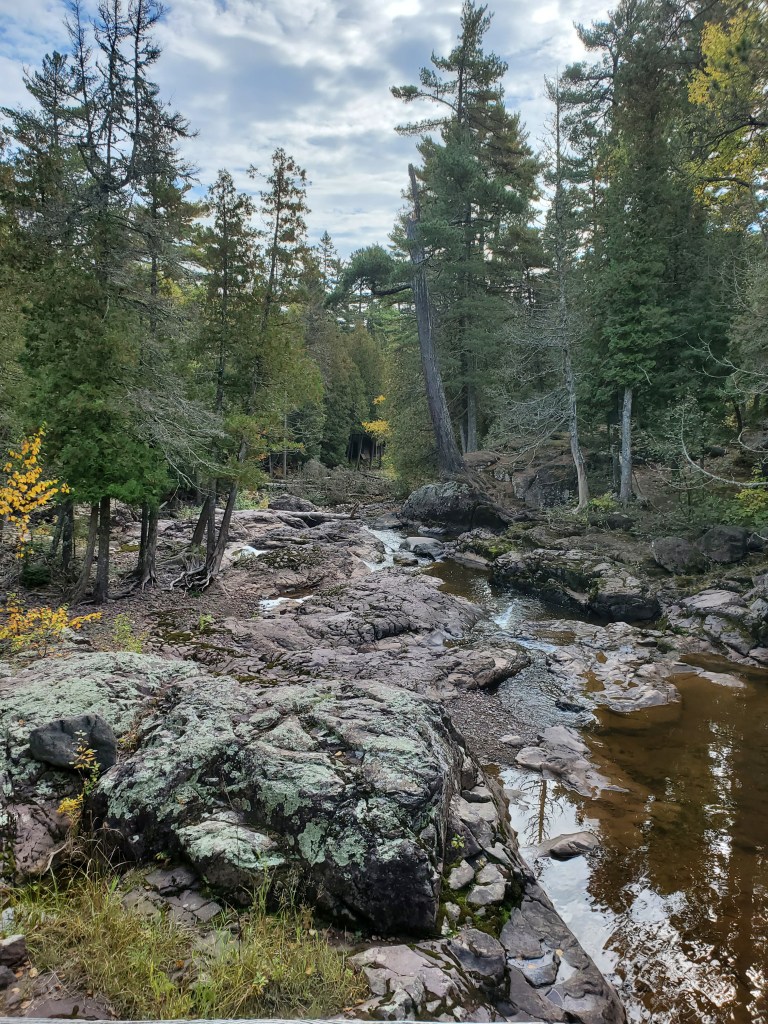
Jumping ahead to this September. . . we went up north to Lake Superior, on the edge of the Superior National Forest, beyond Duluth and almost to the Canadian border. A pristine wilderness, and we would be there at the peak of fall colors.

A Beautiful Fall Day–Up North

It was our first time out after Jim’s illness, finding our way back to the world. Wonderful friends had invited us to a cabin and said, “Of course, bring Eddie.”  And Eddie had been Eddie, kind and loving to everyone, and trusting that this change of venue was fine, jumping onto a red chair and settling for a nap, whenever he could.

The weekend was coming to an end. Jim was already in bed in our little guest cabin. Outside the night was pitch black; it had been raining all evening. As I got ready to climb in bed, I looked for Eddie in his red chair.  No Eddie. I looked all over the cabin, peeked under the beds, opened closet doors that he couldn’t possibly have gotten into, but still no Eddie. I woke Jim to help me search. He suggested that maybe Eddie had gotten outside. The screen door did not latch, although it made an angry retort if you didn’t manually close it.

Eddie was gone. We’d lost him and in a place immense and filled with dangers everywhere. I started thinking about those TV dramas where a child goes missing and someone says, “The first 24 hours are the most important.” So, in my pajamas, I slipped on my hiking shoes, grabbed a rain jacket and flashlight and took off down the dark road calling “Eddie, Eddie,” still traumatized from almost losing Thor only a month ago and thinking dark thoughts about our status in the universe.

Who did we think we were, venturing out when Jim was still recovering? We’d been preoccupied with having everything go well for Jim, so that his legs would not swell and pull us back into the hole of sickness we’d been climbing out of.  And now we’d put Eddie—a big part of the menagerie that made up our third thing—at risk, Eddie, who trusted us and believed in the goodness of the world.

I searched near the steep shoreline and down the two roads near the cabins.  There were a couple of hiking trails along the river, but I didn’t dare take those in the dark though I imagined Eddie sniffing his way down them, following a provocative scent, then trying to find his way back to the cabin. All the while, a wolf watching and waiting to make dinner of him. No Eddie. As I walked back, my eyes filled with tears, overwhelmed with loss—the loss of Eddie along with the loss of Jim’s health.

Imagine This–In the Dark

I walked into the cabin, knowing there’d be no sleep, just as there’d not been much sleep in the weeks before. There was Jim in the kitchen, Eddie at his feet, begging for a bite of toast. I couldn’t believe it. Eddie had found his way back in the murky, threatening darkness. 

But Eddie had never been gone at all. There was a mattress stored under the bed, and although both Jim and I had looked under the bed, we had not been able to see that Eddie had squeezed himself on top of that mattress and directly beneath the bed mattress, with barely enough room to raise his head, like being the filling on a mattress sandwich. He’d finally come out to all the excitement. Crisis averted, our boy, the linchpin of our third thing was safe and sound.

We live in a time rife with threats—to our country, to climate, to the flora and fauna of our earth, and we live with this during a time in our own lives filled with uncertainty. Having a third thing is one way of standing together among that uncertainty. Jim’s and my third thing might not be the stuff of poetry, but it is our third thing, and, like life itself, both ubiquitous and fragile. Will we someday lose Eddie, or Thor or Stella or something else we dearly love? Of course, but meanwhile we have Eddie, who found his way to our doorstep and people who love him. While I was searching for the “lost” Eddie, there he was, wedged between the mattress version of a rock and a hard place, sleeping soundly and trusting that all would turn out okay.

Purpose Notwithstanding … Show Up

A picture containing text

Description automatically generated

A deep sigh of contentment, I’m in the world of exploration, ambition, and dreams. Time feels limitless. 

In actuality, I’m doing a Zoom meeting for the first class of OLPD 5501: Principles and Methods of Program Evaluation, the class I’m teaching this semester. Evaluation should be front and center, and it is, but, as the students one-by-one introduce themselves, inside I’m feeling all the positive anticipation of young people. Some describe their purpose for taking the class as exploring a new subject. Others are fulfilling ambitions, finishing their coursework for a degree. All are dreaming of possible futures. It’s incredibly energizing.

Coming back to my real life, I recall Richard Leider’s Annual Purpose Check-up in his book, Something to Live For. He suggests that yearly, retirees, who’ve found that something to live for, do an inventory that assesses how they are doing at living with purpose.

I wonder how my students would respond if I asked them about whether they are living with purpose. Their lives are filled with the a priori purposes of age and circumstance—getting an education, finding a partner, having a family, finding a rewarding career, if possible. They are driven by both internal and biological forces. Though some might be aware of a larger purpose, I suspect most are busy living.

I remember being one of those students—at least four times in my life when I worked on degrees to follow my own ambitions and dreams all while intent on getting married and having children. As far as purpose goes, I didn’t give it much thought beyond living a good life with family and doing something I enjoyed. Life was full of chances to grow—up, hopefully. Like everyone, I had good times, not so good times, new friends, old friends, losses and opportunities, career ups and downs. When something didn’t work out, I latched onto another way to keep going forward. What is salient here, I believe, is that time never seemed to be an obstacle. I didn’t worry about running out of it and there never seemed to be a lack of opportunities 

But it turns out, time does matters. We age. I turned 70. At 72, I retired. I was ready to retire. I was tired of the grind (note the word “tired” in “retired”). Nonetheless, retirement felt new—and as my history demonstrates, the new has a pull on me. 

At first in retirement, time expanded. Retirement removed a huge pile of obligations from my days, months, and years. I read books like Leider’s and Cohen’s The Creative Age.

But one thing was different, that amorphous concept called the future started to feel finite. At first the reminders were physical, a sore knee or hip, that slightly slower pace walking, a diminished desire to run up steps two-at-a-time, all of which reminded me of a changed and aging body, with limitations.

Then came the contextual changes of a smaller life. My world shrank. Colleagues from work no longer included me in after hours parties. I searched for personal interests to replace work interests. The books I read about retirement pushed the idea of having a purpose. Like Karen Rose, in her blog, If I Don’t Know My Purpose, Am I a Retirement Failure?, I worried about finding one. Looking back, I realized my most fervent purpose had always been raising children with career intermingled. The thing about retirement and aging is that those two centering purposes, family and career, diminish in importance, and I had to rethink about what might replace them.

Leider’s emphasis on purpose is grounded in research that says people with purpose live longer, happier lives. If you search Google for “purpose” and “goal setting,” you get the idea that without these, your life is meaningless. However, purpose, with its concordant striving, implies that what’s present is not enough, I am not enough unless I have a purpose for my life complete with short and long term goals. But I am not a program or a business! I am a human being, both faulted and perfect at the same time. 

Purpose also implies always looking ahead, managing what is to come by setting in motion actions that achieve goals, manifest purposes. But life is messier than that. To use a personal and admittedly extreme example, when my second husband and I married, we set in place actions to have a vibrant marriage complete with fulfilling and dynamic careers that would serve others—we had Purpose(s). But then he got terminal cancer, something worse than messy. Coming home from the hospital, after being given his diagnosis, I remember thinking, “I must show up.” Showing up, doing what needed to be done and giving love on a daily basis became my way of being in the world. 

After my husband died, I searched for purpose in my career, almost as a substitute for the purposes that died with his death. I read books about finding your purpose, The Purpose Driven Life. I prayed for a purpose like he and I had had. It seemed like my search became the purpose. During my quest, time inexorably moved forward. I retired with never having found that clear purpose for my career.

Upon retirement, I found myself doing that sort of life review that involves making meaning of the events of one’s life. Then I remembered the showing up commitment. It was one of those light bulb moments—like the truth was always there only I was so busy searching for purpose, I couldn’t see it.

Showing up is how I want to live. One might argue that “showing up” is a purpose, but I believe it’s more a way of being in the world. It means letting go of that driven search for purpose and goals and instead asking yourself, “What gives meaning to my life today?” and then showing up.

Picture by Lisa Congdon.