Eighty Years, Eighty Letters

Photo by Joanna Kosinska on Unsplash

I have been obsessed with the minutia of aging, examining every new line, every wiry hair on my chin (prompting immediate removal), every unfamiliar ache in the morning. But when asked to write a tribute for a friend’s milestone birthday, I go whole-hog in the other direction– not just offering congratulations, but taking the opportunity to outline, sometimes in exhaustive detail, why their life has been well-lived.  I ignore tired jokes about wrinkles, slumping shoulders, or forgetfulness.

Almost as if I were writing their advance obituary.

But when it comes to my own Big Birthdays, I’ve mostly ignored them. When I turned 70, Dan planned a sweet mini reunion with friends and family, complete with a cruise on beautiful Lake Minnetonka. It was the first time since I turned 40 that I stopped to consider what another decade meant.

Looking back now at 40 – that was a downer. I was convinced life as I knew it was ending. I imagined myself turning into a wrinkled crone by the end of the week. I spent several hundred dollars on face creams that promised to forestall the ravages of age. Some of them made my eyes burn. I ended up tossing most of the unused jars when I realized I wasn’t actually disintegrating. I didn’t look that bad. I could continue to be vain!

Photo by Zoshua Colah on Unsplash

But this summer I turned 80, and although I didn’t anticipate it, I could feel agitation building as the date drew closer. I set boundaries:

No, no reunions, no celebrations. 

No, I don’t want anything special! 
No gifts – we have nowhere to put anything! 

Do I really have to go to the Sages Lunch this year, when I helped organize it last year?

At one point I even considered writing my own obituary, not out of despair, but practicality. After all, at 80, every year feels a bit more like a crapshoot. But then I remembered – I’m not very afraid of death, although like most people, I hope it will be quick and relatively painless. So if I wasn’t especially fearful, why the restlessness? Why the resistance?

A week before my birthday, I was meditating outdoors with a small group in the clear early morning light in Boulder. Someone read a John O’Donohue poem on longing before we began, and one line stuck with me like a mantra: May a secret Providence guide your thought…”

Fifteen minutes into the silence, Providence – The Great Whatever – answered “You are supposed to write letters to 80 people to tell them how they have changed you.”

It was loud.  It could not be ignored.  It was also rather weird –so clear, it startled me. The universe doesn’t usually shout at me.

And so I began. At first I wondered if I even knew 80 people well enough to write to. But it turns out that at 80, you’ve lived a long time and met a lot of people. As I started making a list, I quickly passed 80. I began to recall how each one was memorable, and why.  Some names were easy. The memories were warm, the lessons clear. Others required more work, were uncomfortable. I had to ask: how did this person change me, even if the change came through friction rather than closeness? Some were no longer living. Some I had lost touch with. In a few cases, I already had letters written – messages I’d sent to the families of friends who’d died, telling them what that person had meant to me. I had saved copies. I added them to the list.

And then I realized something else: not all letters would go to individuals. Sometimes it was groups of people who had shaped me — a writing class, a church committee, a circle of friends. And sometimes the letter could be to a thing — a dining room table from my childhood, or a familiar object that held memory like a sponge. Always, behind the inanimate, were people. Always, it came back to connection.

Oh my.  What seemed, when Providence’s voice boomed, at first like an impossible assignment –  80 letters for 80 years – suddenly feels doable. More than that, it feels necessary. Because in uncovering the people and memories that shaped me, I am also writing something else: a quiet testimony to what I’ve always known, deep down. 

I did not arrive at 80 on my own.

I got here on the shoulders of so many who walked beside me, talked me down, saved my bacon, gave me new direction, nudged me forward when I was stuck, or simply witnessed my becoming. Big influences, small gestures, words that stayed with me — it doesn’t really matter. What matters is the accumulation of moments, and the gratitude I feel for having been changed, again and again, by the presence of others.

In this photo, I am the white-haired 80-year-old, with some of my best friends from Tappan Junior High School, Ann Arbor Michigan.  We met this summer to remember how important we have been in each other’s lives.  This “letter” is for them…and the several who were there in body or spirit but not in this picture. My friend Elsa, second from the right, describes us as a hive…that’s the way that it feels, except there is no queen bee.

“Best friends” from the past and now…

And maybe, just maybe, Providence will answer if I become sufficiently agitated and self-centered and, therefore, speak again when I need a new assignment.

Oh — maybe most important: 80 is not a boundary, just another irrelevant human marker, an indicator our of our futile attempts to corral time.

 

Why Knit?

Photo provided by fellow knitter, Kathy Jensen

When people comment on a sweater that I knit for myself, it is usually followed by “My grandmother taught me to knit, but I haven’t done it since I was a kid” or “I tried it once…”.  This response astonishes me because I know, deep in my bones, that my life is enriched by knitting in so many ways.  It is rarely about the sweater, the pair of socks, or the baby blanket.  It is about a raft of other emotional and embodied experiences that I associate with knitting. 

I learned to knit when I was 11 and living with my parents in Norway for a year. Yes, knitting was part of the curriculum for all students in public schools at that time  – unfortunately, it was eliminated at some point in the 90s.  My 11-year-old school project was a ski hat with a Norwegian stranded design in the cuff…no scarves for me!   And, I still knit the Norwegian Way (which can be learned on YouTube, if you care to, from the adorable aging Norwegian knitting couple, Arne and Carlos).

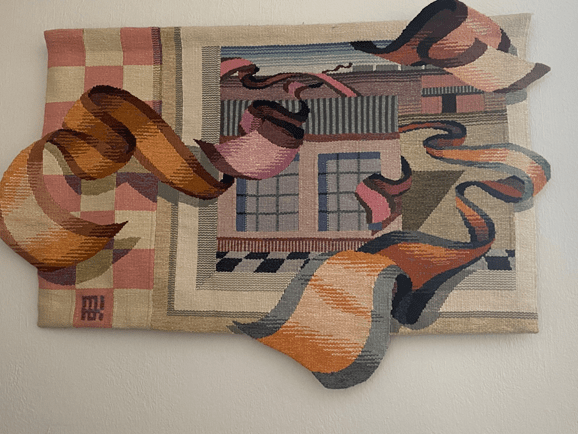
I have always loved anything made of fabric…tapestries, hand-woven clothing, batik, quilts…there is something that sings to my soul when I look at the way in which women, throughout time, have used whatever they have on hand to create something beautiful – and sometimes useful.  One of my prized possessions is this untitled tapestry by Ann Baddeley, which I call Freedom to Fly.  I first saw a much larger version, requiring a house of a different size and a bank account to go with it (many tapestries are priced by the square inch).  The gallery called me six months later and said that they had found a similar but smaller and slightly more affordable one.

With the advent of a demanding career and children, I stopped knitting for many years, with a few exceptions — a poorly thought-out Icelandic pullover for my husband and an adorable Norwegian cardigan worn by both my daughters (and now several grandchildren).  But my first grandchild (now 19) inspired me, and I haven’t stopped since….I am a regular member of Ravelry.com, an on-line space for knitters, where there are always over 3000 people with me when I log in.  There I can upload pictures of my own projects (147 since I joined in 2008) and look at what other people have done with the same yarn.  We “friend” and chat – there are groups to enjoy specific yarns or designers, and KALs (knit-a-longs) where people enjoy talking about how they are re-imagining a specific project, whether it is yarn substitutions, colors, sizing, or other “mods”.

But there is much more than being part of both a very old and also very current tradition which, with a few exceptions, is female dominated from the raising of the sheep to the designs. When people ask me why I knit, I rarely refer to the objects I have made but to the process of making them.  Just as some people love the preparation of the materials for an elaborate dish – chopping this-and-that, determining the garnish, collecting the individual spices – I linger in on-line and physical yarn stores, murmuring over colors, textures, and dreaming of what COULD be done with them, even if I know that I will not go any further than the murmurs.   Like a cook loves their knives, I like all of my 50 pairs of needles, the small scissors that I use to clip loose ends, and the various colored markers that we knitters use to keep track of complicated projects.  In other words, the STUFF of knitting is appealing to me.  When we lived in Minneapolis, Dan took me to Steven B’s, lorded over by the self-designated Glitter Knitter – for a special a yearly birthday treat and a prize skein. 

But more than that, we knitters share an understanding of knitting as therapy.  I try never to knit anything that has an absolute deadline (your gift WILL be late!) because I have enough deadlines and appointments in the rest of my life.  There is something about the feel of a delicious yarn passing through the fingers that excites the senses.  Then, there is the rhythm of it – when the stitches just seem to flow and you lose track of time.  I think of it as akin to walking meditation.  There is curiosity and challenge when you want them – always new techniques, different ways of making the wool do what you hope. 

More important is that knitting is one space in my life where I rarely judge myself.  If I make a mistake – well, it always happens and, after the first unprintable exclamation, I contentedly Tink (knit backwards) until I can fix it.  Because the process, the excitement, and the tactile elements are most important, if the final product is a bit disappointing – well, someone who visits Goodwill will probably find it warm and cozy – and maybe even like it!  Or, you can always rip it all out and use that beautiful yarn for something else…

I don’t recommend knitting unless someone is really interested…but I hope that you find something equivalent in your life, something easily available that will give you the sense of being centered that I find when it is just me, a ball of yarn, and an idea of something to make with it.

From woolyknitter.blogspot. (Credit : pinterest.com)

Pause?

Photo by Ashim D’Silva on Unsplash

Several weeks ago, I attended a contemplative writing session with Reverend Karen Hering, whose skill at eliciting new thinking always amazes me.  That evening, however, I  found myself befuddled by her first question:  When have you paused? . 


It took me several minutes to think of any time when I have paused in a memorable way.  During most of my life, I embraced the ideal of being busy, being of concrete use to other people, and, above all, being productive in a way that could be counted.  Like many (most?) women, I found it hard to say no, which meant that both at work and in my personal life, I was often overloaded, constantly prioritizing which obligation would get the most attention at any given moment. 

Vincenzo Campi, Christ in the House of Mary and Martha, c.1580

I

I reveled in the research suggesting that multi-tasking is a female superpower…. 

In other words, there were few pauses.  As I scrolled through my past life, my first hit responding to Karen Hering’s question was the last month of my first pregnancy:  It was a torrid August in Massachusetts, and I was not working, largely immobile, and waited on by my husband.  However, it was less a pause than a period of intense anticipation.

A few days later,  I smacked my head and remembered that, as an academic, I had regular long sabbaticals, whose purpose is, in theory, a time for renewal and reflection, to live fully in the ideal of the Torah:  “…in the seventh year shall be a sabbath of rest unto the land, a sabbath for the LORD: thou shalt neither sow thy field, nor prune thy vineyard “ (Leviticus (25:4-5).  But in the modern university, that ideal is as far from reality as the typical observance of the Sabbath as a day of rest.  Instead, when I  filed my sabbatical plans with the university, they included writing, data collection, and a projection of the usual output of publications, research proposals, and  new course syllabi. 

It is obvious that the usual American vacation – one or two weeks, crowded with delightful activities – may provide novel adventures but hardly qualifies as a pause….

The expectation that we should be doing something useful barely shifts when we retire, as we are urged make and then to work down our “bucket list” of experiences that we have been putting off.  And don’t forget the podcasts and books urging us to find a new purpose that will keep us sufficiently busy that we don’t sink into a Laz-e-Boy with a TV remote and a glass of wine.  But there are equally pervasive expectations that we should build yoga and meditation into our schedules.  Pausing has become a big business, especially for we retirees, who are also urged to remember that aging is expected to bring sagacity and spiritual growth

Photo by Amanda Jones on Unsplash

But these mixed cultural messages beg the real question that has nagged me since my disquieting evening with Karen Hering:  Why pause?  And, in my case, how to recognize “pause opportunities” rather than additional programmed obligations?

I thought about my recent efforts to do anything that might lead to meditating.  Long ago I read a book about different forms of meditation – I can’t remember much except that it gave permission to apply the label to almost any practice that clears out incessant to-do messages.  It remains my goal rather than a scheduled event most days, and when I decide to take a break, I try something.  Most of the time I successfully reduce my creeping anxiety about the to-do list, but I am also occasionally startled by an insight or a feeling that emerges not out of thinking, but out of emptiness.  I am willing to call those insights accumulating wisdom, even if I can’t easily name them.

Then there is the unanticipated stop-in-your-tracks that occurs as I practice reading slowly,  a skill that atrophied during the years of skimming piles of student papers with red pen in hand.  When I encounter an unexpectedly beautiful sentence, or a poem that just appears when I pick up a book, I sometimes feel my heart beating faster.

And there’s the  benefit of having a young child in my life who has  not digested the ideal of productivity.  To walk around the block with a four-year-old can take an hour, because it is in her nature to pause.  New flowers (or weeds) blooming (“What is that one called?  Smell it!”),  A bug eating a leaf (“it’s so blue!”).  Yards with intriguing ornaments, whether kitschy or real art, that are always worth re-examining.  When I feel today’s time ticking away, I remember how quickly four-year-olds turn in to teenagers and adjust my adult cadence to her desire to observe intently, with no real purpose in mind. 

— Jimsonweed, Bandelier National Monument

Sometimes I think that my granddaughter is channeling Georgia O’Keefe:

Nobody sees a flower really; it is so small. We haven’t time, and to see takes time – like to have a friend takes time.

So, if pausing is a value that I am starting to savor, what knot does it unravel other than being, for a moment, less engaged with busy-ness?  Yannis Ritsos suggests that these encounters with the intangible may be fundamental to my evolving consciousness:

I hide behind simple things so you will find me….

Every word is a doorway
to a meeting, one often cancelled,
and that’s when a word is true: when it insists on the meeting.

As I read this, I am aware that it is not big planned or anticipated pauses that give me the greatest joy, but the small ones that knock on my door—and then ask me to change. Ordinary time is suspended in wonder and, as Ritsos claims, becomes an opening to the “thin places” where I am able to experience life beyond that which I can touch.  When I meet a sense of communion with a granddaughter or friend, a feeling, a nascent idea, or a burgeoning of love, perhaps I am simply experiencing a flow that cannot be programmed.  The real problem solved is the (re)cognition that much of what I value most at this stage in my life is not planned, but experienced – often as a pause.