The Butter Box

My father balanced a martini and a cigarette, settling in heavily as he often did when he came home at night.  We snuggled, me tucked under his arm;  he adjusted one of my short legs so it looped over his. Without words, we savored the smells and sounds of dinner on the stove, wrapped in comfort.  The couch softened, and we sank further in, my breathing increasingly paced with his. 

I was cozy, savoring my special time, while the smells and sounds of dinner on the stove wrapped the room in comfort. I didn’t want to move.

“Why, Daddy?” I asked.

“I have some stories to tell,” he said, smiling.

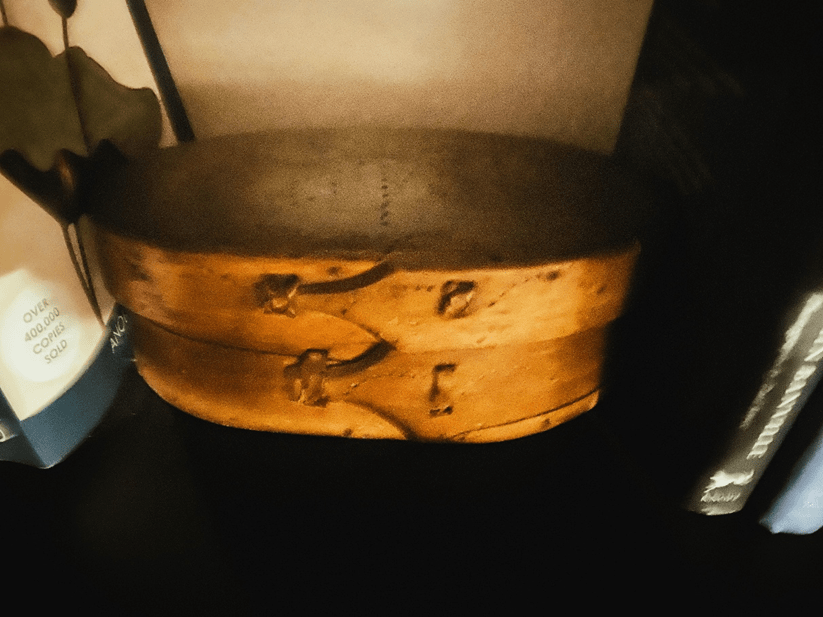
Well, it was sort of a box—small, oval, and battered. I must have walked past it every day, probably knew it was there, but never actually noticed it. Something there, but not consciously there.

I wasn’t especially curious, but the promise of a “Daddy story” was always enough. He loved to tell them—sometimes real, invented—and that was how he spread his love through our little family, how he made himself our daddy.

The box was light, wooden. The top pressed on.
“It’s easy to open, Karen,” he said. “Go ahead—but be gentle. There are some loose things inside.”

I tugged at the lid—a serious job for six-year-old hands—and hoped for candy, or maybe a small toy stowed away for just such a Daddy–Karen evening.

“Daddy, there’s nothing really in here—just some old stuff!”

That’s when the story began.

“A very long time ago, in another country called Sweden, your great-great-grandfather was a small boy, about your age, living on a farm. And your great-great-grandmother was a small girl, living on another farm. But the farms were poor, and the soil was rocky. They had a few sheep, but too many stones to keep a cow. They grew potatoes, drank sheep’s milk, and lived in a small house—much smaller than ours.”

In my mind, all I could think was: boring!

“Daddy, can you make the story go a little faster?”

“They left Sweden and took a boat to the United States…”

His voice was deep and slow, like music. I remember how happy I always felt when he was in a storytelling mood—but this one seemed too slow, confusing. I knew better than to interrupt too much. Interrupting could mean the story would end.

Then he picked up the box and held it to my nose.
“Smell it, Karen—it’s old roses. They still smell.”

“Daddy—I see brown things at the bottom. Are they really roses?”

“Those roses are more than fifty years old. They came from your great-grandmother’s garden in Minnesota.”

“Oh.”

“The box is ancient too—it was what they used to store butter in Sweden. It’s the only thing we have that came over with them.”

He paused. I could feel him trying to decide how the story should go on. But he didn’t. We got up, had dinner, and put the box back on the table.

Since there, I’ve come to understand why he breathed deeply and stopped.

For him—and therefore for me—the box was a link to a past we would never fully know, but that made us Swedish. Or rather, Swedish-American.  It represented something about who we were and where we belonged in the world that was hard to explain.

Every so often, he would say, “Let’s look at the box again,” and I would bring it down. I’d ask, for the hundredth time, “Who are the people in the funny tin picture?” and “Why did they make necklaces out of hair?” and “How can the roses still smell when they’re so old?”

Decades later, when I was in my fifties, I saw him unpack the box again as he settled into a retirement apartment, moving from Ann Arbor to Minneapolis to be closer to me.

“Daddy—the butter box! It wouldn’t feel like home without it on a shelf in your study. Can I open it?”

I still called him Daddy, though by then we spoke more about our shared research interests than anything else.

“Of course you can—the roses still smell, even though my sense of smell isn’t what it used to be.”

As I pried the lid loose, I saw that his mother had taped a small torn label inside. It read: This is for Stanley.

I knew what he meant. I would have it next. I said nothing.

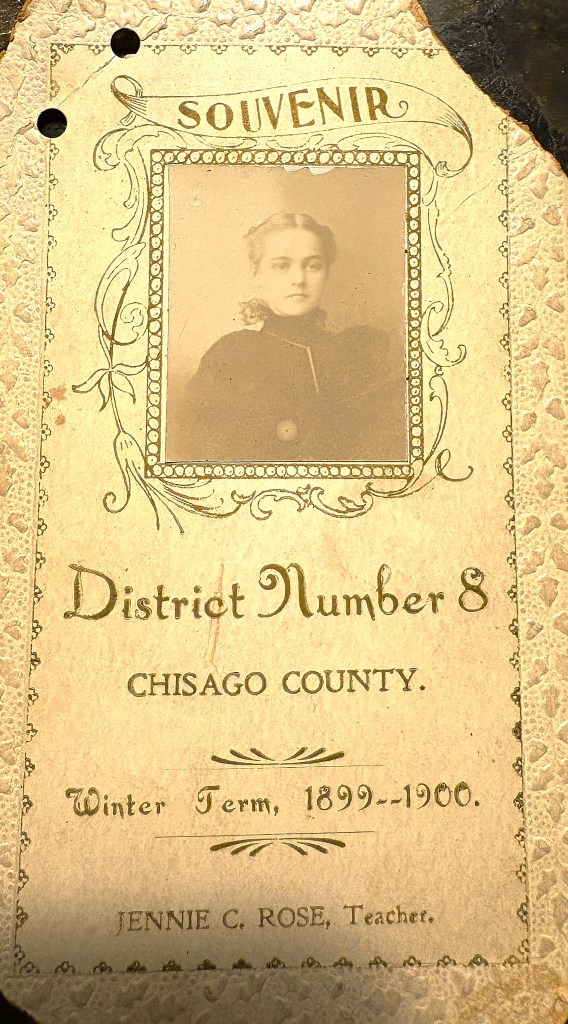
Now the box is on a shelf in my living room. The roses still smell–well, at least the cloves that were used to dry them. The old tintype and the hair necklace are still inside. My grandmother’s class list from when she was a teacher — 1899.
When does a simple object become something so valuable that it would be the first thing that you pick up, after your dog, if you had to evacuate?  Is it the object?  Or the stories it engenders, not just to one person, but to many.  When do objects become part of a family’s web, holding it together across generations?

Obviously, it is easier if your object is a butter box than your great-great-grandmother’s Queen Anne table. 

But for me, the boundaries between the butter box and all the people who loved it have become blurry –it is hard to separate the object from the remembered presence of someone you hold very dear.

Soon, I’ll ask my granddaughter to bring it down from the 8-year-old level shelf where it sits.  And I will tell her the story – perhaps not as beautifully as my father, but with the same effort to weave an invisible but durable web of connection.

“Opal, can you open the box?”
“Sure, Nana—what’s inside?”
“Just open it and see…”

Stories and Legacy: A Dialogue

Photo by S O C I A L . C U T on Unsplash

Karen’s Descant is all about telling stories.  We resonate in our bones with Doris Lessing’s observation that stories are what make us human:

Humanity’s legacy of stories and storytelling is the most precious we have. All wisdom is in our stories and songs. A story is how we construct our experiences. At the very simplest, it can be: ‘He/she was born, lived, died.’ Probably that is the template of our stories – a beginning, middle, and end. This structure is in our minds.

Lessing’s appreciation of legacy has been reflected intermittently in our dialogues over the past few months.  What follows is a much edited summary.

Karen Martha:

Last fall one of my friends mentioned that for many of us, our children are our legacy. That has danced in my head all winter, because I have no idea what my legacy might be. I’ve never considered my children my legacy, more like my effort to enrich the human genetic pool, and they are on their own after that. I mean, what if one of them robs a bank? Would I be responsible for that?

This led me to start thinking about what a legacy is. As always, I love to pick your brain. What do you think of when you hear the word “legacy?”

Karen Rose

I think that our culture often asks us to focus on the tangible assets that we will leave behind, whether it is money, an endowed building, or objects that we have created – and that is the first dictionary definition.  And we have been wrestling with that obliquely – as in What is My Footprint.  But the other side of legacy is not what we will leave but what we have received from the past.  I am asked to see myself as a legacy, not from one or two people but also from what flows through them to me. 

Karen Martha:

I hadn’t thought of legacy as what flows through us from the past. It’s hard to get my mind around that since my mother refused to talk about the past, and I lost contact with my father when I was in third grade. My past feels like it starts with my parents.

Karen Rose:

I can be very concrete about some aspects of my past.  My “Swedish family” came to the United States, primarily to the Midwest, starting in the 1860s.  Through accident or karma, all of those who came early married other “Swedes” – mostly native born – up through my parent’s generation.  This legacy cannot be defined precisely because I know that I am truly American and not really Swedish-American. Yet, the family stories about all those distant relatives – people who I met before I had real memories or sometimes never met – which make me feel like a legacy. And I don’t even remember the specifics of most of the adult chatter that seemed endless when I was young! The most precious object that I own is a small box that accompanied my great-great grandmother on the boat to the US.

Other assets – or obstacles in some cases – are less obvious…but what do you think?

                Photo by Laura Fuhrman on Unsplash

Karen Martha: I resonate to the idea as carrying the past forward but what about someone like me who grew up in a family where there were no happy stories or family keepsakes? I’m inclined to tell myself that no legacy is, in fact, the legacy. It was impressed on me growing up that it was up to me and my sisters to do better than my family as a whole had. “You are going to college. You do not have a choice in this.” It was as though they were say that it was up to me to live out their dreams and start a legacy anew. That said, there was a darker side to this legacy. It built in me a strong desire to not only realize their dreams but also to avoid their mistakes, among them a strong thread of alcoholism. I was determined NOT to be like them.

Karen Rose:

But you have put considerable effort into retrieving legacies that you were not freely given in your nuclear family.  You looked for and found your biological father’s relatives, and you  visited them with your own children and their families.  You describe a hole that feels a bit similar to people who are adopted and want to find out more about their blood relatives, even if they are surrounded by love in their adoptive family.

Do you think that this need to feel the threads that tie us to those who have been before – even if we never knew them – is due (at least in part) to our sense of ourselves as peripatetic rather than firmly rooted?  You have moved 30 times since becoming a young adult; I can’t quite match that, but have lived in other countries and in six states, never settling anywhere long enough to feel as if I had a home place…

The underlying question is whether my sense of myself as legacy could have been tied to stories about place rather than only to people if my life had been very different…

Karen Martha:

When I think about place, I am reminded that the minute my grandfather stepped on a boat to the US from Norway, he was leaving his familial legacy behind. I believe that place does matter, probably more in some countries than the US. When I visited Norway I stood next to the fence dividing my grandfather’s farm from the farm my grandmother came from. My second cousin said, “This is where you started, your grandparents talking over this fence, falling in love, and moving to the US.” As she told that story, I felt firmly rooted, even though I’d not spent my life in that place and even though my grandfather had left to start a new life in a new country.

Karen Rose:

We are our history, which includes far more than any particular short story that we tell about ourselves…It is not just the stories that I overheard about distant family connections, but also those that I have incorporated based on events and relationships. The older I become, the more aware I am of how much of my identity is tied in with living in another country and becoming almost fully absorbed into another culture when I was old enough (11) to understand the differences but emotionally and socially very pliable. I have lost touch with everyone I knew then, but their faces and their stories loom very large in my own narrative. 

So, for both of us, a critical and unplanned encounter with place and people has shaped our story of who we are.

Photo by Markus Winkler on Unsplash