Vulnerability 2: THIS IS IT

Less than three weeks ago, I was hit making a right turn from a freeway exit. I never saw the car until it slammed into the side of my car on the driver’s side and the airbag inflated—almost simultaneously. Wham! The airbag smacked the side of my head, stunning me. I was not sure if I was alive and if more was coming. I had to escape, get out of the car, see if I could stand, walk around. Make sure I was okay. In a Volkswagen, if the side airbag inflates, the others do too, so it took a frantic few seconds for me to figure out how to exit the car.

I’m okay; the car was totaled. In the warp speed of modern life, I already have a new vehicle, and I’m driving around with renewed caution. As I told one of my grandchildren, “Confident Karen has been compromised.” Yet again.

Maybe I’m telling this story because I need to keep telling it and telling it to take the power out of the memory. I’m also telling it here because it’s the perfect example of how physically vulnerable we are as human beings. Did you ever, as a child, step on an ant hill and crush both the ants and their home? I did. I felt powerful when I did it, but I also saw how fragile life is. I believe that experiences like this teach us, from childhood on, that we, too, are living things, and thus as physically vulnerable as the smallest ant.

Life can change in what seems like seconds. Sometimes there are clues but often we sidestep their importance. Take life threatening illnesses. Gary Stout complained of indigestion for a couple of months before finally seeing a doctor. In four days (which included the weekend), we had a terminal pancreatic cancer diagnosis. Jim Storm looked a bit yellow on our trip to Florida in spring of the year that he almost died from sepsis. I thought he was tanning too much; he thought he had the flu. He had a perforated ulcer that led to life-threatening sepsis.

Fortunately, such tragedies are not the norm, but admit it, modern life can be a jungle lurking with human versions of predators—unexpected bills, diseases in ourselves and loved ones, deaths, loss of jobs, threats of poverty or alcoholism, pandemic. What makes us different than animals, however, is our consciousness. We believe we can ward off predators with anticipatory actions, yet life deals surprises, aptly expressed by the word “accident.”

 In fact, as Erich Fromm writes: The price that man pays for consciousness is insecurity. He can stand his insecurity by being aware and accepting the human condition. . . He has no certainty; the only certain prediction he can make is: “I shall die.”

Here’s where emotional vulnerability comes in. Fromm proposes that humans develop a frame of orientation. We organize the world cognitively and emotionally, and we adapt. To me, that orientation is the human equivalent to the instincts that drive animals. Our vulnerability is not only physical, but there’s an emotional component, threats to our orientation, the meaning we are constantly making.

Here’s an example from my 6th grade. I was older than my classmates, and I was mortified when my unexpected breasts emerged before theirs. I thought everyone was staring at them. I hunched my shoulders forward and put a tee shirt under my clothes to hide them. It didn’t help that my mother took me to Zahn’s Department store to be fitted for a bra. I still recall the humiliation of the poking and pinching as she and the clerk said how perfect my breasts were. Really? Couldn’t they see my reddening face? Every day in school, I felt vulnerable, different, and fearful that I wouldn’t be accepted by my classmates, the other girls.

In her blog Vulnerability: What’s in a Word, Karen Rose described what I believe is one recourse for vulnerable beings on an unpredictable planet—the ability to share our vulnerability, so we are not alone with it. But it isn’t as easy as it sounds.

From protecting my budding breasts to protecting my adult insecurities, I’ve been a slow learner about emotional vulnerability. Jim Storm was a good role model, as he loved a good discussion. If I said, “We have to talk,” he was in. “Let’s” he’d answer smiling, sitting down in his favorite chair, folding his hands, and adopting his social worker mien. He listened and honored my inner truth, demonstrating that not only do we need our own courage to be vulnerable, but we can also open the door for others to do the same.

I’m reminded of the Robert Frost poem, A Servant to Servants, and the famous line, “The best way out is always through.” I have slowly wandered my way through this life being more and more willing to be vulnerable to people, emotionally.

Getting older is helpful. I realize, THIS IS IT. I may not get another chance to tell others that I love them, that they are full of baloney and I still love them, or that they are driving me nuts and I still love them. I’m not suggesting crossing boundaries, but simply owning my vulnerability, both physical and emotional. I’ve gradually learned that by plowing ahead, taking the risk of being vulnerable, I’ve both revealed new dimensions in relationships and also given others permission to be vulnerable to me. I can be there for others and myself.

To live is to be vulnerable, yet most of us want life to last as long as possible. Our physical vulnerability is offset by good surprises, babies, weddings, graduations, birthdays, our dream job. Even better are relationships filled with love, and this planet is ever glorious. So why not be vulnerable to others—you already are—and go through it together.

Condition: Provisional

https://www.flickr.com/photos/rayandbee/5915105592
The Wheel of Life
Vigeland Sculpture in Frogner Park, Oslo

As I live through this COVID-19 pandemic, one phrase keeps popping up in my mind: the human condition. To me, the human condition is our imperfection, our inability to escape suffering, and that we live in a natural world indifferent to us. I keep reminding myself and my family that we are experiencing firsthand what can go wrong in a natural world that we thought we had mostly tamed. At the same time, our culture promotes an ethic of personal responsibility, suggesting that we have an influence on what happens to us. So what does it mean to be subject to the human condition but responsible at the same time?

Take my grandfather Nils Jacobsen’s life. In 1917, before the end of World War I and another pandemic, the Spanish flu, he brought his wife, Marthe, and two-year-old son, Alden, my father, from their farm in Norway to Racine, Wisconsin, where they hoped to build a new life. The 1920 census listed them living in a rental in Ward 8. They were still finding their footing. In 1926, Nils sold the family farm in Norway, which he inherited as the eldest son, to his brother.  It appears that life was going well in Wisconsin. Times were good! 

By the 1930 census, Marthe and Nils owned a home, a sweet bungalow that’s still standing, and they listed a second son, my father’s brother. But it was the start of the Great Depression. Soon after, Marthe died at age 51, and by the 1940 census, Nils, my father, my mother, my father’s brother, and my older sister were living in a rental flat. It was World War II, and the fishing on the Great Lakes had dried up.  My father and Nils struggled to find work they could do. Nils died in 1948, a bitter old man, as my mother described him. 

Not an altogether happy tale, but I suspect most families, if they dig, can find similar stories. How much of what happened was Nil’s responsibility? Maybe selling the farm? But surely not Marthe’s death, the loss of their home, and the loss of fishing for a living. I tend not to judge him harshly. Nils and his family lived through World War I, the Spanish Flu pandemic, the Great Depression, and World War II. As for Nils dying a bitter old man, I’d say he succumbed to the human condition

While Nils confronted the human condition writ large, until now, my own experience has been more personal.  After my second husband, Gary, died, I struggled, literally, for years with searching for meaning about his death.  I endured guilt that I had done something to bring this outrage on us, and I believed that if I could identify what I’d done, I could atone for it—I should atone for it. When I wasn’t feeling guilty, I was asking myself about the larger karmic meaning of his death—were the repercussions in our immediate world a way of balancing the scales, so to speak? I found no clear answers. 

Being a church-goer, I decided to take my pain to the minister, Pastor Rob. Pastor Rob didn’t like the idea of karma—that I bore responsibility for Gary’s death and, thus, for my grief.  He thought such thinking was where New Agers go wrong. Instead, he told me that Gary and I, like all humans, were subject to the human condition, which includes suffering. Neither of us had caused his death and I didn’t owe any atonement. Wow! I walked out his office feeling lighter, a new freedom. I still didn’t know the meaning, and in truth, I continued to seek it, but not finding it now felt okay. My search became part of my human condition. 

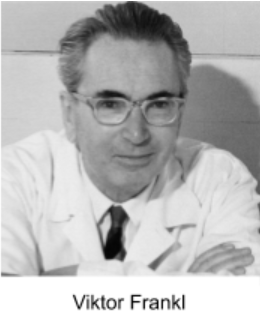
Later I learned about provisional existence. Viktor Frankl wrote that prisoners in concentration camps could not see an end to their suffering.  They could see no future so they lived a “provisional existence.” Pastor Rob had given me such an existence. I found no meaning, but I could live with that, provisionally, and keep looking. Frankl said something else that resonates with me in these times, that rather than me asking for the meaning of Gary’s death, I am being questioned by life and I need to find my own answer in my own terms.  In Frankl’s words: Each man is questioned by life; and he can only answer to life byanswering for his own life

So here I am, living in a world-wide pandemic. This isn’t the retirement I planned, stuck at home, worried about family, friends, and the world more generally. Worried about an uncertain future, are my savings withering so that I’ll be one of the people living solely on Social Security? Will we have a depression? What about my grandchildren, one in college who’s been forced to come home?  The other about to graduate into a precarious world, and there will be no celebration. I am being questioned by life, and how will I answer? 

I have choices. I can weather the pandemic, hopefully stay healthy, and go forward with what is available now.  I can support family and friends as they move forward, too. If my money’s gone . . . well, I’ll deal with that if I must.  My other choice, of course, is, like my grandfather, to grow bitter, that my glorious retirement has been denied me, that my plans have been slayed by a merciless nature. 

 Every day I take advantage of the one freedom still left, the opportunity to take a walk in the unfolding spring, oblivious to the havoc of a virus. It’s Minnesota, so it takes a while for spring to show its color, but because my life has so drastically slowed down, I linger on my walk and look for small signs of the turn towards spring.

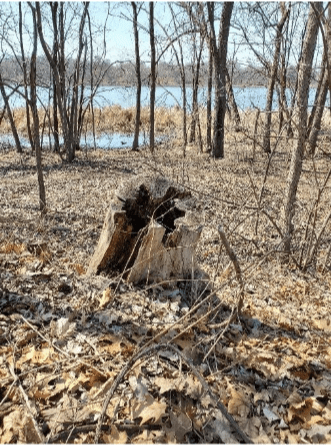
One day I noticed tree stumps, and I walked along eagerly photographing tree stumps, which mind you, are presumed to be dead, cut off. But then I noticed that some tree stumps don’t quit easily. They make the best of things and put out new shoots of life. Now and then there’s a hollowed out-stump that couldn’t regenerate itself. But everywhere in nature there are examples of persistence. Think about those weeds we so fervently pull. 

I have my share of human arrogance, but I’m learning to accept the indifference of our world—some natural and some human behavior—it is the human condition.  But in fact, indifference is a condition all life faces, human, stumps, and otherwise. So I carry on, knowing that as I’m questioned by life, I can keep on putting out shoots, it’s on me to find my own answer. 

A picture containing photo, fence, showing, outdoor

Description automatically generated

Later I learned that coppicing is a traditional method of woodland management that harnesses the ability of many species of trees to put out new shoots from their stump or roots if cut down.