Leftovers

Phase 1 of the holiday season – Thanksgiving. I always say it’s my favorite because there are no presents involved. I’m not sure that’s true, but it suggests I have an altruistic side.

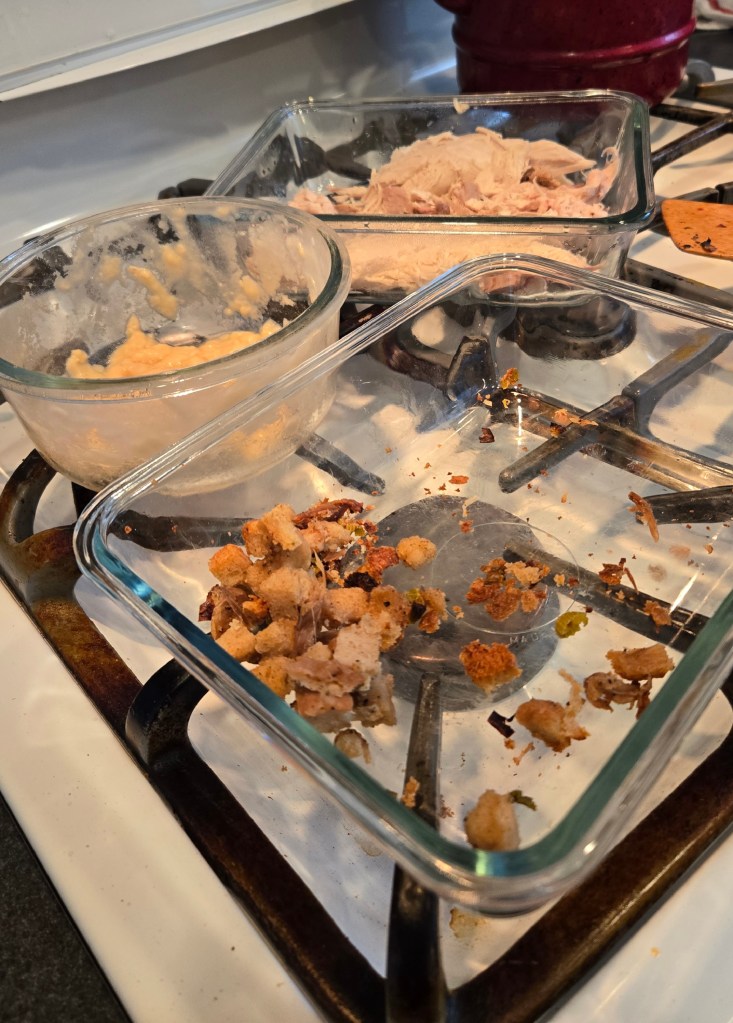
Now, with the holiday over and another approaching, I’m thinking about leftovers. Don’t you love them? The best part of Thanksgiving!

Leftover 1: Gratitude.  Last year neither of my two children and their spouses wanted to host Thanksgiving. They seemed to have caught the rest of the country’s malaise about it, too much work, with football and maybe turkey as the only reasons to get together. But, remember, I’m the person who says it’s my favorite of the holidays, so it seemed appropriate that I step up and host.

I was new in my apartment after selling Jim’s and my house, which had been the center of many family events. Could I possibly host Thanksgiving? In an apartment? I remembered a favorite movie, Hannah and Her Sisters, where Mia Farrow hosts her big family in a New York City apartment. If Hannah could do it, surely I could. So, I hosted Thanksgiving with good help from my family. And it worked. We gave Hannah some competition.

As that 2024 Thanksgiving grew to a close, we were scheduled to move to another family’s house for dessert, a tradition we started several years ago. But I was exhausted. I’d burned my wrist draining the potatoes, and it hurt. The kitchen was presentable, and all I wanted to do was sit and watch mindless TV—yes, something even more mindless than football. So I didn’t go. AND I announced that I was passing the baton—someone else had better step up and do Thanksgiving next year.

 “I am too old for all this work, and I’ve done my share!”

So, when Thanksgiving came around this year, my daughter stepped up, yet somehow, on the morning of Thanksgiving, I found myself responsible for an apple pie and the mashed potatoes. Everything that could go wrong did, and I barely finished in time to get to my daughter’s house.

During the entire time in my kitchen, I whined to myself, “I passed that baton. This is ridiculous. These potatoes are pathetic, mushed, not mashed potatoes, and the pie. Why did I agree to sit and peel apples and potatoes? And what’s wrong with my kids that they wanted mashed potatoes from Costco? Have I raised lazy children? . . . ya da ya da ya da.”

And then it hit me – sometimes the Universe does need to smack you pretty hard. I realized that husband #1; husband #2; husband #3; some old boyfriends and my sister (all deceased) would have given anything to be in my shoes: 81 and still mashing potatoes and partying with family

Who cares about potatoes or pie—I was getting to enjoy Thanksgiving with everyone I love. I was getting to make pie and potatoes for them. Getting to do this (see https://designingyour.life/), became my new mantra. My resentful, “I HAVE TO” went “puff” and left the room, leaving gratitude in its place.

Leftover 2: Intergenerational Conversation. Last year as dinner ended, we started a discussion about AI. Everyone at the table had a stake in AI. I was teaching an undergraduate writing course and struggling to convince students that you can’t learn to write if ChatGPT writes your paper.

The discussion was fast and fun; no one left the table to watch more football, which means something. We are a family of frogs, we jump into the pond quickly. Our one turtle, Luisa, is often left standing on the bank; she jumps in later, usually with great wisdom.

This year, we’d finished eating and were lingering in the kitchen, snitching bites of dressing and turkey. Elizabeth, my daughter-in-law, asked her 24-year-old son, Henrik, if he wants to have children. I don’t remember how we landed there, maybe because two of our young people are about to graduate from college. Henrik never did answer, but the question kicked off another great discussion about the uncertainty of the future, mainly the planet, and how grim it looks to Gen Z.

The future, by definition, is uncertain, but what my Gen Z grandchildren are feeling is more complicated than uncertainty. The word, “existential” kept floating up. Generation Z young people ask different questions about meaning, purpose and identity than the Silent Generation or even the Boomers did. As we talked, they hesitated to share their dreams for their futures, wary of the future of the planet and climate change.

I can’t recapture the opinions, but I concluded that young people are facing problems unique to our time with climate change at the heart of them, especially as the world responds. They are terrified, although they didn’t use that word. (Remember this is an “n” of 3, so ask your own Gen Zers). And yes, we hid under our desks because of nuclear bomb threats, but this is different.

Reflecting later, I realized we had had a family conversation that crossed generations. Gratitude welled even greater in me, couched in concern for my grandchildren. I was, nevertheless, grateful for the sharing across generations.

Leftover 3: Hope. We eventually moved to more mundane topics, but I worried that what I was hearing might be despair. I didn’t want them to throw in the towel for a life of hedonism. So, I later questioned the Gen Z grandchildren separately.

I started with Henrik, “You aren’t giving up on dreams for your life, are you? Embracing a life of hedonism—do you even know what that is?” (Who knows what they teach in college anymore.)

“Don’t worry, and yes, I know what hedonism is. For now, I don’t know what I’m doing after graduation, but you know me, I’m just curious about it all.”

Whew!

Later, in my car with Luisa, who you will remember is our family turtle, never jumping in too soon, I asked her about her aspirations. She gave me even more hope, summing her thoughts up as “I don’t want to miss my life waiting around for the end of the earth, so I’m living it.”

Upon hearing those words, my gratitude for the day swelled into hope. Yes, the situation in the US and worldwide, especially climate, looks dire, hopeless, gloomy, depressing. . . you get it. But along comes Thanksgiving, and the leftovers. We engage in meaningful conversations and emerge with hope, nurtured by connection and making meaning together.

Another LEFTOVER:

From Wendell Berry, Think Little

. . . the world is blessed beyond my understanding, more abundantly than I will ever know. What lives are still ahead of me here to be discovered and exulted in, tomorrow, or in twenty years?
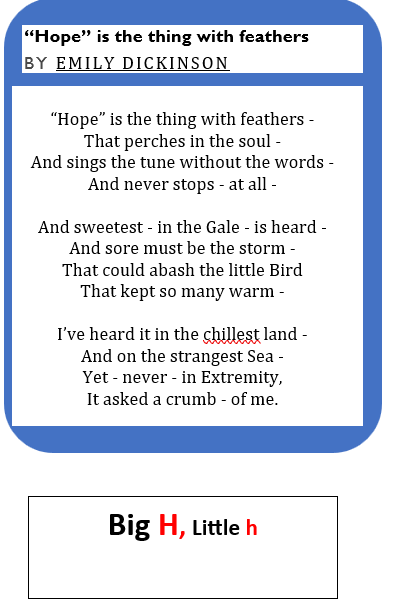
Big H . . . Little h

Hope is the thing with feathers. I’ve heard that line many times, read the poem over and over, but I’ve never been sure what it means. LitCharts says the poem means, that hope is a strong-willed bird that lives within the human soul—and sings its song no matter what. Almost an a priori trait that we humans hold. But sometimes I worry that “hope” is cheap talk, especially when the speaker of the house, Mike Johnson, says, after the Nashville school shooting:   We are hopeful and prayerful.

Maybe another reason I’m unsure about hope is that the last year of my husband Jim’s life, I felt like that thing with feathers had flown away, to other souls perhaps. He declined daily, although at the time, he believed—and tried to persuade me—that if he just exercised more, sat in his compression boots longer, or ate more liver and beets, all would improve. But it didn’t. He’d make plans to go places like the Lakes Area Music Festival in Brainerd or Blue Fin Bay, our special place on Lake Superior. Then, at the last minute he’d tell me to cancel the reservations, never admitting he wasn’t up to it, instead hanging on to hope with an excuse like—”We don’t need to drive all that way when we have a lake right here, and we can watch the music festival online.”

 Although I said nothing to Jim, I felt like illness had usurped our lives. I don’t know whether he felt the same way or not, but nightly we’d try to perk up each other by simply sitting together holding hands. In retrospect, hope may have flown away, but love held steady.

 It is not my singular experience that hope can be threatened as we age. As Sarah Forbes writes in the Journal of Gerontological Nursing:

The elderly face numerous cumulating losses, such as the loss of a secure future, financial security, functional independence, bodily mobility, significant relationships, societal and familial roles, and bowel and bladder control.

Whew, that makes me not only unsure but discouraged, too. I (The word elderly alone is enough to send me to the mirror to see if I am indeed, elderly).

While this quote refers to a unique age group, hope is something we have throughout our lives, from the moment we awaken, “I hope I have a good day,” to falling asleep at night, “Gosh I hope I sleep well.” We hope for good weather or to spend time with loved ones. When I was young, I used to hope that after I paid the bills for the month, there’d be some money left over. Human hopes are a long, long list. In the spirit of my earlier blog about Big P, little p, or Big Purpose, little purpose, I’m labeling these hopes of daily life, little h.

But what about Big H. . .

This morning I picked up the StarTribune and read Pot use rises along with calls for help, and Woman opens fire in Texas church. Tucked further in was an article about climate change and record warmth in Minnesota’s north. Rarely does reading the paper give me hope about anything. Maybe that sells papers, but it sure can add additional weight to those “cumulating losses” that come with age. I call this kind of hope, or lack thereof, Big H, worldly stuff: climate, society, and what kind of future the world’s children will have.

After Jim died, I struggled to regain hope. A family member became seriously ill, I learned of contemporaries dying, and the news remained dark. It felt bleak, and I missed my man who always told me, “Humans will figure it out. I’m hopeful.”

But then, suddenly, when I least expected it, that thing with feathers found me. I’d agreed to teach half time this year for the University.  Friends wondered why I said yes to this when I was retired and busy with both Jim and other projects. But something told me I should. The first week of class, I asked students to post short PowerPoints about themselves online so we could get to know one another virtually, to counter an environment where we feel like just a name. And there, in those PowerPoints, perched that bird! I broke into a smile as I read about young people intent on making their lives and the world better. Here are some of the activities these students do in addition to raising families and going to school:

  • Volunteer with local animal rescue;
  • Advocate for parents and babies
  • Change the lives and livelihoods of my people (Gambia);
  • Music therapist;
  • Mandela Fellow;
  • Peer health educator working with drug users;
  • Physician working with Disaster Preparedness and Response;
  • College success coach;
  • Started a non-profit Mother to You (sends medical supplies to Senegal);
  • US House of Representatives Senior Policy Advisor; and
  • MN Justice Research Ctr, transform current legal system.

There are 45 students in my class so I could go on, but my point is that when I read their PowerPoints, I read hope, an abundance of both Big H and little h. Suddenly this elderly person knew that hope was flourishing all around her.   

Although I struggled to feel hope in that last year of Jim’s life, I remember all the little h’s that Jim and I had in the ten years of our marriage. At the same time, he fervently believed that humans would come together and solve the world’s problems. Jim epitomized both Big H and little h. I remember him in the hospital, a week before he died, asking me for his wallet so he could reserve a weekend at Blue Fin when he got better. Maybe Emily Dickenson had it right. If we pay attention, that thing with feathers is all around us.

Main Course. . . Patience

My 16-year-old granddaughter, our “technical consultant,” called me last week in tears that her school, which has been hybrid, was going completely online.  There would be no more “real school” as it is delivered now, with plastic barriers in the lunch room, one-way halls for passing, tables that once afforded group work replaced by desks spaced far apart, and masks, masks, and masks! She said, “Even if we have to wear masks and don’t have as much chance as normal to socialize, it’s still better than sitting at home alone in front of a computer!” She almost never shouts or gets riled, but she was mad and making it known.

“Be patient” I advised. “Your teachers and the principals want to keep everyone safe. I’m sure they have good reasons for doing this.” She wasn’t hearing me, although a few days later when some students started an online petition to keep hybrid school, she said she wasn’t going to sign, arguing that maybe it was for the better since Minnesota is having a real Corona Virus surge.  Patience has prevailed for now, although she loves to dream about everything she will do this spring, when “we get a vaccine.” Her patience for now, is grounded in hope, that dreaming ahead we humans love to do.

We’re having a great opportunity with the Corona Virus to practice patience, and now with the election of Joe Biden, it’s twofold. First we were in limbo about who won and now we now find ourselves waiting for the handover of power. As for the virus, in Minnesota the governor has ordered a significant lockdown for the next four weeks. What can we do but wait—be patient?

That said, being patient is not always easy, especially when confined to the same house with the same people doing the same things day after day. I have four grandchildren, and all of them are experiencing disruptions to their lives that they neither anticipated nor have been taught how to handle. I can remind them that humans have survived many terrible things, world wars, other pandemics, droughts, depressions, etc., and I can express encouragement. Nevertheless, I wish I knew how to do more to help them. 

As a teacher, I learned that one of the most powerful ways to teach is to model, or, by example. Practice what you preach, walk the talk! This was brought home to me when I was teaching fifth grade while in graduate school. I would make note cards to study for a test, and whenever I had a break in my teaching day, like lunch, I’d use the notecards to study. I’d sometimes have students test me with the note cards. One day before a math test, I noticed that many of my students had made note cards about what would be on the test. When I commented on this, they told me they were studying like they saw me study. Wow!  I had not even tried to teach them this strategy, but they had learned it by watching me.

In a reverse of the generational expectations about who teaches whom, my technical consultant granddaughter is the one teaching me how to DO patience.  Her approach is about kindness, thinking about others instead of oneself. At the beginning of the pandemic when schools and everything else abruptly closed, she started calling her two grandmothers every couple of days so we wouldn’t be lonely. She has continued this throughout, and I truly look forward to it, as does her other grandmother I’m sure, who, in her late 80’s, lives alone in South Dakota. Talk about modeling!  And talk about “to teach is to learn!” She teaches me by example as she teaches herself. I am awed.

Last week my other granddaughter texted me that she missed my sloppy joes. It’s a custom in our family to get together to celebrate birthdays, and I make sloppy joes. I told the technical consultant granddaughter about this text, who immediately said, “You should make some and take them over to her.” I did, and as I set them on the doorstep, I welled up with pure joy—I was doing something to help, making the waiting just a tad easier.

When our governor nixed even outdoor gatherings for Thanksgiving, I was angry. In my family, we know how to gather around a bonfire while socially distancing, which was what we had planned. I remembered why Thanksgiving has always been my favorite holiday. It’s a holiday not about gifts or elaborate decorating or religious significance. It’s about celebrating our many blessings, the reliability of a sun that rises every morning on a spinning planet, rich with everything we need; strangers, friends, and family who mostly want to live right lives; and moments of joy and love.

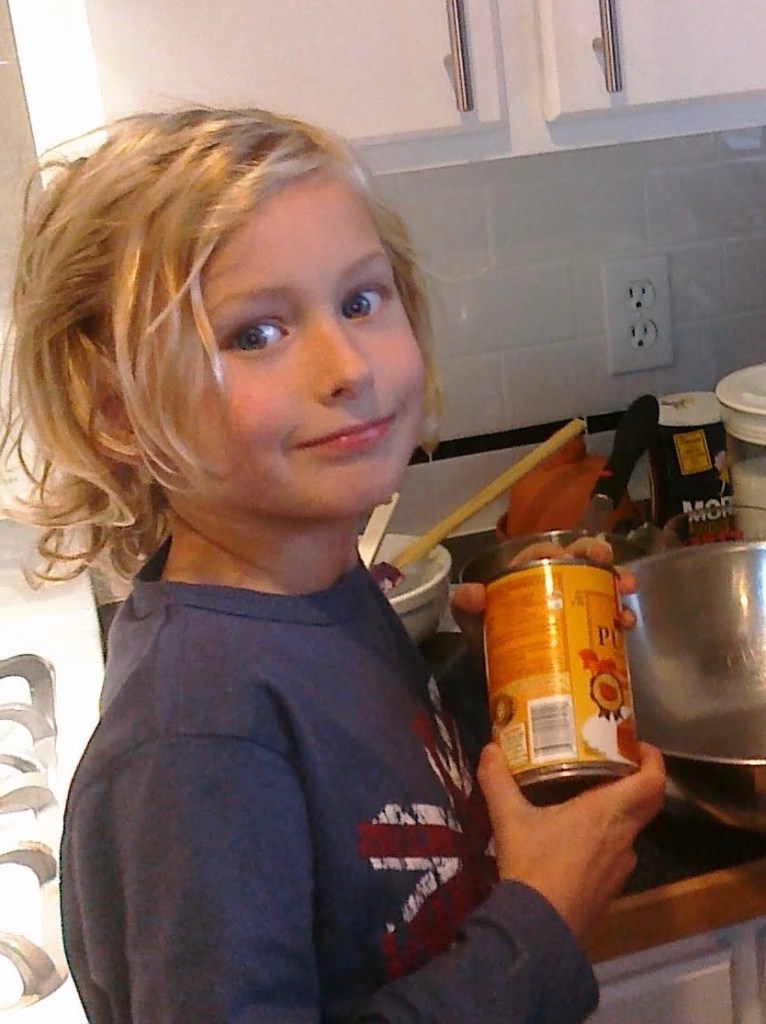
Henrik, about to mix the filling

While I fretted about how to preserve my favorite holiday, my grandchildren, via a series of texts, planned a virtual pie baking afternoon for Wednesday (We’ve always baked pies together the Wednesday afternoon before Thanksgiving). They are not letting a shutdown order stop them. Who better to forge a new way to celebrate than the young!

Next, our families sent out Zoom invitations to get together for the holiday. So, this year, on Thanksgiving day, after my husband and I have stuffed our chicken and put it in the oven, we’ll gather with our families around a laptop, the province of the young, for moments of joy and love, waiting hopefully and patiently for next year, when we can all be together once again. 

Musings. . . George Floyd. . . Dreams. . . Hope

The week after the murder of George Floyd, Karen Rose and I, as Minneapolitans, were too shocked to post, write, or even think about our blog. In a place we both love dearly and call home, something so tragic happened that the sadness was overwhelming. Because I am in Minneapolis, I mostly responded by following the news 24/7, putting aside worries about the pandemic for a bigger concern. Karen Rose, who’s been away from our city because of how the pandemic unfolded, said she kept thinking of Langston Hugh’s poem Dreams.

Dreams

Langston Hughes – 1902-1967

Hold fast to dreams 
For if dreams die
Life is a broken-winged bird
That cannot fly.

Hold fast to dreams
For when dreams go
Life is a barren field
Frozen with snow.

While the George Floyd tragedy unfolded, I remembered two African American students I encountered in my preservice teaching education. The first was Kenny, at the time a fourth grader at Irving Elementary School in Minneapolis. As young as he was, Kenny had charisma. Kids and adults wanted to be around him. He exuded friendliness and confidence in himself, even though he couldn’t read. When he learned that my husband had attended Irving and that his parents still lived in the neighborhood, Kenny started visiting my in-laws who were quite taken with him. Evelyn, my mother-in-law, would have him in for a piece of cake or cookies, whatever she was baking, and Kenny became a regular at her house.

The other boy was fittingly named George, and I worked with him at Willard Elementary where I was doing my student teaching under the supervision of an incredible Black woman who ran a disciplined classroom with warm caring. She assigned George to me. George had tested below average at the start of the year and was about to be labeled educable mentally retarded (the term at the time), but she saw a spark in George’s eyes and did not want this to be his fate. George responded because Mrs. Hendrieth believed in him, and she assigned me to give him the attention he so sorely needed but hadn’t been given. By the end of the school year, he was reading on grade level and tested a 106 IQ, well within normal range. (IQ testing was the fashion of the time).

As I thought about justice and opportunity and as Al Sharpton put it, “keeping a knee on Blacks’ necks” I remembered those two boys and wondered what happened to them. That’s when I realized how big hope can be, because I always hoped that they had the opportunities and lives they deserved, that all people deserve.  

So what is hope?  It’s not just the opposite of despair, but it’s what keeps dreams alive. In early May, when it seemed things couldn’t get much worse than the pandemic, Karen Rose wrote about hope. How prescient that blog is for where we find ourselves today. She noted, hope rests on our capacity to change, even with an incomplete vision of what will be asked of us. I believe that George Floyd’s death has reminded all Americans of the dreams we hold for this country. But it also screams at us that not everyone has had a fair chance at these dreams. 

The relentless protesting, as jarring and frightening it has been at times, made us start looking for what is hopeful in our current mess of a country. Here’s our list of what gives us hope about our capacity to change.

Our Top Ten Reasons for Hope

1. Youth are energized and leading the movement for justice. A few days into the protests, Minneapolis St. Paul high school students arranged their own protest on the grounds of the state capitol. Young artists are speaking out.

https://www.startribune.com/mother-of-george-floyd-s-daughter-speaks-out-thousands-crowd-state-capitol/570964242/

https://www.startribune.com/two-young-artists-create-a-cemetery-in-minneapolis-to-honor-victims-of-police-killings/571213142/

2. People of all ages, ethnicity, race, income are standing together for justice, even in these polarizing times. Maybe we have found our unifying cause.
https://theconversation.com/george-floyd-why-the-sight-of-these-brave-exhausted-protesters-gives-me-hope-139804

3. Some police and National Guard personnel crossed lines in support of justice.
https://www.cnn.com/2020/06/01/us/officers-protesters-images-george-floyd-trnd/index.html

4. Reforms in policing are already beginning.
https://www.vox.com/2020/6/10/21283966/protests-george-floyd-police-reform-policy

5. Small town newspapers, from Brainerd, Minnesota
https://www.brainerddispatch.com/news/crime-and-courts/6522127-George-Floyd-memorial-raises-hope-of-change to Marshfield,Massachusetts
https://www.marshfieldnewsherald.com/story/news/2020/06/04/george-floyd-protest-police-attendees-hope-rally-marshfield-brings-unity/3137900001/ report hope and a chance for unity in response to George Floyd’s death.

6. Confederate statues, symbols of those who fought to preserve slavery, are finally being taken down.
https://www.nbcnews.com/news/us-news/virginia-has-most-confederate-memorials-country-might-change-n1227756 and https://myfox8.com/news/residents-react-to-confederate-monument-removal-overnight-in-alabama/

7. Faith groups are coming together to work for justice.
https://www.southwestjournal.com/news/2020/06/faith-groups-respond-to-george-floyds-death/

8. Support and calls for justice are worldwide.
https://www.npr.org/2020/06/02/867578129/cities-around-the-world-hold-protests-in-response-to-george-floyds-death

9. Businesses are speaking up for justice.
https://www.businessinsider.com/corporate-responses-to-george-floyd-death-analysis-racism-diversity-inclusion-2020-6

10. Individuals are asking what they can do and how they need to change.
https://lithub.com/letter-from-minneapolis-why-the-rebellion-had-to-begin-here/?fbclid=IwAR3EyDdOqw4dNnJ1BoiVfWgANpvdjWl0qVj966sY-5gSrG3aAUWZSt0x0pU

And now for a story that always reminds me that I can make a difference. When my second husband, Gary Stout, was dying, he felt regret that he had been nominated to be secretary of HUD, but was not given the position. He felt that he could have had a real impact on housing and urban development. In the last weeks of his life, he received many calls and letters from people he had worked with on small projects throughout the United States, including Anoka, MN. These people thanked him for the work he had done in revitalizing their communities. He was astounded by these heartfelt expressions of gratitude. He told me that he never realized the impact small projects can make in individual lives and locally. He said that for the first time he realized he had not failed even though he hadn’t made it to the pinnacle in urban development. His work had made a difference after all.

I remind myself of this often, because it’s easy to dismiss the impact of our small lives, day-by-day, person-by-person, and in our small circles. As for the lessons of George Floyd, real justice can only come when each of us commits to small changes in how we individually work for justice. I urge us all to be part of the change.

TO BE CONTINUED