Strange But True

Guest blog by Carol Boyer Peterson

--Photo by David Matos on Unsplash

Have you ever heard a story that seemed so unlikely that you thought to yourself, “that couldn’t happen”? Yet, reluctantly, most of us learn that awkward and even bizarre experiences can yield unanticipated life changes.

My recent story is about how loneliness, isolation, and physical challenges led to an opportunity to reengage with life that I could not have anticipated. Who could imagine that spending two months in a memory care facility would become a journey into vulnerability and community? But it happened.

A little over two years ago, I tripped over an errant lawn-watering spigot and broke bones in both of my hands and fractured my wrist. Surgery was required on my left hand; a cast, on my right hand/arm. At the time, I was also part of a 15-month clinical research trial for chronic leukemia, and my orthopedic surgeon could not predict how long it would take for my bones to heal.

Keep in mind that, as a participant in a clinical research trial, I learned compliance—not easy for someone who prides herself on being in control! So, I should have readily accepted the hospital’s recommended placement in a traditional rehab facility, but my instinct told me otherwise.

While I was confident that my bones would heal, I knew that what I wanted was a quiet place where I could get the care that I needed and spend time in solitude, prayer, and reflection. I chose a nearby senior living community that had skilled nursing, a faith-based organization where I had volunteered and was familiar with some of the staff. However, there were no rooms available in the rehab section. Given the urgency of finding a room and my deep conviction that I needed to be at this particular location, I agreed to a room in their memory care facility, where I joined 12 elderly people—many close to my age—who were no longer able to live independently.

My health care professionals were horrified, but I prevailed.

My sparsely furnished room was on the second floor; my view, the monastery and an adjoining college campus. When I arrived, I spent much of each day alone…and looking out the window. But the shock of being physically unable to care for myself—even eating and brushing my teeth required assistance—and living in a locked ward with 12 other souls with advanced dementia became much more than a story of an awkward and inappropriate healing environment.

Rather than stay in my room, I chose to become an active member—albeit differently dis-abled—of this community. I participated in group activities, interacted daily with other residents, ate with them, volunteered to lead a chair exercise group (I am a certified exercise coach), and more. I learned to love being with my new friends, who quickly became comfortable with my active presence in their daily routines.

I often tell people that my perspective on everything was forever changed by the experience of being my late husband Jerry’s primary caregiver for nearly a decade. As his Lewy Body Dementia progressed, I learned to slow down, be more patient, and live with a good heart because I loved him so dearly. But, it was also a time of increasing detachment from the rest of the world.

And yet, two years after Jerry passed away in the same memory care facility that was now my temporary residence, something implausible happened: I felt part of a community. In a place that clearly was not intended for someone like me, I gained a different and deeper respect for the many challenges faced by those with advanced dementia. I also became reacquainted with critical life lessons, including how essential it is to protect individual dignity, call people by their first names, and listen closely to their life stories, which often appear in fragments rather than a well-designed narrative.

So, looking back, I can now see that my story—which others might have seen as ripe for a comic review titled “Life in the Alzheimer’s Unit while needing help with the Activities of Daily Living”—turned out to have been a gift.

Spending time in a memory care facility brought me face-to-face with my own vulnerabilities in a way that I had never even considered before. And, perhaps most important of all, it got me “unstuck” from loneliness and isolation, giving me instead a renewed sense of hope, healing, and connection. At a time when things could easily have gotten much worse, they started getting better—all because of a choice that I made against the advice of pretty much everyone…a choice based on instinct, not rational thought.

Fast forward to today. My cancer is in remission, my bones are healed, and I’m beginning to find a new way forward with greater humility, courage, and a heart that is more open to others. Caring, which has long been a defining characteristic in my life, will be guided by my faith and what I started to learn in those two months. Writing and sharing stories about my life-affirming or life-changing experiences will become part of my calling to bring peace and light into the lives of others. And, even though this is not what I planned for myself when I retired early and married Jerry, I will take the curious, compassionate, spiritual, and loving version of myself—which is slowly emerging—with me on this next phase of my life journey.  

“We do not think ourselves
into new ways of living;
we live ourselves
into new ways of thinking.”
                       —Richard Rohr

Carol Boyer Peterson

I am a widow, stepmom, grandmother of 9, social scientist and retired university administrator. I love many forms of exercise from Pilates to hiking. Despite the long winters, I also love living in Northern Minnesota with a view of Lake Superior. I am blessed to have dear friends and family who are with me on my life journey.

Circle of Friends

Getty Images, courtesy of Unsplash

A few weeks ago, I read an email from my friend Gary, part of regular, long-ish musings that he sends to a select few.  He was stimulated by the observation that people typically have no more than 150 friends and, true to his reflective nature, he dove in and found Robin Dunbar’s observations on friendship.  I mentioned this “fact” to my husband, who quickly noted that it was close to Harari’s observation in Sapiens that human societies change when their membership increases above 150, becoming more complex and often hierarchical.  Enter the blacksmith and the mayor….

Well, Gary is an extrovert who has lived in the same part of Minneapolis for almost his whole life.  He also worked for over 30 years in a position that thrust him into conversational spaces with faculty members from a more diverse group of departments than any other person at the University of Minnesota.  In other words, Gary is a social anomaly in our modern, mobile world. Many of the thousands of faculty and professional staff at the knew Gary, directly or indirectly and, coupled with his rootedness in the community,  I am sure he would recognize well over 150 people as pleasant acquaintances with whom he has shared conversations and food. As a thoughtful and interesting person, he could converse equally well with those immersed in Veterinary Medicine, Classics, or the Registrar’s office. His Christmas card list is long.  Distilled out of his hundreds of acquaintances is a core of 11 close friends who he has treasured for over 30 years.

As I reflected on his email, I felt small and a bit lonely!  I counted up my close friends (people I see or am in regular zoom contact and have known for 30+ years), and I could come up with only 3, or at a stretch, 4. I have no obvious social anxiety or deficiencies, so I had to starting thinking about why….

Unlike Gary, I have lived in four countries, 5 states and 16 distinct places. I graduated from high school and college at a time when a long-distance call cost real money.  My friends from those days are all highly mobile – none live where I grew up, and after college we all scattered across the globe.  And I more recently moved across several states.

When I think of a circle of friends, I go all the way back to junior high school and a a group that I had a 60th reunion with last year – that is me in the green sweater.  We live in different places, see each other every decade or so,  but we can start up a conversation as if no time had passed.  This means a lot: I feel joyful when I think of our shared adolescence and the interesting and fun people they continue to be.  I have not had a “circle of friends” like that since.

My friendships don’t fit neatly into a set of concentric circles that reflect differential “closeness” with me at the center.  As a member of overlapping national and international associations, I have a long-standing web of personal-professional relationships – people with whom I have regularly broken bread or shared coffee that that may be as large as Gary’s.  Whew – even though I am not a true extrovert, I seem to have a natural preference for connecting,  and when I think of the joy of finding someone who I really like in the lobby of a soulless hotel in a major city or another country, I smile. 

But I am retired, as are many of them. I am unlikely to travel to Florida just to see Joe or to Sweden to visit Olof and Helene, and we no longer have conferences that ensure meeting several times a year.  Still, looking back on the jokes, the work chatter interspersed with family life, the occasional sharing of hard stuff, music preferences, and furry companions, I know that they are much more than “acquaintances”.  It lightens my heart to know that I worked, over many years, in the company of people who mean much more to me than what they do or produce. 

A web is not a circle.  When I think of my “close friends” whom I have known for decades (and will get on an airplane to see) the list of expands a bit.  In this, I am in a community that ebbs and flows, a web where everyone is connected to others, directly or through me, and where we share the same feelings of care and concerns for each other.  I am not at the center and not at the edge, but our lives are intertwined even as they are separate. 

I am drawn to ask what we mean by friendship, beyond the obvious indicators of caring, trust, a sense of mutual intimacy and a shared sense of humor.  I have been  a mentor to many students, I have kept in regular touch with around 7, many of whom I have known for decades. Is that friendship, or something else?  Or the colleagues with whom I have shared years where we collaborated on projects that engaged us deeply?  They are so much more than acquaintances, yet not people who I would invite to a barbecue. I am grateful for each of them.  Karen Hering says that I  can claim them as companions on life’s journey.

Image courtesy of Nina Cvijo, on Unsplash

And what do I say about people with whom I have shared intense relationships – old loves, sponsors, mentors, co-conspirators of one kind or another – who are in my life for a shorter period, but who think of me as often as I think of them and who are forever sewn into my heart.  I can I can touch base with any of them when it feels right.  Claim them again….

In the end, I have decided that I can’t place people I have known within circles.  I want to remember them in the web of relationships that have meaning for me and for them – and that can be activated after many years with an email or a phone call to evoke a mutual burst of warmth and gratitude. 

What About the Cows?

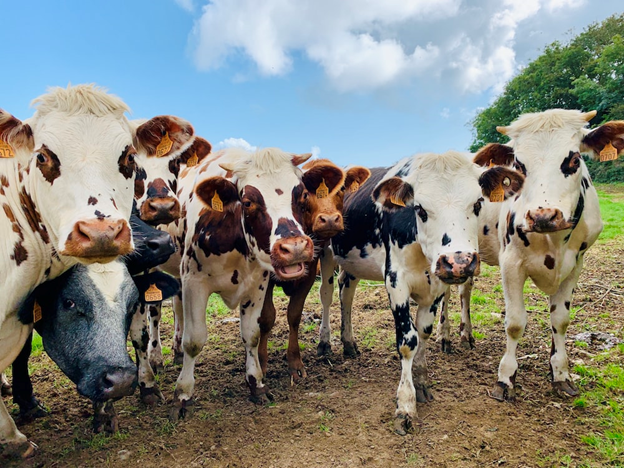
Photo by Lomig on Unsplash

Karens’ Descant has regularly touched on the topic of paring down, decluttering, releasing loved objects, and living smaller.  Still, when I came across Thich Nhat Hanh’s story about the farmer who lost his cows in No Mud, No Lotus, I was struck (again) by his gentle insistence that we must look beyond the obvious detritus with which we are surrounded.

 His parable runs something like this:  A farmer, looking anxious, passes by The Buddha and group of monks, and asks “Have you seen my cows?”  The Buddha replies that they have not, and that he should look in another direction.  After the farmer leaves, he turns to his group and says “Aren’t you very lucky.  You don’t have any cows to lose.”

Well, that’s a head scratcher.  The Buddha and his followers may be fed by the kindness of strangers (or devotees), but the farmer’s existence is dependent on his cows.  At first the parable seemed a bit like Marie Antoinette’s “Let them eat cake” response to the absence of bread – a life of contemplative ease contrasted with a life that is marginal in its well-being.  No wonder the farmer was anxious – he has a family to feed and small children who are crying for milk – and cows on the run also distract him from the many other tasks that a small farmer must accomplish (mindfully, one hopes) in order to sleep well at night.  I am all in with the farmer….

But as the story unfolds, it is clear that my automatic social critic lens is (once again) too narrow to take in the meaning of The Buddha’s response.  Thich Nhat Hanh reminds us that the story is not about real farmers and rambunctious cows, but about our attachments to ideas and habits – particularly those that we associate with our well-being and happiness: 

One of the biggest cows that we have is our narrow idea of happiness.  You may suffer just because of your idea; and you continue to suffer, until, one day, you are capable of releasing the idea and right away you feel happy — No Mud, No Lotus, p 59)

To be truly happy, we must release our cows – the attachments that hold us back.  As I Googled “releasing our cows”, I discovered that there is even a printable worksheet to help….

Ok – as I look at my life I have to consider not just the “stuff” that Dan and I have been pretty good about culling, recycling and donating, but at the other less visible baggage that I still carry.  I don’t have to get too reflective to find cows mooing in almost every corner of my inner life.  Here is just a quick list….

  • I am attached to my convenience – such as having 2 cars even though we rarely need them.  Oh, the excuses I make – they are paid for, we always combine errands to drive less, we don’t have a garage to hook up an electric charger…My friend Kyle, who has chosen not to own a car, kindly pointed out this cow today after I tut-tutted about his ecological failings in using Swiffers
  • I am attached to my slothfulness – I have never liked exercising, and can conjure up 1000 excuses even when my Apple Watch tells me that I may expire in an untimely fashion from lack of activity. I feel guilty when a few days go by and I am happily puttering, writing, cooking – and I even count gardening as exercise, but I belonged to a YWCA health facility for a year – and never went.
  • I am attached to worrying – about my children and grandchildren, whose lives and future I cannot control (or even directly influence…).  And would they be annoyed if they knew how much I worry…about whether the house will need to be painted in a few years (yes, probably – but will worrying about it make it less inevitable?); about if and when we should consider moving into a life care community.  Well, this list is endless and useless…
  • I am attached to having the dishwasher loaded a certain way – I even sneak up after Dan has loaded it to rearrange stuff…let’s not go into the other areas of secretive tidying so that things will be arranged in a way that I like…well, sometimes I tell him the right way to do things (which he sensibly ignores).
  • I am attached to my own significance — I say yes to requests even when I immediately know that it will require me to do things that will make neither the other person’s life or mine much better (and I sometimes have to back out with a limp excuse).  And I feel guilty about NOT going to a conference, which involves canceling dates/coffees/dinner, etc. with people whose lives will not be deeply affected by my absence (they all have other friends).  I even work at maintaining a public image that no longer fits, polishing my “emerita vita”, which no one is likely to read….

Honestly, even the beginning of the mooing cacophony makes me start to laugh at myself, albeit with a large dash of added discomfort.  I should add that this list does not make me feel like beating myself up:  these cows are not harming anyone else in a significant way.  They are not “character defects” but cows – all the small things that, when I chase them, reduce rather than increase the joy in my life.  I think that I will print out the worksheet and start thinking about releasing my cows.  If I can give away a beloved chair, take almost all of the books that we have finished reading to a neighbor’s Little Free Library, and pare down the boxes of family memorabilia to a size that our families might actually want to take a look at some day – well, surely I can reduce my attachment to a few cows.

Photo by Lenstravelier on Unsplash

BEGIN AT THE END?

Planning is only the ego’s decision to be anxious now. ~Hugh Prather, Notes to Myself

Beginning with the end in mind is, for many people, the 13th commandment.  It is the second of Franklin Covey’s “7 habits of highly effective people”  and assumes that we need to be goal directed.  One business consulting website, for example, argues that each person needs to be able to articulate what they want but also:  What is the purpose of what I’m trying to achieve? What outcomes do I want? Why are these outcomes important/valuable?  While it appears that we are being asked about our principles, the underlying message is that effective people lead their lives according to one or more value-driven plans. But I don’t have such a plan and I never have had one.  So where does that leave me? 

Of course my assertion that I lived a goal-free life is an overstatement.  One example:  I knew early – before college — that I wanted to work with people in other countries.  I had no firm idea of what that would do for me but felt a persistent curiosity about places where assumptions about “how we do things around here” were different.  So I worked tirelessly to find opportunities, especially those where someone else might foot part of the cost.  My efforts worked out well:  I met many people who are still important to me and never felt that my time in strange airports and out-of-the-way countries was wasted.  But the goal of becoming what my husband calls “International Karen” was vague, guided by questions about what I might learn and how that might change me.  It required instinctive rather than logical responses to opportunities. Being curious helped when I accepted (for instance) an out-of-the-blue invitation to review a teacher education program in Azerbaijan, a country about which I knew almost nothing (another “I work for airfare” opportunity).   Paul Coelho asserts in The Alchemist, “When you want something, all the universe conspires in helping you to achieving it”.  But every encounter increased my questions and my longing rather than a sense of closing in on a goal. 

Longing for something (like becoming  International Karen) is not the same as having a goal.   A defined “end in mind” has some clarity, but longing is, for me, often shapeless and imprecise, shifting with accumulating experiences.  And that has become more so as I get older. 

I still long to live in another country (again) but need to balance that against the fact that Dan, whose company consistently grounds and delights me, does not share that longing.  I have a persistent fantasy about a tiny home in Georgia O’Keefe’s scrubby New Mexico landscape, with its unique amalgam of Gringo, Spanish, and Indigenous cultures, but am reminded that living hours from good medical care is unwise, much less coping with the an off-the-grid lifestyle and the lack of neighbors.  I play with more realistic versions of one aspect of this longing–silence and a particular kind of nature–in a glamping version of Nomadland.  Then I remember that I want to spend more time with my grandchildren, who are neither silent nor located in New Mexico. 

In other words, the inherent dilemmas between the experiences and relationships that I want are increasingly apparent.  As my wise older friend Larry often said, “I can do almost anything I really want, but not everything I really want.”  Longing is an element of my primal need to keep reshaping my life, balanced against other realities. I must keep examining my longing and what it is telling me….it is a voice speaking to me rather than having an end in mind.  I may long for multiple, incompatible futures, knowing that they express something of my heart’s desire.  But I only need to think about the more near-term future, which may mean trading off Nomadland in New Mexico for Christmas with family in Boston.  But longing is also never satisfied; there is no end to most of my dreams.  When I published my first book, I didn’t achieve an end – instead I peered into a whole new world in which I could think about and use words in ways that would give me pleasure (and maybe do something for others as well).

There is another, but decidedly non-Covey approach that is increasingly appealing as I (finally) exit an intellectually and spiritually engaging career.  I hinted at this when I wrote about my friend Barb’s work on choosing joy as a key to successfully negotiating the last 1/3 of life.  In my mid-70s, I am aware that realizing longing—turning it into a goal and a plan–is constrained by the unknowability of what the future holds and how that might reshape what I long for.  But I can choose which emotions I want to experience regularly.  Joy may be a bit exaggerated for someone who is Swedish-American to the core, but I can consider the meanings that the word evokes in me:  Happiness.  Flourishing. Engaged. Useful and not used up.

The past two years made it apparent that the next step is often revealed by unanticipated (and even unwanted) “opportunities”.  Most of us existed with a simple hope that a year-and-a-half of chaos and inability to plan for anything, including dinner with friends, would end. But it is complicated. In the waning phases of my paid work, someone recommended that I become a life coach.  Intrigued, I did my homework and consulted with friends who combined coaching with their research and teaching.  Seemed like a no-brainer and clearly a plan:  I could develop a small life coaching “business” as part of my retirement.  But I have not, in part because of COVID, in part because we moved away from my networks, and in part because I found opportunities to use what I learned in ways that that I did not anticipate.  I am not interested in being an entrepreneur.  Do I feel that I have been unable to achieve something I wanted?  Absolutely not:  Instead, I see the many ways in which coaching has just become part of how I live in relationship with others.  It changed me without becoming a goal.

I am beginning to understand that my inchoate and often unarticulated curiosity, imbricated with  longing and constraints,  conspire to help me to define “opportunity” more nimbly and make choices guided by something that is more instinct than intellect.  I admit that my mostly goal-free and mostly “successful” life has been a gift – and  try to appreciate the last lines of Robert Frost’s poem, Acceptance (which I will never fully live into):  

Let the night be too dark for me to see
Into the future. Let what will be, be.

iStock Photo