Leftovers

Phase 1 of the holiday season – Thanksgiving. I always say it’s my favorite because there are no presents involved. I’m not sure that’s true, but it suggests I have an altruistic side.

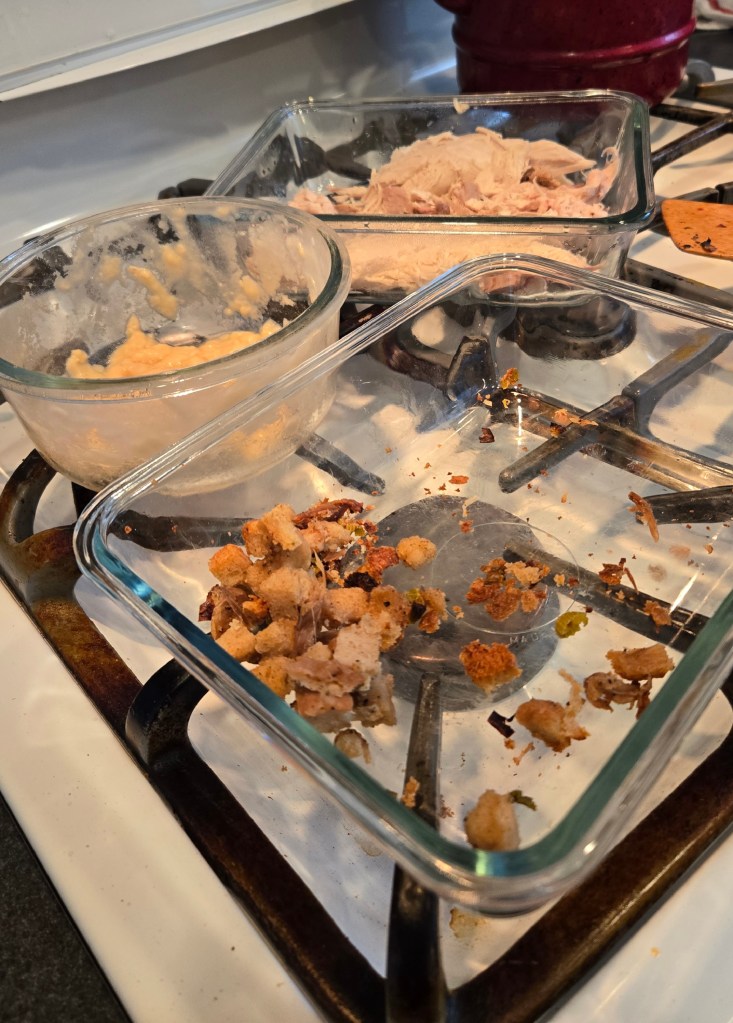
Now, with the holiday over and another approaching, I’m thinking about leftovers. Don’t you love them? The best part of Thanksgiving!

Leftover 1: Gratitude.  Last year neither of my two children and their spouses wanted to host Thanksgiving. They seemed to have caught the rest of the country’s malaise about it, too much work, with football and maybe turkey as the only reasons to get together. But, remember, I’m the person who says it’s my favorite of the holidays, so it seemed appropriate that I step up and host.

I was new in my apartment after selling Jim’s and my house, which had been the center of many family events. Could I possibly host Thanksgiving? In an apartment? I remembered a favorite movie, Hannah and Her Sisters, where Mia Farrow hosts her big family in a New York City apartment. If Hannah could do it, surely I could. So, I hosted Thanksgiving with good help from my family. And it worked. We gave Hannah some competition.

As that 2024 Thanksgiving grew to a close, we were scheduled to move to another family’s house for dessert, a tradition we started several years ago. But I was exhausted. I’d burned my wrist draining the potatoes, and it hurt. The kitchen was presentable, and all I wanted to do was sit and watch mindless TV—yes, something even more mindless than football. So I didn’t go. AND I announced that I was passing the baton—someone else had better step up and do Thanksgiving next year.

 “I am too old for all this work, and I’ve done my share!”

So, when Thanksgiving came around this year, my daughter stepped up, yet somehow, on the morning of Thanksgiving, I found myself responsible for an apple pie and the mashed potatoes. Everything that could go wrong did, and I barely finished in time to get to my daughter’s house.

During the entire time in my kitchen, I whined to myself, “I passed that baton. This is ridiculous. These potatoes are pathetic, mushed, not mashed potatoes, and the pie. Why did I agree to sit and peel apples and potatoes? And what’s wrong with my kids that they wanted mashed potatoes from Costco? Have I raised lazy children? . . . ya da ya da ya da.”

And then it hit me – sometimes the Universe does need to smack you pretty hard. I realized that husband #1; husband #2; husband #3; some old boyfriends and my sister (all deceased) would have given anything to be in my shoes: 81 and still mashing potatoes and partying with family

Who cares about potatoes or pie—I was getting to enjoy Thanksgiving with everyone I love. I was getting to make pie and potatoes for them. Getting to do this (see https://designingyour.life/), became my new mantra. My resentful, “I HAVE TO” went “puff” and left the room, leaving gratitude in its place.

Leftover 2: Intergenerational Conversation. Last year as dinner ended, we started a discussion about AI. Everyone at the table had a stake in AI. I was teaching an undergraduate writing course and struggling to convince students that you can’t learn to write if ChatGPT writes your paper.

The discussion was fast and fun; no one left the table to watch more football, which means something. We are a family of frogs, we jump into the pond quickly. Our one turtle, Luisa, is often left standing on the bank; she jumps in later, usually with great wisdom.

This year, we’d finished eating and were lingering in the kitchen, snitching bites of dressing and turkey. Elizabeth, my daughter-in-law, asked her 24-year-old son, Henrik, if he wants to have children. I don’t remember how we landed there, maybe because two of our young people are about to graduate from college. Henrik never did answer, but the question kicked off another great discussion about the uncertainty of the future, mainly the planet, and how grim it looks to Gen Z.

The future, by definition, is uncertain, but what my Gen Z grandchildren are feeling is more complicated than uncertainty. The word, “existential” kept floating up. Generation Z young people ask different questions about meaning, purpose and identity than the Silent Generation or even the Boomers did. As we talked, they hesitated to share their dreams for their futures, wary of the future of the planet and climate change.

I can’t recapture the opinions, but I concluded that young people are facing problems unique to our time with climate change at the heart of them, especially as the world responds. They are terrified, although they didn’t use that word. (Remember this is an “n” of 3, so ask your own Gen Zers). And yes, we hid under our desks because of nuclear bomb threats, but this is different.

Reflecting later, I realized we had had a family conversation that crossed generations. Gratitude welled even greater in me, couched in concern for my grandchildren. I was, nevertheless, grateful for the sharing across generations.

Leftover 3: Hope. We eventually moved to more mundane topics, but I worried that what I was hearing might be despair. I didn’t want them to throw in the towel for a life of hedonism. So, I later questioned the Gen Z grandchildren separately.

I started with Henrik, “You aren’t giving up on dreams for your life, are you? Embracing a life of hedonism—do you even know what that is?” (Who knows what they teach in college anymore.)

“Don’t worry, and yes, I know what hedonism is. For now, I don’t know what I’m doing after graduation, but you know me, I’m just curious about it all.”

Whew!

Later, in my car with Luisa, who you will remember is our family turtle, never jumping in too soon, I asked her about her aspirations. She gave me even more hope, summing her thoughts up as “I don’t want to miss my life waiting around for the end of the earth, so I’m living it.”

Upon hearing those words, my gratitude for the day swelled into hope. Yes, the situation in the US and worldwide, especially climate, looks dire, hopeless, gloomy, depressing. . . you get it. But along comes Thanksgiving, and the leftovers. We engage in meaningful conversations and emerge with hope, nurtured by connection and making meaning together.

Another LEFTOVER:

From Wendell Berry, Think Little

. . . the world is blessed beyond my understanding, more abundantly than I will ever know. What lives are still ahead of me here to be discovered and exulted in, tomorrow, or in twenty years?

What Is A Death Café – And Who Would Want To Go Anyway?

A few weeks ago, Dan and I went to a Death Café – it was on a whim, because I saw it in a Barnes and Noble e-mail that I was in the process of deleting.  Also because I have been trying to live into Julia Cameron’s advice to have an artist’s date every week.  Planning anything a week ahead when I am trying to spend as much time as possible with Opal (our 20 month-old granddaughter) seems almost impossible.  She-Who-Rules has not figured out that adults are happier when the children in their lives have a regular nap schedule…in any case, why not go on the spur of the moment?

photo credit: Death Cafe

We had no idea what to expect, but showed up along with eight other people at the “Solarium” (a space with lots of windows next to the Pets section) in the back of the Boulder, Colorado B&N. Our volunteer facilitator introduced herself as someone with experience with both hospice and midwifery.  Beginnings and endings, her specialty.  We started with a brief introduction to the Death Café – who knew that this was an international movement, and that all over the globe there were other people participating in discussions about death on a regular basis.  If you don’t believe me, Google it yourself (https://deathcafe.com)– the first thing that pops up is “Welcome to Death” followed by an invitation:  “At a Death Cafe people drink tea, eat cake and discuss death. Our aim is to increase awareness of death to help people make the most of their (finite) lives.”  Today, as I write this, I could attend one in St Luis Obispo or Quezon City in the Philippines.

How odd – my first thought – how can this be so popular?  Why does the idea of meeting with strangers to talk about death have meaning from Lake Forest, New York to Goteborg, Sweden (oddly, as we entered, I passed by the popular book, The Gentle Art of Swedish Death Cleaning, by Margareta Magnusson).  So I sat feeling intrigued but somewhat detached, observing the people sitting in the circle with Dan and me with interest.  Across from me were three older women (in other words people roughly my age!) all looking very Boulder.  That means middle class with tiny efforts to be a bit offbeat – a purple streak through gray hair or an embroidered vest.  There was a couple who appeared to be about 50, and next to me a very large man of about the same age, who made it clear that he had come only because he was asked by the facilitator.  A rather sad looking woman in her sixties arrived late, and positioned herself slightly outside the circle, although we made every effort to rearrange the chairs. 

So why had they come?  We began by offering up our reasons, some of which (like mine) were curiosity, others because they had recently experienced a death.  One was still trying to make sense of a loss many years ago of a beloved brother; another because the passing of her sister made her aware that there was no one left in the world who knew her as a child. No one there was ill or recovering from a serious illness.  In fact, we all looked rather vital….

I opened, saying that I was coming from curiosity – wanting to try new things – and because the last year had been full of deaths and skirmishes with death for multiple friends.  By the time we finished with our offerings – what drew us, what our experiences were with death –it felt as if we were part of an intimate circle.  The feeling of instant membership was odd—I can’t think of another time when I have entered a group of strangers and felt so quickly as if I belonged.  Also, the often-noisy Judge in my head – the one that edits what other people are saying while they are just beginning to formulate their thoughts — was surprisingly quiet.  What people talked about silenced The Judge – it was as if the topic of death encouraged a level of intimacy that you would never find in other settings. 

The 50-year old man talked (at great length) about the paradox of watching his brother suffer over several years and the joy of seeing him become increasingly spiritual and at one with his life.  We talked about acceptance – one of my mantras – we talked about the experiences of being present with someone who was dying.  We talked about whether we wanted a death surrounded by loving relatives or whether, in our deepest heart, we wanted to be alone on the journey.  One woman – the only one with any apparent attachment to an image of afterlife – was very positive that she would be reincarnated – and that she would retain a great deal of the knowledge and experience that she already possessed.  No one else seemed to be certain of anything except that the idea that dying filled him or her with awe.  Only Cat, the 50-ish wife of the man whose brother had dies some years ago, said little.

So we were there for well over an hour.  Dan and I left feeling that it had been a remarkable experience.  Why can’t we find this level of connection without having to confront death?  What is it about a Death Café that promotes connections when other conversational opportunities do not?

Photo credit: Death Cafe

Postscript:  I drafted this early last spring when I was in Boulder, Colorado – escaping harsh Minnesota winter for a milder version. Looking back after six months, community seemed to surface from a collective experience that was simultaneously anonymous and intimate.  We were there for remembrance as well as being open about both the wounds and healing that we experienced individually.  If you want to be part of this, you can:  The website says, “People who adopt the model set out in our guide are welcome to set up their own Death Cafes. So far we’ve held Death Cafes in 65 countries.”  I think that I will take them up on the invitation….

Saving A Life, Especially If It Is Your Own

I often wonder why I’m the only one still living?   In 1975, my Father gifted me with his very special kidney.  Dad saved my life. My kidney is now 93 years old, but it makes me feel young.

During my six months in the hospital, I nurtured friendships that withstood the test of time.   I connected with 21 amazing patients of all ethnicities and ages. All of them have died, some because of their transplant, others from accidents or other chronic diseases.  They were lifelong friends and a sounding board for me. I miss them all.  

My Dad once asked me why I thought I did so well with my kidney?  I immediately responded that I never labeled myself a “transplant patient.”   Instead, I was a grateful daughter who was blessed by my Dad’s gift.

The gratitude theme tended to show up in everything I did.   Professionally, I focused on public health, and as a full-time consultant starting in my 40’s; I tended to attract jobs where I can “pay it forward.”  For example, my late sister had diabetes. What could I do for her? I found myself coordinating a statewide diabetes strategic plan and managed other projects that helped people like my sister.  

Through the years, I had some ups and downs related to the transplant but found I had a core of resilience that I kept revisiting.  It served me well—until five years ago.

To keep my kidney, I take drugs that prevent rejection but suppress my immune system.  There was only one drug available when I had my transplant, and I’ve taken it for 44 years.  At age 60, I started to get a slew of squamous cell skin cancers. My kidney drug played a role in causing them, and I had 26 skin cancer surgeries in the past 4.5 years.   

Recently, I became aware of a newer transplant drug that could decrease skin cancer incidence by 30 percent.   I immediately researched this drug and did the due diligence to see if it was worth a shot. At my doctor’s appointment, I was told the drug I’d been on for 44 years was a “poison.”  When I read the drug studies, I was shocked! The drug is mutagenic, causing damage to DNA and increasing cancer risk.  

Because it was the sole drug I could take to keep my kidney and me alive, I deliberately never researched the drug side effects.  Because I tend to want data on everything, this took some willpower. Remember my roots are in public health! I didn’t just promote primary and secondary prevention; I applied it to my life.   Loving myself to take care of myself was another aspect of my resilience. I imagine the doctors would call that “compliance.”

I find I am now in a whole new grateful universe.   As I let go of the old drug, I thanked it for keeping me alive.  Then something amazing began to happen. Colors now seemed brighter.  I’m filled with startling wonder and awe. I’ve become a better listener.  And I tell more people I love them. 

As I was struggling with the decision about the new drug, I decided to call an old friend I hadn’t seen in years.  Ed had his first transplant two years before me, and he’d visit every week when I was in the hospital in 1975. I was eager to ask him if he was on the new drug and chat about his experience.   On July 15, I searched Google to get Ed’s phone number– and then my whole body froze. His obituary came up. Ed died on July 8–I was now the last one left.   

What does it all mean?   Life is unpredictable, and it’s important to look at what I can control.   Being negative or judgmental is wasted time. If I’m grateful, I’m positive.  When I look for the best in people and life, I release drama and get my energy from peace.  As I move through my retirement, I feel more alive than ever.

No, I don’t know why I’m the only one still living.  What I can do is focus on what makes me happy. And continue to wake up every day awash with gratitude.