Into Each Life. . .

It started innocently enough. I visited my granddaughter at college in early September—she’s the one that called me every day during the pandemic and the third of my four grandchildren off to college. The Friday after arriving home, I developed a horrific headache. I thought it would resolve quickly—sleep it off. But it lasted through September. Then came October. It would go away over night and come on quickly in the morning. Needless to say, I imagined the worst—tumor (even though the pain was mostly in my back and neck), long COVID (that didn’t occur to me until well into October), brain inflammation, Parkinson’s—a different catastrophe every day.

I saw an ENT doctor. Sinus? Allergy? I was clean as a whistle. As October wore on, I became incredibly anxious. One Sunday, Jim, my husband, had to talk me down as I learned to be anxious about being anxious—not a good thing.

My doctor did his best—a neurological test was perfect as was my blood test. He prescribed a pep talk—he believed in me; referral to a mental health professional; and an antidepressant that I was too anxious to take after reading about the side effects on the information sheet that came with the prescription.

In some deep place, I knew this was “all in my head” but anxiety overrode rational thought. Meanwhile, I was on a two-month waiting list for my doctor’s referral to a therapist, and everywhere else I called, all I heard was “We’re not accepting new patients.”

So I did what any good academic would do, bought and read books and scanned websites. There are some great resources out there, people committed to helping the suffering. One is Dr. Howard Schubiner, in Michigan, an authority on mind-body syndrome. By now I’d diagnosed myself. I bought the book and did his eight-week program. It helped. I also did PT, which also helped, but some days my neck and back felt on fire, which fed the anxiety.

About Thanksgiving I started feeling better, so I went ahead with cataract surgery. Maybe that would help. It didn’t, although the doctor called the results “amazing.” I was thrown into a new panic during my recovery and had difficulties getting new glasses. I postponed the second eye. 

Muddling through Christmas, I faked it, while inside feeling woozy. I started carrying hiking poles because I was afraid I’d fall—then, another perfect neurological test. “Your balance is amazing.” I wanted Ativan, but all I got was a lecture about how bad it is for someone my age—really? I should live in a constant cold shower (one of the recommendations for lowering anxiety) because there’s a correlation between Ativan and cognitive decline? Fortunately, my gynecologist wasn’t so opinionated, although I didn’t take it often—it made me enormously tired.

          In January, my turn with the psychologist finally came up—and she cancelled! A week later, I did my first virtual appointment and liked her immediately—the luck of the draw worked in my favor. She’s been supportive, available, responsive, and skilled.

          Like any good consumer, I turned to Facebook advertisements—once you look at something, they never stop coming in your feed. I now own a sunlight, a device you hold in your hand to help you sleep, a neck massager with heat, a bra to keep my shoulders back, my own tens device, a device for stretching your neck, a Theracane, and lessons in loosening your fascia from Daily Om. American Express loves me.

I’ve learned a lot about pain—that it really is in the head mostly, that childhood trauma and other traumas settle in the body and the brain finds pain pathways. But the brain can relearn, too. People do get over chronic pain even when there’s a basis in the body. Two people can have the same problem, and one will have pain, while the other will not. I learned about an app called CurableHealth.com. It’s a program started by young entrepreneurs who had struggled with chronic pain and tinnitus. It saved me on many days—podcasts with experts, information, meditations, writing exercises, and brain training—all for $69 a year. Another is the DARE app for anxiety.

Whew! It’s been a journey with good days and bad days – and I am not alone. The National Council on Aging says that between 3% and 14% of older adults suffer from anxiety and that estimate is based on reported cases only. Older adults have more problems with medications, since they are often taking other medications. My doctor prescribed three different antidepressants, while also saying “There is no pill for this.”

That said, I’ve learned that there are supportive friends, spouses, and family; there’s an abundance of YouTube videos about reducing anxiety and meditations; there are apps for meditation and helpful books.  These offer “solutions,” which, mainly advise “accept it and get on with the business of living and what matters to you”. Easier said than remembered when you awaken at 4am in a sweat, and you don’t know why.

My heart goes out to all chronic pain and PTSD sufferers, as well as those with Generalized Anxiety Disorder, the most common in older adults. Doctors can prescribe band-aids but getting to the root of the problem takes hard work and support. I see many articles in newspapers about the lack of mental health services for every age and the importance of having insurance coverage so people can access these services. I’ve experienced it firsthand and as one of the lucky, with insurance and now a qualified counselor.

In my bookcase directly in my sightline from my desk is a book entitled This Time Next Year We’ll Be Laughing. That’s my dream. It keeps me going as does an affirmation to get on with the business of life.

Life Connections

Photo by Alina Grubnyak on Unsplash

Retirement has put me in a stock-taking mood, less a search for meaning than simply an understanding of my past and present.  I often turn to internal story-telling….

My narratives change with new insights and reedits. These days, I have moved away from event-based stories (the college years; the productive 50s…). Julia Cameron, in her follow-up to The Artist’s Way focusing on the over-60 crowd, urges us to take our chronological age, divided it by 7, and write about the years included in each span.  As Dan and I watched the 7-Up series, which every 7 years revisits the lives of a randomly assembled set of English children, I thought of how powerful it is to break away from the constraints of decades or major events as chapter markers in our stories…

But in the past few months my internal storytelling has focused less on chronology and more on the way in which people intersect with each other and with loosely defined periods in my life.  Much of this happens when someone from my past seems to pop in to my mind for several days, causing me to rethink how and where they belong in the threads braided into my experience.

Last week a personal message on LinkedIn told me of the death of someone with whom I had lost contact.  That loose connection, between continents (my friend who died was Dutch) and across generations (the messenger is at least 20 years younger than I am), activated memories of a wider network of people who were meaningful to me over more than a decade, even though they did not constitute an identifiable social group.  What I was struck with again is the how this nebulous collection of colleagues, friends, acquaintances has provided meaning to my life, even though its members do not cohere into a usual life-story format.  They represent, collectively as well as individually, an extended period in which I felts as if I was learning about the world, other people, and professionally every day. 

Photo by Moritz Kindler on Unsplash

Thich Nhat Hanh’s idea of interbeing – the dependence of all beings and things upon one another captures this nostalgic gratitude:   

… I was looking for an English word to describe our deep interconnection with everything else. I liked the word “togetherness,” but I finally came up with the word “interbeing.” The verb “to be” can be misleading, because we cannot be by ourselves, alone … the action of interbeing reflects reality more accurately. We inter-are with one another and with all life…. Whether we’re at work or at home, we can practice to see all our ancestors and teachers present in our actions… We can experience profound connection and free ourselves from the idea that we are a separate self ( from The Art of Living)

While this way of thinking is still a bit mind boggling to a Westerner raised with Descartes’ individualistic claim that “I think therefore I am”, it leads me to pay attention to human connections beyond the people I love with all my heart.  Facebook, LinkedIn and Twitter can be a rabbit hole and a space to post the least interesting things that happen in my life (yes, I admit to occasionally bragging about Wordle), but they also allow me to contemplate the loose linkages that are part of my direct experience of interbeing.  

I smile when I read the words of adult children of friends whom I haven’t seen in years, and I am filled with awe as I look at them sending their own babies to college. At one level this seems trivial, but at another it reminds me that networks are never lost, even if they are not currently active.  And, as the miracle of Facebook informs me that a friend who meant the world to me from 7th through 12th grade had visited her childhood home, I became instantly reconnected to her parents, whose escape from Nazi Germany created the opportunity for hosting a gaggle of very ordinary American teenage girls, which in turn opened up other doors of connections, known and unknown.

Photo by Joshua Hoehne on Unsplash

I am also in awe of how my own (middle aged) “kids”, who grew up in a world of cheap phone calls, cheap flights, and the internet, keep consistent contact with beloved friends from high school as well as college.  I, however, grew up in an era when a long-distance call home to my parents from college was short because it was costly, and visits to relatives who lived a few states away were rare because they involved several days of driving.  Constant connection is a habit I never developed, and my life is littered with people—friends, relatives, mentors– with whom I lost touch with completely.  And now, increasingly, I think about those who died before I could reconnect and share the unspoken gratitude for what we meant to each other.

I regret these lapses as a byproduct of the dismal period when the art of letter writing had died but the internet was not yet born. However, I am persistently struck by the way in which inactive connections become potent with even a few exchanges.  During Covid, Google provided me with the email of someone who I knew in both college and grad school — I thought she would be amused that I had cited her 1972 dissertation in a paper.  We have been exchanging episodic emails with personal, professional and family news – almost as if there were not a 50-year gap in our shared experiences. Facebook and loose connections allowed my own adolescent gang of “cool nerds” to commit to our 50-year high school reunion and, more surprisingly, to two additional get togethers with some (including me) traveling long distances.  Our parents are gone, none of us live near where we grew up, and we are the only ones other than siblings who can tell stories about our teenage years that stir a sense of connection not only with each other but with place and time. 

I know that taking interbeing seriously requires more sustained spiritual practice.  But perhaps it is the enforced isolation from our closest friends and family during Covid that supports the deeper significance of our looser human connections, whether one-off conversations, attentive participation in group events, or the spontaneous reconnecting that seems to be happening in my life.  As I get older, the significance of loose ties that are filled with caring and compassion has never seemed more important.  I am committed to contacting at least one “loose” connection regularly, only to remind ourselves of how we fit into each other’s stories….

The Gift of a Child

Christmas 2011
Christmas 2022

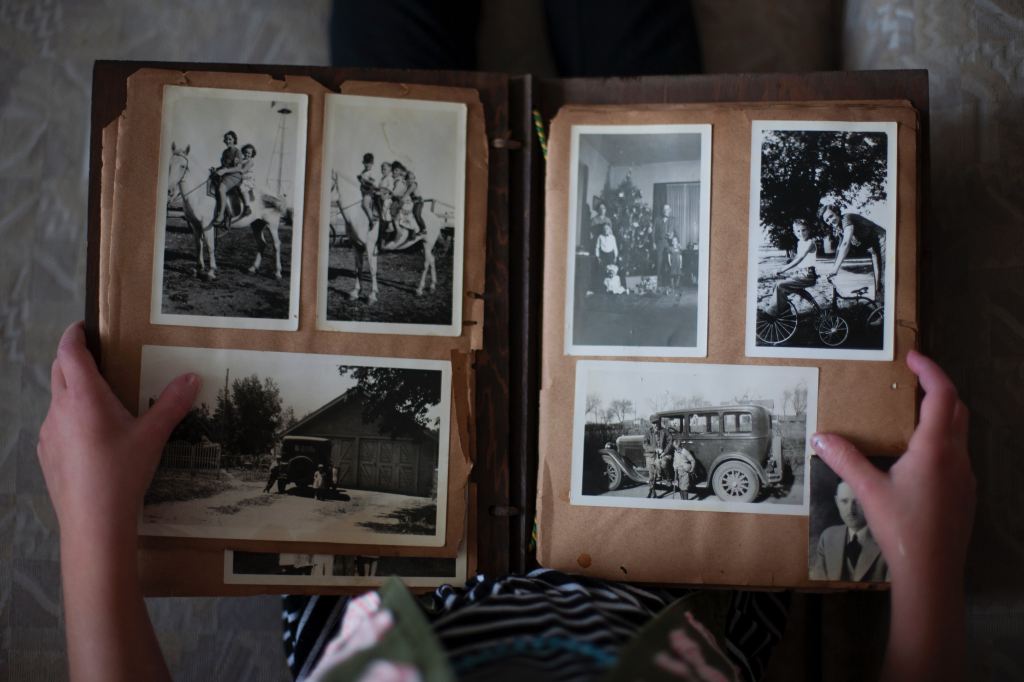
Karen and I were looking over the blogs we’ve written and realized we’ve never written about grandparenting. So I decided to take a first stab at the topic. It felt overwhelming—like I’d be writing a dissertation in order to say all that comes up for me. I remembered my mother, who wanted to be a grandmother, even though motherhood had not been easy for her. And Gary Stout, who, when told by the doctor that he had 6-18 months to live said, “Now I’m glad I have grandchildren.” His daughter’s pregnancies were not planned and came while they were both getting a foothold on being adults. He was not happy at the time.

Then, the Sunday before Christmas, sitting in church, the topic came back to me again. A woman was reading the Christmas story to some children, and I found myself asking, “I wonder if Jesus had grandparents.” (I suspect some of you know the answer to this.) Specifically, I was thinking about a grandmother, since I’m a woman. I do not know the answer to this question, but it made me recall the birth of my first grandchild, Peter, in 1999.

When my son, Walter, announced to me that he and his wife, Elizabeth, were expecting, I was excited, but more for them than for me. I was busy trying to restart my life after Gary’s death. I cheered them on through the pregnancy, but the prospect of becoming a grandmother barely entered my consciousness.

Walter and Elizabeth were adamant about experiencing Peter’s birth privately, as a couple.  They made it clear to their large family that they didn’t want anyone with them during the birth, and they especially didn’t want a waiting room of relatives hanging outside, following every development.  We respected that.  We didn’t even ask for a call when they left for the hospital.  And we knew they would not call until it was over. 

The call came on a warm July evening. I had just laid down for bed, window open, enjoying the night breeze and sounds of the city.  The phone interrupted my drift into sleep.

“Mom, he’s here.  Peter’s born,” Walter’s sobs seemed to pour through the phone.  “It was so unbelievable.  He’s wonderful.”

“Congratulations new dad,” I said, “Pretty terrific, isn’t it?” I could imagine their night.

“Please come, please.  You have to see him.”  Now he was openly crying—the unflappable Walter was crying harder than his newborn son.

When your son implores you to come, you take off your pajamas, get dressed and drive to the hospital. They were in Abbott Northwestern Hospital. I’d last been there the day before Gary died. The halls seemed to squeeze the breath out of me, but I found the maternity ward.

And there he was, Peter, my first grandchild red and raw, wrapped in a hospital blanket, looking around at his new home and his new daddy.

“Do you want to hold him?”  Walter asked.

I didn’t need to answer.  My arms opened, and Walter laid Peter in them.  I looked down into the stone blue eyes and met my first grandson.  The room and voices seemed to fade.  We simply stared at each other.  “Hello,” I said. “I’m your grandmother.”  And he just kept staring.  I could not look away, bound by a love I’d forgotten I could feel welling into me.  Here was a new soul ready for the journey.  I gave him my promise to always be there for him. 

That was 23 years ago. Peter is now a young adult working at his first job in Washington DC. I’ve been there through most of his journey thus far. That honor, that privilege, that gift makes me think of my own grandmothers, both of whom I never met. Ruth, my mother’s mother, died in childbirth at the age of 22. My mother was three, with a new baby brother but no mother. My father’s mother, Martha, died in 1930, at the age of 51. My father was thirteen years old. Neither of these women had the chance to be a grandmother.

When I had my own children I was in my twenties. They were a precious responsibility, and much as my heart overflowed with love, there was always that looming responsibility to parent well and provide for them. But I am now older. I realize that not everyone gets the gift of grandchildren. I know what a gift a child is. I know, too, that a grandmother is another sort of gift, since I never really had one. These realizations make me want to bring joy and love into every moment I spend with my grandchildren. These realizations make me feel blessed.

What About the Cows?

Photo by Lomig on Unsplash

Karens’ Descant has regularly touched on the topic of paring down, decluttering, releasing loved objects, and living smaller.  Still, when I came across Thich Nhat Hanh’s story about the farmer who lost his cows in No Mud, No Lotus, I was struck (again) by his gentle insistence that we must look beyond the obvious detritus with which we are surrounded.

 His parable runs something like this:  A farmer, looking anxious, passes by The Buddha and group of monks, and asks “Have you seen my cows?”  The Buddha replies that they have not, and that he should look in another direction.  After the farmer leaves, he turns to his group and says “Aren’t you very lucky.  You don’t have any cows to lose.”

Well, that’s a head scratcher.  The Buddha and his followers may be fed by the kindness of strangers (or devotees), but the farmer’s existence is dependent on his cows.  At first the parable seemed a bit like Marie Antoinette’s “Let them eat cake” response to the absence of bread – a life of contemplative ease contrasted with a life that is marginal in its well-being.  No wonder the farmer was anxious – he has a family to feed and small children who are crying for milk – and cows on the run also distract him from the many other tasks that a small farmer must accomplish (mindfully, one hopes) in order to sleep well at night.  I am all in with the farmer….

But as the story unfolds, it is clear that my automatic social critic lens is (once again) too narrow to take in the meaning of The Buddha’s response.  Thich Nhat Hanh reminds us that the story is not about real farmers and rambunctious cows, but about our attachments to ideas and habits – particularly those that we associate with our well-being and happiness: 

One of the biggest cows that we have is our narrow idea of happiness.  You may suffer just because of your idea; and you continue to suffer, until, one day, you are capable of releasing the idea and right away you feel happy — No Mud, No Lotus, p 59)

To be truly happy, we must release our cows – the attachments that hold us back.  As I Googled “releasing our cows”, I discovered that there is even a printable worksheet to help….

Ok – as I look at my life I have to consider not just the “stuff” that Dan and I have been pretty good about culling, recycling and donating, but at the other less visible baggage that I still carry.  I don’t have to get too reflective to find cows mooing in almost every corner of my inner life.  Here is just a quick list….

  • I am attached to my convenience – such as having 2 cars even though we rarely need them.  Oh, the excuses I make – they are paid for, we always combine errands to drive less, we don’t have a garage to hook up an electric charger…My friend Kyle, who has chosen not to own a car, kindly pointed out this cow today after I tut-tutted about his ecological failings in using Swiffers
  • I am attached to my slothfulness – I have never liked exercising, and can conjure up 1000 excuses even when my Apple Watch tells me that I may expire in an untimely fashion from lack of activity. I feel guilty when a few days go by and I am happily puttering, writing, cooking – and I even count gardening as exercise, but I belonged to a YWCA health facility for a year – and never went.
  • I am attached to worrying – about my children and grandchildren, whose lives and future I cannot control (or even directly influence…).  And would they be annoyed if they knew how much I worry…about whether the house will need to be painted in a few years (yes, probably – but will worrying about it make it less inevitable?); about if and when we should consider moving into a life care community.  Well, this list is endless and useless…
  • I am attached to having the dishwasher loaded a certain way – I even sneak up after Dan has loaded it to rearrange stuff…let’s not go into the other areas of secretive tidying so that things will be arranged in a way that I like…well, sometimes I tell him the right way to do things (which he sensibly ignores).
  • I am attached to my own significance — I say yes to requests even when I immediately know that it will require me to do things that will make neither the other person’s life or mine much better (and I sometimes have to back out with a limp excuse).  And I feel guilty about NOT going to a conference, which involves canceling dates/coffees/dinner, etc. with people whose lives will not be deeply affected by my absence (they all have other friends).  I even work at maintaining a public image that no longer fits, polishing my “emerita vita”, which no one is likely to read….

Honestly, even the beginning of the mooing cacophony makes me start to laugh at myself, albeit with a large dash of added discomfort.  I should add that this list does not make me feel like beating myself up:  these cows are not harming anyone else in a significant way.  They are not “character defects” but cows – all the small things that, when I chase them, reduce rather than increase the joy in my life.  I think that I will print out the worksheet and start thinking about releasing my cows.  If I can give away a beloved chair, take almost all of the books that we have finished reading to a neighbor’s Little Free Library, and pare down the boxes of family memorabilia to a size that our families might actually want to take a look at some day – well, surely I can reduce my attachment to a few cows.

Photo by Lenstravelier on Unsplash