‘Tis the Season: Graduation

Last Saturday my granddaughter, Luisa, graduated from high school. She’s the youngest of my grandchildren, which reminded me of the passage of time, starting out as babies and now one out of college, two in college, and Luisa soon off to college. Thinking about graduation makes me realize what a shared rite of passage it is. Karen and I have skirted around the notion of rituals, probably because there are no well-defined rituals as we age—some people have retirement parties, but it’s not a given, and certainly a funeral is a ritual for the living, not the departed. Reflecting on the joyful event later, I noted the. . .

Changes in Our City and Schools      

Luisa is the only one who attended school in Minneapolis, so it was my first big urban school event. As we took our seats in the large auditorium, the first thing I noticed was the diversity. In fact, the school is 60.4% white, 21.3% African American, 9.7% Hispanic, 3.9% are of two or more races, 3.7% Asian, with 0.8% American Indian, and 0.2% Pacific Islander. The Somali families immediately stood out because of their colorful dress and larger families — grandparents, siblings including children and babies, and moms and dads. Minnesota has the largest Somali population in the US, with most of them living in Minneapolis. The women wore the traditional head scarf and the baati, a long overdress, and many men wore the macaawiis, a sarong, and the benadiri kufia, a cap. But that doesn’t do justice to the gold jewelry, glittering fabrics, sculpted make-up, and spectrum of colors. The women seemed to glisten with their beauty, and the men stood tall.

The Graduation

Once we were settled, the graduates marched in with the band playing Pomp and Circumstance. I teared up as I watched the students walking down the aisle and parents standing on seats to get a picture—aren’t smart phones wonderful! The trappings were all there — the school band’s terrific rendition of the National Anthem, the choir singing Stephen Paulus’s The Road Home, and the articulate student speaker, who was a young Somali woman.

Before awarding the 441 diplomas, the principal practically begged us not to make a lot of noise or to be in the aisles as each graduate’s name was announced. The silence lasted very briefly.  Somali names like Abdi and Ali clustered at the beginning, and the families were so excited to see their students walk across that stage that they went wild, jumping and cheering and blowing vuvuzelas—so much for quiet. I suspect that in some families these may have been the first high school graduates.  

I loved the excitement, though not everyone loved the ruckus, possibly because we live in a newly multicultural city, originally dominated by less effusive Scandinavians. I believe in honoring the different ways in which we celebrate. I also noticed that the cheering settled quickly and we could still hear the names. By the time Luisa crossed the stage, her brothers decided that it was okay to make some noise. Sitting on either side of me, they jumped and shouted. Ironically, on my video, you can only hear her first name being called; their celebratory noise blotted out the rest.

Intergenerational

After the graduation, the auditorium lobby was filled with families and graduates, everyone taking pictures. It felt like family because many of the graduates knew my son because he’d been their principal in middle school. It was joyful to see former students reconnect with him.  I was not left out: a former student of mine recognized me and gave me a big hug, telling me that his daughter had just graduated. The father and I also overlapped at the U of MN, when I was in graduate school, and he was an undergraduate.  When we met, walking across campus, he would say “You’re my inspiration!” What a circle; what an intergenerational experience!

Which brings me back to the roles that we play as young and old. Yesterday, struggling out of a store with a heavy box of kitty litter, my other granddaughter, Maggie, grabbed it, insisting that. “I can do things to help you, and you listen to me and give me advice and help me.” There it was, from the mouth of the next generation, how the generations support each other when we are not celebrating rituals. Sometimes I am sad about growing older, but her words reminded me that I would experience none of this without growing older. My older self is also a bundle of memories going back to post WWII, the 50’s, 60’s, etc. I have a perspective to share that can enrich everyone my life touches.

Through the entire graduation, I was awed by the stretch of generations, from grandparents in wheelchairs to babies crying during the ceremony—how we are all one, especially in the rituals that celebrate life passages. Luisa, too, reminded me of how generations stretch across the planet, because she was born in Guatemala. As her grandmother and a former teacher at the graduation, I represented all the grandmothers, parents, and educators throughout the world who love and support the next generation. We are all connected; we are all family.

Curiouser and Curiouser….

–          Alice in Wonderland illustration by Arthur Rackham (1907) [Public Domain

Grown-ups never understand anything or themselves, and it is tiresome for children to be always and forever explaining things to them (Antoine de St. Exupery, The Little Prince)

A few weeks ago, someone quoted from Brene Brown’s Atlas of the Heart: “Choosing to be curious is choosing to be vulnerable because it requires us to surrender to uncertainty”.  Brown goes on to associate curiosity with discomfort:  “We have to admit to not knowing, risk being told that we shouldn’t be asking.” Later, Brown links curiosity with the perception of an information gap that we commit to closing.   I immediately bristled – internally, since it would have been inappropriate to react to the nodding of heads and pervasive affirmation in the group. 

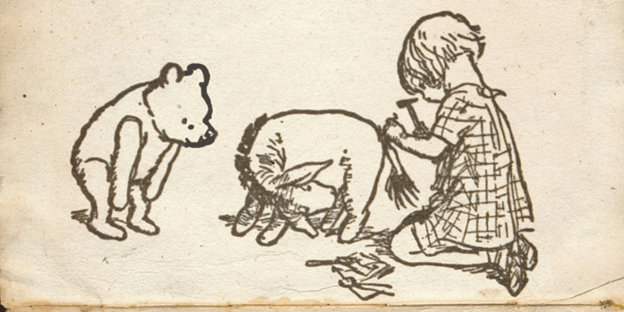
When I was a young child – and even when I was old enough to read them myself – two of my most beloved books were Alice in Wonderland and The House at Pooh Corner.  I read them joyfully to my children – and later to my grandchildren.  What I cherish about both of them is their exploration of simple, uncomplicated curiosity.  Alice hesitates only briefly before biting, although she knows that “one side will make you smaller, the other will make you large”, while the doorknob says “nothing’s impossible.”  Pooh looks at every day as a fresh adventure, whether it is confronting the loss of Eeyore’s tail or stalking the mysterious Heffalump.  While Alice sometimes bemoans a choice she has made, she quickly picks herself up and asks another impertinent question.  Pooh, on each day’s adventure, only hopes that there will be honey involved.

Curiosity may involve a risk, but it is not something that holds either Alice or Pooh back – more than momentarily.  Eeyore reminds us that worrying about not knowing – at least more than briefly – can be a path to cynicism and depression.  I took this lesson to heart:  Be curious.  Move on with the adventures.  Don’t do anything potentially life-threatening, but assume that the jams that you get in to will be temporary.  Don’t think about the “information gap” but move toward the unknown.  In other words, nurture the impulse to try stuff, and a full range of emotions that encompasses trepidation, but also the delight that comes with doing or learning about something new.

It turns out that Brown is talking to people who feel “stuck” in a comfort zone.  She covers all the research that says that we will be happier and freer if we respond to “I don’t really know” with curiosity. We all get stuck sometimes….certainly, retirement for someone like me, who loved going to work, meant that I had to allow myself to drive past the exit for my office without feeling lost and uncomfortable!  And although many routines nurture us (brushing our teeth, eating lunch, going to bed at roughly the same time on most days), it is easy to slip into ways of thinking and habits that constrain.  But getting stuck seems to be something that we choose more and more often as we exit adolescence.  With Alice, Pooh, and Thich Nhat Han as guides, however, we see that embracing vulnerability (which Brown endorses) is not a conscious decision to endure discomfort, but a practice of anticipating novelty and adventure – of embracing childish wonder and a Beginner’s Mind.  

And then there is the spiritual side.  One version of Genesis situates our humanness in “original curiosity”:  “And when the woman saw that the tree was good for food and that it was pleasant to the eyes, and a tree to be desired to make one wise, she took of the fruit…”  Albert Einstein echoes this, suggesting that “curiosity has its own reason for existing.  One cannot help but be in awe when one contemplates the mysteries of eternity, of life, of the marvelous structure of reality…Never lose a holy curiosity.”  Julia Cameron also argues that curiosity is a spiritual path rather than a cognitive decision, and that it requires habits – she suggests random writing in “morning pages”, scheduled “artist dates” to explore a new esthetic, and regular walks that have no purpose other than to look deeply at whatever is in one’s path. 

Photo by petr sidorov on Unsplash

I admit that I don’t do these as consistently as I once anticipated, but I have other habits that invoke the same opportunity to approach the world with a Pooh-like sense of wonderment.  Meditation – something that for years I thought that was beyond my capacities – clears my brain of monkey-mind, and creates space for hope that goes beyond ticking off items on the incessant to-do list.  Connecting every week with someone (or several people) who are willing to engage in authentic and vulnerable conversations about “big stuff” never fails to make me curious.

Of course, I take Brene Brown’s assertions about the benefits of curiosity to heart because it is particularly important as we age.  According to Henry Emmons and David Alter’s 9 Keys To Staying Sharp, curiosity comes only a few steps behind the basics of moving, eating well, and getting enough sleep in warding off mental decline.  Nor do I want to ignore Brown’s s admonitions against getting too comfortable and avoiding vulnerability.  If I am always afraid of falling, will I ever learn how to skip again?  However, I also note that as we age we can more easily choose to embrace vulnerability and become more playful, as long as we are willing to follow Shel Silverstein and  “grow down” (along with giving away our business attire and our mother’s china):

He got his trousers torn and stained,

He ran out barefoot in the rain,

Shouting to all the folks in town,

“It’s much more fun, this growin’ down.

 — Shel Silverstein

When Will I Be Ready to Shift into Shrink?

My husband was in one of his “move everything around” moods, so I had to clear some shelving in the master bedroom. He was moving it into his man-cave. I can’t believe at 79 I’m married to a man-cave sort of man. I thought that was a younger generation affliction.

I also couldn’t believe all the things I’d stashed away in that shelving unit. Besides two shelves of cookbooks, there were assorted threads with needles, several sanding sponges, knitting needles and yarn, workout descriptions ripped from magazines (which I’ve never done), two cameras, charging cords for whatever—I won’t bore you with the rest of the list. Take my word for it, I’ve used that shelving as an “out of sight, out of mind” receptacle.

Having no where to go with the junk, I moved it into my office, thinking I could transfer it to the shelving there—which, when I apprised it, was already full. This wasn’t going to be an easy relocation chore. And I haven’t read—nor do I want to—Marie Kondo’s The Life-changing Magic of Tidying Up. Unlike Karen Rose, who has downsized and confronted clutter twice in the last decade, my moves did not require ditching anything more significant than a dining room table that was too large for our current house.

Just as I was looking for another place to stash my junk—rather than dealing with it—what showed up on Facebook but an article by Ann Patchett called “How to Practice,” which is about clearing out her stuff in response to contemplating death. Was the universe trying to tell me something? I sat down to write this blog—anything to avoid dealing with the mess on my office floor.

*****

After taking a break, I came back to the mess. What could I possibly get rid of to make room for the things I want to keep? And what are the things I actually want to keep, surely not all those sanding sponges? Then I remembered my Aunt Selma (she was a reluctant step-grandmother who preferred to be an aunt). Selma and her husband, Uncle Earl, had a tiny duplex in my hometown of Racine. They lived on the main floor in a fortress of mahogany furniture trimmed in brass. Two pictures I loved adorned the living room walls, peacocks made from feathers in different poses. Their son, Don, my stepfather brought them from Japan after WWII.

As I grew up and as an adult, I watched Earl and Selma age. First they moved to a smaller apartment—gone was the mahogany dining room set. Earl died from Parkinson’s, and Selma moved to another small apartment. She gave my husband and me the mahogany bedroom set. She eventually landed in a Lutheran Home (for the elderly) with only those two pictures, a bed, and a couch. When she died at 99, she had a bed in a nursing home with one of the peacock pictures hanging over the head of the bed. Selma’s life kept shrinking. She knew it, she’d rationalize it, telling me that she no longer liked caring for a house.

So here I was, wondering what to get rid of and whether my life was also shrinking. When do we shift to reverse and instead of accumulating, start donating? When is it time to start shrinking our lives?  I pondered the stuff on my office floor; I noted how crowded my office is, and the books I no longer read (mostly about Piaget or other child development theories – along with and the various – previous and sometimes forgotten — crises in education).

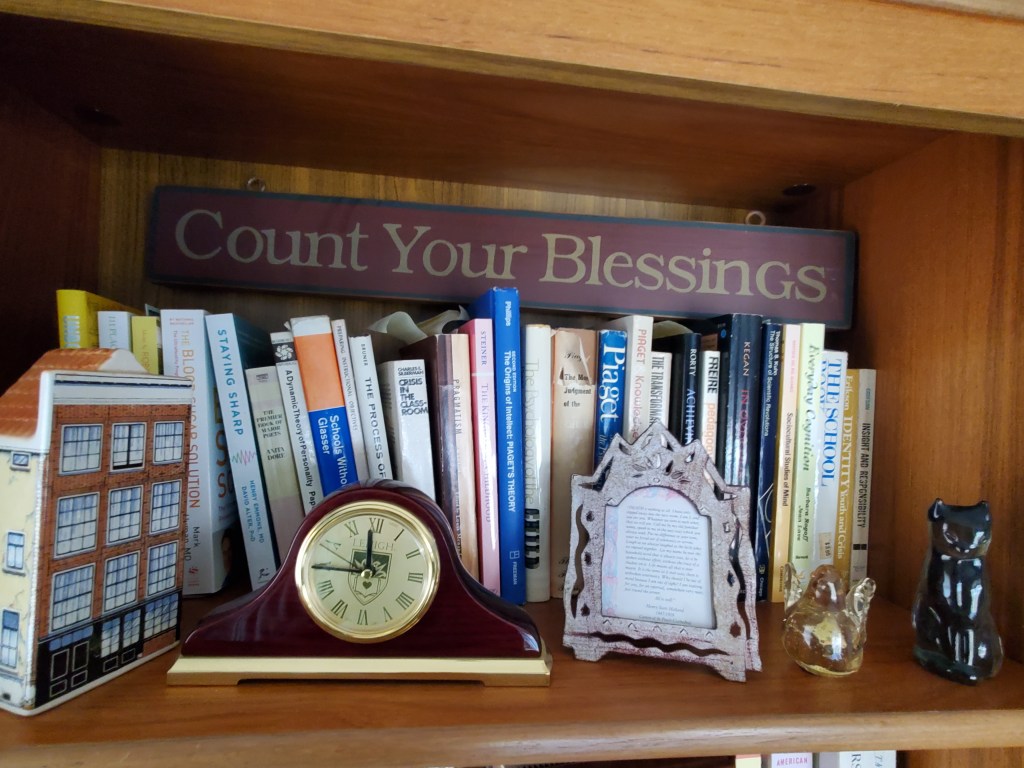
Then I perused the stuff on my shelves. Among them, a replica of the Anne Frank house, which I bought on my first trip to Europe; the clock my colleagues at Lehigh University gave me when I moved back to the Twin Cities; a crystal bird I won for scoring a birdie in the golf league I belonged to as a stay-at-home-mom; a framed card about death that I found in the last book my husband Gary read before he died (It was about J. Edgar Hoover. I kept telling him to read something more uplifting.); and a cut crystal cat that belonged to my mother, my children and I picked it out together for her. These items weren’t just stuff!  They were symbols, memories of life stages, places, and relationships—these were the stuff of love

How could I possibly let any of these items go? Karen’s life in stuff! I thought about our last blog—which apparently didn’t inspire our readers all that much—about legacy. These were part of my story, my legacy, and I wasn’t ready to let go.  Well, maybe I could ditch some of the books and a couple of the sanding sponges.

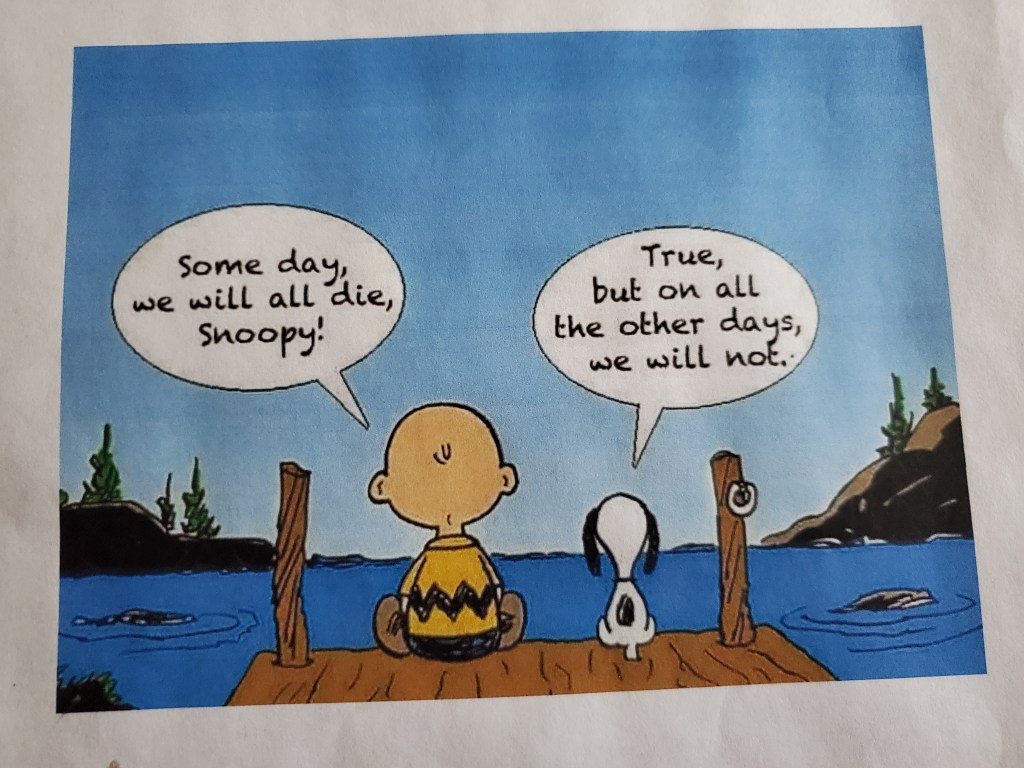
Taking stock of all I’ve accumulated reminded me of the many conversations my husband and I have about moving some place smaller—I’d have to deal with these things. That brought me back to Aunt Selma and the shrinking life. My life would and will shrink. These thoughts led inevitably to death, knowing that I, too, will die, and it’s coming sooner than I expected when I was in my 40’s and 50’s. I used to tell my grandchildren that someone has to be the first person to live forever, why not me? But I’ve stopped saying that.

For a brief minute I pictured my children sitting around cleaning out my office after I die.

 “Why do you suppose she saved this?” they would wonder, holding the Lehigh clock that no longer works or the cheap crystal birdie. I don’t know what they’d say about the sanding sponges. Maybe I should put a little label under each item describing its importance—might help me, too, if I go senile.

I thought of something Karen Rose’s husband says, “if it is smaller than a brick and has sentimental value, keep it. Otherwise, seriously consider giving it away.” Whew, I was off the hook. Most of my mementoes are smaller than a brick, although the embodied meanings are more than sentimental. I’m not ready to let go. For the time being, I won’t do anything until I get tired of walking around the mess on my office floor. I’m not dying yet, which leaves me wondering how long will it take until I reckon with death and move one more iota towards acceptance? For now, I’ll continue to treasure my artifacts of memories. I’m just not ready to shift into shrink.

Used by permission of the white board it was posted on.

Stories and Legacy: A Dialogue

Photo by S O C I A L . C U T on Unsplash

Karen’s Descant is all about telling stories.  We resonate in our bones with Doris Lessing’s observation that stories are what make us human:

Humanity’s legacy of stories and storytelling is the most precious we have. All wisdom is in our stories and songs. A story is how we construct our experiences. At the very simplest, it can be: ‘He/she was born, lived, died.’ Probably that is the template of our stories – a beginning, middle, and end. This structure is in our minds.

Lessing’s appreciation of legacy has been reflected intermittently in our dialogues over the past few months.  What follows is a much edited summary.

Karen Martha:

Last fall one of my friends mentioned that for many of us, our children are our legacy. That has danced in my head all winter, because I have no idea what my legacy might be. I’ve never considered my children my legacy, more like my effort to enrich the human genetic pool, and they are on their own after that. I mean, what if one of them robs a bank? Would I be responsible for that?

This led me to start thinking about what a legacy is. As always, I love to pick your brain. What do you think of when you hear the word “legacy?”

Karen Rose

I think that our culture often asks us to focus on the tangible assets that we will leave behind, whether it is money, an endowed building, or objects that we have created – and that is the first dictionary definition.  And we have been wrestling with that obliquely – as in What is My Footprint.  But the other side of legacy is not what we will leave but what we have received from the past.  I am asked to see myself as a legacy, not from one or two people but also from what flows through them to me. 

Karen Martha:

I hadn’t thought of legacy as what flows through us from the past. It’s hard to get my mind around that since my mother refused to talk about the past, and I lost contact with my father when I was in third grade. My past feels like it starts with my parents.

Karen Rose:

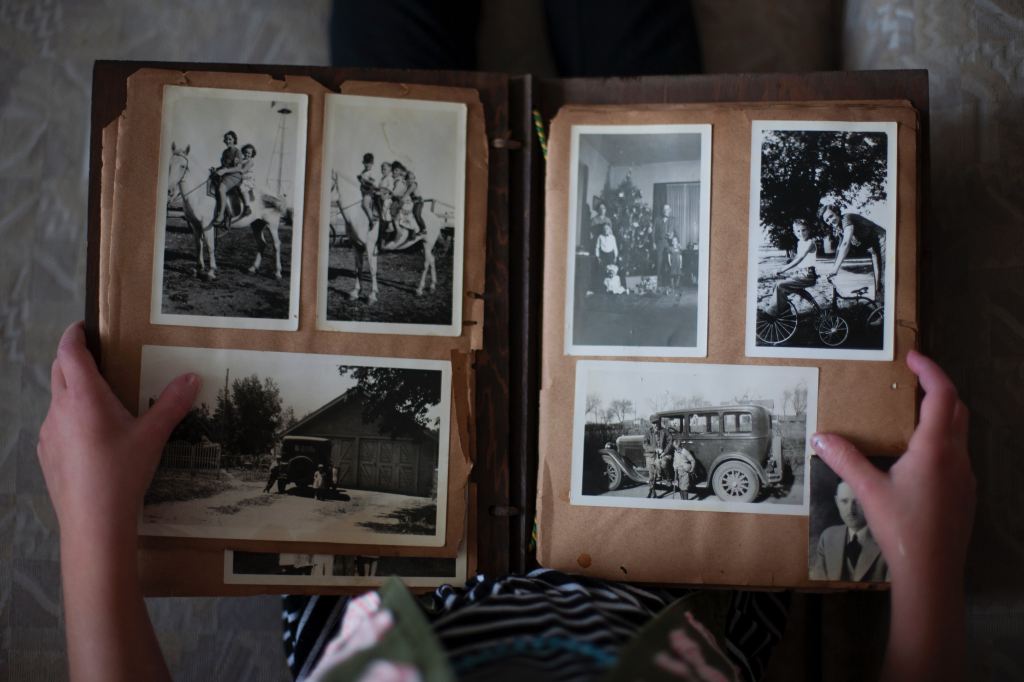
I can be very concrete about some aspects of my past.  My “Swedish family” came to the United States, primarily to the Midwest, starting in the 1860s.  Through accident or karma, all of those who came early married other “Swedes” – mostly native born – up through my parent’s generation.  This legacy cannot be defined precisely because I know that I am truly American and not really Swedish-American. Yet, the family stories about all those distant relatives – people who I met before I had real memories or sometimes never met – which make me feel like a legacy. And I don’t even remember the specifics of most of the adult chatter that seemed endless when I was young! The most precious object that I own is a small box that accompanied my great-great grandmother on the boat to the US.

Other assets – or obstacles in some cases – are less obvious…but what do you think?

                Photo by Laura Fuhrman on Unsplash

Karen Martha: I resonate to the idea as carrying the past forward but what about someone like me who grew up in a family where there were no happy stories or family keepsakes? I’m inclined to tell myself that no legacy is, in fact, the legacy. It was impressed on me growing up that it was up to me and my sisters to do better than my family as a whole had. “You are going to college. You do not have a choice in this.” It was as though they were say that it was up to me to live out their dreams and start a legacy anew. That said, there was a darker side to this legacy. It built in me a strong desire to not only realize their dreams but also to avoid their mistakes, among them a strong thread of alcoholism. I was determined NOT to be like them.

Karen Rose:

But you have put considerable effort into retrieving legacies that you were not freely given in your nuclear family.  You looked for and found your biological father’s relatives, and you  visited them with your own children and their families.  You describe a hole that feels a bit similar to people who are adopted and want to find out more about their blood relatives, even if they are surrounded by love in their adoptive family.

Do you think that this need to feel the threads that tie us to those who have been before – even if we never knew them – is due (at least in part) to our sense of ourselves as peripatetic rather than firmly rooted?  You have moved 30 times since becoming a young adult; I can’t quite match that, but have lived in other countries and in six states, never settling anywhere long enough to feel as if I had a home place…

The underlying question is whether my sense of myself as legacy could have been tied to stories about place rather than only to people if my life had been very different…

Karen Martha:

When I think about place, I am reminded that the minute my grandfather stepped on a boat to the US from Norway, he was leaving his familial legacy behind. I believe that place does matter, probably more in some countries than the US. When I visited Norway I stood next to the fence dividing my grandfather’s farm from the farm my grandmother came from. My second cousin said, “This is where you started, your grandparents talking over this fence, falling in love, and moving to the US.” As she told that story, I felt firmly rooted, even though I’d not spent my life in that place and even though my grandfather had left to start a new life in a new country.

Karen Rose:

We are our history, which includes far more than any particular short story that we tell about ourselves…It is not just the stories that I overheard about distant family connections, but also those that I have incorporated based on events and relationships. The older I become, the more aware I am of how much of my identity is tied in with living in another country and becoming almost fully absorbed into another culture when I was old enough (11) to understand the differences but emotionally and socially very pliable. I have lost touch with everyone I knew then, but their faces and their stories loom very large in my own narrative. 

So, for both of us, a critical and unplanned encounter with place and people has shaped our story of who we are.

Photo by Markus Winkler on Unsplash