
Eighty Years, Eighty Letters

Photo by Joanna Kosinska on Unsplash

I have been obsessed with the minutia of aging, examining every new line, every wiry hair on my chin (prompting immediate removal), every unfamiliar ache in the morning. But when asked to write a tribute for a friend’s milestone birthday, I go whole-hog in the other direction– not just offering congratulations, but taking the opportunity to outline, sometimes in exhaustive detail, why their life has been well-lived.  I ignore tired jokes about wrinkles, slumping shoulders, or forgetfulness.

Almost as if I were writing their advance obituary.

But when it comes to my own Big Birthdays, I’ve mostly ignored them. When I turned 70, Dan planned a sweet mini reunion with friends and family, complete with a cruise on beautiful Lake Minnetonka. It was the first time since I turned 40 that I stopped to consider what another decade meant.

Looking back now at 40 – that was a downer. I was convinced life as I knew it was ending. I imagined myself turning into a wrinkled crone by the end of the week. I spent several hundred dollars on face creams that promised to forestall the ravages of age. Some of them made my eyes burn. I ended up tossing most of the unused jars when I realized I wasn’t actually disintegrating. I didn’t look that bad. I could continue to be vain!

Photo by Zoshua Colah on Unsplash

But this summer I turned 80, and although I didn’t anticipate it, I could feel agitation building as the date drew closer. I set boundaries:

No, no reunions, no celebrations. 

No, I don’t want anything special! 
No gifts – we have nowhere to put anything! 

Do I really have to go to the Sages Lunch this year, when I helped organize it last year?

At one point I even considered writing my own obituary, not out of despair, but practicality. After all, at 80, every year feels a bit more like a crapshoot. But then I remembered – I’m not very afraid of death, although like most people, I hope it will be quick and relatively painless. So if I wasn’t especially fearful, why the restlessness? Why the resistance?

A week before my birthday, I was meditating outdoors with a small group in the clear early morning light in Boulder. Someone read a John O’Donohue poem on longing before we began, and one line stuck with me like a mantra: May a secret Providence guide your thought…”

Fifteen minutes into the silence, Providence – The Great Whatever – answered “You are supposed to write letters to 80 people to tell them how they have changed you.”

It was loud.  It could not be ignored.  It was also rather weird –so clear, it startled me. The universe doesn’t usually shout at me.

And so I began. At first I wondered if I even knew 80 people well enough to write to. But it turns out that at 80, you’ve lived a long time and met a lot of people. As I started making a list, I quickly passed 80. I began to recall how each one was memorable, and why.  Some names were easy. The memories were warm, the lessons clear. Others required more work, were uncomfortable. I had to ask: how did this person change me, even if the change came through friction rather than closeness? Some were no longer living. Some I had lost touch with. In a few cases, I already had letters written – messages I’d sent to the families of friends who’d died, telling them what that person had meant to me. I had saved copies. I added them to the list.

And then I realized something else: not all letters would go to individuals. Sometimes it was groups of people who had shaped me — a writing class, a church committee, a circle of friends. And sometimes the letter could be to a thing — a dining room table from my childhood, or a familiar object that held memory like a sponge. Always, behind the inanimate, were people. Always, it came back to connection.

Oh my.  What seemed, when Providence’s voice boomed, at first like an impossible assignment –  80 letters for 80 years – suddenly feels doable. More than that, it feels necessary. Because in uncovering the people and memories that shaped me, I am also writing something else: a quiet testimony to what I’ve always known, deep down. 

I did not arrive at 80 on my own.

I got here on the shoulders of so many who walked beside me, talked me down, saved my bacon, gave me new direction, nudged me forward when I was stuck, or simply witnessed my becoming. Big influences, small gestures, words that stayed with me — it doesn’t really matter. What matters is the accumulation of moments, and the gratitude I feel for having been changed, again and again, by the presence of others.

In this photo, I am the white-haired 80-year-old, with some of my best friends from Tappan Junior High School, Ann Arbor Michigan.  We met this summer to remember how important we have been in each other’s lives.  This “letter” is for them…and the several who were there in body or spirit but not in this picture. My friend Elsa, second from the right, describes us as a hive…that’s the way that it feels, except there is no queen bee.

“Best friends” from the past and now…

And maybe, just maybe, Providence will answer if I become sufficiently agitated and self-centered and, therefore, speak again when I need a new assignment.

Oh — maybe most important: 80 is not a boundary, just another irrelevant human marker, an indicator our of our futile attempts to corral time.


Vulnerable: What’s in a Word?

“I came to explore the wreck.
The words are purposes.
The words are maps.
I came to see the damage that was done
and the treasures that prevail.”

–Adrianne Rich

Vulnerable: Susceptible to physical harm or damage, susceptible to emotional injury, or susceptible to attack.  “Vulnerable populations” are unable to care for themselves; elderly people are “frail and vulnerable”.

Most of us spend our life avoiding vulnerability. We exercise endlessly to stave off weakness; we guard what we say in meetings to avoid attacks and disagreements that could weaken our influence; when things get tough, we decide to leave our lovers before they can leave us.  We do what we can to protect ourselves – physically and emotionally. 

Of course we can’t be invulnerable in every context – we share things with our best friends or partners that we wouldn’t want to shout out to the world.  In early life we learn to admit when we are wrong, even if we do so sparingly.  We go camping, hiking or skiing without deep concerns about being attacked by a bear or breaking our leg, even when those are possibilities.  We are willing to be vulnerable because the rewards can be great – it is worth it to be connected, to be trustworthy, and to have fun.

 I suspect that each of us hones a personal, intuitive calculus that allows us to make quick decisions about when to leave our safe, self-protected space to realize something more important.  But then fear of failure and loss pushes back, demanding to reduce vulnerability to as small a part of life as possible. 

In my 30s, I believed that I needed a continuous career because I ached at other women’s vulnerability when spouses left and they couldn’t support themselves.  I wanted to stay home with my babies, but didn’t dare and chose safety over the complex pleasures and challenges of full-time mothering.  The pattern of looking for every chance to reduce vulnerability was well ensconced, although most of my choices were right for me at the time.

But then, more secure in my career (and becoming older, possibly wiser) I became more tuned in to the antonyms of vulnerability – what happens when reducing vulnerability becomes a practice and a priority.  Some are worth pondering:

Guarded: cautious, circumspect, reticent, non-committal

Protected: insulated, sheltered, screened off

Resistant: averse to, immune, unaffected by

Insensitive: inconsiderate, thoughtless, hard-hearted, callous

Indomitable: unassailable, unshakeable, intransigent

Thick-skinned: unfeeling, insensitive, hardened

I admit that I have often wanted to be all of these (well, not thick-skinned).  I hoped to control how other people would see me and how situations would affect me, and to find a relatively unshakeable balance, equanimity.  When challenged, and on those many days when I lacked self-confidence, trying to be non-committal and immune seemed pretty good.  When I was overwhelmed because I said yes to more requests than I could easily manage, being a bit more insensitive to other people’s needs felt like the wisest path.  As a young woman in a predominantly male world, being regarded as indomitable was a strategy to reduce uncertainty at work — and seemed to engender respect (acting more like a man?). 

Yet, as I look at the antonyms, I see that self-protection was cumulative.  I adopted predictable behaviors in meetings, and even with close colleagues, which shielded me – but did I gain respect at the expense of trust? I was intransigent in arguing for policies that served my students well – but did that get in the way of developing relationships that might have supported both me and my students?  Could I have accomplished the same goals with more vulnerability and less protection?

Then, sometime in my early 50’s, I found myself in a group where members developed a deep trust and shared painful details of their past and current lives.  There were two rules: you could not interrupt, and you could not offer advice.  I had to learn to listen rather than react. I read Thich Nhat Han, and absorbed the lesson that “the most precious gift we can give others is our presence.”  I had to acknowledge that I didn’t always know the solution to someone’s question or problem, but I could, if invited, join in a search.  I took in other mantras, accepting the inevitability of “failure” because I could not eliminate uncertainty.  I read Sun Tzu’s  Art of War, and took to heart “To know your Enemy, you must become your Enemy.”   I realized that to be an effective warrior for my students I needed to see the nuances of other people’s thoughts and allow them an honorable way of leaving or amending a conversation. 

I deliberately took baby steps to became more vulnerable.

At work, people noticed.  In my marriage it was too late, but when I remarried, I saw that prioritizing intimacy and understanding was as important as love – and much more important than being right.

Being vulnerable doesn’t mean being a pushover.  It doesn’t mean being weak or unable to take care of oneself.  It means that I need to measure my days against the antonyms – were there places where I leaned on them?  If so, what did I gain and was it worth it?  Did that leave me with vague hints that a change (or even an apology) is needed? 

The only way we get deeper knowledge of another person is if we both are willing to be seen, honestly, without defenses. And, I often feel that when I make myself vulnerable, I allow others to try it out as well.  

I don’t overestimate how well I am doing: I am still vain, self-absorbed and protective.  But more vulnerability has made me happier and more connected, not frailer.  It feels like my later-in-life superpower…

Photo by Damir Korotaj on Unsplash

The RMD Blues….Or, What Happens When A Frugal Person Retires?

Photo by micheile henderson on Unsplash

I hope to tell you we were shocked

At the 80-year-old man found dead

$180,000 in grimy envelopes scattered

Everywhere like old hopes, old sin.

RegretMichael Riley

I was touched by Michael Riley’s poem, which conflates the misery of the miser and the equally meaningless life of a rich retiree with handmade shoes.  But, in a way, I relate to both unattractive images.  I managed not to squander today’s pleasures in fear of having too little tomorrow – but barely.  Retiring “comfortably” caused discomfort because there was something “wrong” about having a monthly income without working.

That disquiet began when I became aware of the dreaded RMD – the required minimum distribution from tax deferred retirement savings accounts….I spent hours in my late 60s using IRS tables to see whether I would have enough to live on until, in total frustration, I called Darla, who manages our money.  Her response:  “Yes, if you keep living the way you are.  In fact, because you are retiring late, you should spend what you want now, and travel where you want to go.  When you are 80, one or the other of you probably won’t want to do that anymore.”  Darla is blunt. 

When Karen Martha and I started this blog, we resolved to reflect on what we were thinking about (confronting?  agonizing over?) as we moved from satisfying mid-life and work to something less well defined.  We were also clear about what we wanted to avoid.  So many retirement blogs emphasize issues of money – how much you need to have to retire, how to manage it once you have retired, and how financial decisions should affect others, such as whether to work part time or to move to a less costly city/state.  We wanted, in contrast, to focus on what was in our hearts. But, money becomes unavoidable at some point.

We have much in common, but over our many years of friendship we never really delved into our unrealistic but unmanaged fear of poverty.  Karen Martha grew up with a single mother in her early years, and experienced financial hardship until her mother remarried; my father went back to graduate school in his 30s and, although not poor, my parents had to watch their finances carefully.  However, the Karens agree that our lessons — NEVER have any credit card debt and ALWAYS save more than necessary — were not particularly logical since we worked in education – not highly paid, but also a profession with employment security and good pensions.

Fast forward to my middle 70s:  Dan and I have Social Security, and we have enough from retirement accounts to live more comfortably than anticipated.  What a blessing!  I have the luxury of blogging, traveling, volunteering and playing with grandchildren, and don’t anticipate much paid work.  The same is true of most of my friends. 

But “you worked hard for it” feels self-satisfied when newspapers report weekly that most Americans are unable to save for retirement, and others are chronically under-insured and a step away from a health-induced financial disaster.  Then there is the annual “windfall” of RMD from those pre-tax retirement accounts which will, apparently, never run out. In other words, I feel guilty and even (sometimes) unworthy of being one of the “advantaged older population”. 

When I was working, I adhered to my family’s legacy of prioritizing charitable donations, but there was an upper bound set by the NEVER credit card debt and ALWAYS save rules.  Now, enter the late fall specter of the RMD windfall…the old messages argue in one ear that anything that I do not need this year should be reinvested so that I won’t be eating dog food when I turn 100.  An equally insistent message to give away what I can afford speaks in the other ear.  Then there is a new rumbling note that floats above:  I was fortunate to live during a period of unprecedented economic growth and to be financially secure; my grandchildren are unlikely to have the same experience.  How much should I be saving for them? 

Peter Singer has one answer in Famine, Affluence, and Morality: We all, within our means, have a moral obligation to reduce suffering, and owe this to all people and places because of our common humanity.  But his argument ignores every parent’s obligation to protect our loved ones from realistically anticipated harms.  The Native American 7th generation principle also requires me to attend to the suffering of the planet and all of the creatures and plants that make our home livable.  And what about the international movements to create peace and stability in our fragile social systems? Or initiatives that support flourishing as well as alleviating suffering (e.g., youth programs)?  Oh, the causes that I feel drawn to – and the guilt that I feel when deleting requests for contributions from groups that “do good” and are highly rated by Charity Navigator….

RMD sits there in the middle:  I have to take it and pay incomes taxes according to the government.  Then – SAVE for Dan and me, SAVE for the coming disasters that will occur in 50 years, SAVE for unaffordable college tuition for the next generation, or DONATE now. 

So, although I said that I would never, never be one of those retired people who perseverate about money even though they have more than enough, I find that I cannot avoid the subject.

And lifelong frugality kicks in…should we take that long-postponed Viking River Cruise? (Yikes!  Have you seen what they cost for a room that has a view?)  Should I feel depraved because we bought an upscale (used) car when the food bank sends me letters every month?  And what about my alma mater, which has a decent endowment but would like more for scholarships?

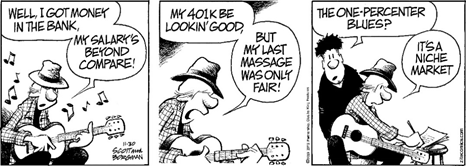
The gift of being affluent and older – definitely not in the 1% — is a niche market.  Until now, I have not had to think about the sardonic message of the cartoon below but it makes me uncomfortable.  When I was saving and young/middle aged, I would have viewed the message as political.  Now I have to ask if it is personal….

Yet another threshold

Photo by Max Harlynking on Unsplash

Too many people see the years beyond 70 as a static period in which there is little change, just a slowing down. But in Anam Cara, John O’Donohue encourages us to “visualize the mind as a tower of windows”:

Sadly, many people remain trapped at the one window, looking out every day at the same scene in the same way. Real growth is experienced when you draw back from that one window, turn, and walk around the inner tower of the soul and see all the different windows that await your gaze. Through these different windows, you can see new vistas of possibility, presence, and creativity

I have had to look through a lot of windows recently, and ones that I would not have chosen. However, although the paths taken have not been easy, each was part of a different journey in which I learned something about myself. Recently, someone asserted that my life was “really hard.” My immediate internal response was intense irritation, but I politely noted that my life was not so hard—after all, bad things happen to everyone. I quickly realized that I was annoyed because the kindly offered words did not acknowledge that I was grateful for the many blessings that accompanied the view from each unchosen and unanticipated window.

Photo by Remy Penet on Unsplash

By now, you’re probably wondering who is this person. I am a social scientist who is always gathering data and extrapolating from those data. I am also a deeply spiritual person, so I have the tendency to infuse my experiences—which might, on the surface, look ordinary—with spiritual meaning to deepen my understanding of our lives during these challenging times.

As we age, many of us view our lives as a series of milestones and thresholds that are usually clothed in ritual. For some, a milestone marks the completion or culmination of something (e.g., college degree, wedding anniversary, retirement, death of a loved one, etc.), whereas a threshold signals the commencement or start of something (e.g., wedding, career or life transition, relocation, etc.). Crossing a new threshold is always a challenge and requires a certain amount of trust.

Nearly three years ago, for example, I said goodbye to my late husband, Jerry. This was not how the two of us had envisioned growing old together. Instead, I was called to do such difficult, intense, and sacred work as Jerry’s primary caregiver for seven years…and now that work was over—a major milestone for me. Shortly thereafter, I crossed a threshold and slowly embarked on a journey of grieving—a journey made more complicated by the COVID restrictions.

Fast-forward 15 months. My journey of more-or-less solitary grieving ended abruptly—a milestone for me—when a routine blood test revealed chronic leukemia. Even though I still had more grieving to do, the social scientist in me volunteered to participate in a 15-month clinical research trial—another threshold and a healing journey for me in the company of dedicated caregivers/researchers.

Photo by Marcelo Leal on Unsplash

Along the way, I encountered two unplanned pauses when nasty falls resulted in broken bones in both of my hands, my wrist, and later my kneecap. In each case, I was forced to slow down even more and give my body the time it still needed to heal. Because, on both occasions, I needed to be cared for more intensely, I joined a larger group of elderly people who were no longer able to live independently. This was, for me, a very new journey into vulnerability and community.

Gratefully, my disease is now in remission and my bones are healing—a milestone for me—and I can begin to allow myself to look through new windows at possible future thresholds. Unlike the thresholds of the last decade that I could not ignore, this time I get to decide which doors and thresholds I will open and cross.

John O’Dononue offers this blessing for “a new beginning”:

Awaken your spirit to adventure,

Hold nothing back, learn to find ease in risk;

Soon you will be home in a new rhythm,

For your soul senses the world that awaits you.

To Bless the Space between Us

Although I’ve faced many (sometimes abrupt) beginnings in my life, I’m still not comfortable being vulnerable—or not knowing what comes next. Here are the questions that now consume my anticipated re-entry into a “new normal”: How can I take all that I’ve learned over these challenging years and choose among “all the different windows” that await my gaze? How can I make sure that the threshold I am about to cross will nurture my well-being and resilience? And, perhaps most critical, what might be holding me back?

Photo by Les Argonautes on Unsplash

I now can see that I will not have answers to these questions before it is time for me to step gingerly across yet another threshold as it appears in this wild journey called life. To avoid stasis and “just a slowing down,” I must be content to make a choice and, in the words of Jan Richardson, writer, artist, and ordained Methodist minister, “Let what comes, come.”