Leftovers

Phase 1 of the holiday season – Thanksgiving. I always say it’s my favorite because there are no presents involved. I’m not sure that’s true, but it suggests I have an altruistic side.

Now, with the holiday over and another approaching, I’m thinking about leftovers. Don’t you love them? The best part of Thanksgiving!

Leftover 1: Gratitude.  Last year neither of my two children and their spouses wanted to host Thanksgiving. They seemed to have caught the rest of the country’s malaise about it, too much work, with football and maybe turkey as the only reasons to get together. But, remember, I’m the person who says it’s my favorite of the holidays, so it seemed appropriate that I step up and host.

I was new in my apartment after selling Jim’s and my house, which had been the center of many family events. Could I possibly host Thanksgiving? In an apartment? I remembered a favorite movie, Hannah and Her Sisters, where Mia Farrow hosts her big family in a New York City apartment. If Hannah could do it, surely I could. So, I hosted Thanksgiving with good help from my family. And it worked. We gave Hannah some competition.

As that 2024 Thanksgiving grew to a close, we were scheduled to move to another family’s house for dessert, a tradition we started several years ago. But I was exhausted. I’d burned my wrist draining the potatoes, and it hurt. The kitchen was presentable, and all I wanted to do was sit and watch mindless TV—yes, something even more mindless than football. So I didn’t go. AND I announced that I was passing the baton—someone else had better step up and do Thanksgiving next year.

 “I am too old for all this work, and I’ve done my share!”

So, when Thanksgiving came around this year, my daughter stepped up, yet somehow, on the morning of Thanksgiving, I found myself responsible for an apple pie and the mashed potatoes. Everything that could go wrong did, and I barely finished in time to get to my daughter’s house.

During the entire time in my kitchen, I whined to myself, “I passed that baton. This is ridiculous. These potatoes are pathetic, mushed, not mashed potatoes, and the pie. Why did I agree to sit and peel apples and potatoes? And what’s wrong with my kids that they wanted mashed potatoes from Costco? Have I raised lazy children? . . . ya da ya da ya da.”

And then it hit me – sometimes the Universe does need to smack you pretty hard. I realized that husband #1; husband #2; husband #3; some old boyfriends and my sister (all deceased) would have given anything to be in my shoes: 81 and still mashing potatoes and partying with family

Who cares about potatoes or pie—I was getting to enjoy Thanksgiving with everyone I love. I was getting to make pie and potatoes for them. Getting to do this (see https://designingyour.life/), became my new mantra. My resentful, “I HAVE TO” went “puff” and left the room, leaving gratitude in its place.

Leftover 2: Intergenerational Conversation. Last year as dinner ended, we started a discussion about AI. Everyone at the table had a stake in AI. I was teaching an undergraduate writing course and struggling to convince students that you can’t learn to write if ChatGPT writes your paper.

The discussion was fast and fun; no one left the table to watch more football, which means something. We are a family of frogs, we jump into the pond quickly. Our one turtle, Luisa, is often left standing on the bank; she jumps in later, usually with great wisdom.

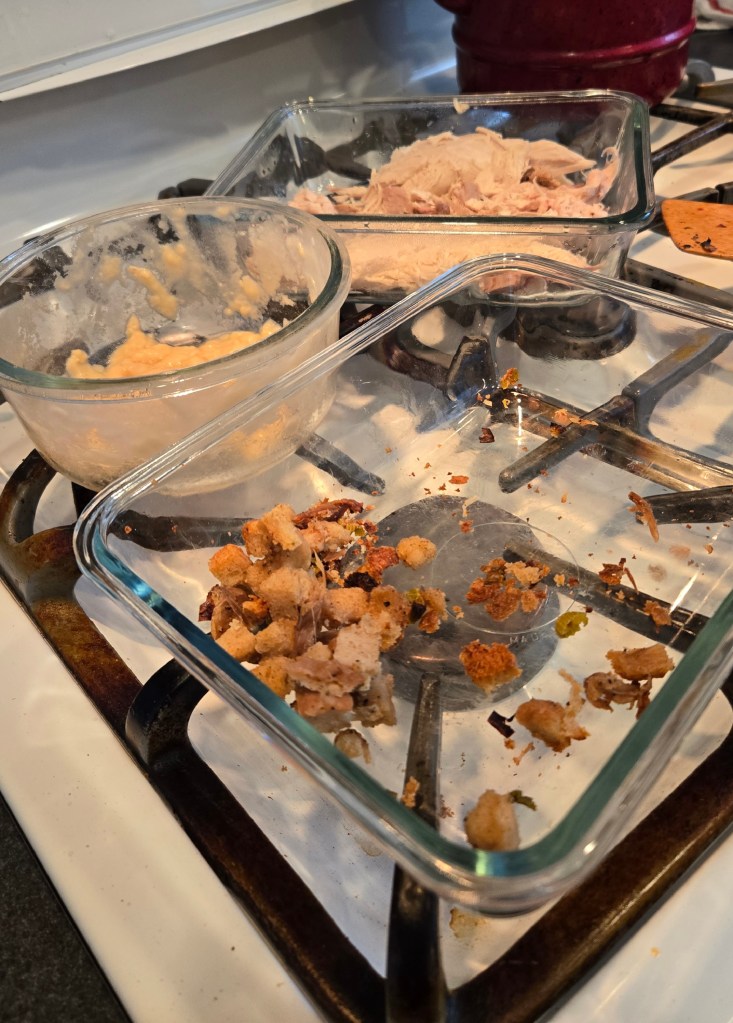
This year, we’d finished eating and were lingering in the kitchen, snitching bites of dressing and turkey. Elizabeth, my daughter-in-law, asked her 24-year-old son, Henrik, if he wants to have children. I don’t remember how we landed there, maybe because two of our young people are about to graduate from college. Henrik never did answer, but the question kicked off another great discussion about the uncertainty of the future, mainly the planet, and how grim it looks to Gen Z.

The future, by definition, is uncertain, but what my Gen Z grandchildren are feeling is more complicated than uncertainty. The word, “existential” kept floating up. Generation Z young people ask different questions about meaning, purpose and identity than the Silent Generation or even the Boomers did. As we talked, they hesitated to share their dreams for their futures, wary of the future of the planet and climate change.

I can’t recapture the opinions, but I concluded that young people are facing problems unique to our time with climate change at the heart of them, especially as the world responds. They are terrified, although they didn’t use that word. (Remember this is an “n” of 3, so ask your own Gen Zers). And yes, we hid under our desks because of nuclear bomb threats, but this is different.

Reflecting later, I realized we had had a family conversation that crossed generations. Gratitude welled even greater in me, couched in concern for my grandchildren. I was, nevertheless, grateful for the sharing across generations.

Leftover 3: Hope. We eventually moved to more mundane topics, but I worried that what I was hearing might be despair. I didn’t want them to throw in the towel for a life of hedonism. So, I later questioned the Gen Z grandchildren separately.

I started with Henrik, “You aren’t giving up on dreams for your life, are you? Embracing a life of hedonism—do you even know what that is?” (Who knows what they teach in college anymore.)

“Don’t worry, and yes, I know what hedonism is. For now, I don’t know what I’m doing after graduation, but you know me, I’m just curious about it all.”

Whew!

Later, in my car with Luisa, who you will remember is our family turtle, never jumping in too soon, I asked her about her aspirations. She gave me even more hope, summing her thoughts up as “I don’t want to miss my life waiting around for the end of the earth, so I’m living it.”

Upon hearing those words, my gratitude for the day swelled into hope. Yes, the situation in the US and worldwide, especially climate, looks dire, hopeless, gloomy, depressing. . . you get it. But along comes Thanksgiving, and the leftovers. We engage in meaningful conversations and emerge with hope, nurtured by connection and making meaning together.

Another LEFTOVER:

From Wendell Berry, Think Little

. . . the world is blessed beyond my understanding, more abundantly than I will ever know. What lives are still ahead of me here to be discovered and exulted in, tomorrow, or in twenty years?

What’s It All About: Just in Time for 2025

I walk down the hall of my new apartment building. Every doorway looks the same, gray, an apartment number, and a light to the side. Gray stretches indefinitely, soulless. I wonder if someday I’ll get lost in the sameness. I am a small, insignificant, older woman, putting one foot in front of the other in my daily trek to get my mail and newspaper, small things tethering me to the outside world.

          Here it is 2025, and I’m still asking myself what it’s all about. When I was seven or eight, I’d scare myself by worrying that I was an actor in someone else’s dream. I didn’t exist. How could I be sure I existed, that I was real? And if I was real, why did I exist? I had no answer other than to immediately divert my mind and think about the next day when I’d call a friend to play with me.

Then college. I registered for a humanities course, with no idea of what humanities was except a requirement to graduate. In a crowded room in Ford Hall, I learned I wasn’t alone in doubting my existence. A French guy named Descartes asked himself the same question about his dreams and concluded “I think, therefore I am.” Had it been that simple all along, and I was just too young to see it?

Once I established my existence—after all a famous philosopher had confirmed it—I started to focus on why I existed—what was human existence all about?

Next was the 1966 movie, Alfie. I was 23 and about to marry. If you saw the movie, you know that Alfie, played by Michael Caine, is a handsome womanizer, oblivious to the pain he causes the women he “loves” and leaves. One lover has a son, and Alfie becomes a father. Alfie begins to attach emotionally, but then the mother takes the boy away. Alfie denies his loss by finding another woman, who’s married, and he gets her pregnant. She has an illegal abortion with Alfie present. There’s an incredible scene when he views the aborted fetus, and for the first time, Alfie faces his life.

The movie and the finality of the abortion has stuck in my head since 1966. It wasn’t the procedure itself that impressed upon my mind; I understood the woman’s reasons, Rather, it was the contrast between the hedonism that looked so attractive when Alfie lived it, and the woman’s dilemma, a life growing in her, but having that baby meant the possible loss of a husband and family, which, for all its problems was a life of meaning. The theme song still lives in my head, “What’s it all about, Alfie? Is it just for the moment we live? . . .” And here I am, 81 years old. I haven’t lived a life of hedonism, that’s probably why I made it to 81. But still I wonder what it is all about, especially as I look back, and realize my moment went by so quickly.

I’m guessing we all wonder what life is about. Having a purpose is touted as one route to an answer—of sorts. I recently heard about a program to inspire disengaged youth by helping them find a purpose. At the other end of the age continuum, we retirees are told that we’ll live longer and be happier if we find a purpose. Maybe we can all hide in our purpose and avoid the deeper question.

Then there’s the path of hedonism. I vividly remember my 50th high school reunion when we went around the room telling each other what we were doing with our lives fifty years after graduation. I was shocked by how many people bragged about their good lives of boating, dining, cocktails, and relaxing in Florida in the winter and Door County during summer (I grew up in Wisconsin). When it was my turn, there I stood, thinking life was about more than that. I stuttered that I was still working (my way of escaping the larger question).

Turning eighty pushed me to answer what it’s all about. It’s scary to me—I want to feel okay with my life because I don’t know what’s coming. I will always hear my mother, dying at 74, saying, “I’m not ready. There are things I need to do.”

A few Christmases ago my children gave me an Aura frame. It’s a tablet that flashes pictures at 15-second intervals. You load the pictures from your phone and other devices onto the tablet. At the time I was disappointed. “What am I going to do with this?” I thought.

Nevertheless, I placed the frame in a central spot, plugged it in, and synched with the Internet. There was my family. They had already loaded their favorite pictures of a growing, changing family of the past 25 years and even pictures from my and their childhoods. Gradually, I added some of my own and Jim’s family added pictures, too. I came to love my Aura. Jim and I would eat dinner at the dining room table and watch the screen, telling stories about the memories triggered by the pictures

Some days life reads like a fine novel. It’s all there: a great plot—my life; characters—family and friends I’ve loved; a climax—the 50’s and 60’s when family and work came to fruition; and now the denouement—old age and me asking once again, What is it all about, after all? It feels pressing, the need to know.

I walk into my apartment from my soulless hall, and there’s the Aura streaming my story line. I pause and watch: Jim, my sisters as children, our dog Eddie, Lake Michigan, my bicycles, our grandchildren, friend and fellow blogger, Karen, vacations, a big snapping turtle, a pileated woodpecker—you get the picture, family, friends, pets, this amazing planet, eighty remarkable years and memories, most everything I’ve loved and love. Aha, this is what it’s all about, I think.

The answer has been there all along, and I can give it to you in one word— love. It’s about love.

. . . for one human being to love another… is perhaps the most difficult of all our tasks, the ultimate, the last test and proof, the work for which all other work is but preparation. Rilke

My Perfect ‘Little p’

Lake Harriet Community School

If you’re someone who’s followed this blog, you know that ‘little p’ refers to one of those small purposes that each of us carries out daily, purposes that make families run smoother, make people feel loved, and spread kindness. Things like volunteering at a book sale to raise money for scholarships, preparing and serving lunch at church after a funeral, and making sure family members have a good day. These are not grand purposes, but incrementally, they make life better.

A common ‘little p’ is volunteering. Although it’s almost a cliché to say that when we volunteer, we get more than we give, I have to indulge that cliché when I talk about tutoring, my ‘little p.’ I definitely get more than I give.

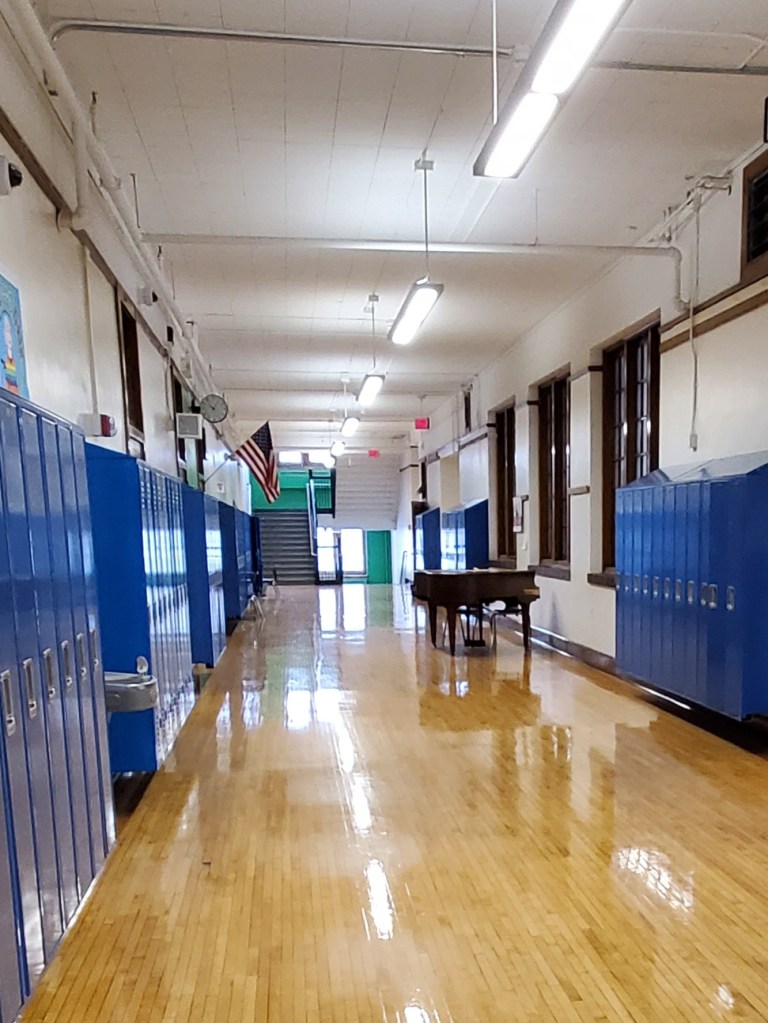
I have the perfect tutoring gig—four mornings a week at a nearby school in Minneapolis where my son is the principal, Lake Harriet Community School. It’s a small school, grades 3-5, and a highly successful school—a Minneapolis Public School that ranks 4th in the state. It’s also over a hundred years old, with shiny wood floors, heavy oak doors, windows, and woodwork, and tired classrooms, even though they’ve been kept up well. Like many districts, currently, it has children who were in primary school during the COVID shutdowns, and some are not ready for grade level work (we are avoiding calling them “behind.”). One way schools are addressing the needs of these children is through tutoring. That’s one reason I’m tutoring, specifically in math. The gift to me is that I AM NEEDED.

I tutor three small groups and then I help in a classroom. I’m on my feet for three hours, and on my toes mentally, even though it’s basic mathematics—in my day we called it arithmetic. Mathematics is not being taught the way you and I learned it or the way I taught thirty years ago. Now arrays are used to teach multiplication; children learn properties like commutative and identity; and algebraic thinking is introduced in first grade, etc. Clearly I must stretch mentally and find ways to teach new ways of doing arithmetic. That’s my second gift—keeping my brain challenged.

Then there are the obvious benefits, tutoring gets me out of bed and cleaned up early in the day; it gets me moving in natural ways rather than going to a gym; and my favorite, tutoring gives a purpose to my days.

Like other things we do in our mostly small lives, tutoring, at first, felt insignificant. I initially labeled it a feel-good way to spend some of my time in retirement. (By now you know I’m a hopeless cynic). I mean, how much difference can 2-4 hours a week make in a child’s mathematical growth? But to be an educator—which I am—is to believe fervently in small steps, small miracles of understanding. So, cynicism notwithstanding, a part of me believes what I do matters. I’m a caring adult in these children’s school experience who believes in them and supports them.

Yesterday, the impart of tutoring was resoundingly brought home to me. It occurred in the 4th grade class where my role is to hang out and help as needed. I’m the right hand “woman” to the teacher, who is especially creative and commanding when she teaches. She often starts the class period with a video that gives an example of kindness. Here’s a link to the video she showed yesterday. I urge you to watch it before you read further.

Please Enjoy before You Read On!

After viewing the video, the teacher asked students what was going on, what was the video about. Why were some residents in the nursing home tearing up? It took some time for these ten-year-olds to stop focusing on the gifts and to think about what was really going on for the residents. But they got there. As one little girl put it, “She showed that she cared about them.” That led to a discussion about loneliness. I’m not sure that all the children understood, but it was one of those small steps of learning.

For the remainder of the class we studied what to do with a remainder in division. That was fun and equally challenging. In my car on the way home, I reflected on the class in the context of the video. And suddenly I felt it, the biggest reason I tutor—I feel like I belong! I belong to this one classroom, to the other teachers I support with small groups, and in this small school. Best of all, I belong in a world that I care for because I know what individual children need.  I am doing my part to make this place and their lives better in small, incremental ways. 

If you want to find out more about Ruby, here’s her website:

https://3wishesproject.org/who-we-are/

Possibilities

A person standing on a balcony

Description automatically generated with medium confidence

I Dwell in Possibility

Emily Dickinson 

Joachim Trier’s movie, Worst Person in the World, is about a young woman exploring the possibilities in her life looking for that one true passion. It’s a universal story line—the quest–yet as my friend and I walked to our cars after the movie, all I could think about was the line “I no longer have a future” (spoken by one of the other characters). “It’s exactly how I sometimes feel about getting old.” I told my friend. “Like I no longer have a future.” She agreed that that line had stood out to her, too.  We walked around the corner to our car, parked on a street of lovely old mansions near Lake Michigan in Milwaukee. The early spring sun brightened the landscaped lawns and melting snow. 

“Take these gorgeous homes,” I said. “I’m never going to own or live in one. Twenty years ago, I would have walked by them and daydreamed about living in one. But that’s never going to happen.”

My friend noted that one of the harder realities about getting older is the realization that the range of possibilities is shrinking, if only because we’re running out of time—not to mention that most of us have more money going out than coming in. 

A few weeks later, I visited a college with my daughter and granddaughter. I heard my daughter say, “Gosh, I wish I could go back and do college all over at a place like this.” Her wishful thinking reminded me that there’s a universality to dreaming about what might have been or what might yet happen. The fact is, however, we get only one life. She is through college, and I’m never going to own a mansion in Milwaukee. But does that mean that I have no future?

I could still move somewhere new. . . or maybe travel. Is this why we older people like to travel? We have time and we’re looking for novelty? For my husband, the fun is in the planning. He gets to run through all the possibilities. For days before we go somewhere he changes the itinerary. When I saw Frances McDormand in Nomadland, it struck me that though she didn’t have any money, she traveled and was open to possibilities, too. 

This morning I asked myself what I like best about being retired. The first answer that popped up was having the time to contemplate and work on myself (a blog will soon follow on this). Richard Rohr in Falling Upward: A Spirituality for the Two Halves of Life, argues that in the first half of our life, we build and identify with a persona—I’m an educator, I’m a mother. Others are policemen, teachers, professors, plumbers, community activists—however we see ourselves. We work hard to create and maintain this persona, but underneath is an authentic person. In the second half of life, however, we have time and inclination to turn inward and explore that person, who we are at our core. That’s a powerful and challenging possibility.

In a recent podcast of No Stupid Questions on NPR with Stephen Dubnar (Freakonomics) and Angela Duckworth (professor at U Penn, well known for her work on grit) take on the question of What’s so Great About Retirement? There are many good reasons to listen to this podcast (or read the transcript), but the one that stood out to me was Duckworth’s emphasis on goals or purpose:

She describes her father, a retired chemist, who upon retirement announced that he didn’t want to do anything, and he proceeded to get up in the morning, have his coffee and his breakfast, shuffle over to the love seat, sit down, take the remote control, and turn on the Weather Channel. She believes that his choice to spend his retirement this way made him profoundly unhappy (Both Karen R. and I believe she should have looked closer instead of judging him). Duckworth notes:

I have a theory of happiness, which is very simple. I think people pursue goals spontaneously at every age. Whether you’re 4 or 84, you have goals. You have things that you want to accomplish. I think, actually, the greatest unhappiness there is, is not to have goals at all. 

As soon as I heard this, I knew I was back at my favorite rabbit hole—purpose. Maybe having purpose is the way we counter the perception that we have no future other than aging. Maybe I need to stop raging about it and look more closely. Purpose, in the second half of life, may be drawn from an inner imperative. That requires the very inner work that Rohr writes about, and it doesn’t have to result in a big world changing purpose/imperative. Instead, it can be a commitment to the little p’s in front of us daily

Two of my little p’s, as you’ve heard me say before, are tutoring and rosemaling. On the surface they seem like time fillers, but I made these choices after self-examination, not because I needed a job, or wanted to pursue a career, or whatever. Tutoring reflects my joy in teaching children, of being in schools, and in observing that fascinating process called learning. Rosemaling reflects a search for my identity as part Norwegian and my love of making things. While perhaps not soul work, these two choices came from an exploration of who I am and what I love doing. And finding them screams “You do have a future right in front of you, Karen!” Maybe it’s not a mansion on Lake Michigan, but the fruits of inner work from where I stand today, are every bit as rewarding as building a career was when I was younger. It’s true, I won’t get another life, but meanwhile, having found some little p’s, I wake up most days engaged in the one I have.

A person drawing on a piece of paper

Description automatically generated with medium confidence