My father balanced a martini and a cigarette, settling in heavily as he often did when he came home at night. We snuggled, me tucked under his arm; he adjusted one of my short legs so it looped over his. Without words, we savored the smells and sounds of dinner on the stove, wrapped in comfort. The couch softened, and we sank further in, my breathing increasingly paced with his.
I was cozy, savoring my special time, while the smells and sounds of dinner on the stove wrapped the room in comfort. I didn’t want to move.
“Why, Daddy?” I asked.
“I have some stories to tell,” he said, smiling.
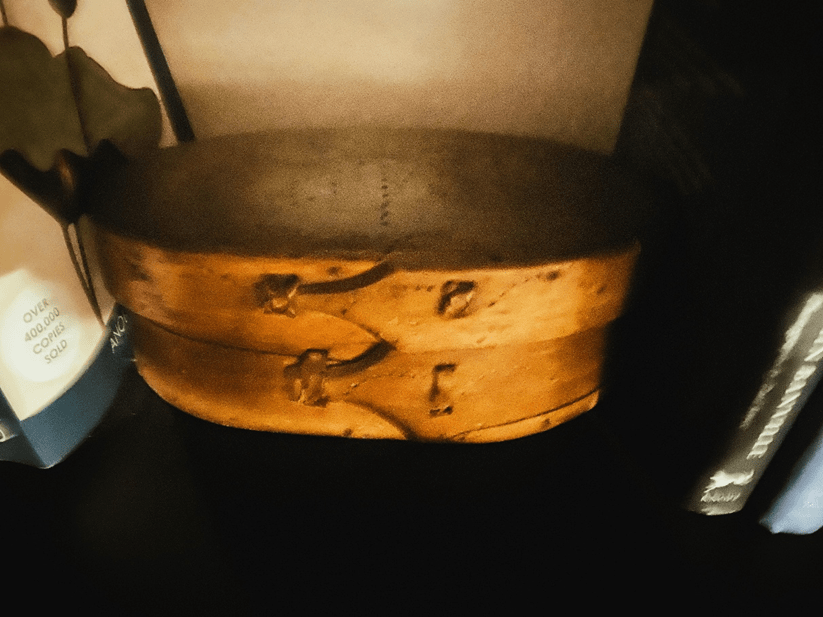
Well, it was sort of a box—small, oval, and battered. I must have walked past it every day, probably knew it was there, but never actually noticed it. Something there, but not consciously there.
I wasn’t especially curious, but the promise of a “Daddy story” was always enough. He loved to tell them—sometimes real, invented—and that was how he spread his love through our little family, how he made himself our daddy.
The box was light, wooden. The top pressed on.
“It’s easy to open, Karen,” he said. “Go ahead—but be gentle. There are some loose things inside.”
I tugged at the lid—a serious job for six-year-old hands—and hoped for candy, or maybe a small toy stowed away for just such a Daddy–Karen evening.
“Daddy, there’s nothing really in here—just some old stuff!”
That’s when the story began.
“A very long time ago, in another country called Sweden, your great-great-grandfather was a small boy, about your age, living on a farm. And your great-great-grandmother was a small girl, living on another farm. But the farms were poor, and the soil was rocky. They had a few sheep, but too many stones to keep a cow. They grew potatoes, drank sheep’s milk, and lived in a small house—much smaller than ours.”
In my mind, all I could think was: boring!
“Daddy, can you make the story go a little faster?”
“They left Sweden and took a boat to the United States…”
His voice was deep and slow, like music. I remember how happy I always felt when he was in a storytelling mood—but this one seemed too slow, confusing. I knew better than to interrupt too much. Interrupting could mean the story would end.
Then he picked up the box and held it to my nose.
“Smell it, Karen—it’s old roses. They still smell.”
“Daddy—I see brown things at the bottom. Are they really roses?”
“Those roses are more than fifty years old. They came from your great-grandmother’s garden in Minnesota.”
“Oh.”
“The box is ancient too—it was what they used to store butter in Sweden. It’s the only thing we have that came over with them.”
He paused. I could feel him trying to decide how the story should go on. But he didn’t. We got up, had dinner, and put the box back on the table.
Since there, I’ve come to understand why he breathed deeply and stopped.
For him—and therefore for me—the box was a link to a past we would never fully know, but that made us Swedish. Or rather, Swedish-American. It represented something about who we were and where we belonged in the world that was hard to explain.
Every so often, he would say, “Let’s look at the box again,” and I would bring it down. I’d ask, for the hundredth time, “Who are the people in the funny tin picture?” and “Why did they make necklaces out of hair?” and “How can the roses still smell when they’re so old?”
Decades later, when I was in my fifties, I saw him unpack the box again as he settled into a retirement apartment, moving from Ann Arbor to Minneapolis to be closer to me.
“Daddy—the butter box! It wouldn’t feel like home without it on a shelf in your study. Can I open it?”
I still called him Daddy, though by then we spoke more about our shared research interests than anything else.
“Of course you can—the roses still smell, even though my sense of smell isn’t what it used to be.”
As I pried the lid loose, I saw that his mother had taped a small torn label inside. It read: This is for Stanley.
I knew what he meant. I would have it next. I said nothing.
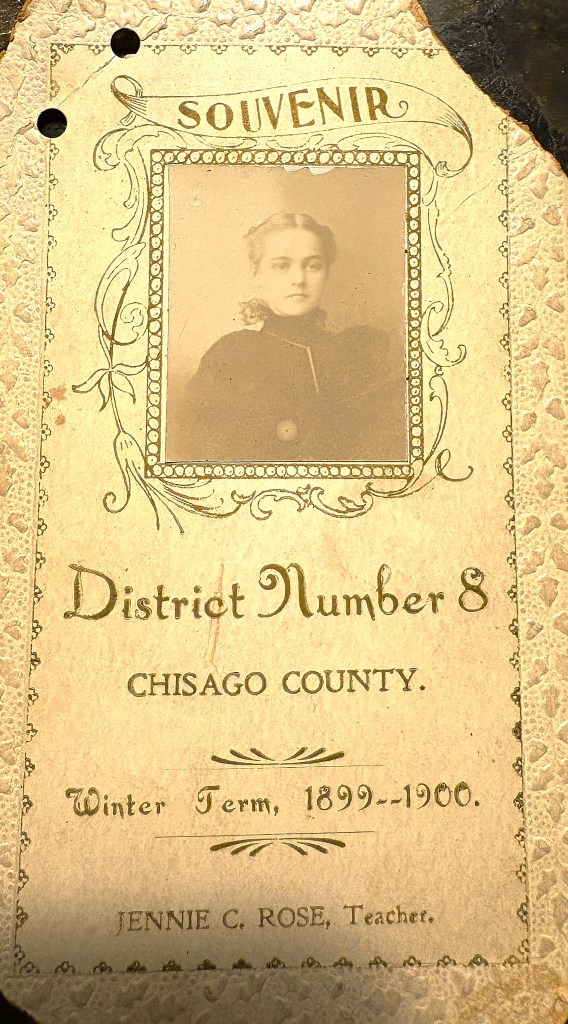
Now the box is on a shelf in my living room. The roses still smell–well, at least the cloves that were used to dry them. The old tintype and the hair necklace are still inside. My grandmother’s class list from when she was a teacher — 1899.
When does a simple object become something so valuable that it would be the first thing that you pick up, after your dog, if you had to evacuate? Is it the object? Or the stories it engenders, not just to one person, but to many. When do objects become part of a family’s web, holding it together across generations?
Obviously, it is easier if your object is a butter box than your great-great-grandmother’s Queen Anne table.
But for me, the boundaries between the butter box and all the people who loved it have become blurry –it is hard to separate the object from the remembered presence of someone you hold very dear.
Soon, I’ll ask my granddaughter to bring it down from the 8-year-old level shelf where it sits. And I will tell her the story – perhaps not as beautifully as my father, but with the same effort to weave an invisible but durable web of connection.
“Opal, can you open the box?”
“Sure, Nana—what’s inside?”
“Just open it and see…”
 Karens' Descant