What Our Mothers Never Told Us

Photo by Natali Bredikhina on Unsplash

How much do we really know about our parents – and how much do we want to know?

We in the boomer generation grew up knowing that fathers never talked about their experiences in the 2nd World War.  They were raised in a time when we kids were supposed to view them as super-beings, who cared for us but didn’t have much emotion themselves (except the random yelling when frustrations boiled over). 

But our mothers often told us even less. My mother grew up in the Midwest during the Great Depression, and knew or observed significant hardship, although she and her sisters were housed and fed. I inherited some of what she learned: Saving string and rubber bands.  Washing and reusing tinfoil and plastic bags.  Now that we are in a new age of conservation to save the planet, the habits that were passed on in our childhood look remarkably prescient.  But her stories were slivers of a lived reality in an age where people rarely shared their deepest and more difficult experiences, and generally believed that therapy was for those who were weak and broken, as not for people like themselves. People who knew how to put one foot in front of the other and march on.  They were tough – and in the case of my mother, also tender in her care for my sister and me.

But my parents also told stories that gave me insight into the uncertainty that surrounded their lives as children and older adolescents – and also the lucky circumstances that allowed them to prosper when others did not. My mother told me about learning to clean the kerosene lamps, the only evening light in her home, when she was quite young.  Uncle Richard, a brilliant man, had no choice but to take any job he could during the depression to help support his family including a sister with significant disabilities.  He was a charming, well-read, funny – and a short-distance truck driver for his whole life. He never complained.

What our parents didn’t talk about was what it was like to be orphaned during the Great Depression.  In my father’s case, having a father die removed any certainty about the future, but he was lucky to have an uncle who was a professor (one of the few positions that was largely “safe” from unemployment during the depression) who gave him a place to live and attend college. Nothing was  said about moving from the family home, the separation from siblings and his mother, or the displacement and hunger that must have preceded his break.

I knew even less about my mother, and the slivers of hidden but still palpable trauma were always unconnected.  As a child, she told me that she was orphaned at 14 in “the accident” that killed her parents.  Decades later, I learned that she and her sisters were not allowed to go to the funeral in the tiny town of Scandia, Minnesota.  No relative could take all three girls, so they were quickly dispatched to live with people they barely knew in towns that were, at a time of poor roads and slow cars, impossibly distant from one another. As the oldest, my mother went to live with Uncle Sherman Johnson, in North Dakota, who was (for the time) economically privileged.  She very rarely mentioned her life there, but the tiny bits inserted into other stories made clear that she struggled to fit in.  There were younger children; she took on the role of older sister, but once said that she felt like hired help.  Although the Johnson family tried to stay in touch (their fondness for her was apparent in cards that I read) she rarely saw them after she left for college, also paid for by Uncle Sherman.  I never visited them as a child;  She never told any details about “the accident” to anyone, nor did I ever hear her talking about it with her sisters on the rare occasions when they visited.  When I was an adult, I was able to discern from tiny fragments that her father shot her mother while cleaning his gun and then shot himself. 

She survived by putting it behind her, to create a life that, on the outside, looked happy and vibrant.  It worked for a while. 

My mother and me, in 1956.

As I talk to other friends, the holes in our mother’s stories occupy vast spaces. A period of poverty that required them to give up their children for a time — but the decisions and events that caused that to occur and the struggle to reunite with them were hidden.  A grandmother who died in childbirth, leaving their mother to be raised without a sustained loving presence during a time when responsible relatives would have been consumed with making sure than there was food. A mother who never talked about being thrown out of her parent’s home when she was 14.

We now think of these events as trauma, and have developed strategies, therapeutic and educational, to support children’s resilience in the face of loss and deep uncertainty.  We read the newspaper and feel intense compassion for the children growing up in war zones or places of extreme poverty in our own country, who face even greater challenges. But, as a child of parents who lived through it, I had no access to their deepest places of pain, or the moments of joy that obviously sustained them since they managed to be caring and—on the surface, sometimes carefree—parents.

I have my own traumas, although not as deep as those of my parents.  I have shielded my children, who are now middle aged, from them.  Is this the way it is supposed to be, protecting my loved ones from knowledge of the places in my heart and life that have shattered, and stories about how I put the pieces back together?  Would knowing more make us compassionate or increase our desire for distance? Should we burn our journals and other evidence before we die in order to preserve our own fiction of wholeness?  Or, as I wish my mother had done, spill the beans and come clean….

I saw it first as suggestion

….We both drew in our breath and looked away

….And it magnifies in the eyes of those no longer young

Katherine Solniat, excerpted from Secrets About Nothing
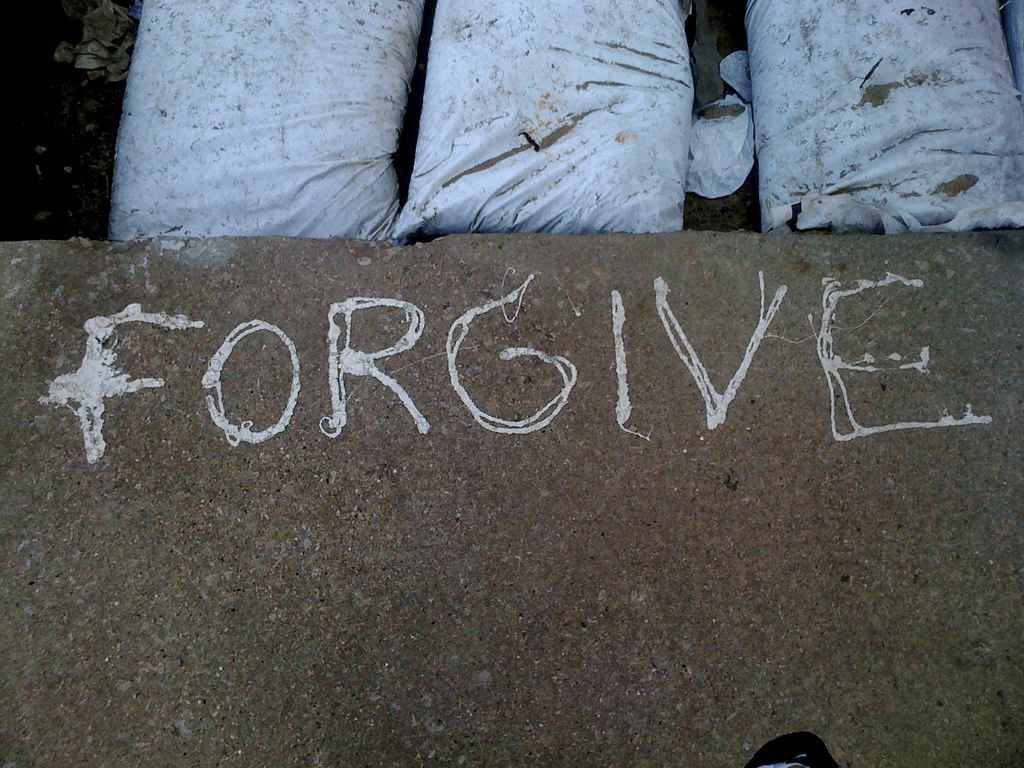
Forgiveness

For the next two blogs, we two Karen’s will focus on forgiveness. It is a part of growing older to review one’s life, and giving and receiving forgiveness inevitably surfaces.  But what is forgiveness? Here’s a psychological definition—nicely precise.

An act of deliberately giving up resentment toward an offender while fostering the undeserved qualities of beneficence and compassion toward that offender. (Freedman & Enright, 1996, p. 983).

Here’s a philosophical take, richer with the nuance implicit to forgiveness.

Forgiveness is one of the really difficult things in life. The logic of receiving hurt seems to run in the direction of never forgetting either the hurt or the hurter. When you forgive, some deeper, divine generosity takes over. When you can forgive, then you are free. When you cannot forgive, you are a prisoner of the hurt done to you. If you are really disappointed in someone and you become embittered, you become incarcerated inside that feeling. Only the grace of forgiveness can break the straight logic of hurt and embitterment. It gives you a way out, because it places the conflict on a completely different level. In a strange way, it keeps the whole conflict human. You begin to see and understand the conditions, circumstances, or weakness that made the other person act as they did.

John O’Donohue, excerpt from Eternal Echoes

Part 1: Forgiving Our Mothers; Forgiving Inter-generational Sorrow….

This blog is about forgiving our mothers — and healing.  Too many women have experienced emotionally or toxic relationships with their mothers.  We are not among them. Yet, every childhood has its scars, and many women we know trace these to their mothers rather than their fathers. 

Both of us grew up largely in the 1950s, when parenting was quite different from today. Because of the norms of the time, our mothers were more present in our lives. Fathers were out making a living. Additionally, parents had fewer resources, and children expected, at least in part, to raise themselves.  Our parents were imperfect, but in very human ways.  Both of us also raised children in the 70s and 80s, and we tried to be more attentive/better mothers, but we also made mistakes, some of which caused our children pain.  Forgiveness is what we work on, sometimes successfully and sometimes less so, in every part of our lives.  These are excerpts of our own stories.  We invite anyone who wishes to make a contribution…..

Karen Rose

The Johnson family c. 1912. Sigrid Johnson Danielson and Edward Danielson are in the middle

When I was in my late 50s, I went to a shaman – I thought of it as a kicky thing to do, and a dear friend, who is always open to alternative ways of experiencing her life, made the recommendation.  The shaman introduced himself as a psychiatrist who gave up his traditional practice to study shamanic recovery – and the experience was about as odd as I anticipated.

 I lay on a table with my eyes closed, while he was apparently dancing around me with a variety of native instruments that made subtle noises.  After several minutes of this, he stopped abruptly, and came over to speak:  “You come from a long line of unhappy women.  I can blow it out of you.”  He then put a hollow tube – was it made of bone? – near my heart and blew.  It was over.  I left, profoundly shaken but much lighter, hoping that I had not passed inter-generational sadness on to my daughters.

He was right, but I had never put the pieces together.  My two grandmothers were both, in retrospect, miserable.  Laura Rose’s father owned a sawmill on the St. Croix River in Minnesota – but drank himself and his family into poverty.  I never knew her as anything other than sour. Sigrid Johnson, from a relatively affluent immigrant farm family, was trapped in rural Minnesota with a husband and his reportedly ill-tempered father.  She and Edward Danielson (my grandfather) died in “the accident” – an apparent murder-suicide.  It was during the Depression, and their three girls were separated and dispatched to live with different distant relatives.  My mother, the oldest at 14, ended up in North Dakota—well fed and educated, but never at home.  “The accident” was taboo — neither she nor my two aunts talked about it.  According to my father, she had never discussed it with him.

Wen I was quite small I somehow understood that my job was to make my mother happy, Along with my sister, we were successful for quite a while.  She was an ideal 1950s Mommy – a good cook, active in the Democratic Party, on the board of the local Girl Scouts, happy to help with my writing, and almost always there to talk when I came home from school. When I was in high school, friends wanted to gather at my house because my mother was so welcoming.  After I left home, the weight of inherited alcoholism and untreated trauma emerged, and by the end of her life it seemed as if she was someone else – unavailable, a recluse, a non-drinker who never made peace with her addiction, and a smoker until she died, even while on oxygen.  It infuriated me to see her like that, especially when her mental illness made her largely indifferent to my children.

The shaman opened a door to forgiveness.  I slowly began to see how generations of unexamined sadness seeps through the lives of the people who are closest to us, and create pools of shared but vague disequilibrium and depression.  I am learning, albeit later in life, how to express rawer emotions in ways that bring others into my life rather than pushing them away.  Beginning to forgive my mother for what she was unable to change in her past or herself gave me a glimpse of a new kind of freedom. 

Karen Martha

In 1996, as my mother lay dying of kidney and bone cancer, in her lucid moments she agonized about the many difficulties she’d had in her life and how she had handled them. She kept saying, “I needed more time. I’m not ready. I need to fix things.”

In terms of me, her middle daughter, she felt great guilt about allowing me to be put in Taylor Home, an orphanage/home for children, when I was four. It was 1948, she was divorced and left with three girls to take care of alone. She worked days as a short order cook and nights as a bar waitress, but she could not support us. The county took her children away from her, and I’m not sure if she had choices about where we would go, but my sisters went to relatives, and I went to a home.

I suddenly found myself living in a Gothic mansion sharing a dormitory with strange and older girls, unable to see my sisters or my mother. I felt ripped from my security and at the mercy of strangers. I spent hours outdoors, sitting on a swing, twisting round and round, swinging higher and higher, waiting for someone to take me home. I was there until I started kindergarten, so about two years. My mother succeeded in getting her girls back, she remarried, and we began anew as a family.

But the story doesn’t end there, because I made it my cause to punish my mother for what she had done to me. If she tried to hug me and say she loved me, I pulled away. Sometimes I simply said, “I hate you.” She gave up, and though we lived as mother and daughter, that essential bond was never completely restored.

As my mother lay dying, she asked my forgiveness for putting me in the home. I believed I had gradually forgiven her, and I regretted that we had lost our relationship as mother and daughter. To her request for forgiveness, I remember saying, “There’s nothing to forgive. You did the best you could.” But that’s not the same as saying, “Of course, I forgive you, and I love you very much.” I never quite got to that place, and if I had the chance today, I would say that to her. I hope what I did say was enough that she died in peace.

Karen Martha and her mother, at her son’s/grandson’s high school graduation

For my mother and me, forgiveness reaches back generations. In 1924, my mother’s own mother, Ruth, “abandoned” her by dying in childbirth. My mother was four when Ruth went to the hospital to have her second baby, a brother to my mother. Ruth died in childbirth of a stroke, at age 21, and never came home. All that returned was a crying baby and a devastated father. How does a four-year-old understand this except as having been abandoned? It was a pain my mother carried her entire life. Everything about my mother can be filtered through that loss. But that’s another story.

How do you forgive someone for dying, especially when you are four? Instead, my mother carried the pain. I had the chance to forgive, and I could have made mine unequivocal. For now, I hold my mother in my heart and remember her many fine qualities. Fortunately, I have a granddaughter named after her, Margaret, whose curly brown hair, sparkling brown eyes, and effervescent personality remind me often of my mother, who did the best she could.

To be continued.