
Photo by Aga Adamek on Unsplash
We have memories throughout our lives. My youngest granddaughter, about to turn 8, talks about them often – a particularly engaging dream in the past, a game that we used to play when she was “little” (last year) but don’t anymore, something that she used to be but is not now (meat eater to vegetarian). Like me, she enjoys reading books and looking at TV shows that she liked earlier, with even a hint of nostalgia, as if enjoying a piece of childhood that is slipping away.
Sound familiar? Since childhood I have kept memory storage bins, each of which is like that huge box of family photos that you don’t want to throw away and can’t bear to sort. Many are chronological, labeled high school, college, married with children, etc. Others are topic-centered – friends, lovers, places, peak and low experiences. Significant memories are in multiple bins. I know that these “keepers” are barely sorted…
Richard Rohr describes aging as an opportunity to return to a “second simplicity” in which we can discard useless complexity, mental, and sensory overload in favor of getting down to basics: Who am I? How have I been in the world? What do I want from my relationships with others and with myself?
I confess: I am skeptical about whether a simple identity, with all the compulsions and desires of my earlier years stripped away, is within my reach. Although I am retired, life still feels busy and complicated. But I am willing to give it a try because I am drawn to the path…
But is it that simple? Do I just need to Marie Kondo my memory files, finding those that give me joy or, alternatively, those that Rohr calls “bright sadness.” And what happens to the increasing complexity that I become aware of when I unearth “old stuff” that has been buried for a while?
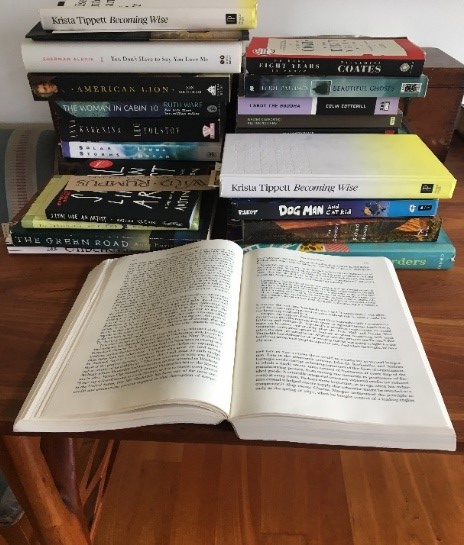
I could stop rummaging and just read more – friends talk about how reading is increasingly a simple pleasure. But I like fiction, and great novels tickle my memory. Any woman who has lived through a failing marriage will be moved by Anna Karenina, even if their own story is not an exact parallel. I need Jane Austen to relive the way in which the constraints of our own culture shaped my earlier self – and how I prevailed (or did not…). And new books – I just finished Stone Yard Devotional by Charlotte Wood – propel me to reflect on my life, which adds rather than detracts from complexity! I am not going to stop reading, even when it makes me dive into yet another storage bin…
But some files are dusty, and I have avoided them for years because they are
complicated. One could be labeled “Random Regrets.” I should just pitch them in the trash without looking…but, like the old box of unsorted family photos, the temptation is too great.

Photo by Julia Oberhauser on Unsplash
At the top are moments of deep embarrassment, usually where ignorance or bad behavior stripped away a carefully constructed façade. I still cringe at the time when I forcefully claimed that Austria was no longer a country…to a friend’s parent who was in active service in Europe in WWII. I could put that one in the “No Longer Need” bin.
Less embarrassing but more poignant are regrets about people who were once in my life but are no longer. This hit me again as I was fumbling around in another file labeled “Living in London, 1967” and unearthed Jonathan, who has not come to mind for at least 40 years. He was a typical, slightly damaged product of bad food, cold showers, and bullying in what the English call a “public school”. Handsome enough, well-read in the Oxford kind of way, he could out-vocabulary me on almost any topic. And I allowed him to kiss me when we went out and said yes when he called.
But I didn’t really want more – I was willing to go out with him only until I solidified my relationship with a tall, rangy, and bright-eyed Cambridge graduate with floppy hair. He had recently returned from sailing across the Atlantic in a small boat and had an explorer’s spirit, only somewhat tamed.
Jonathan was a spare.
As I write that, I know it is true, but the discomfort is what Rohr calls a “bright sadness.” I can see recurrent patterns of casually using people that escaped me at the time, perhaps because they were so frequent. The memory of Jonathan (who was in my life for a short time) induces thick discomfort about how the thoughtlessness of the young adult me, whose need to be right, popular, and a bit of a smart ass, overcame my desire to be kind.
When I rummage around in the regrets file, I know that I cannot afford to toss everything if I hope to be on the path of second simplicity. As I refile Jonathan into a new “Bright Sadness” bin, I am reminded of my increasing humility. I still make mistakes, but I want to avoid old patterns that are inconsistent with the simpler me who gets up each morning asking how I can make that day’s actions more consistent with a loving universe. Yet I also know that Marie Kondo-izing my memory bins is needed to reconcile with my less compassionate side, which I can now call “the Jonathan problem.”

Photo by Jonathan Francisca on Unsplash
The path to a second simplicity does not feel simple, nor do I think that Richard Rohr expects that. To walk that path I need to confront, with humility (and often uncomfortable humor), who I have been. No polished version; just me, warts and all. That is closer to the curious wonder that I remember from my elementary school years than to the gravitas that I later labored to assume.
Returning to a simpler but wiser self – a complicated job that requires regular housecleaning?

 Karens' Descant