Use It or Lose It?

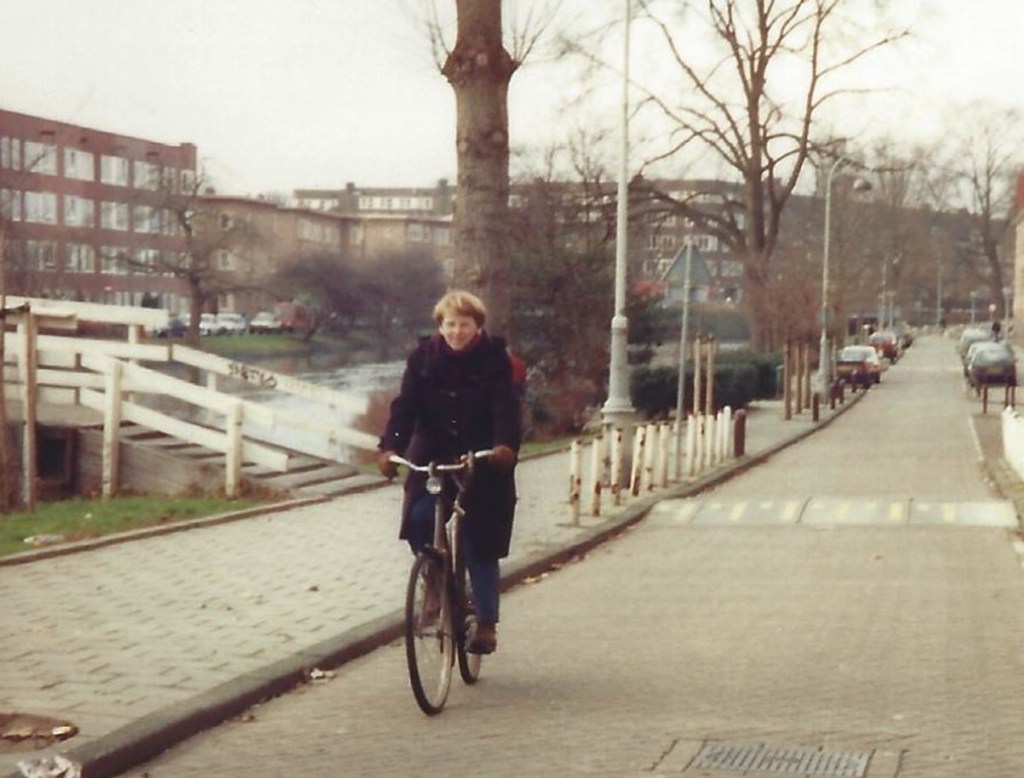
Amsterdam 1991

If you’ve followed this blog, you know that bike riding is my happy place. I’ve even posted a collage of some of my bicycles through the years. So, when I moved this summer, I, of course, took my latest bike—a step-through to accommodate my stiffening hip, no more throwing that leg over the seat, or standing on a curb to get on the bike. This new bike was a year old, gave a nice ride, but lacked the cachet of my Bianchi. I locked the it in the parking garage in my new apartment. As I wrapped the kryptonite lock around the bike, I promised it, “Don’t worry, we’ll go out for a spin as soon as I get settled.”

Two weeks later, mid-summer, I went to my parking spot and no bike. Someone had cut the lock and taken it! They also cut off the handlebar bag and threw it on the floor. DARN! That’s not exactly what I said. . . I felt violated. I examined the bikes locked by other parking stalls. Some had three locks, while others had wimpy locks. I had a kryptonite one! It wasn’t fair.

July came and went. I took a wonderful vacation and went to a retreat. In August I started the real work of moving into a new apartment, unpacking boxes and finding places for ten years of stuff.

Meanwhile, the cut cable from my bike lock hung in the garage. Every time I went to drive my car, there it was, a reminder that I had no bike, that I hadn’t been on a bike all summer, and someone had stolen from me. At the same time, I struggled with heavy boxes filled with books, slid furniture into place, and often waited for help. I just wasn’t as strong as I’d been ten years ago, when Jim and I had moved into our house.

That worried me. Would I be as strong on my bike as I’ve been in the past? “Use it or lose it,” came to mind – a saying that any older person can, perhaps reluctantly, recognize as true. I asked myself, “Karen, remember when you dropped cross-legged to the floor to sit? Or lifted that leg over the seat of the bicycle? Remember when you were more powerful than a locomotive and could leap tall buildings in a single bound?” 

“Karen, if you don’t get on a bicycle SOON, you’ll lose that, too—balance, proprioception, agility, quickness.” I set a goal of getting back in that saddle VERY SOON.

But I needed a bicycle.

Then my son-in-law showed up with one, a step through, designed to cruise the neighborhood. He’d bought it to lure my daughter into biking with him— but she detests bicycling, and this bike hung in their garage with the other four that he’s given her through the years. It’s a Townie, made by Electra, with nothing electric about it. Big and bulky, with an ample seat, and high handlebars. This bike was clearly for an older person. A grandma bike. Was he trying to tell me something?
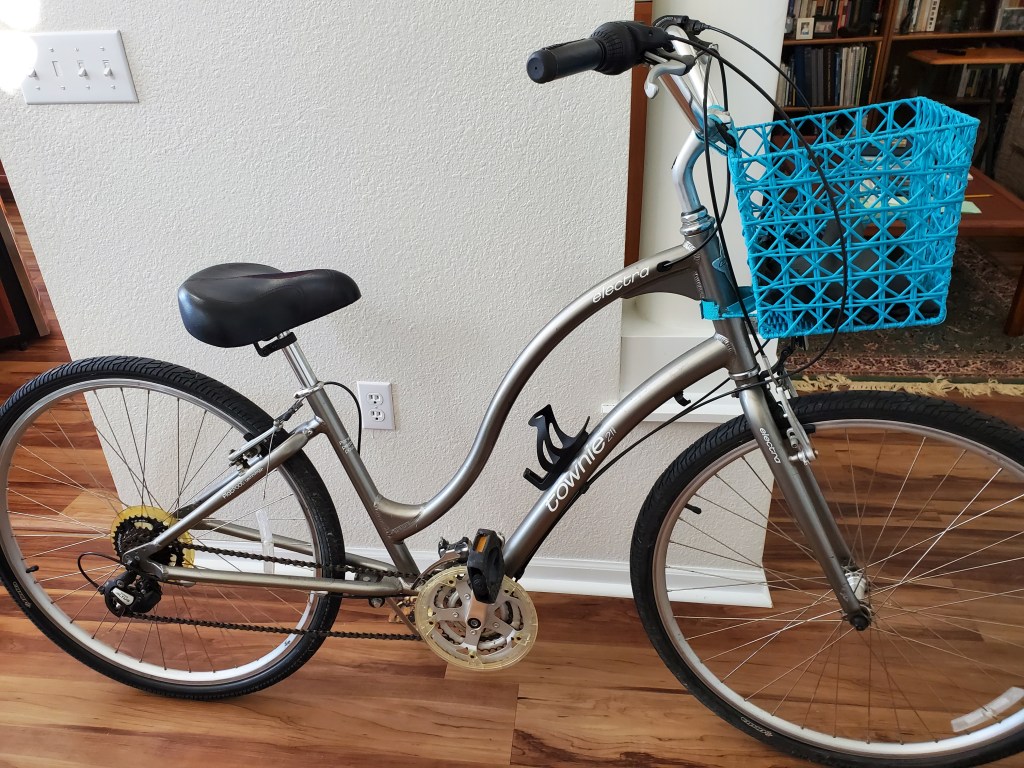
I moved it into my apartment. I wasn’t taking any chances of having it stolen again. There it sits, an old lady bike taunting me. “Slow down, Karen, you can’t get on or off easily. You could fall.”

I wonder just how wise that goal of getting back to riding is. “Practice makes perfect,” I told myself last year when I had a hard time stopping and putting that leg down without pain in my knee and a sense that I might pitch forward. One friend said, “Karen, it’s not if you fall, it’s when you fall.”  Sobering words. But then I heard Karen Rose’s voice: “In the Netherlands, people ride until they die.” So why not me?  And this bike looks a lot like the one I rode in Amsterdam in 1983 (except for the basket…which has negative pizazz). 

Complicating everything is the advice about transitions. “When you leave something behind, that makes space for something new to come in.” Like what? A scooter? Nah, too fast. Tricycle? Heaven forbid, a wheelchair?  And I wonder “Is this true at age 80?” There are lots of losses, family homes, meaningful work, work friends, lifelong friends, spouses, grandchildren who grow up and fly the nest, stuff you treasured but no longer have room for, lifestyles. . . not to mention sitting cross-legged. Or riding a bicycle.

Lots of us are waiting for something new to come in — and getting older in the meantime. And there’s an increasing bond with others who are navigating the territory of aging. At a recent outdoor concert, I sat in a row of six women my age who’d either lost their spouse or were living with one who was ailing. Our conversations reflected our age: “Don’t put your chair there, it’ll tip and you don’t want to fall;” “I brought some grapes so we don’t have to eat that salty fatty food they’re selling;” “I have to leave by nine, I don’t like to drive when it gets dark.” That’s bonding—we’re in the same tippy boat, waiting for something new to flow in on the next tide.

Where does that leave me? I haven’t given up the dream—another happy place has to be out there. I could always buy a new bicycle, maybe an electric one or definitely one with some zip.  Or maybe I could learn to accept a free granny bicycle.  For the time being, though, I’ve found another happy place, my new deck and coffee with a piece of almond bread from the Black Walnut Bakery. For now, happy is right here.

A Way Back

Marylyn, Laurel, and Karen (me)

My younger sister, Laurie, or Laurel as she preferred to be called, died in January, seven months ago, age 76. I think about her almost every day. I think mostly about loss, because our loss started when we were about high school age when we started to grow apart. As a close friend put it to me, “You two were like oil and vinegar.” I have a mix of memories from our childhood; many are happy. My mind has a way of shelving the not so happy memories in the back so I can pull out the happy ones in the front.

          Over the last 30 years, I barely saw Laurel. But I never labeled us as “estranged” until her death, when I started reflecting on our non-relationship. The dictionary defines estrangement as having lost former closeness and affection: in a state of alienation from a previous close or familial relationship. That about sums it up, although it doesn’t capture the mix of sadness and shame I felt after Laurie’s death, when I realized it was too late to heal our rift.

          Joshua Coleman, in the Atlantic, noted that families used to center around mutual obligation and interdependence to assure everyone’s survival, and those values shaped our identities. But we no longer rely on each other for survival, so forming an identity has taken a more individualistic turn. Whereas identity used to be grounded in religion, class, and community, “personal growth and happiness” are now more important for figuring out who we are. We have the autonomy to carve out identities separate from our families.

My two sisters and I, the Evans sisters, growing up in the late 40’s and early 50’s, started out relying on each other. We needed to have each other’s back. Our father was an alcoholic given to angry bursts, and after our mother divorced him, she married another alcoholic with a similar meanness. He became the stepfather who raised us. We had to look after each other.

          That all changed in high school, about the time when adolescents seek their own identity. Marylyn, our oldest sister, four years older than I and 6 years older than Laurie went off to college at the U of Wisconsin in Madison—she escaped the family dysfunction. Laurie and I were left in high school, but we ran with different crowds. Meanwhile, our mother and stepfather struggled with financial and marital problems, so we fended for ourselves. Laurie hung with outsiders, characterized as “wild.” I took the school-centered path. That’s when our estrangement started.

          Finding one’s way out of an alcoholic family is fraught with problems, as evidenced by the fact that AA has spun off AlAnon with12 step groups focused on supporting family members. From the first, Laurie was the target of our stepfather’s erratic discipline. The research on estrangement says that one sibling often believes they were treated worse than others. Those who are targeted often become “grievance collectors,” and as I look back, I see how our stepfather’s unrelenting criticism of Laurie made it hard for her to find her own path in life. Marylyn became a librarian, and I became an educator. Laurie was an experimenter and a searcher.

          A searcher! Something I never saw when Laurie and I were busy being oil and water. Again, turning to studies about estrangement, one of the things that fosters it is mobility. We move around in this society. Since we don’t rely on one another, we’re free to move on. It’s like a Catch 22—moving around gets us out of dysfunction but it also robs us of opportunities to confront and grow from our differences. Marylyn moved to Florida, and Laurie moved to Detroit and then to Texas. I stayed in the Twin Cities and raised my children. Had I been able to connect with Laurie, I might have learned that Laurie and I weren’t so different after all—I consider myself a searcher in many aspects of life. My searching was and is less experimental than Laurie’s but it’s there.

          Eventually Laurie found a passion, rescuing homeless animals. She raised two fine children on her own until she met and married a guy from Detroit who made them his family. I couldn’t ask for more for Laurie given her difficult start. Unfortunately, I saw all this from a distance, busy with my own life.

Laurel with her beloved pets

I always told myself—and believed it—that Laurie and I would someday sit down, hash it all out, the little slights and differences that we both nursed. We’d laugh about it and go forward. But the truth is we didn’t. I’m writing this because in reading about estrangement, I know how prevalent it is. Some 25% of families have some level of estrangement—that’s not trivial. I’m also writing this to urge anyone who feels even the slightest estrangement with a family member or friend—Find a way back!

          This spring, after Laurel’s death, a dear friend died, a friend with whom I’d had a period of estrangement for which I could find no cause. He stopped talking to me, no matter how many times tried to open a dialogue. When the pandemic hit, I missed him more than ever. I folded 1000 origami cranes, stringing them together (which is the difficult part), put them in a box, and deposited them in his driveway. The crane is a powerful peace symbol, one that my friend had introduced me to. Upon finding my gift, he called me, and we healed our friendship.

          With Laurie, I could find no way back, but I didn’t look hard either. I didn’t travel to Texas for a sustained visit. Instead, I mailed cards for her birthday and Christmas and other important occasions. I didn’t sit down nightly folding six cranes for nearly a year. I waited for something to happen so we’d get together. And it did, only it was a death and funeral. Realistically, it would have taken both of us to heal the estrangement, but one person needed to open the door. Now that Laurel—she’ll always be Laurie to me—is gone, I’ve lost that possibility. But the memories I have of growing up together remind me that love can persist, even when we feel separated. Reconnection lives in that love.

Losing Thor and Finding Belonging

A picture containing grass, cat, mammal, outdoor

Description automatically generated

The adventure began when I realized at dinner that I’d not seen Thor all day. It was 7pm. I knew he’d come home when he got hungry. After dinner I went outside to water the flowers, expecting him to rub against my leg, as he does when I show up in the garden, his secret domain. No Thor. I checked the closets—he’s notorious for walking out from some place we don’t know exists in our house. Again, not a sign of him.

When I acquired Thor from the Humane Society as a kitten, I’d promised myself that I’d take exceptional care of him. He was the first cat I’d chosen myself, not given to me by someone needing to get rid of a cat. Because of that promise, I had to find Thor before bed. I started walking the neighborhood calling him. My neighbor to the south offered to help, but I worried that he wouldn’t come to her. He was by nature skittish of other humans. 

By bedtime, no Thor. I reluctantly searched the thicket of trees behind our yard, “Thorrrrrr. . . Thorrrrr.” But no Thor embraced my legs, only mosquitos and unidentified bugs.

I was worried. I made one more perusal of the neighborhood, calling softly, so as not to awaken anyone. I went to bed, hoping that he’d be at the door by 1am, and I’d let him in, give him a treat and sleep well. 1am, 2am, 3am—no Thor and no sleep. I was up by six, roaming the neighborhood, calling his name. I knew it was bad. He ALWAYS comes when called, and he doesn’t stay out all night, a patterned behavior I’d reinforced.

Thus began my search. A part of me believed searching was futile. Our neighborhood is defined by a lake. I walked around that lake that first morning at 6am. And I continued to search nearby blocks all day.

I read websites about how to find a missing cat, listed him on the missing pets website, and created a poster, as the sites advised. I printed over 100 posters, bought a stapler at Ace Hardware, and plastered the neighborhood with them.

Then it started, my neighbors, most of whom I don’t know except by sight, sent texts telling me they were sorry and would keep an eye out. A young man who heard me call Thor, said he’d alert his grandparents, retired neighbors whom I’d never met. The next night I met them, and they told me they’d scoured the shoreline for Thor.

The third evening, a woman phoned and said she saw a grey cat at a neighbor’s house. She offered to wait until I could get there. I jumped in the car and raced to the location, a block from Minnehaha Creek Parkway and five blocks from my house. Could he have gone so far, lost, and heading in the wrong direction? 

When I met the woman and her husband, they walked the neighborhood with me, calling Thor’s name. This part of the Diamond Lake neighborhood is filled with traditional, pricey homes with landscaped gardens. I traipsed the alleys, and I saw people enjoying the summer evening with friends. A few acknowledged me and said they’d keep an eye out. No Thor, however.

I was now too tired not to sleep, and I was also racking up mega points on my Fitbit, walking the neighborhoods. South of our house is 60th St., the demarcation between Richfield, a first ring suburb, and Minneapolis. The street also marks a change in the neighborhood, with the Richfield neighborhood peopled with Hispanics and tiny starter houses. I got the same helpful reception in that neighborhood, “Oh, your cat is lost? I’ll keep an eye out. Put some food out and something he likes to cuddle.”

Sunday morning: Day four. Thor was probably gone for good, since I knew he’d come when I called if he heard me. I’d allowed him to be outside, and he had always stayed close to the house, but something had probably scared him, and he’d gotten confused. I sadly took responsibility.

I decided to do laundry, knowing there was nothing else to do. By the laundry room, I heard meowing, and thought it was our other cat, Stella, who’d been following me everywhere since Thor had gone missing. This meow sounded different, soft, more like Thor’s. I walked into my husband’s office, pried open a sticky pocket door to a closet we never use, and guess who ran out? Thor! I screamed, breathless with happiness. I couldn’t believe it. I’d checked that closet the day he went missing, and I’d been downstairs many times. Why hadn’t he made a peep, or come out the first time I checked? Thor went right upstairs to his bowl and commenced eating. Only a cat can be locked in a closet four days and not come out a hopeless neurotic. 

The ending is happy. A few days later as I walked around the neighborhood taking down posters, a little boy I’ve never met asked me, “Has Thor come home yet?”  I told him yes, and I walked on realizing what a remarkable experience of belonging to a neighborhood I’d had. Other neighbors sent texts asking if Thor was back yet. People cared. People offered to help. People walked with me when I was searching. People commiserated when they saw me calling “Thorrrrr.”

Karen has written eloquently about belonging, but losing Thor made me find belonging. I normally feel like an outsider—it’s my personality; I’m more of an observer than a participant. But in this neighborhood, for four days, I was an insider. I felt connected to others by the common experience of loving and losing a pet.

I learned that belonging is two sided and requires effort to engage as much as having others invite you in. I’d been on a quest. I‘d walked the modest neighborhood south of me and the pricey neighborhood to the north, and in both places, people cared. It wasn’t about our differences but about our attachments to what we love. I reached out, engaged and people engaged back. Losing Thor, however briefly, taught me that if I reach out, there’s a world out there that will respond, and I can belong. 

Text, letter

Description automatically generated
No Need for These Anymore