Phase 1 of the holiday season – Thanksgiving. I always say it’s my favorite because there are no presents involved. I’m not sure that’s true, but it suggests I have an altruistic side.
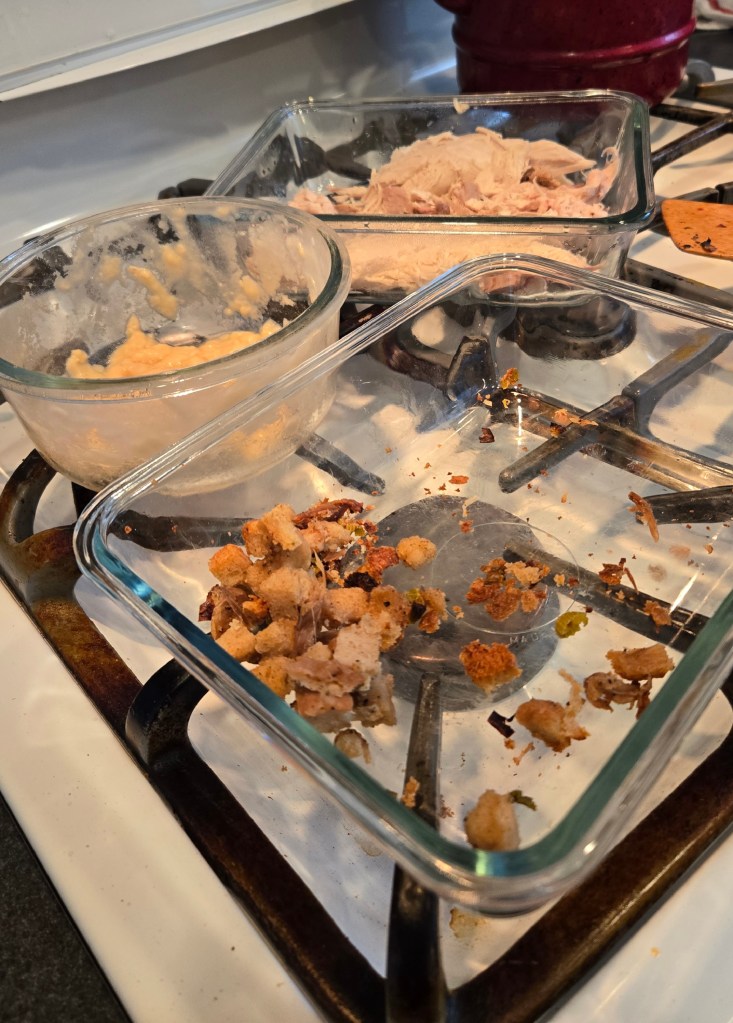
Now, with the holiday over and another approaching, I’m thinking about leftovers. Don’t you love them? The best part of Thanksgiving!
Leftover 1: Gratitude. Last year neither of my two children and their spouses wanted to host Thanksgiving. They seemed to have caught the rest of the country’s malaise about it, too much work, with football and maybe turkey as the only reasons to get together. But, remember, I’m the person who says it’s my favorite of the holidays, so it seemed appropriate that I step up and host.
I was new in my apartment after selling Jim’s and my house, which had been the center of many family events. Could I possibly host Thanksgiving? In an apartment? I remembered a favorite movie, Hannah and Her Sisters, where Mia Farrow hosts her big family in a New York City apartment. If Hannah could do it, surely I could. So, I hosted Thanksgiving with good help from my family. And it worked. We gave Hannah some competition.
As that 2024 Thanksgiving grew to a close, we were scheduled to move to another family’s house for dessert, a tradition we started several years ago. But I was exhausted. I’d burned my wrist draining the potatoes, and it hurt. The kitchen was presentable, and all I wanted to do was sit and watch mindless TV—yes, something even more mindless than football. So I didn’t go. AND I announced that I was passing the baton—someone else had better step up and do Thanksgiving next year.
“I am too old for all this work, and I’ve done my share!”
So, when Thanksgiving came around this year, my daughter stepped up, yet somehow, on the morning of Thanksgiving, I found myself responsible for an apple pie and the mashed potatoes. Everything that could go wrong did, and I barely finished in time to get to my daughter’s house.
During the entire time in my kitchen, I whined to myself, “I passed that baton. This is ridiculous. These potatoes are pathetic, mushed, not mashed potatoes, and the pie. Why did I agree to sit and peel apples and potatoes? And what’s wrong with my kids that they wanted mashed potatoes from Costco? Have I raised lazy children? . . . ya da ya da ya da.”
And then it hit me – sometimes the Universe does need to smack you pretty hard. I realized that husband #1; husband #2; husband #3; some old boyfriends and my sister (all deceased) would have given anything to be in my shoes: 81 and still mashing potatoes and partying with family
Who cares about potatoes or pie—I was getting to enjoy Thanksgiving with everyone I love. I was getting to make pie and potatoes for them. Getting to do this (see https://designingyour.life/), became my new mantra. My resentful, “I HAVE TO” went “puff” and left the room, leaving gratitude in its place.

Leftover 2: Intergenerational Conversation. Last year as dinner ended, we started a discussion about AI. Everyone at the table had a stake in AI. I was teaching an undergraduate writing course and struggling to convince students that you can’t learn to write if ChatGPT writes your paper.
The discussion was fast and fun; no one left the table to watch more football, which means something. We are a family of frogs, we jump into the pond quickly. Our one turtle, Luisa, is often left standing on the bank; she jumps in later, usually with great wisdom.
This year, we’d finished eating and were lingering in the kitchen, snitching bites of dressing and turkey. Elizabeth, my daughter-in-law, asked her 24-year-old son, Henrik, if he wants to have children. I don’t remember how we landed there, maybe because two of our young people are about to graduate from college. Henrik never did answer, but the question kicked off another great discussion about the uncertainty of the future, mainly the planet, and how grim it looks to Gen Z.
The future, by definition, is uncertain, but what my Gen Z grandchildren are feeling is more complicated than uncertainty. The word, “existential” kept floating up. Generation Z young people ask different questions about meaning, purpose and identity than the Silent Generation or even the Boomers did. As we talked, they hesitated to share their dreams for their futures, wary of the future of the planet and climate change.
I can’t recapture the opinions, but I concluded that young people are facing problems unique to our time with climate change at the heart of them, especially as the world responds. They are terrified, although they didn’t use that word. (Remember this is an “n” of 3, so ask your own Gen Zers). And yes, we hid under our desks because of nuclear bomb threats, but this is different.
Reflecting later, I realized we had had a family conversation that crossed generations. Gratitude welled even greater in me, couched in concern for my grandchildren. I was, nevertheless, grateful for the sharing across generations.
Leftover 3: Hope. We eventually moved to more mundane topics, but I worried that what I was hearing might be despair. I didn’t want them to throw in the towel for a life of hedonism. So, I later questioned the Gen Z grandchildren separately.
I started with Henrik, “You aren’t giving up on dreams for your life, are you? Embracing a life of hedonism—do you even know what that is?” (Who knows what they teach in college anymore.)
“Don’t worry, and yes, I know what hedonism is. For now, I don’t know what I’m doing after graduation, but you know me, I’m just curious about it all.”
Whew!
Later, in my car with Luisa, who you will remember is our family turtle, never jumping in too soon, I asked her about her aspirations. She gave me even more hope, summing her thoughts up as “I don’t want to miss my life waiting around for the end of the earth, so I’m living it.”
Upon hearing those words, my gratitude for the day swelled into hope. Yes, the situation in the US and worldwide, especially climate, looks dire, hopeless, gloomy, depressing. . . you get it. But along comes Thanksgiving, and the leftovers. We engage in meaningful conversations and emerge with hope, nurtured by connection and making meaning together.

Another LEFTOVER:
From Wendell Berry, Think Little
. . . the world is blessed beyond my understanding, more abundantly than I will ever know. What lives are still ahead of me here to be discovered and exulted in, tomorrow, or in twenty years?


 Karens' Descant