‘Tis the Season: Graduation

Last Saturday my granddaughter, Luisa, graduated from high school. She’s the youngest of my grandchildren, which reminded me of the passage of time, starting out as babies and now one out of college, two in college, and Luisa soon off to college. Thinking about graduation makes me realize what a shared rite of passage it is. Karen and I have skirted around the notion of rituals, probably because there are no well-defined rituals as we age—some people have retirement parties, but it’s not a given, and certainly a funeral is a ritual for the living, not the departed. Reflecting on the joyful event later, I noted the. . .

Changes in Our City and Schools      

Luisa is the only one who attended school in Minneapolis, so it was my first big urban school event. As we took our seats in the large auditorium, the first thing I noticed was the diversity. In fact, the school is 60.4% white, 21.3% African American, 9.7% Hispanic, 3.9% are of two or more races, 3.7% Asian, with 0.8% American Indian, and 0.2% Pacific Islander. The Somali families immediately stood out because of their colorful dress and larger families — grandparents, siblings including children and babies, and moms and dads. Minnesota has the largest Somali population in the US, with most of them living in Minneapolis. The women wore the traditional head scarf and the baati, a long overdress, and many men wore the macaawiis, a sarong, and the benadiri kufia, a cap. But that doesn’t do justice to the gold jewelry, glittering fabrics, sculpted make-up, and spectrum of colors. The women seemed to glisten with their beauty, and the men stood tall.

The Graduation

Once we were settled, the graduates marched in with the band playing Pomp and Circumstance. I teared up as I watched the students walking down the aisle and parents standing on seats to get a picture—aren’t smart phones wonderful! The trappings were all there — the school band’s terrific rendition of the National Anthem, the choir singing Stephen Paulus’s The Road Home, and the articulate student speaker, who was a young Somali woman.

Before awarding the 441 diplomas, the principal practically begged us not to make a lot of noise or to be in the aisles as each graduate’s name was announced. The silence lasted very briefly.  Somali names like Abdi and Ali clustered at the beginning, and the families were so excited to see their students walk across that stage that they went wild, jumping and cheering and blowing vuvuzelas—so much for quiet. I suspect that in some families these may have been the first high school graduates.  

I loved the excitement, though not everyone loved the ruckus, possibly because we live in a newly multicultural city, originally dominated by less effusive Scandinavians. I believe in honoring the different ways in which we celebrate. I also noticed that the cheering settled quickly and we could still hear the names. By the time Luisa crossed the stage, her brothers decided that it was okay to make some noise. Sitting on either side of me, they jumped and shouted. Ironically, on my video, you can only hear her first name being called; their celebratory noise blotted out the rest.

Intergenerational

After the graduation, the auditorium lobby was filled with families and graduates, everyone taking pictures. It felt like family because many of the graduates knew my son because he’d been their principal in middle school. It was joyful to see former students reconnect with him.  I was not left out: a former student of mine recognized me and gave me a big hug, telling me that his daughter had just graduated. The father and I also overlapped at the U of MN, when I was in graduate school, and he was an undergraduate.  When we met, walking across campus, he would say “You’re my inspiration!” What a circle; what an intergenerational experience!

Which brings me back to the roles that we play as young and old. Yesterday, struggling out of a store with a heavy box of kitty litter, my other granddaughter, Maggie, grabbed it, insisting that. “I can do things to help you, and you listen to me and give me advice and help me.” There it was, from the mouth of the next generation, how the generations support each other when we are not celebrating rituals. Sometimes I am sad about growing older, but her words reminded me that I would experience none of this without growing older. My older self is also a bundle of memories going back to post WWII, the 50’s, 60’s, etc. I have a perspective to share that can enrich everyone my life touches.

Through the entire graduation, I was awed by the stretch of generations, from grandparents in wheelchairs to babies crying during the ceremony—how we are all one, especially in the rituals that celebrate life passages. Luisa, too, reminded me of how generations stretch across the planet, because she was born in Guatemala. As her grandmother and a former teacher at the graduation, I represented all the grandmothers, parents, and educators throughout the world who love and support the next generation. We are all connected; we are all family.

Milestones: Just for the Young?

June is the month of milestones, weddings and graduations in particular. I had the joy of seeing a granddaughter graduate from high school, and a grandson finish college and start his first job. Equally exciting, a good friend in her late 40’s, who’d forever longed to be married, tied the knot!  Adding to the joy, I partied with family and friends, old and new. At the time, though, there was a tiny tinge to the events—if only for me. Maybe it was a negativity in me after having COVID in April, in spite of two years of taking every precaution, or maybe it was the general mood of the country with shootings and Roe v. Wade at stake. I had the sense of being a spectator to others’ joys, and I wondered, what are the milestones left in my life?

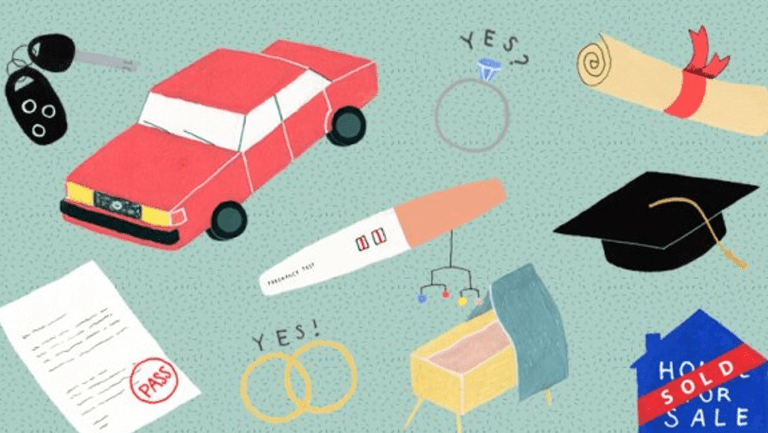
At the time, and with the support of the dictionary, I assigned a milestone as a tangible event that marks “a significant point in development.” A study at Stanford University buttressed my understanding with its list of common milestones in life up to age 74, including a getting a full-time job, starting to save for retirement, getting married, buying a home, and starting a family. It was clearly a truncated list, and worst of all, it ended at age 74, making me again question what milestones are left for my life, given that I’m 78.

My ironic inner self took over and I found myself saying things like—going into assisted living? Or memory care? In the meantime, I traded my beloved, powder blue, Bianchi bicycle for a “step-through” bike, since it hurts my hip to swing my leg over the seat. Was that a milestone—learning to make do so I can keep doing the things I love? That led to a list of “learning to live with things” like medications, cortisone shots for arthritis, support socks, bodies that are starting to give out. I was still in my bleak mood, I guess.

Then one evening I went to a bar where my son’s band, the Strolling Clones was playing—they only play Rolling Stones music, hence the name. Friends and family were there, and when we could hear each other, we somehow managed to ask Henrik, my 20 year old grandson what it was like to graduate the year COVID began and not have a graduation or open house and then to not go to college. He had missed one of those big milestones.

He told us, “At the time, it was horrible. But now I realize I didn’t miss anything. I did something different.” Henrik chose to go to a folk school inside the Arctic Circle in Norway, where he majored in Norwegian language and history and survival. Survival was the challenge, long camping trips into the mountains involving both canoeing and skiing with heavy backpacks to campsites.  Then there were the solo camping trips, dropped somewhere in the middle of nowhere and having to survive. When his year was finished, he decided to enroll in college in California, telling us he’d had enough of being cold and wet and eating boiled fish.

We all remarked that since being back, he’s a different person. Before COVID and Norway, he played video games ad infinitum, and now he seems willing and enthused even if you ask him to cut the lawn or help you move something. He’s more curious and just out there in the world. So “what happened?” we asked him. He replied, “Sitting alone at a campsite in winter, climbing mountains, swimming in icy water—it was all scary stuff, and I did it. I learned that if I just keep going I can get to that light at the end of the tunnel. And being alive is everything!”

That, and a little coaching from my Boulder, Colorado coach, led me to realize that milestones always come with challenges. Off to college away from home for the first time can be tough; that first job is not easy; and marriage—well, many of us all been there, and if you stick with it, it’s a lifelong challenge. The insights we get from these experiences are what really count.

Adapting, getting on with it, as Karen Rose wrote about in Yes! is what comes after that milestone party. Henrik didn’t get a graduation, but he crossed a social/emotional milestone, he experienced an understanding about life that changed him and moved him forward in his development, learning that he can get through the hard stuff.

Now I had a new insight of my own—a milestone, if you will. I realized that many of the milestones we celebrate and take for granted, like graduations and marriage, are socially defined, built into our culture, but, other than retirement, we don’t have such obvious ones as we age. But maybe they aren’t needed, either. We get something bigger from the accretion of milestones throughout our lives, knowledge of ourselves and living, for example. The lack of social markers doesn’t mean there are no milestones as we age. I’ll bet all of us can identify experiences that moved us forward in our development.

I love two of Pema Chodron’s four truths—how really sweet and precious our lives are and impermanence. . . the essence of life is fleeting. Studies show that older people are happier than younger—both people in their 20’s and 30’s and the middle-aged. Maybe it’s because of the social/emotional learning that enables older people to accept what is—which is also a cornerstone of emotional well-being—and to see what is as both precious and impermanent. I like to think I have milestones ahead of me, though I know they won’t be college or starting a new job or having a family. I like to think they will be deeper, inside me, as I get better at this precious thing called life.