What’s It All About: Just in Time for 2025

I walk down the hall of my new apartment building. Every doorway looks the same, gray, an apartment number, and a light to the side. Gray stretches indefinitely, soulless. I wonder if someday I’ll get lost in the sameness. I am a small, insignificant, older woman, putting one foot in front of the other in my daily trek to get my mail and newspaper, small things tethering me to the outside world.

          Here it is 2025, and I’m still asking myself what it’s all about. When I was seven or eight, I’d scare myself by worrying that I was an actor in someone else’s dream. I didn’t exist. How could I be sure I existed, that I was real? And if I was real, why did I exist? I had no answer other than to immediately divert my mind and think about the next day when I’d call a friend to play with me.

Then college. I registered for a humanities course, with no idea of what humanities was except a requirement to graduate. In a crowded room in Ford Hall, I learned I wasn’t alone in doubting my existence. A French guy named Descartes asked himself the same question about his dreams and concluded “I think, therefore I am.” Had it been that simple all along, and I was just too young to see it?

Once I established my existence—after all a famous philosopher had confirmed it—I started to focus on why I existed—what was human existence all about?

Next was the 1966 movie, Alfie. I was 23 and about to marry. If you saw the movie, you know that Alfie, played by Michael Caine, is a handsome womanizer, oblivious to the pain he causes the women he “loves” and leaves. One lover has a son, and Alfie becomes a father. Alfie begins to attach emotionally, but then the mother takes the boy away. Alfie denies his loss by finding another woman, who’s married, and he gets her pregnant. She has an illegal abortion with Alfie present. There’s an incredible scene when he views the aborted fetus, and for the first time, Alfie faces his life.

The movie and the finality of the abortion has stuck in my head since 1966. It wasn’t the procedure itself that impressed upon my mind; I understood the woman’s reasons, Rather, it was the contrast between the hedonism that looked so attractive when Alfie lived it, and the woman’s dilemma, a life growing in her, but having that baby meant the possible loss of a husband and family, which, for all its problems was a life of meaning. The theme song still lives in my head, “What’s it all about, Alfie? Is it just for the moment we live? . . .” And here I am, 81 years old. I haven’t lived a life of hedonism, that’s probably why I made it to 81. But still I wonder what it is all about, especially as I look back, and realize my moment went by so quickly.

I’m guessing we all wonder what life is about. Having a purpose is touted as one route to an answer—of sorts. I recently heard about a program to inspire disengaged youth by helping them find a purpose. At the other end of the age continuum, we retirees are told that we’ll live longer and be happier if we find a purpose. Maybe we can all hide in our purpose and avoid the deeper question.

Then there’s the path of hedonism. I vividly remember my 50th high school reunion when we went around the room telling each other what we were doing with our lives fifty years after graduation. I was shocked by how many people bragged about their good lives of boating, dining, cocktails, and relaxing in Florida in the winter and Door County during summer (I grew up in Wisconsin). When it was my turn, there I stood, thinking life was about more than that. I stuttered that I was still working (my way of escaping the larger question).

Turning eighty pushed me to answer what it’s all about. It’s scary to me—I want to feel okay with my life because I don’t know what’s coming. I will always hear my mother, dying at 74, saying, “I’m not ready. There are things I need to do.”

A few Christmases ago my children gave me an Aura frame. It’s a tablet that flashes pictures at 15-second intervals. You load the pictures from your phone and other devices onto the tablet. At the time I was disappointed. “What am I going to do with this?” I thought.

Nevertheless, I placed the frame in a central spot, plugged it in, and synched with the Internet. There was my family. They had already loaded their favorite pictures of a growing, changing family of the past 25 years and even pictures from my and their childhoods. Gradually, I added some of my own and Jim’s family added pictures, too. I came to love my Aura. Jim and I would eat dinner at the dining room table and watch the screen, telling stories about the memories triggered by the pictures

Some days life reads like a fine novel. It’s all there: a great plot—my life; characters—family and friends I’ve loved; a climax—the 50’s and 60’s when family and work came to fruition; and now the denouement—old age and me asking once again, What is it all about, after all? It feels pressing, the need to know.

I walk into my apartment from my soulless hall, and there’s the Aura streaming my story line. I pause and watch: Jim, my sisters as children, our dog Eddie, Lake Michigan, my bicycles, our grandchildren, friend and fellow blogger, Karen, vacations, a big snapping turtle, a pileated woodpecker—you get the picture, family, friends, pets, this amazing planet, eighty remarkable years and memories, most everything I’ve loved and love. Aha, this is what it’s all about, I think.

The answer has been there all along, and I can give it to you in one word— love. It’s about love.

. . . for one human being to love another… is perhaps the most difficult of all our tasks, the ultimate, the last test and proof, the work for which all other work is but preparation. Rilke

Use It or Lose It?

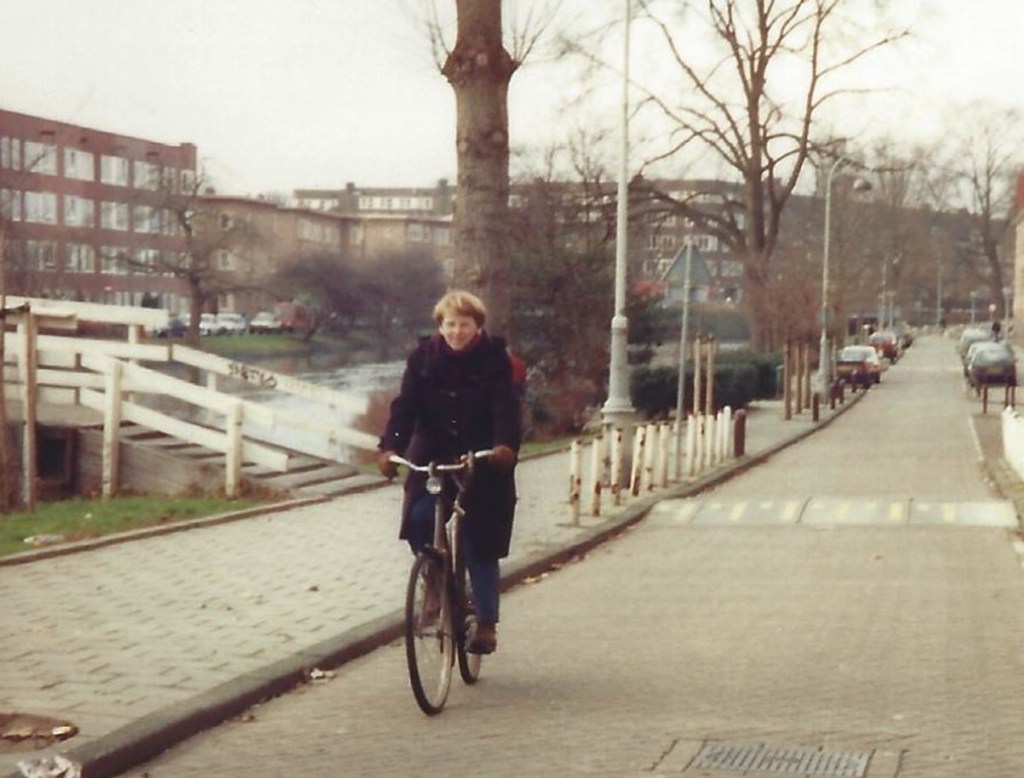
Amsterdam 1991

If you’ve followed this blog, you know that bike riding is my happy place. I’ve even posted a collage of some of my bicycles through the years. So, when I moved this summer, I, of course, took my latest bike—a step-through to accommodate my stiffening hip, no more throwing that leg over the seat, or standing on a curb to get on the bike. This new bike was a year old, gave a nice ride, but lacked the cachet of my Bianchi. I locked the it in the parking garage in my new apartment. As I wrapped the kryptonite lock around the bike, I promised it, “Don’t worry, we’ll go out for a spin as soon as I get settled.”

Two weeks later, mid-summer, I went to my parking spot and no bike. Someone had cut the lock and taken it! They also cut off the handlebar bag and threw it on the floor. DARN! That’s not exactly what I said. . . I felt violated. I examined the bikes locked by other parking stalls. Some had three locks, while others had wimpy locks. I had a kryptonite one! It wasn’t fair.

July came and went. I took a wonderful vacation and went to a retreat. In August I started the real work of moving into a new apartment, unpacking boxes and finding places for ten years of stuff.

Meanwhile, the cut cable from my bike lock hung in the garage. Every time I went to drive my car, there it was, a reminder that I had no bike, that I hadn’t been on a bike all summer, and someone had stolen from me. At the same time, I struggled with heavy boxes filled with books, slid furniture into place, and often waited for help. I just wasn’t as strong as I’d been ten years ago, when Jim and I had moved into our house.

That worried me. Would I be as strong on my bike as I’ve been in the past? “Use it or lose it,” came to mind – a saying that any older person can, perhaps reluctantly, recognize as true. I asked myself, “Karen, remember when you dropped cross-legged to the floor to sit? Or lifted that leg over the seat of the bicycle? Remember when you were more powerful than a locomotive and could leap tall buildings in a single bound?” 

“Karen, if you don’t get on a bicycle SOON, you’ll lose that, too—balance, proprioception, agility, quickness.” I set a goal of getting back in that saddle VERY SOON.

But I needed a bicycle.

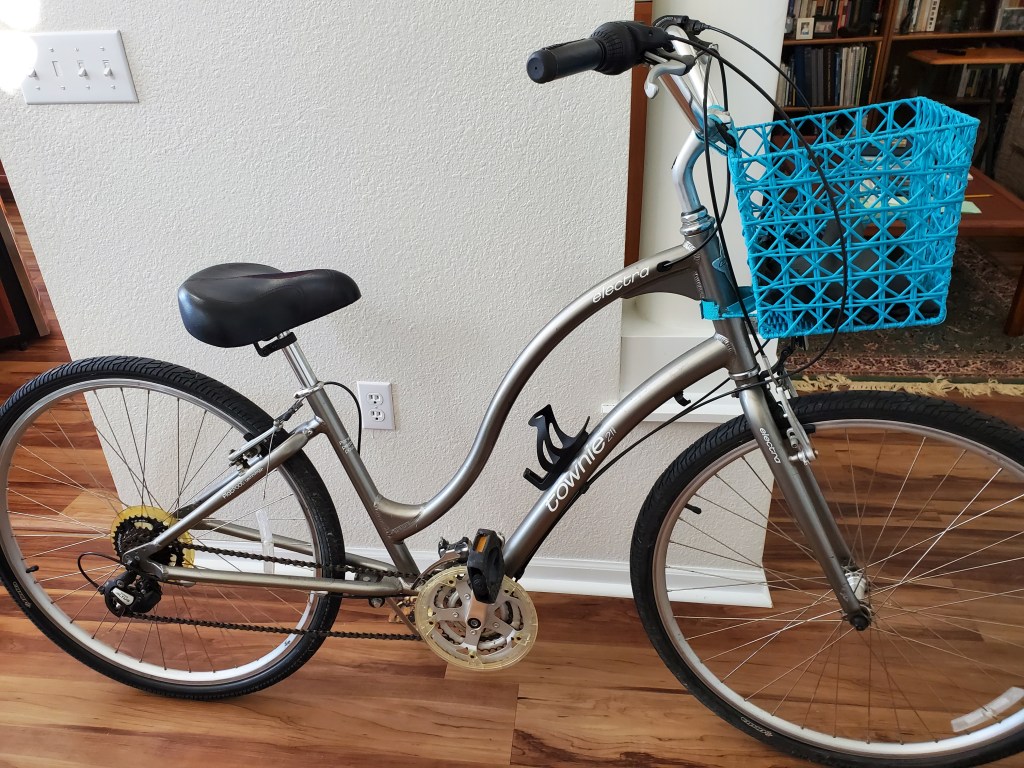
Then my son-in-law showed up with one, a step through, designed to cruise the neighborhood. He’d bought it to lure my daughter into biking with him— but she detests bicycling, and this bike hung in their garage with the other four that he’s given her through the years. It’s a Townie, made by Electra, with nothing electric about it. Big and bulky, with an ample seat, and high handlebars. This bike was clearly for an older person. A grandma bike. Was he trying to tell me something?

I moved it into my apartment. I wasn’t taking any chances of having it stolen again. There it sits, an old lady bike taunting me. “Slow down, Karen, you can’t get on or off easily. You could fall.”

I wonder just how wise that goal of getting back to riding is. “Practice makes perfect,” I told myself last year when I had a hard time stopping and putting that leg down without pain in my knee and a sense that I might pitch forward. One friend said, “Karen, it’s not if you fall, it’s when you fall.”  Sobering words. But then I heard Karen Rose’s voice: “In the Netherlands, people ride until they die.” So why not me?  And this bike looks a lot like the one I rode in Amsterdam in 1983 (except for the basket…which has negative pizazz). 

Complicating everything is the advice about transitions. “When you leave something behind, that makes space for something new to come in.” Like what? A scooter? Nah, too fast. Tricycle? Heaven forbid, a wheelchair?  And I wonder “Is this true at age 80?” There are lots of losses, family homes, meaningful work, work friends, lifelong friends, spouses, grandchildren who grow up and fly the nest, stuff you treasured but no longer have room for, lifestyles. . . not to mention sitting cross-legged. Or riding a bicycle.

Lots of us are waiting for something new to come in — and getting older in the meantime. And there’s an increasing bond with others who are navigating the territory of aging. At a recent outdoor concert, I sat in a row of six women my age who’d either lost their spouse or were living with one who was ailing. Our conversations reflected our age: “Don’t put your chair there, it’ll tip and you don’t want to fall;” “I brought some grapes so we don’t have to eat that salty fatty food they’re selling;” “I have to leave by nine, I don’t like to drive when it gets dark.” That’s bonding—we’re in the same tippy boat, waiting for something new to flow in on the next tide.

Where does that leave me? I haven’t given up the dream—another happy place has to be out there. I could always buy a new bicycle, maybe an electric one or definitely one with some zip.  Or maybe I could learn to accept a free granny bicycle.  For the time being, though, I’ve found another happy place, my new deck and coffee with a piece of almond bread from the Black Walnut Bakery. For now, happy is right here.

My Skin Doesn’t Fit Anymore…

A few weeks ago, Dan and I were with some friends who are almost as goofy as we are. As we finally started to leave (The Dog! The Dog awaits us…), we somehow fell into a joke about choosing our summer clothes to cover up parts of our bodies that we never thought about when we were younger.  That morphed into the observation that no one was rushing to do an AI image of any of us undressed…I laughed, and said, “well, my skin doesn’t fit like it used to.”  To which Dana responded, “We never had a full length mirror in our house.  I remember, about 20 years ago, coming out of the bathroom in a friend’s house and seeing myself naked for the first time in years…I rushed in to Bob crying “I am sooo sorry!  I didn’t know…”  Bob, who is pretty darn trim for someone “our age”, cracked up at the recollection.

Let me make it clear – I do not, in any way, want to be 20 or 30 again.  Or even Taylor Swift, who looks amazing at the advanced age of 35.

But when I turned 40, I must have spent the equivalent of a thousand dollars in today’s money on face creams, cleansers, exfoliating masques….not to mention eye serums that promised to eliminate the now-visible dark circles that are an inevitable part of my Scandinavian heritage….Marilyn, a very attractive older woman (probably 60?) in my church urged me to wear a bikini as long as I could, because someday I would not be caught dead in one.

Fast forward 20 years, and my oldest granddaughter, then around 9, literally gasped at the idea of a bikini for me: 

“Grandmas in bikinis – IT’S JUST NOT RIGHT!” Out of the mouths of babes…

Of course, the underlying story is how we get used to our aging bodies. In my mind, I still look like I did when I was forty or even fifty.  Or even 60.  After all, I I am lucky to fit into many of the same clothes….But, when I look at pictures ranging from 40-ish to almost 79, I don’t. 

I am recognizably the same person – but the differences are not very subtle.  I look like a grandma.  I do not wear a bikini any more.  And, when in a bathing suit, I make sure that I have a flowy coverup that goes down to my knees.  Or longer.

I recall the 50 mile bike race (in a hilly part of Wisconsin) that I managed to finish (first in my age category!) 25 years ago, as if it was yesterday. I no longer ride my bicycle.  In fact, I decided to give it away after we moved to Boulder and I confronted narrow bike lanes on the side of busy roads and mountain-bike ready dirt trails going up steep slopes that had replaced my treasured, leafy, flat bike paths around Minneapolis’ chain of lakes.  The cyclists in Boulder wear a lot of Lycra….Well, I have an old friend in England (even older than I am) who sold his car a few years ago and bikes everywhere on a collapsible/portable vehicle.  But he had long practice on hilly streets in Greece to fortify his balance and still lives much of the year in an urban center where everything he needs is close. 

Part of my decision about the bicycle is not the limitations of my body – it is me, always happiest when in a chair, looking at a mountain—not climbing it. Part of it is also caution: Breaking a major bone at my age is a lot tougher than when I was younger, and I was warned after my hip replacement that I should avoid, at all costs, falling backward in a certain way that I am not sure I fully understand but deeply fear….

But losing the freshness of early middle-age and the elasticity of older but still bike-ready Karen is coupled with an intensely held conviction that I am still a CUTE and FEISTY old lady: The changes are just part of being an ever-emergent human being. I have not been transformed like busy caterpillar, dissolving into nothing in order to break out as a butterfly with a very short shelf life. No, this is all part of the gradual shifts that, rather than transforming me, enable glimpses of how I am still becoming different. Like my pictures, I am evolving toward something that is still me, but changed in some ways. My sense of humor has improved – a lot.  I have a relationship with patience, meditation, and quiet that often makes me feel light somewhere in my heart region.  I have learned to listen to other people rather than immediately focusing on what I should be saying next.  I am not sure that I love more, but I know that I love more deeply.  Joy comes quite easily, in small delicious spurts.  It is all worth the deeper wrinkles, a slightly gimpy gait, and a firm preference for 7-year-old games that involve sitting in a chair rather than on the floor…

Am I raging against the dying of the light- heck no!  Dylan Thomas was not even 40 when he wrote those lines, and hadn’t a clue.  And if my skin—or yours – doesn’t fit as well as it used to…well, we still have a lot of fun.  And we appreciate what hiking poles were meant for. But I’m pretty sure about the bikini…

P.S. — the bikini grandma isn’t me. It was generated using AI with the terms grandma, bikini and fun!

Big H . . . Little h

Hope is the thing with feathers. I’ve heard that line many times, read the poem over and over, but I’ve never been sure what it means. LitCharts says the poem means, that hope is a strong-willed bird that lives within the human soul—and sings its song no matter what. Almost an a priori trait that we humans hold. But sometimes I worry that “hope” is cheap talk, especially when the speaker of the house, Mike Johnson, says, after the Nashville school shooting:   We are hopeful and prayerful.

Maybe another reason I’m unsure about hope is that the last year of my husband Jim’s life, I felt like that thing with feathers had flown away, to other souls perhaps. He declined daily, although at the time, he believed—and tried to persuade me—that if he just exercised more, sat in his compression boots longer, or ate more liver and beets, all would improve. But it didn’t. He’d make plans to go places like the Lakes Area Music Festival in Brainerd or Blue Fin Bay, our special place on Lake Superior. Then, at the last minute he’d tell me to cancel the reservations, never admitting he wasn’t up to it, instead hanging on to hope with an excuse like—”We don’t need to drive all that way when we have a lake right here, and we can watch the music festival online.”

 Although I said nothing to Jim, I felt like illness had usurped our lives. I don’t know whether he felt the same way or not, but nightly we’d try to perk up each other by simply sitting together holding hands. In retrospect, hope may have flown away, but love held steady.

 It is not my singular experience that hope can be threatened as we age. As Sarah Forbes writes in the Journal of Gerontological Nursing:

The elderly face numerous cumulating losses, such as the loss of a secure future, financial security, functional independence, bodily mobility, significant relationships, societal and familial roles, and bowel and bladder control.

Whew, that makes me not only unsure but discouraged, too. I (The word elderly alone is enough to send me to the mirror to see if I am indeed, elderly).

While this quote refers to a unique age group, hope is something we have throughout our lives, from the moment we awaken, “I hope I have a good day,” to falling asleep at night, “Gosh I hope I sleep well.” We hope for good weather or to spend time with loved ones. When I was young, I used to hope that after I paid the bills for the month, there’d be some money left over. Human hopes are a long, long list. In the spirit of my earlier blog about Big P, little p, or Big Purpose, little purpose, I’m labeling these hopes of daily life, little h.

But what about Big H. . .

This morning I picked up the StarTribune and read Pot use rises along with calls for help, and Woman opens fire in Texas church. Tucked further in was an article about climate change and record warmth in Minnesota’s north. Rarely does reading the paper give me hope about anything. Maybe that sells papers, but it sure can add additional weight to those “cumulating losses” that come with age. I call this kind of hope, or lack thereof, Big H, worldly stuff: climate, society, and what kind of future the world’s children will have.

After Jim died, I struggled to regain hope. A family member became seriously ill, I learned of contemporaries dying, and the news remained dark. It felt bleak, and I missed my man who always told me, “Humans will figure it out. I’m hopeful.”

But then, suddenly, when I least expected it, that thing with feathers found me. I’d agreed to teach half time this year for the University.  Friends wondered why I said yes to this when I was retired and busy with both Jim and other projects. But something told me I should. The first week of class, I asked students to post short PowerPoints about themselves online so we could get to know one another virtually, to counter an environment where we feel like just a name. And there, in those PowerPoints, perched that bird! I broke into a smile as I read about young people intent on making their lives and the world better. Here are some of the activities these students do in addition to raising families and going to school:

  • Volunteer with local animal rescue;
  • Advocate for parents and babies
  • Change the lives and livelihoods of my people (Gambia);
  • Music therapist;
  • Mandela Fellow;
  • Peer health educator working with drug users;
  • Physician working with Disaster Preparedness and Response;
  • College success coach;
  • Started a non-profit Mother to You (sends medical supplies to Senegal);
  • US House of Representatives Senior Policy Advisor; and
  • MN Justice Research Ctr, transform current legal system.

There are 45 students in my class so I could go on, but my point is that when I read their PowerPoints, I read hope, an abundance of both Big H and little h. Suddenly this elderly person knew that hope was flourishing all around her.   

Although I struggled to feel hope in that last year of Jim’s life, I remember all the little h’s that Jim and I had in the ten years of our marriage. At the same time, he fervently believed that humans would come together and solve the world’s problems. Jim epitomized both Big H and little h. I remember him in the hospital, a week before he died, asking me for his wallet so he could reserve a weekend at Blue Fin when he got better. Maybe Emily Dickenson had it right. If we pay attention, that thing with feathers is all around us.