I Never Thought. . . Or How Aging Has Brought Me to My Knees

Getty from Unsplash

One late Sunday evening, after being in the house alone all weekend, I started down that melancholy path of “getting old is hard.” I realized that I had not learned much about aging from my parents or other relatives. I’d mostly responded when they needed help, and they didn’t share their aging experience with me (or maybe I didn’t listen). I started saying to myself, “I never thought that. . . “ and my list began.

I never thought that aches and pains could be a topic of conversation. Now, when I sit with my contemporaries, we invariably start with the litany. Who knew the bonding that can occur around bunions, trigger fingers, sore shoulders, hips. . .

I never thought. . . I’d have to eat kale to stay young. Growing up in the 50’s, the main green was iceberg lettuce, cold and crisp.

First everyone said, “try romaine.” I thought it tasted overly strong. Next were field greens. I adjusted to both,

but then came kale. I sometimes wish I’d never heard of it. It’s a dark time for greens and diet.

And I will never forget Elaine’s big salad:

https://www.youtube.com/shorts/Fet3c0U4vWs

What about grains? I thought spaghetti was a perfectly lovely grain, especially with a greasy meatball on top. Now it’s all about farro and quinoa—rice, you know, has arsenic in it.

I never thought that drinking coffee after 2pm could be a problem when I went to bed. I was one of those schoolteachers with a cup in one hand and chalk in the other. My own kids complained about teachers’ coffee breath, but I was sure I didn’t have it. How I long for the days of endless cups, every time I needed a break from something tedious!  And coffee started keeping me awake just when ordinary coffee became delicious—we could buy whole beans and grind them ourselves. No more church basement coffee, which, incidentally, still tastes good to me.

I never thought I’d walk into a room and wonder why I was there. Or loose the title of a favorite book on the tip of my tongue. Forget the name of Ozzie and Harriet’s other son—Ricky and ?? (I refuse to ask Google. I’m waiting for the memory to surface.) I’m still quick with music titles—they must live in another part of the brain.

I never thought I’d need a strategy for unscrewing jars—some of my rosemaling friends carry pliers to open paint tubes. My late husband Jim and I used to have contests over who would get the jar opened first. When he wasn’t looking, I’d use a rubber thingamajig to help me win. (I’m sure he knew and humored me).

And I never thought I’d think twice or three times or four, about taking a big trip. I’d check my passport and go.

And then there’s being married three times. I never imagined such a thing when I promised “till death do us part.” Three fine men—enough said.

Interestingly, as I listed all the changes aging has wrought, I found myself considering the whole of my life and a different list started to emerge. It wasn’t a dirge but celebratory.

I never thought family and friends would bring such joy. When I can’t do something, I call my children or grandchildren. Can’t change a bulb? Call someone, and while they climb the ladder and screw in a bulb, we get to talk. Can’t assemble something from IKEA? Call grandson Henrik—he loves to put things together while I make us a salmon dinner. Need help around the house? Granddaughters love telling me what to do, and I like taking their bossy directions. Need advice? Call a friend. I’m free to take their advice or not, and we get to talk.

Can’t run the stairs—so use the railing. . . and be careful.

Big trip—thank goodness I have more judgment than my younger self did.

And those aches and pains? They’re a good excuse to spend the afternoon reading a book, of which I probably won’t remember the title, but I can look it up on Google.

The marvel of living through the changes in the world is another landing. Yes, I could get bogged down on the frustrations with screen time and AI and processed food and TSA requirements and phone chains and ya da ya da ya da. But wow, what a journey! World War II to 2025.

My mother had bad knees. In her 60’s she had one of them replaced. Although the replacement ended her pain, she barely walked after the surgery. When told she needed to exercise it, she said, “Not me. I don’t exercise. I don’t even like people who exercise.”  It was a joke, but there was truth in it. She did not see the point of exercise. The artificial knee bulged under her skin, not like the natural looking replacements of today. Seeing that scared me, I resolved that I would be different; I would exercise and stay fit—I would head off the bad knees and old age, too. From about my thirties, I ran, walked, lifted weights, saw a trainer, swam lengths, did aerobics, the treadmill, rowing machine and elliptical. . . at least until COVID.

Well, guess what? My knees never got the message. They hurt and are bone on bone as doctors like to describe it.  I’ve been literally brought to my knees. I never thought that could happen. But maybe it’s a good thing. I never thought I’d understand humility either, but I do, along with other values that aging is teaching me. And, at the end of the day, I can still get on my knees and say thank you for everything I never thought would happen.

Photo from Bing

Dear Old Age

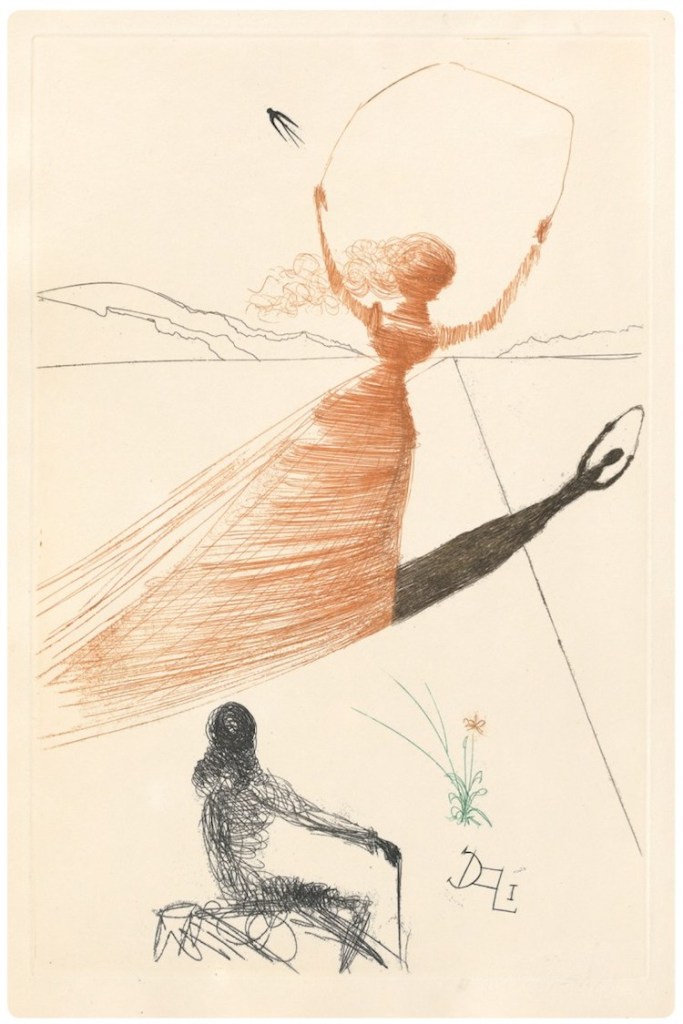
Savador Dali: Alice in Wonderland

April 20, 2025

Re: Old Age

Dear Old Age,

You snuck up on me. One day I was going to the gym three times a week, and the next I was shaky in the knees standing up in the morning. I give you credit—you attacked me in a vulnerable spot—the family weak knees. I can almost hear you gloating. “Those Evans/Jacobson women, they’re weak in knees. That’s where I’ll come for her.”

I recognize that weakness in the knees doesn’t always imply old. Plenty of younger people get knee replacements. But it’s a symptom, and if I could only fix the symptom, everything else would be fine. I wouldn’t be getting older, and worried that I won’t get to do all those things I still want to do.

I want move to Norway and live there. Go to the family farm, Vaagenes, and rent a cabin, long term. I’d even settle for that second home on Lake Michigan . Sadly, I’m not going to do that. Darn, Old Age, you stink. . . . . . . Heh, wait, I got to live in Salzburg for three months just a few years ago. I stayed in a Zimmer with a tiny kitchen, bath, puffy duvet, and a big window with no screens and tiny, biting mosquitos. I ate boiled eggs every morning, a gift from the chickens cackling below that window. I do know what it is to live somewhere completely alone and in a foreign place! I do know that I can adjust to the new and learn about different cultures. Ha Ha – fooled you Old Age!

What about that dream of bicycling the North Shore, carrying camping gear, finding a secluded spot and setting up a tent in the evening? Of course, I still want to do that. I’ve never camped. We’d (notice I’m not alone—there must be another lover in here somewhere) sleep under the stars, fish for our dinner, and make love in a sleeping bag. Okay, it’s not going to happen for so many reasons, but don’t forget the Parkway and Lake Nokomis, my happy places where I biked with abandon. Been there, and almost done that, Old Age!

I’ve always wanted to turn a manicured, pesticide polluted lawn into a habitat for pollinators. I’d thumb my nose at my neighbors letting that residue drain into the beautiful lakes and streams we have in Minnesota. Old Age, gotcha again—I turned our lawn into a field of clover, seeding it summer after summer until the plants matured and bloomed into a home for the birds and the bees. I once saw a flock of flickers land and pillage the soil for healthy worms.

Another thing, I could get married—again—have the storybook ending this time. We’d meet, fall in love quickly, never argue, and agree on the same TV shows. As we near death, we’ll hold hands, serene as we fade away. Okay, three’s supposed to be the charm, but I might need four tries at marriage. I know, it’s a silly idea, but nothing was silly about being married the first three times. I had children, grandchildren. I held hands in movies, cuddled before falling asleep, wrestled over bills and where to live and how to live. I comforted lovers, and they comforted me. So, Old Age, look at all the love I’ve had along the way.

There are so many different lives I could have had in this amazing world –become a Buddhist, live off the grid, move to DC and protest. I want to try them all, but I’m running out of time.

Okay, Old Age.  I concede. I’m probably not going to live in Norway, or bicycle and camp under the stars. I never was a gardener—I detest getting my hands dirty. As for a fourth marriage, not sure I have the energy. I’m not interested in fighting, Old Age. Truce. . .     I actually like the life that I have, even if I want all the other experiences too.  I can even accept getting old, if you help me use it to build something different, something equally new, even if it doesn’t look flashy from the outside. I’m still here. Include me, inspire me, and I’ll always show up.

Love, Karen

Loneliness

Loneliness. . . that feeling of isolation you don’t know how to change. Advice abounds: join a group, call a friend for coffee, get a hobby, and of course, find a purpose. . . but you can’t seem to make yourself do those things. It’s your own fault you feel lonely. You need to shut off the TV, get off the couch, and stare down loneliness. You stay stuck in feelings, not the solution. Solutions are for math class. You long for the ideas of others, their insights about the world. You wish someone would call, but they don’t. You’re so tired of hearing nothing but your own mental chatter.

The surgeon general says we have an epidemic of loneliness, defined as an objective state “of having no one around or of being by oneself for protracted periods of time.” That’s you. In the UK, 49.63% of adults and in the US, one out of two adults report feeling lonely. You’re not alone after all. Half of the world is with you. You tell yourself, “Humans are inherently alone. Everyone knows that.”

 “Maybe I’ll go to the grocery store,” you think—there’s no one to say this aloud to. You don’t need groceries. You don’t really care about cooking and eating except as appeasements to hunger. Regardless of what the Mayo Clinic says about not watching TV when you eat, you do like to sit in front of it and have dinner. Antiques Roadshow, people like you, many are antiques themselves, rooting around in attics hoping for a windfall.

And they talk. “Maybe you should go to the grocery store and get yourself something special for dinner,” that blabbermouth in your head does tend to repeat herself.

You’re a tad ashamed of your self-absorbed loneliness. Look at Helen Mirren. She’s alone and she’s not lonely. She takes responsibility for herself—like you should. She reframes being alone as solitude, and it’s her choice. “Does having a choice make a difference?” you wonder. Mirren notes:

One of the great gifts of growing older is to discover the exquisite art of being alone. What used to be an uncomfortable silence, is now a luxury. The house is peaceful, and I can dance in the kitchen without being judged or just doing nothing. My best company is myself, with a coffee, a good movie and the freedom to be, because solitude is not absence, it is fullness and peace of mind.

You resolve to reframe your loneliness as solitude.

Maybe you could write a journal, like Amy Tan’s The Backyard Bird Chronicles. People would flock to your door. “That probably won’t happen,” your inner voice tells you. “You no longer have a bird feeder.” Sometimes that voice does say something worth listening to.

A few days later it rains. Streaks of water coat the windows, making everything outside blurry. It’s one of those 48° chilling rains. No grocery store visit today. You’re still on a Helen Mirren kick, so you make some tea (which you don’t really like but it works for the Brits), and you decide to reread May Sarton’s Journal of a Solitude. Maybe it has some hints for reframing.

Sarton describes solitude as a retreat from the demands of others, a way to find the “rocky depths” of her personality, a chance to do inward work to understand herself.  She argues that we have to make myths of our lives. . . to yield further insight into what it is to be alive, to be a human being. “Maybe I’ll be Emily Dickenson,” you think. Sarton explains:

My experience of great solitude is that its character is unstable—at times exalts and fortifies then soon beats down, and throws one into a starving and thirsty state. (Does that mean you should go to the grocery store?)

You’re more drawn to Sarton’s solitude than Mirren’s, who makes it sound like tea and a biscuit. Sarton sees personal growth in solitude and she doesn’t sugar coat it. Knowing ourselves can be painful, but you’ve always been willing.

That said, you’ve read all of May Sarton’s journals, and you know the truth about her. She maintained a huge correspondence with admirers and entertained a stream of visitors—friends, hired help, and readers—such that she lamented about how tired they made her. Is that really solitude?

The days roll on. You fill out questionnaires in self-help books, hoping to find your purpose. You grocery shop, watching people. You eat dinner and guess the answers for Jeopardy, although you’re not as quick as you used to be—but what 80-year-old knows the names of rap artists anyhow? Finally, it’s bedtime. Two cats vie for a spot on the bed—see, you do have company. You read a self-help book with another one of those questionnaires and then settle in with something entertaining. A whiff of Pranarōm’s Sleep Aid and you’re off to dreamland, full of people and adventures, wild car rides, trips with significant others, not being able to run when you need to, flying (that’s my favorite—wouldn’t you love to fly?). Dreamland. It’s a place where you are never lonely.

Dear Readers.

I am not lonely. I have a passionate engagement with a rosemaling group, volunteer work I love, two writers’ groups, church, friends, and an attentive family. I have, however, had lonely times in my life, so I know what it is like. I worry that our society blames the lonely person, puts it on them to find a way out. So, if you know someone that you suspect is lonely, offer a hand up from that swamp. Call them up. Share your thoughts about something of interest. Connect.

All the lonely people, where do they all come from…

 (Paul McCartney)

Hope – Yet Again

Photo by Ian Taylor on Unsplash

The older I get, the more I rely on hope.  I last wrote about hope at the beginning of the COVID pandemic, when uncertainty and dread predominated around the world and in me.  I wrote to remind myself that hope is not a gift, but a practice and a ritual, like brushing teeth or lighting candles to signal an occasion. 

But here we are, only five years later, and the world again feels chaotic.  I nurture my shrinking store of hope with a new practice: limiting my morning news consumption to headlines and then moving into meditation.  I rewrite stories of a bleak future by thinking about the promise of a younger person in my life, where younger can mean 50 or 5. I consider, like other friends, leaving my social websites.  Think of the time I will have to read more books! …and call people on the phone.  Every conversation is an opportunity to connect with hope.

However, I can’t avoid everything. I logged in to LinkedIn and confronted a despairing post about the Target corporation’s decision to eliminate its diversity, equity and inclusion office.  Then I remind myself that change is non-linear. A famous quote, “the arc of the moral universe is long, but it bends toward justice,” is often interpreted as a call to patience and perseverance, ignoring MLK’s deep experience with progress and predictable backlash.  If there is progress, it is like a spiral. 

Efforts to label DEI, initiated to redress historical exclusion, as discrimination are jaw-dropping: Should I rail in anguish? Now I can anticipate boycotts of Target as well, all in the name of resisting the threat of oligarchy and a retreat from what seemed like progress in confronting our individual and national shadow selves

Getty Images on Unsplash

But does overt resistance bring us hope?  Or, should I be reminded of Arundhati Roy’s profound observation: “the rupture exists….And in the midst of this terrible despair …it is a gateway between one world and the next.”  I need to remain open to alternative stories.

I reconsider a small investigation that I conducted with a group of students years ago, which rewrote our story of failure.  I moved to the University of Minnesota because of a new president who sought to re-energize the role of a state-funded research university, paring away historical artifacts to embrace a more limber capacity to respond to emerging social needs.  The initiative was optimistically titled Commitment to Focus.   Unfortunately, a list of recommendations from a faculty committee included sharing the Veterinary and Dental Schools with an adjoining state.  Between outraged farmers driving their tractors onto an urban campus, and the implacable opposition of the state’s professional associations, Ken Keller was blamed for insensitivity to “real Minnesota” and his position became nonviable in a state where populist legislators wanted to continue every program along with the tradition of accepting most students who could breathe (even though the result was a high rate of failure). 

When my students and I interviewed administrators and faculty a year later to understand the harm done by Keller’s abrupt departure, it became clear that the interim president had adopted his agenda with minor tweaks and a different name.  The subsequent president changed the name again but went forward with the plan (minus visible changes in Dental and Veterinary programs).

Based on this experience, how might we respond when highly publicized diversity, equity and inclusion offices are officially disbanded?  I propose hope, not because corporations (or universities) do the right thing, but because the arc of justice is not embedded in a name, but in actions.

Photo by Austin Kirk at Unsplash

Diversity initiatives have a positive effect on corporate bottom lines — even the ultra-conservative Forbes agrees — and these pre-existed DEI offices. This, has, of course, been the argument in higher ed for decades:  diversity in the opinions, experiences and backgrounds that students and faculty bring with them are the “juice” that stimulates learning and improvement. In other words, universities and corporations have self-interest as well as social commitments to keeping the spiral moving in the direction of diversity.

So, is abandoning a label and office always corrupt or a cop out?  Or is it a story of how resistance can also be a portal, allowing us to see it afresh?  We know that when lofty ideas (like DEI offices) spread rapidly, easy initiatives are adopted more often than challenging efforts.  Low-quality diversity training, on which billions are spent, has limited effects on  the individuals and groups that it is supposed to benefit.  A few universities and corporations have already taken the longer route toward changing the organizational culture to be more welcoming and supportive of difference (which is associated with better decision making and positive organizational outcomes).

If circumstances force people or groups to give up one treasured item or habit, some will quit or sulk.  But many go on and search for replacements, which may involve novel approaches, new ways of thinking.  Will that be the case with Target?  With universities in states where mandates have decimated DEI offices?

It may happen.  It may not.  But it pleases me to think about resistance as subversive innovation…. turning the spiral toward justice.  And I think about my grandchildren, just bursting with ideas and ideals, with confidence – beyond optimism – that their generation will imagine new ways of organizing, working, and changing that will allow them to carry on the family tradition of working at hope. 

Photo by Miguel Bruna on Unsplash

I recently signed up for a woman’s retreat whose aim is “to free us from disillusionment, negativity, lack of imagination, anger, busyness, and more.”  Sounds like just what I need…and I will continue to find those whose opinions I value, to bring curiosity back in – along with hope.