Why Knit?

Photo provided by fellow knitter, Kathy Jensen

When people comment on a sweater that I knit for myself, it is usually followed by “My grandmother taught me to knit, but I haven’t done it since I was a kid” or “I tried it once…”.  This response astonishes me because I know, deep in my bones, that my life is enriched by knitting in so many ways.  It is rarely about the sweater, the pair of socks, or the baby blanket.  It is about a raft of other emotional and embodied experiences that I associate with knitting. 

I learned to knit when I was 11 and living with my parents in Norway for a year. Yes, knitting was part of the curriculum for all students in public schools at that time  – unfortunately, it was eliminated at some point in the 90s.  My 11-year-old school project was a ski hat with a Norwegian stranded design in the cuff…no scarves for me!   And, I still knit the Norwegian Way (which can be learned on YouTube, if you care to, from the adorable aging Norwegian knitting couple, Arne and Carlos).

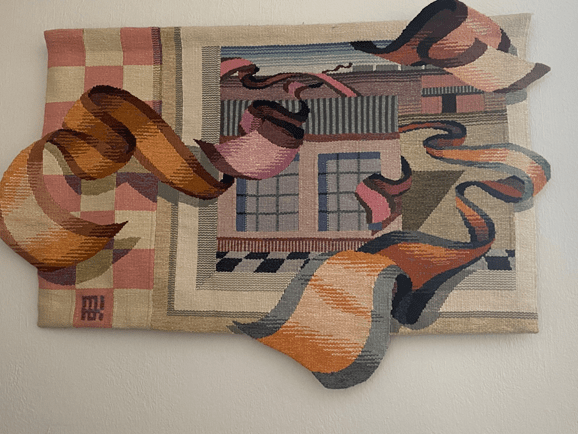
I have always loved anything made of fabric…tapestries, hand-woven clothing, batik, quilts…there is something that sings to my soul when I look at the way in which women, throughout time, have used whatever they have on hand to create something beautiful – and sometimes useful.  One of my prized possessions is this untitled tapestry by Ann Baddeley, which I call Freedom to Fly.  I first saw a much larger version, requiring a house of a different size and a bank account to go with it (many tapestries are priced by the square inch).  The gallery called me six months later and said that they had found a similar but smaller and slightly more affordable one.
With the advent of a demanding career and children, I stopped knitting for many years, with a few exceptions — a poorly thought-out Icelandic pullover for my husband and an adorable Norwegian cardigan worn by both my daughters (and now several grandchildren).  But my first grandchild (now 19) inspired me, and I haven’t stopped since….I am a regular member of Ravelry.com, an on-line space for knitters, where there are always over 3000 people with me when I log in.  There I can upload pictures of my own projects (147 since I joined in 2008) and look at what other people have done with the same yarn.  We “friend” and chat – there are groups to enjoy specific yarns or designers, and KALs (knit-a-longs) where people enjoy talking about how they are re-imagining a specific project, whether it is yarn substitutions, colors, sizing, or other “mods”.

But there is much more than being part of both a very old and also very current tradition which, with a few exceptions, is female dominated from the raising of the sheep to the designs. When people ask me why I knit, I rarely refer to the objects I have made but to the process of making them.  Just as some people love the preparation of the materials for an elaborate dish – chopping this-and-that, determining the garnish, collecting the individual spices – I linger in on-line and physical yarn stores, murmuring over colors, textures, and dreaming of what COULD be done with them, even if I know that I will not go any further than the murmurs.   Like a cook loves their knives, I like all of my 50 pairs of needles, the small scissors that I use to clip loose ends, and the various colored markers that we knitters use to keep track of complicated projects.  In other words, the STUFF of knitting is appealing to me.  When we lived in Minneapolis, Dan took me to Steven B’s, lorded over by the self-designated Glitter Knitter – for a special a yearly birthday treat and a prize skein. 

But more than that, we knitters share an understanding of knitting as therapy.  I try never to knit anything that has an absolute deadline (your gift WILL be late!) because I have enough deadlines and appointments in the rest of my life.  There is something about the feel of a delicious yarn passing through the fingers that excites the senses.  Then, there is the rhythm of it – when the stitches just seem to flow and you lose track of time.  I think of it as akin to walking meditation.  There is curiosity and challenge when you want them – always new techniques, different ways of making the wool do what you hope. 

More important is that knitting is one space in my life where I rarely judge myself.  If I make a mistake – well, it always happens and, after the first unprintable exclamation, I contentedly Tink (knit backwards) until I can fix it.  Because the process, the excitement, and the tactile elements are most important, if the final product is a bit disappointing – well, someone who visits Goodwill will probably find it warm and cozy – and maybe even like it!  Or, you can always rip it all out and use that beautiful yarn for something else…

I don’t recommend knitting unless someone is really interested…but I hope that you find something equivalent in your life, something easily available that will give you the sense of being centered that I find when it is just me, a ball of yarn, and an idea of something to make with it.

From woolyknitter.blogspot. (Credit : pinterest.com)
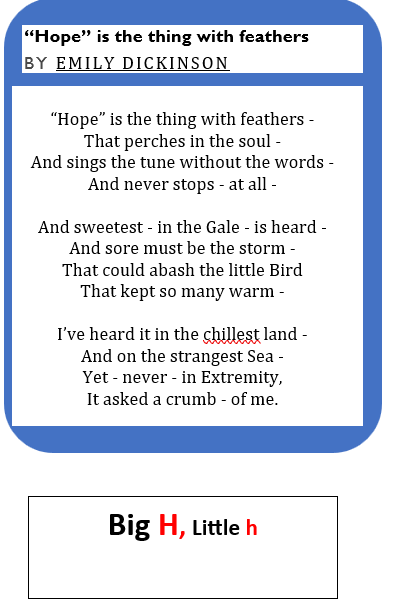
Big H . . . Little h

Hope is the thing with feathers. I’ve heard that line many times, read the poem over and over, but I’ve never been sure what it means. LitCharts says the poem means, that hope is a strong-willed bird that lives within the human soul—and sings its song no matter what. Almost an a priori trait that we humans hold. But sometimes I worry that “hope” is cheap talk, especially when the speaker of the house, Mike Johnson, says, after the Nashville school shooting:   We are hopeful and prayerful.

Maybe another reason I’m unsure about hope is that the last year of my husband Jim’s life, I felt like that thing with feathers had flown away, to other souls perhaps. He declined daily, although at the time, he believed—and tried to persuade me—that if he just exercised more, sat in his compression boots longer, or ate more liver and beets, all would improve. But it didn’t. He’d make plans to go places like the Lakes Area Music Festival in Brainerd or Blue Fin Bay, our special place on Lake Superior. Then, at the last minute he’d tell me to cancel the reservations, never admitting he wasn’t up to it, instead hanging on to hope with an excuse like—”We don’t need to drive all that way when we have a lake right here, and we can watch the music festival online.”

 Although I said nothing to Jim, I felt like illness had usurped our lives. I don’t know whether he felt the same way or not, but nightly we’d try to perk up each other by simply sitting together holding hands. In retrospect, hope may have flown away, but love held steady.

 It is not my singular experience that hope can be threatened as we age. As Sarah Forbes writes in the Journal of Gerontological Nursing:

The elderly face numerous cumulating losses, such as the loss of a secure future, financial security, functional independence, bodily mobility, significant relationships, societal and familial roles, and bowel and bladder control.

Whew, that makes me not only unsure but discouraged, too. I (The word elderly alone is enough to send me to the mirror to see if I am indeed, elderly).

While this quote refers to a unique age group, hope is something we have throughout our lives, from the moment we awaken, “I hope I have a good day,” to falling asleep at night, “Gosh I hope I sleep well.” We hope for good weather or to spend time with loved ones. When I was young, I used to hope that after I paid the bills for the month, there’d be some money left over. Human hopes are a long, long list. In the spirit of my earlier blog about Big P, little p, or Big Purpose, little purpose, I’m labeling these hopes of daily life, little h.

But what about Big H. . .

This morning I picked up the StarTribune and read Pot use rises along with calls for help, and Woman opens fire in Texas church. Tucked further in was an article about climate change and record warmth in Minnesota’s north. Rarely does reading the paper give me hope about anything. Maybe that sells papers, but it sure can add additional weight to those “cumulating losses” that come with age. I call this kind of hope, or lack thereof, Big H, worldly stuff: climate, society, and what kind of future the world’s children will have.

After Jim died, I struggled to regain hope. A family member became seriously ill, I learned of contemporaries dying, and the news remained dark. It felt bleak, and I missed my man who always told me, “Humans will figure it out. I’m hopeful.”

But then, suddenly, when I least expected it, that thing with feathers found me. I’d agreed to teach half time this year for the University.  Friends wondered why I said yes to this when I was retired and busy with both Jim and other projects. But something told me I should. The first week of class, I asked students to post short PowerPoints about themselves online so we could get to know one another virtually, to counter an environment where we feel like just a name. And there, in those PowerPoints, perched that bird! I broke into a smile as I read about young people intent on making their lives and the world better. Here are some of the activities these students do in addition to raising families and going to school:

  • Volunteer with local animal rescue;
  • Advocate for parents and babies
  • Change the lives and livelihoods of my people (Gambia);
  • Music therapist;
  • Mandela Fellow;
  • Peer health educator working with drug users;
  • Physician working with Disaster Preparedness and Response;
  • College success coach;
  • Started a non-profit Mother to You (sends medical supplies to Senegal);
  • US House of Representatives Senior Policy Advisor; and
  • MN Justice Research Ctr, transform current legal system.

There are 45 students in my class so I could go on, but my point is that when I read their PowerPoints, I read hope, an abundance of both Big H and little h. Suddenly this elderly person knew that hope was flourishing all around her.   

Although I struggled to feel hope in that last year of Jim’s life, I remember all the little h’s that Jim and I had in the ten years of our marriage. At the same time, he fervently believed that humans would come together and solve the world’s problems. Jim epitomized both Big H and little h. I remember him in the hospital, a week before he died, asking me for his wallet so he could reserve a weekend at Blue Fin when he got better. Maybe Emily Dickenson had it right. If we pay attention, that thing with feathers is all around us.

What’s It All About

As I reflected on turning 80, I remembered some milestones along the journey, which started when I was a pre-teen, realizing that I would die someday. I    saw a table in the Racine Journal Times that predicted how long you would live based on your age.

“I’m going to live to be 69,” I told my stepfather, Don, waving the paper in front of him. 69 sounded like forever.

          “That’s based on probability,” Don said. “And the war probably affected the calculations. I wouldn’t put too much stock in it. No one knows how long they’ll live.

          I shelved my predicted use-by-date and proceeded to live my life, although I never forgot that number. I wanted to pass it, to live to 100, at least. I once told my grandson that someone has to be the first person to live forever, and why shouldn’t that someone be me. Then, in my 69th year, as I approached my 70th birthday, about to move past my milestone, almost to taunt me, I came down with the flu, and I was SICK. I felt that if I could somehow get to my birthday, I’d get well, be okay. Whew! 70. I made it, and I felt better almost immediately. I’d dodged my first longevity bullet.

          My next bullet was 74, the age at which my mother died. I didn’t think about it—well, maybe a little. I did notice that after seventy, I developed a consciousness about age. Time seemed to speed up, too. I was no longer in those long years of childhood, sitting on the front porch in August thinking school would never start.

Friends started to die, much too young. Seventy-four came and went. But then, suddenly, I was 79, soon to be eighty…and here I am, an 80-year-old. I suspect that after 80, I should take these age goals in smaller bites—I think I’ll try for 82, the age that my husband, Jim, died.

It strikes me that there’s something competitive in setting age goals and then celebrating when I pass them. I tell myself, “Karen, it’s not a race.” And yet it feels like an accomplishment that says to the world, “She ate her broccoli; She didn’t smoke; She got 8 hours of sleep at night”. . . and so on. We are fed a daily diet of strategies to lengthen our lives.

I think about my husband, watching him struggle up the stairs, stop and catch his breath, walk to the car, where he’d hang over the door to catch his breath once again before sitting down, and then drive to LA Fitness where he walked the treadmill. Watching someone work so hard at staying alive while dying, suggests that my time could be better spent doing the things I love rather than things that might help me live longer. Maybe I’ll throw the race and have a leisurely run instead.

Not only does turning 80 make me think about what growing older means for me, it also really scares me. I can’t remember a time in my life when the future felt so ominous. My fears are larger than my own death, which is quite enough to contemplate. I worry about the world that my grandchildren will navigate: climate change and unrest throughout the world. I push these worries from my mind because my time to solve the problems of the world has passed.

In my 20’s, 30’s, 40’s, 50’s, 60’s and even 70’s, I was always planning the next steps in my life. But at 80, my world grows smaller, I feel myself move inward and worry about my own death. I won’t get to choose whether I die from disease or old age.  I’d like to be “one who wraps the drapery of his couch about him, and lies down to pleasant dreams”,  but I have watched death up close and it can be hard.

I recently saw a condo that I thought would be a good place for me to live more simply and freely – where I could stay for a long time. I couldn’t sleep because I was so excited thinking how I would update it, where I’d put my furniture, and how I’d afford owning two domiciles while my house—where I have lived with Jim for over a decade—was sold. It was classic Karen—when life gets stressful—leave it behind—MOVE on. . . and out. Then I realized that that has never really worked.  There is no moving away from what scares me this time.

And so here I am, 80, healthy, riding my bike around the beautiful Minneapolis lakes, renovating my lower-level living space, planning trips, curious about the future — but reluctant to plan too much. What does that leave me? Something plenty big. Life, life itself, the basics.

Winter is here in Minnesota, the wind cuts, the roads and sidewalks are slippery, we retreat indoors. Walking with my daughter outside today we started on the “I hate winter” mantra. “Stop!” I said. “I promised myself to stop saying that all winter long. It doesn’t make winter any easier, and it keeps me from seeing the beauty in winter.”

And I want to see the beauty in all that is around me, in a way I have never wanted to before. I want to revel in the humdrum of daily life, a good book, my annoying cats who hound me when I’m at the computer, a broken valve on the boiler, Apple TV when I’m tired, and a hot water bottle on my feet at night—all of which happened this first week of being 80, all of which I’m grateful for having lived.

The RMD Blues….Or, What Happens When A Frugal Person Retires?

Photo by micheile henderson on Unsplash

I hope to tell you we were shocked

At the 80-year-old man found dead

$180,000 in grimy envelopes scattered

Everywhere like old hopes, old sin.

RegretMichael Riley

I was touched by Michael Riley’s poem, which conflates the misery of the miser and the equally meaningless life of a rich retiree with handmade shoes.  But, in a way, I relate to both unattractive images.  I managed not to squander today’s pleasures in fear of having too little tomorrow – but barely.  Retiring “comfortably” caused discomfort because there was something “wrong” about having a monthly income without working.

That disquiet began when I became aware of the dreaded RMD – the required minimum distribution from tax deferred retirement savings accounts….I spent hours in my late 60s using IRS tables to see whether I would have enough to live on until, in total frustration, I called Darla, who manages our money.  Her response:  “Yes, if you keep living the way you are.  In fact, because you are retiring late, you should spend what you want now, and travel where you want to go.  When you are 80, one or the other of you probably won’t want to do that anymore.”  Darla is blunt. 

When Karen Martha and I started this blog, we resolved to reflect on what we were thinking about (confronting?  agonizing over?) as we moved from satisfying mid-life and work to something less well defined.  We were also clear about what we wanted to avoid.  So many retirement blogs emphasize issues of money – how much you need to have to retire, how to manage it once you have retired, and how financial decisions should affect others, such as whether to work part time or to move to a less costly city/state.  We wanted, in contrast, to focus on what was in our hearts. But, money becomes unavoidable at some point.

We have much in common, but over our many years of friendship we never really delved into our unrealistic but unmanaged fear of poverty.  Karen Martha grew up with a single mother in her early years, and experienced financial hardship until her mother remarried; my father went back to graduate school in his 30s and, although not poor, my parents had to watch their finances carefully.  However, the Karens agree that our lessons — NEVER have any credit card debt and ALWAYS save more than necessary — were not particularly logical since we worked in education – not highly paid, but also a profession with employment security and good pensions.

Fast forward to my middle 70s:  Dan and I have Social Security, and we have enough from retirement accounts to live more comfortably than anticipated.  What a blessing!  I have the luxury of blogging, traveling, volunteering and playing with grandchildren, and don’t anticipate much paid work.  The same is true of most of my friends. 

But “you worked hard for it” feels self-satisfied when newspapers report weekly that most Americans are unable to save for retirement, and others are chronically under-insured and a step away from a health-induced financial disaster.  Then there is the annual “windfall” of RMD from those pre-tax retirement accounts which will, apparently, never run out. In other words, I feel guilty and even (sometimes) unworthy of being one of the “advantaged older population”. 

When I was working, I adhered to my family’s legacy of prioritizing charitable donations, but there was an upper bound set by the NEVER credit card debt and ALWAYS save rules.  Now, enter the late fall specter of the RMD windfall…the old messages argue in one ear that anything that I do not need this year should be reinvested so that I won’t be eating dog food when I turn 100.  An equally insistent message to give away what I can afford speaks in the other ear.  Then there is a new rumbling note that floats above:  I was fortunate to live during a period of unprecedented economic growth and to be financially secure; my grandchildren are unlikely to have the same experience.  How much should I be saving for them? 

Peter Singer has one answer in Famine, Affluence, and Morality: We all, within our means, have a moral obligation to reduce suffering, and owe this to all people and places because of our common humanity.  But his argument ignores every parent’s obligation to protect our loved ones from realistically anticipated harms.  The Native American 7th generation principle also requires me to attend to the suffering of the planet and all of the creatures and plants that make our home livable.  And what about the international movements to create peace and stability in our fragile social systems? Or initiatives that support flourishing as well as alleviating suffering (e.g., youth programs)?  Oh, the causes that I feel drawn to – and the guilt that I feel when deleting requests for contributions from groups that “do good” and are highly rated by Charity Navigator….

RMD sits there in the middle:  I have to take it and pay incomes taxes according to the government.  Then – SAVE for Dan and me, SAVE for the coming disasters that will occur in 50 years, SAVE for unaffordable college tuition for the next generation, or DONATE now. 

So, although I said that I would never, never be one of those retired people who perseverate about money even though they have more than enough, I find that I cannot avoid the subject.

And lifelong frugality kicks in…should we take that long-postponed Viking River Cruise? (Yikes!  Have you seen what they cost for a room that has a view?)  Should I feel depraved because we bought an upscale (used) car when the food bank sends me letters every month?  And what about my alma mater, which has a decent endowment but would like more for scholarships?

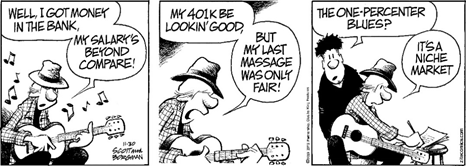
The gift of being affluent and older – definitely not in the 1% — is a niche market.  Until now, I have not had to think about the sardonic message of the cartoon below but it makes me uncomfortable.  When I was saving and young/middle aged, I would have viewed the message as political.  Now I have to ask if it is personal….