Strange But True

Guest blog by Carol Boyer Peterson

--Photo by David Matos on Unsplash

Have you ever heard a story that seemed so unlikely that you thought to yourself, “that couldn’t happen”? Yet, reluctantly, most of us learn that awkward and even bizarre experiences can yield unanticipated life changes.

My recent story is about how loneliness, isolation, and physical challenges led to an opportunity to reengage with life that I could not have anticipated. Who could imagine that spending two months in a memory care facility would become a journey into vulnerability and community? But it happened.

A little over two years ago, I tripped over an errant lawn-watering spigot and broke bones in both of my hands and fractured my wrist. Surgery was required on my left hand; a cast, on my right hand/arm. At the time, I was also part of a 15-month clinical research trial for chronic leukemia, and my orthopedic surgeon could not predict how long it would take for my bones to heal.

Keep in mind that, as a participant in a clinical research trial, I learned compliance—not easy for someone who prides herself on being in control! So, I should have readily accepted the hospital’s recommended placement in a traditional rehab facility, but my instinct told me otherwise.

While I was confident that my bones would heal, I knew that what I wanted was a quiet place where I could get the care that I needed and spend time in solitude, prayer, and reflection. I chose a nearby senior living community that had skilled nursing, a faith-based organization where I had volunteered and was familiar with some of the staff. However, there were no rooms available in the rehab section. Given the urgency of finding a room and my deep conviction that I needed to be at this particular location, I agreed to a room in their memory care facility, where I joined 12 elderly people—many close to my age—who were no longer able to live independently.

My health care professionals were horrified, but I prevailed.

My sparsely furnished room was on the second floor; my view, the monastery and an adjoining college campus. When I arrived, I spent much of each day alone…and looking out the window. But the shock of being physically unable to care for myself—even eating and brushing my teeth required assistance—and living in a locked ward with 12 other souls with advanced dementia became much more than a story of an awkward and inappropriate healing environment.

Rather than stay in my room, I chose to become an active member—albeit differently dis-abled—of this community. I participated in group activities, interacted daily with other residents, ate with them, volunteered to lead a chair exercise group (I am a certified exercise coach), and more. I learned to love being with my new friends, who quickly became comfortable with my active presence in their daily routines.

I often tell people that my perspective on everything was forever changed by the experience of being my late husband Jerry’s primary caregiver for nearly a decade. As his Lewy Body Dementia progressed, I learned to slow down, be more patient, and live with a good heart because I loved him so dearly. But, it was also a time of increasing detachment from the rest of the world.

And yet, two years after Jerry passed away in the same memory care facility that was now my temporary residence, something implausible happened: I felt part of a community. In a place that clearly was not intended for someone like me, I gained a different and deeper respect for the many challenges faced by those with advanced dementia. I also became reacquainted with critical life lessons, including how essential it is to protect individual dignity, call people by their first names, and listen closely to their life stories, which often appear in fragments rather than a well-designed narrative.

So, looking back, I can now see that my story—which others might have seen as ripe for a comic review titled “Life in the Alzheimer’s Unit while needing help with the Activities of Daily Living”—turned out to have been a gift.

Spending time in a memory care facility brought me face-to-face with my own vulnerabilities in a way that I had never even considered before. And, perhaps most important of all, it got me “unstuck” from loneliness and isolation, giving me instead a renewed sense of hope, healing, and connection. At a time when things could easily have gotten much worse, they started getting better—all because of a choice that I made against the advice of pretty much everyone…a choice based on instinct, not rational thought.

Fast forward to today. My cancer is in remission, my bones are healed, and I’m beginning to find a new way forward with greater humility, courage, and a heart that is more open to others. Caring, which has long been a defining characteristic in my life, will be guided by my faith and what I started to learn in those two months. Writing and sharing stories about my life-affirming or life-changing experiences will become part of my calling to bring peace and light into the lives of others. And, even though this is not what I planned for myself when I retired early and married Jerry, I will take the curious, compassionate, spiritual, and loving version of myself—which is slowly emerging—with me on this next phase of my life journey.  

“We do not think ourselves
into new ways of living;
we live ourselves
into new ways of thinking.”
                       —Richard Rohr

Carol Boyer Peterson

I am a widow, stepmom, grandmother of 9, social scientist and retired university administrator. I love many forms of exercise from Pilates to hiking. Despite the long winters, I also love living in Northern Minnesota with a view of Lake Superior. I am blessed to have dear friends and family who are with me on my life journey.
What Our Mothers Never Told Us

Photo by Natali Bredikhina on Unsplash

How much do we really know about our parents – and how much do we want to know?

We in the boomer generation grew up knowing that fathers never talked about their experiences in the 2nd World War.  They were raised in a time when we kids were supposed to view them as super-beings, who cared for us but didn’t have much emotion themselves (except the random yelling when frustrations boiled over). 

But our mothers often told us even less. My mother grew up in the Midwest during the Great Depression, and knew or observed significant hardship, although she and her sisters were housed and fed. I inherited some of what she learned: Saving string and rubber bands.  Washing and reusing tinfoil and plastic bags.  Now that we are in a new age of conservation to save the planet, the habits that were passed on in our childhood look remarkably prescient.  But her stories were slivers of a lived reality in an age where people rarely shared their deepest and more difficult experiences, and generally believed that therapy was for those who were weak and broken, as not for people like themselves. People who knew how to put one foot in front of the other and march on.  They were tough – and in the case of my mother, also tender in her care for my sister and me.

But my parents also told stories that gave me insight into the uncertainty that surrounded their lives as children and older adolescents – and also the lucky circumstances that allowed them to prosper when others did not. My mother told me about learning to clean the kerosene lamps, the only evening light in her home, when she was quite young.  Uncle Richard, a brilliant man, had no choice but to take any job he could during the depression to help support his family including a sister with significant disabilities.  He was a charming, well-read, funny – and a short-distance truck driver for his whole life. He never complained.

What our parents didn’t talk about was what it was like to be orphaned during the Great Depression.  In my father’s case, having a father die removed any certainty about the future, but he was lucky to have an uncle who was a professor (one of the few positions that was largely “safe” from unemployment during the depression) who gave him a place to live and attend college. Nothing was  said about moving from the family home, the separation from siblings and his mother, or the displacement and hunger that must have preceded his break.

I knew even less about my mother, and the slivers of hidden but still palpable trauma were always unconnected.  As a child, she told me that she was orphaned at 14 in “the accident” that killed her parents.  Decades later, I learned that she and her sisters were not allowed to go to the funeral in the tiny town of Scandia, Minnesota.  No relative could take all three girls, so they were quickly dispatched to live with people they barely knew in towns that were, at a time of poor roads and slow cars, impossibly distant from one another. As the oldest, my mother went to live with Uncle Sherman Johnson, in North Dakota, who was (for the time) economically privileged.  She very rarely mentioned her life there, but the tiny bits inserted into other stories made clear that she struggled to fit in.  There were younger children; she took on the role of older sister, but once said that she felt like hired help.  Although the Johnson family tried to stay in touch (their fondness for her was apparent in cards that I read) she rarely saw them after she left for college, also paid for by Uncle Sherman.  I never visited them as a child;  She never told any details about “the accident” to anyone, nor did I ever hear her talking about it with her sisters on the rare occasions when they visited.  When I was an adult, I was able to discern from tiny fragments that her father shot her mother while cleaning his gun and then shot himself. 

She survived by putting it behind her, to create a life that, on the outside, looked happy and vibrant.  It worked for a while. 

My mother and me, in 1956.

As I talk to other friends, the holes in our mother’s stories occupy vast spaces. A period of poverty that required them to give up their children for a time — but the decisions and events that caused that to occur and the struggle to reunite with them were hidden.  A grandmother who died in childbirth, leaving their mother to be raised without a sustained loving presence during a time when responsible relatives would have been consumed with making sure than there was food. A mother who never talked about being thrown out of her parent’s home when she was 14.

We now think of these events as trauma, and have developed strategies, therapeutic and educational, to support children’s resilience in the face of loss and deep uncertainty.  We read the newspaper and feel intense compassion for the children growing up in war zones or places of extreme poverty in our own country, who face even greater challenges. But, as a child of parents who lived through it, I had no access to their deepest places of pain, or the moments of joy that obviously sustained them since they managed to be caring and—on the surface, sometimes carefree—parents.

I have my own traumas, although not as deep as those of my parents.  I have shielded my children, who are now middle aged, from them.  Is this the way it is supposed to be, protecting my loved ones from knowledge of the places in my heart and life that have shattered, and stories about how I put the pieces back together?  Would knowing more make us compassionate or increase our desire for distance? Should we burn our journals and other evidence before we die in order to preserve our own fiction of wholeness?  Or, as I wish my mother had done, spill the beans and come clean….

I saw it first as suggestion

….We both drew in our breath and looked away

….And it magnifies in the eyes of those no longer young

Katherine Solniat, excerpted from Secrets About Nothing

Use It or Lose It?

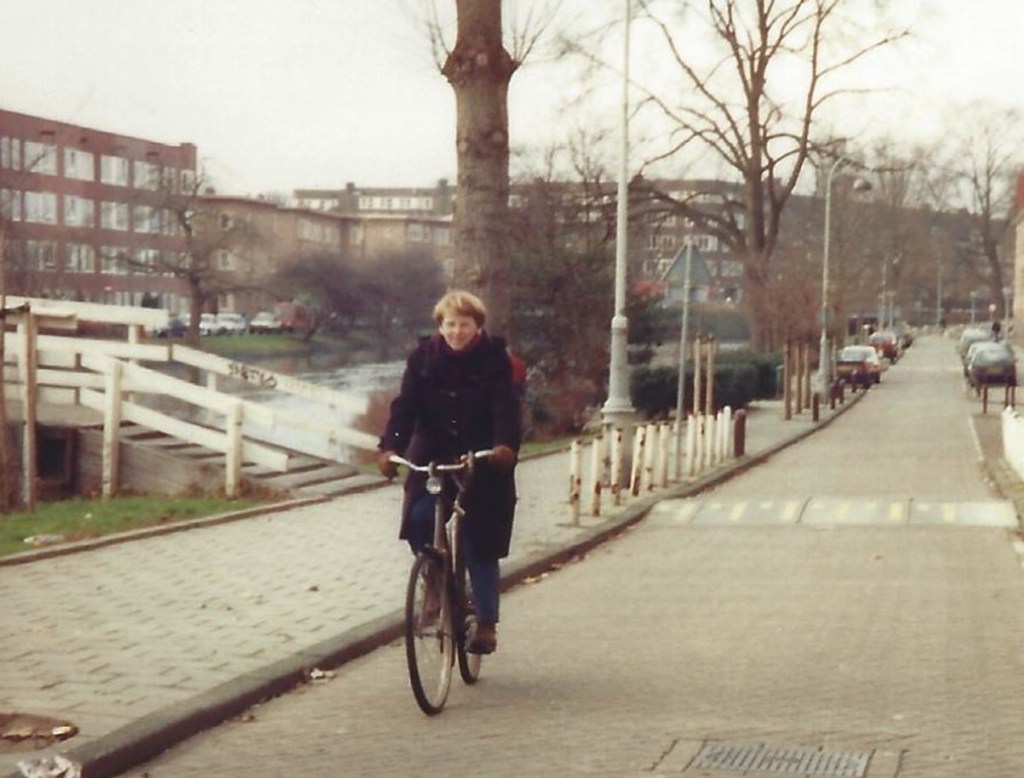
Amsterdam 1991

If you’ve followed this blog, you know that bike riding is my happy place. I’ve even posted a collage of some of my bicycles through the years. So, when I moved this summer, I, of course, took my latest bike—a step-through to accommodate my stiffening hip, no more throwing that leg over the seat, or standing on a curb to get on the bike. This new bike was a year old, gave a nice ride, but lacked the cachet of my Bianchi. I locked the it in the parking garage in my new apartment. As I wrapped the kryptonite lock around the bike, I promised it, “Don’t worry, we’ll go out for a spin as soon as I get settled.”

Two weeks later, mid-summer, I went to my parking spot and no bike. Someone had cut the lock and taken it! They also cut off the handlebar bag and threw it on the floor. DARN! That’s not exactly what I said. . . I felt violated. I examined the bikes locked by other parking stalls. Some had three locks, while others had wimpy locks. I had a kryptonite one! It wasn’t fair.

July came and went. I took a wonderful vacation and went to a retreat. In August I started the real work of moving into a new apartment, unpacking boxes and finding places for ten years of stuff.

Meanwhile, the cut cable from my bike lock hung in the garage. Every time I went to drive my car, there it was, a reminder that I had no bike, that I hadn’t been on a bike all summer, and someone had stolen from me. At the same time, I struggled with heavy boxes filled with books, slid furniture into place, and often waited for help. I just wasn’t as strong as I’d been ten years ago, when Jim and I had moved into our house.

That worried me. Would I be as strong on my bike as I’ve been in the past? “Use it or lose it,” came to mind – a saying that any older person can, perhaps reluctantly, recognize as true. I asked myself, “Karen, remember when you dropped cross-legged to the floor to sit? Or lifted that leg over the seat of the bicycle? Remember when you were more powerful than a locomotive and could leap tall buildings in a single bound?” 

“Karen, if you don’t get on a bicycle SOON, you’ll lose that, too—balance, proprioception, agility, quickness.” I set a goal of getting back in that saddle VERY SOON.

But I needed a bicycle.

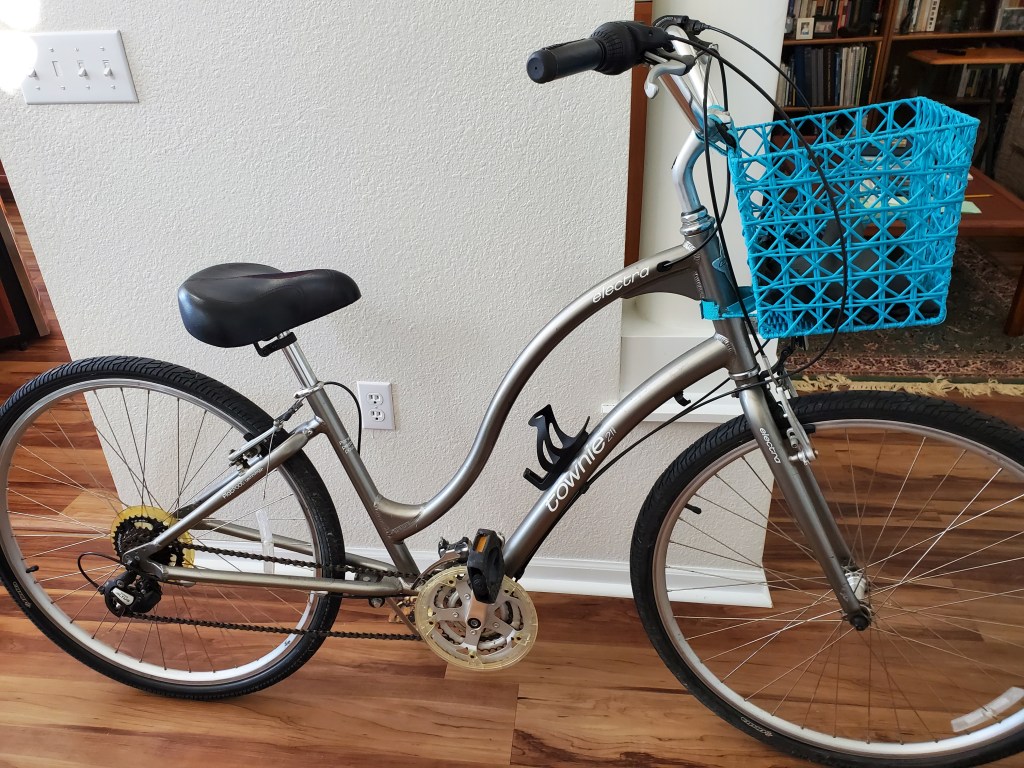
Then my son-in-law showed up with one, a step through, designed to cruise the neighborhood. He’d bought it to lure my daughter into biking with him— but she detests bicycling, and this bike hung in their garage with the other four that he’s given her through the years. It’s a Townie, made by Electra, with nothing electric about it. Big and bulky, with an ample seat, and high handlebars. This bike was clearly for an older person. A grandma bike. Was he trying to tell me something?

I moved it into my apartment. I wasn’t taking any chances of having it stolen again. There it sits, an old lady bike taunting me. “Slow down, Karen, you can’t get on or off easily. You could fall.”

I wonder just how wise that goal of getting back to riding is. “Practice makes perfect,” I told myself last year when I had a hard time stopping and putting that leg down without pain in my knee and a sense that I might pitch forward. One friend said, “Karen, it’s not if you fall, it’s when you fall.”  Sobering words. But then I heard Karen Rose’s voice: “In the Netherlands, people ride until they die.” So why not me?  And this bike looks a lot like the one I rode in Amsterdam in 1983 (except for the basket…which has negative pizazz). 

Complicating everything is the advice about transitions. “When you leave something behind, that makes space for something new to come in.” Like what? A scooter? Nah, too fast. Tricycle? Heaven forbid, a wheelchair?  And I wonder “Is this true at age 80?” There are lots of losses, family homes, meaningful work, work friends, lifelong friends, spouses, grandchildren who grow up and fly the nest, stuff you treasured but no longer have room for, lifestyles. . . not to mention sitting cross-legged. Or riding a bicycle.

Lots of us are waiting for something new to come in — and getting older in the meantime. And there’s an increasing bond with others who are navigating the territory of aging. At a recent outdoor concert, I sat in a row of six women my age who’d either lost their spouse or were living with one who was ailing. Our conversations reflected our age: “Don’t put your chair there, it’ll tip and you don’t want to fall;” “I brought some grapes so we don’t have to eat that salty fatty food they’re selling;” “I have to leave by nine, I don’t like to drive when it gets dark.” That’s bonding—we’re in the same tippy boat, waiting for something new to flow in on the next tide.

Where does that leave me? I haven’t given up the dream—another happy place has to be out there. I could always buy a new bicycle, maybe an electric one or definitely one with some zip.  Or maybe I could learn to accept a free granny bicycle.  For the time being, though, I’ve found another happy place, my new deck and coffee with a piece of almond bread from the Black Walnut Bakery. For now, happy is right here.

Circle of Friends

Getty Images, courtesy of Unsplash

A few weeks ago, I read an email from my friend Gary, part of regular, long-ish musings that he sends to a select few.  He was stimulated by the observation that people typically have no more than 150 friends and, true to his reflective nature, he dove in and found Robin Dunbar’s observations on friendship.  I mentioned this “fact” to my husband, who quickly noted that it was close to Harari’s observation in Sapiens that human societies change when their membership increases above 150, becoming more complex and often hierarchical.  Enter the blacksmith and the mayor….

Well, Gary is an extrovert who has lived in the same part of Minneapolis for almost his whole life.  He also worked for over 30 years in a position that thrust him into conversational spaces with faculty members from a more diverse group of departments than any other person at the University of Minnesota.  In other words, Gary is a social anomaly in our modern, mobile world. Many of the thousands of faculty and professional staff at the knew Gary, directly or indirectly and, coupled with his rootedness in the community,  I am sure he would recognize well over 150 people as pleasant acquaintances with whom he has shared conversations and food. As a thoughtful and interesting person, he could converse equally well with those immersed in Veterinary Medicine, Classics, or the Registrar’s office. His Christmas card list is long.  Distilled out of his hundreds of acquaintances is a core of 11 close friends who he has treasured for over 30 years.

As I reflected on his email, I felt small and a bit lonely!  I counted up my close friends (people I see or am in regular zoom contact and have known for 30+ years), and I could come up with only 3, or at a stretch, 4. I have no obvious social anxiety or deficiencies, so I had to starting thinking about why….

Unlike Gary, I have lived in four countries, 5 states and 16 distinct places. I graduated from high school and college at a time when a long-distance call cost real money.  My friends from those days are all highly mobile – none live where I grew up, and after college we all scattered across the globe.  And I more recently moved across several states.

When I think of a circle of friends, I go all the way back to junior high school and a a group that I had a 60th reunion with last year – that is me in the green sweater.  We live in different places, see each other every decade or so,  but we can start up a conversation as if no time had passed.  This means a lot: I feel joyful when I think of our shared adolescence and the interesting and fun people they continue to be.  I have not had a “circle of friends” like that since.

My friendships don’t fit neatly into a set of concentric circles that reflect differential “closeness” with me at the center.  As a member of overlapping national and international associations, I have a long-standing web of personal-professional relationships – people with whom I have regularly broken bread or shared coffee that that may be as large as Gary’s.  Whew – even though I am not a true extrovert, I seem to have a natural preference for connecting,  and when I think of the joy of finding someone who I really like in the lobby of a soulless hotel in a major city or another country, I smile. 

But I am retired, as are many of them. I am unlikely to travel to Florida just to see Joe or to Sweden to visit Olof and Helene, and we no longer have conferences that ensure meeting several times a year.  Still, looking back on the jokes, the work chatter interspersed with family life, the occasional sharing of hard stuff, music preferences, and furry companions, I know that they are much more than “acquaintances”.  It lightens my heart to know that I worked, over many years, in the company of people who mean much more to me than what they do or produce. 

A web is not a circle.  When I think of my “close friends” whom I have known for decades (and will get on an airplane to see) the list of expands a bit.  In this, I am in a community that ebbs and flows, a web where everyone is connected to others, directly or through me, and where we share the same feelings of care and concerns for each other.  I am not at the center and not at the edge, but our lives are intertwined even as they are separate. 

I am drawn to ask what we mean by friendship, beyond the obvious indicators of caring, trust, a sense of mutual intimacy and a shared sense of humor.  I have been  a mentor to many students, I have kept in regular touch with around 7, many of whom I have known for decades. Is that friendship, or something else?  Or the colleagues with whom I have shared years where we collaborated on projects that engaged us deeply?  They are so much more than acquaintances, yet not people who I would invite to a barbecue. I am grateful for each of them.  Karen Hering says that I  can claim them as companions on life’s journey.

Image courtesy of Nina Cvijo, on Unsplash

And what do I say about people with whom I have shared intense relationships – old loves, sponsors, mentors, co-conspirators of one kind or another – who are in my life for a shorter period, but who think of me as often as I think of them and who are forever sewn into my heart.  I can I can touch base with any of them when it feels right.  Claim them again….

In the end, I have decided that I can’t place people I have known within circles.  I want to remember them in the web of relationships that have meaning for me and for them – and that can be activated after many years with an email or a phone call to evoke a mutual burst of warmth and gratitude.