Sticking with What Works or Starting Anew?

Catching a Big Fish at Post Lake, Wisconsin, about 1955 (looked big to me)

I remember as a child waking up in the morning to a day fresh and new, filled with possibility. Something exciting was waiting to be discovered, maybe just around the corner. All I had to do was get dressed, scarf down a bowl of cereal, and walk outside. Sometimes I rode my bike around the neighborhood, looking for something interesting. Other times I’d try to find a friend to join me. I’d walk to my friend Carole’s house, and from the street, I’d call “Oh, Carole.” If she could play, she came outside and off we’d go inventing on the way. If not, her mother opened the door and said, “Carole can’t play right now.” In that case, I’d wander to the park or go home and read a book of my choosing. I was between five and ten when I experienced my life this way, the unadorned curiosity of a young girl.

          Idealized, of course, but I remember that time seemed to stretch on forever (especially when I was bored at the end of summer).  Bored or not, I didn’t look outside myself for something to do, rather, I acted from within, indulging my moods and curiosity. My notion of work was uncomplicated, something imposed by adults, “Practice your clarinet, finish your homework, do your chores.” It was before I learned that work was ubiquitous to living, any and all work, jobs, housework, yard work, volunteer work, and meaningful work, however it is defined. I had not yet assimilated the byproducts of work, productivity, success, and accomplishment, as guideposts for adult life.

          I remember telling my son, out of college and frustrated because he couldn’t find a job, “don’t worry about it. You won’t escape working. You will spend basically your whole life working.” At the time, I believed that the necessity of work had absolute power over my life, what I called the “tyranny of work,” because I saw work, too often, as something that needed to get done. I’d lost the inner direction that had, as a child, given so much impetus to my daily living. I didn’t see my work in context, as a necessary part of life but also, if completed purposefully, as an expression of my authentic self. I had not yet come face-to-face with the question of what life would be like without work—retirement, if you please.

And Then It Came. . .  Retirement

          On December 11, 2015, I retired at age 73. I woke up that first Monday, after the retirement toasts at the bar on the previous Friday, feeling that overnight the ground had become unsteady. I was prepared to shower, get dressed for work, fight the traffic, and get a good parking space, but there was nowhere to go. I knew I could sleep in, hang out in blue jeans. . . but then what? Unlike my fellow blogger, Karen Rose, I had not taken a phased retirement. I simply decided that it was time to step aside for someone younger with fresh enthusiasm. I worked on soft money, and I was tired of chasing it. As for getting “busy with something that looks a lot like work,” (Falling from Grace, posted 7/8/2019) I thought it would be easy. Finally, I would have the time to sit at my desk doing the creative writing I’d longed to do but had put off throughout my life.

My Facebook posting with the caption:  This is where it ends. . .

Writing, however, didn’t happen. Ideas suddenly went dormant. Rather, I spent three months having panic attacks until I read a book about how to overcome them. But overcoming them wasn’t the same as addressing the root cause. That little girl who once welcomed a day of possibilities had lost the ability to not only see those possibilities but also to act on them. I was caught in the conundrum of living from within or living from the cultural and societal norms that describe work—I’d fallen from grace and had no idea how to catch myself. . . .

Part 2: One Big Step for Karen-Kind                                           

I shared my angst about adapting to retirement with friends—and I mean “adapt.” I saw it more as forced obsolescence. Friends said to find a new routine.  Do the things you’ve been putting off—like cleaning closets. Find a new direction. I bought into it and muddled my way into a sort of routine, cleaned my desk in lieu of the closets, and started searching for that new direction. I grew a ponytail—I’d never had long hair. It was something I could accomplish.
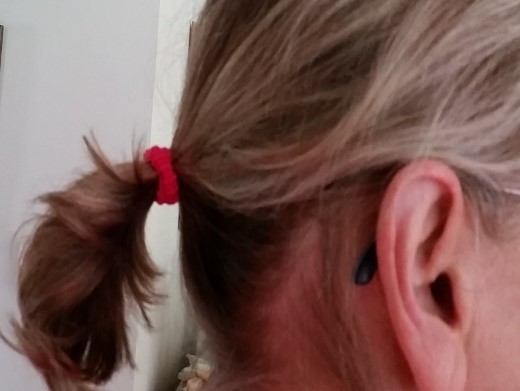
          I started tutoring fourth graders in math at my local school—I wanted to be productive, feel useful, and there’s nothing as regenerating as being around ten-year-olds. I taught a couple of classes as an adjunct professor, and I joined a research project in my field as a consultant. Writing ideas resurfaced, and I found myself at my desk again. Whew, finally those panic attacks waned. I was in safe territory—work ( I cut off the ponytail).

          Then, as life will do when you’re ready for it, I was thrown a curve, albeit a pleasant one. My husband and I and Karen R. and Dan went on vacation to the Cowboy Poetry Gathering in Alpine, Texas http://texascowboypoetry.com/. For two days we were immersed in a culture different than upper midwestern city life. A culture of cowboys, in boots, bolo ties, Ariat shirts freshly pressed, creased jeans, and wide belts with polished silver buckles, standing for over an hour reciting new and classic poems. These poems were about life on the range, around the campfire, under the stars, and the meaning of life when everything slows down and you feel the immensity of our world beneath that naked night sky. Corny poems, sometimes, but poignant, nevertheless, and framed by the big questions we all grapple with—is there someone who watches over us? What is the meaning of our time on earth? Do our lives matter? Turned out, there was more to cowboy poetry than campfires.

          Thinking about the poetry gathering on the plane home and later as I went about my routine of teaching and tutoring, a glimmer of something started to break through. Experiencing the cowboy culture reminded me that there are multiple ways to live and know the world. I was living retirement like my former work life, with never-ending assignments where productivity ruled. I was judging my life through the lens of work, and that’s why I had found retirement wanting, a time for panic, and a need to find something, anything, new to do and quickly.

          I’d crossed that demarcation between work and retirement, and I’d found it painful, so I kept trying to go back to what I knew and had valued for some fifty years—working, doing something meaningful in the eyes of the world. Yet available to me was the life of that young girl who awoke every day to possibilities, unless, of course, I chose to clutter it up with the detritus of those fifty years of working. I realized that I didn’t need to “find a new direction.” I was free to have no direction. To wake up and follow my curiosity. To read a book of my choosing.  To call a friend and hang out at a museum. Even to go to Wales and live (something I’ve dreamed of doing). To sit on the deck and stare at the stars, unless of course, the mosquitos got me first. The point was, I didn’t need to have an agenda, unless that agenda was relearning how to be this person who allows the day to unfold as it wants to. Retirement wasn’t so much the end of work as it was a challenge to “start anew,” to just be and to awaken with curiosity about what the day will bring, and to rediscover the joy of that young girl, which, hopefully, is still in me.

From Anthem

So mornings now I’ll go out riding
Through pastures of my solemn plain,
And leather creaking in the quieting
Will sound with trot and trot again.
I’ll live in time with horse hoof falling;
I’ll listen well and hear the calling
The earth, my mother, bids to me,
Though I will still ride wild and free.
And I ride out on the morning
Before the bird, before the dawn,
I’ll be this poem, I’ll be this song.
My heart will beat the world a warning—
Those horsemen will ride all with me,
And we’ll be good, and we’ll be free.

Buck Ramsey

If I Don’t Know My Purpose Am I A Retirement Failure?

Photo credit:  Ian Schneider

When I was in my 50s, I gave my mother (who was 30 years older) a copy of Rick Warren’s The Purpose Driven Life.  She was in a funk, battling a tendency toward untreated depression, and I thought it might help her.  Of course, I hadn’t considered some underlying reasons why that was a poor idea (she was an avowed atheist and often frustrated by her generation’s limited expectations for what women would do outside the home).  My inappropriate choice was based on the title, which implied that everyone already has a purpose and our job is to accept and live into it.  My mother didn’t read it, so I feel only a smidgen of regret at the gift.  But I think that I was dead wrong….

Here I am, almost as old, inundated with a drumbeat of blogs, and aphorisms that urge me to FIND—REIGNITE–CREATE a purpose-driven life, which is typically described with an almost sexual PASSION at the center.  A sampling from the web includes: 

  • “Be fearless in the pursuit of what sets your soul on fire”
  • “Life – seize it and make it amazing. Discover your passion. Take chances. Follow your dreams. Today is the day. Don’t pass it by”
  • “There is no passion to be found playing small—in settling for a life that is less than the one you are capable of living.”
  • “The things you are passionate about are not random. They are your calling.”

Books extolling this certainty for later-in-lifers proliferate –now is the time to find that passion!  Directly or subtly, effort is at the core:  How to find your passion after you retire.  As one website, 60 & Me suggests, now is the time for people to become more purpose-driven and more passionate – and probably do something that looks like work (paid or unpaid):

“The overlap between what you are good at and what you are paid for is your profession. On the other hand, what you are paid for and what the world needs is your vocation or calling.  The point where what you love overlaps with what the world needs constitutes your mission. Then lastly, the combination of what you are good at and what you love is your passion.”

THIS QUOTE EXHAUSTS ME, in part because I had to read it three or four times to understand it.  MOREOVER, IT MAKES ME FEEL BAD ABOUT MYSELF. Not only do I have to have purpose and passion – I need a mission and a vocation in my retirement!  I have no idea where to start with this….

There is a dark underbelly to the mandate of finding purpose at all life stages.  I have a colleague, quite brilliant, a wonderful administrator who effortlessly makes things happen within a large bureaucracy, is exceptionally kind, and who suffers from a sense that her life is not meaningful because there is no focused PURPOSE at the center, nothing that DRIVES her daily work.  She feels that she is not enough.  Her work life lacks passion. Or focus. Or certainty.  Or something. 

I don’t blame Rick Warren, although producing a book that has sold 30 million copies provides impetus for others to adopt his words (but not his meaning).  Warren’s work focused on finding purpose by living fully into beliefs and a community shaped by a particular set of virtues and principles.  It has less to say to the self-motivated individual who tries to self-actualize through individual striving.  His title was highjacked.

So, back to age, retirement, and a redefined “purpose”. I find comfort in some ideas that I have come across, most of which involve making purpose more “right sized” in our lives rather than the driver of happiness and fulfillment.  Dmitri Pavluk talks about self-actualization, which includes insight (think of the Buddha!), awareness and clarity (look around; be observant!), and connectedness (Yay! Other people) – and, yes, something called purpose.  In other words, purpose can only be understood in the context of a whole life that has both inner and outer expressions. The elements that he defines as self-actualization are related, fluid, and inseparable.  We change.  We grow. Life does not always happen on the schedule that we had in mind. 

Mark Manson, whose blog often addresses questions of personal meaning, says it more simply:

So when people say, “What should I do with my life?” or “What is my life purpose?” what they’re actually asking is: “What can I do with my time that is important?”

I couldn’t make my mother happy, but I know that she adored her family and made my high school friends want to come over to our house because they felt so welcomed.  She exposed me to eggplant in the late 1950s, when no one else in Ann Arbor knew what an eggplant was, much less how to cook it.  She enjoyed living in several foreign countries during her adult life. She taught me not to stand on the sidelines when an important political question is on the agenda.  I am not an atheist, but her questioning of EVERYTHING has been an invaluable model for me.  I remember her (when not severely depressed) as “right sized” and adventuresome. 

When I look at Ian Schneider’s photo above, what I see is visual irony:  How often do passion-purpose lead us to a place where all we can (metaphorically) see is our tired feet in a featureless landscape?  That sense led one of my internationally recognized colleagues to retire earlier than he had planned.  However, a year later, as we checked in at a casual breakfast, he described his choices about how to spend his time—to read and think, explore awareness and joy of nature, create new connections with his wife –with a sense of gleeful gratitude

In the end, isn’t caring for a precious asset – time – at the core of purpose?  I can do the most important and meaningful things that are available today.  And tomorrow.  And stop worrying about BIG PURPOSE AND PASSION.  …To be continued….

A Soul on the Move

            . . . the ground at my own feet. . . 2019

“And the world cannot be discovered by a journey of miles, no matter how long, but only by a spiritual journey, a journey of one inch, very arduous and humbling and joyful, by which we arrive at the ground at our own feet, and learn to be at home.” 
― Wendell Berry, The Unforeseen Wilderness: Kentucky’s Red River Gorge

Given that I’ve lived at least 39 places in my 75 years, I felt compelled to write a sequel to Karen Rose’s piece, Should I Stay or Should I Go, especially since I usually pick the “go” choice. Moving seems commonplace to me, what people do.  But when I listen, I realize that not everyone is on the move. I’ve had neighbors and friends tell me they’ve lived in their houses for 20, 30, 40—since the beginning of time—years. Because I can’t speak to that experience, and, since right now I’m obsessed with doing my own soul work, I decided to think about moving in soul work terms, or, as Wendell Berry calls it, my spiritual journey.

          One of my mother’s favorite stories about me was how, even as a young child, I liked to run away. I’d go missing and she’d find me way around the block.  My recollection is that I wasn’t trying to be naughty; I truly wanted to see what was around the corner.  My son had the same proclivity.  When he was about four, though instructed to stay in front of the house, he would invariably ride his Big Wheel to the gas station around the corner, where I’d find him watching the comings and goings of a busy filling station.  My explanation for our curious natures is that it’s genetics, starting with my paternal grandfather, Nils Jacobsen, who left Norway in 1888 at age sixteen to come to the US. I like to think that he, too, wanted to see what was “around the corner.”

          Early in my life, as an undergraduate at the University of Minnesota, my moves were to find a room I could afford.  Everyone moves around at that point in life.  My tendency to move as a strategy to solve life problems started later, with my first husband, always looking for an affordable and better place, big enough for two children, and located in the same school district.  We moved ten times until we were able to afford a house. Our children, at ten and eleven, had lived somewhere new just about every year of their lives.  After our divorce when our children were grown, I started graduate school and moved again and again, always to find a better place within my means, which wasn’t much. Soul work at that point was building a new life.

          Building a new life to me meant having a fresh start in a new, clean house—no cluttered drawers, dusty shelves, moldering food in the refrigerator—not to mention, unpleasant memories. As Robert Louis Stevenson puts it, “The great affair is to move.” I’m not surprised that after retirement people consider making a move. Retirement, fundamentally, forces one to start over, to reconsider all the choices made over the years, including where to live.

          To be a professor, one has to move upon graduation. I was all in for that requirement. Upon graduation, I moved for a job and adventure, off to Utah and a new life with a new husband, Gary. We would hike in the mountains, ski, and explore the southwest. It was travel rolled into a career move. But then something changed.

          Our second year in Utah, Gary was diagnosed with terminal cancer and given a year to live, if he was lucky. About eight months into his last year, I had a tremendous urge to move “home”, back to the Twin Cities. I found a posting for a job in Minneapolis, applied, and was hired.  I persuaded him that we needed to move; he died four months later in the Twin Cities.

          Although we’d bought a house for me to have when he died, I immediately started looking for a new place to live.  And there it was, the need to keep moving had become almost a pathology. See what was around that corner.  It had to be better than sitting alone in the house where Gary had died, facing my grief.  And move I did, first to a condo that I lived in less than a year, then a house, then to Bethlehem, Pennsylvania, and Lehigh University, all in the space of four years. . . another travel adventure combined with a job change.  I sold it to my now married children as “exploring the east coast.”

          I moved to Bethlehem in June of 2001, and on September 11th, our country was attacked. Planes crashed in Pennsylvania, the Twin Towers in New York City, and the Pentagon. All felt too close. I was alone in a strange city, and I couldn’t reach my children because the cell phone lines were overwhelmed. On that afternoon and days after, I longed for “home,” someplace solid, with familiar ground under my feet. I had learned that in an emergency I would never be able to get to my children quickly. I lasted five years in Bethlehem, spending a good deal of time wanting to move back to the Twin Cities. Yes, I explored the east coast, and I made many friends, but I needed to belong somewhere, a place close to my children and grandchildren. I moved, back to the Twin Cities.

          I bought a townhome I didn’t particularly like, thinking I’d stay there a short time and move on. But then came the Great Recession. The housing market crashed, and I couldn’t get out of my townhome. Everyone else liked it and my friend, BetsAnn said, “Make it into a place you like. Don’t just sit there and complain.” I did, and I stayed there over eight years—almost a record for me—and I became attached to it.  I even looked forward to going “home” at the end of a day.

          In 2013, I remarried, and Jim and I bought a house together, which we’ve lived in for five years. This spring I had the urge to move. I insisted my husband look at townhomes with me.  We looked and concluded that our house suits us and our relationship, and we decided to stay put. Our children live in the Twin Cities, so we don’t have the pull to be near family. Our next move could very well be our last, and we’ll wait, like Karen Rose suggests, until it just feels right.

          But how will I handle my need to leave, to see if there is anything better around the corner? I’ve learned that I have a wanderlust that bubbles up whenever life gets uncomfortable. The lesson that I move to run away has not been easy to learn—39 domiciles attest to that. It means doing the work of my soul—confronting my seemingly logical reasons to move and seeing them for what they are—boredom and low level anxiety, the sense that something isn’t right, covered by a veneer of wanderlust.

          The other day I made my usual circle of the neighborhood, first to the co-op, then the library, from the library to Kowalski’s for a gourmet touch to dinner, a stop at the ATM, and finally home. How comfortable it felt! What I used to believe was boring—staying in the same place—has changed to belonging. That evening I biked the Minnehaha Creek Parkway. Living here long enough has allowed me to know the creek at both low and high levels, in winter under new fallen snow, in spring, raging as the ice gives way, and during summer, when it meanders under a lush canopy of green.

          As for “should I stay or should I go,” my first impulse is to say GO, move.  I am Nils’s granddaughter after all.  But staying in my last two homes has opened me to something else around the corner—the dynamic of neighborhood, the way a calm or raging creek invites me into my own movement and change. This isn’t an advice blog. The only thing I can say for certain from my experience with losing a husband and 911 is that being near family counts. The decision to move, while it may seem straightforward when the reasons are financial or job-related (and even those have nuance), is complicated, especially so with the emotional, physical, and family considerations that come with getting older. Maybe the best we can hope for when sorting things out is Karen Rose’s wish that “a place (will) just speak to me and tell me where to get off.” Meanwhile, for now, for me, I am in a place where I can finally, “learn to be at home.”

Should I Stay or Should I Go?

Stand still. The trees ahead and bushes beside you
Are not lost. Wherever you are is called Here,
And you must treat it as a powerful stranger,
Must ask permission to know it and be known.
The forest breathes. Listen. It answers,
I have made this place around you.
If you leave it, you may come back again, saying Here.
No two trees are the same to Raven.
No two branches are the same to Wren.
If what a tree or a bush does is lost on you,
You are surely lost. Stand still. The forest knows
Where you are. you must let it find you.

David Wagoner, from Collected Poems 1956-1976

Don’t we all long for the sense of place that David Wagoner’s poem describes?  A place where you belong, that reinforces your sense of being “right sized” and in tune with your surroundings?  

That is what I do not have….

Last December, I discovered that my friend Jane was leaving her condo overlooking a small lake just outside Minneapolis.  She sold all the carefully curated furniture (including a fireplace that she had recently installed) and moved to a house in Florida with her new-ish partner Dave.  Boom. A Minnesota native, Jane was not much of a traveler and had season tickets to every theater, orchestra, chamber music or other event in the arts-rich community in the Twin Cities.  In other words, this was not an expected next chapter in her retirement story. At least I didn’t expect it.

Then yesterday, I chatted with Susan, who confided that the 9 weeks she and Bob spend in Puerto Vallarta were just too long – ‘I feel so disconnected – Bob loves it, and would stay longer.  We compromised so that next year we will stay for 6 weeks and come back for a few. Maybe go away again for a couple of weeks on a road trip with the dog to see the kids.’ Disconnected in Mexico…..but looking forward to long summer weeks in their remote and rather primitive cabin in Northern Minnesota – Susan’s “happy place”.

Another couple, long-time Minnesotans, recently moved back into their house, remodeled to suit the vision they had when buying it decades ago.  It sits on a large city corner lot, where they are responsible for shoveling two long stretches of sidewalk. Even when we visit them in the glory of early fall, the house’s steep front entry invokes fears of slipping – and I fast forward to hospitals stuffed with elderly people with pneumonia and broken hips.  But for our friends, an adventuresome trip or two a year in a warmer continent (including lots of hiking), is enough. They never seriously discussed any other options than the major remodel….

What about Sue, who lives in a spectacular three-story mountain home in Colorado, but whose husband is tired of plowing the driveway and dreams of a tripped out Mercedes Sprinter and a couple of years on the road while they are still in great health? (Wait!  Even though they have no children, the dogs are still young…and where will they all live when life on the road gets old?)

As Joe Strummer and Mick Jones put it in The Clash’s famous lyrics:

Should I stay or should I go now?
If I go, there will be trouble
And if I stay it will be double
So come on and let me know…

We and our friends are all vigorous in our mid-60s to mid-70s. Not wealthy, but also not strapped.  We can do almost anything we want to — but not everything (and long ago redefined our fantasies to fit our budgets).  Blessed with the freedom to move or be “snowbirds” who fly away in the winter, we all have different stories that dance around the question of where and how to live once we are not tied to a job.   

Although I still have a year to work part-time, Dan and I have off-and-on been grappling where we want to be forever (or what seems that way). The dilemma of moving-or-staying may seem particularly acute for Minnesotans who, although a tough bunch, are mostly willing to admit that winter is challenging.  We love Minneapolis – the arts, friends, lakes within walking distance, good government, and fun restaurants on every corner – it is truly glorious seven or eight months of each year. But, as we say, there are two seasons: winter and road repair. (A local ice cream, Nicollet Pot Hole, memorializes the tire-busting crevasses that emerge every year after the incessant freeze-thaw of hard winters.)  

The question of staying or going is only partially a byproduct of weather.  We are living out the consequences of the tendency of better educated and more affluent Americans to wander.  Like many of our friends, Dan and I lack real roots. Our parents lived far from where they were born; we moved away from our parents.  My daughters and grandchildren live in Massachusetts and Colorado; Dan’s closest relatives are in Nebraska and New York. Easy enough to get to for planned visits, but not for Sunday brunch or occasional babysitting.  We have no role models (except Dan’s mother, who lived by herself and bought a new car at 92) and worry about creating mid-life drama for our loved ones if we age-in-place. We have vicariously experienced how frequent plane flights to deal with emergencies take an emotional and financial toll on friends in their 60s who are caring for parents in their 80s who live far away.  There is always an independent retirement community with affiliated health care. I AM NOT READY FOR THAT – I don’t want to live in an age-ghetto.  We will think about it again when I am 80!

That leaves us with the explicit or implied dilemmas faced by my friends.  Move to New Mexico, which is cheap-ish and has all four seasons, but requires starting over with friendships and community?  Split time between Boston-Denver-Minneapolis (none of which is a winter paradise), but feel a bit disconnected everywhere? Spend a few weeks away from deep winter (while postponing the issue)?  We have been through all of the options and none fits perfectly.  

Dreaming about alternative life styles is a playful “imagine a different future” activity when you are 25-35-45.  Now, we want to live each day to its fullest, and evaluating the many patterns of staying-going feels like a waste of time.  Why can’t a place just speak to me and tell me where to get off? Like a merry-go-round, the scenery changes and then I realize that I have been here before….