Circle of Friends

Getty Images, courtesy of Unsplash

A few weeks ago, I read an email from my friend Gary, part of regular, long-ish musings that he sends to a select few.  He was stimulated by the observation that people typically have no more than 150 friends and, true to his reflective nature, he dove in and found Robin Dunbar’s observations on friendship.  I mentioned this “fact” to my husband, who quickly noted that it was close to Harari’s observation in Sapiens that human societies change when their membership increases above 150, becoming more complex and often hierarchical.  Enter the blacksmith and the mayor….

Well, Gary is an extrovert who has lived in the same part of Minneapolis for almost his whole life.  He also worked for over 30 years in a position that thrust him into conversational spaces with faculty members from a more diverse group of departments than any other person at the University of Minnesota.  In other words, Gary is a social anomaly in our modern, mobile world. Many of the thousands of faculty and professional staff at the knew Gary, directly or indirectly and, coupled with his rootedness in the community,  I am sure he would recognize well over 150 people as pleasant acquaintances with whom he has shared conversations and food. As a thoughtful and interesting person, he could converse equally well with those immersed in Veterinary Medicine, Classics, or the Registrar’s office. His Christmas card list is long.  Distilled out of his hundreds of acquaintances is a core of 11 close friends who he has treasured for over 30 years.

As I reflected on his email, I felt small and a bit lonely!  I counted up my close friends (people I see or am in regular zoom contact and have known for 30+ years), and I could come up with only 3, or at a stretch, 4. I have no obvious social anxiety or deficiencies, so I had to starting thinking about why….

Unlike Gary, I have lived in four countries, 5 states and 16 distinct places. I graduated from high school and college at a time when a long-distance call cost real money.  My friends from those days are all highly mobile – none live where I grew up, and after college we all scattered across the globe.  And I more recently moved across several states.

When I think of a circle of friends, I go all the way back to junior high school and a a group that I had a 60th reunion with last year – that is me in the green sweater.  We live in different places, see each other every decade or so,  but we can start up a conversation as if no time had passed.  This means a lot: I feel joyful when I think of our shared adolescence and the interesting and fun people they continue to be.  I have not had a “circle of friends” like that since.

My friendships don’t fit neatly into a set of concentric circles that reflect differential “closeness” with me at the center.  As a member of overlapping national and international associations, I have a long-standing web of personal-professional relationships – people with whom I have regularly broken bread or shared coffee that that may be as large as Gary’s.  Whew – even though I am not a true extrovert, I seem to have a natural preference for connecting,  and when I think of the joy of finding someone who I really like in the lobby of a soulless hotel in a major city or another country, I smile. 

But I am retired, as are many of them. I am unlikely to travel to Florida just to see Joe or to Sweden to visit Olof and Helene, and we no longer have conferences that ensure meeting several times a year.  Still, looking back on the jokes, the work chatter interspersed with family life, the occasional sharing of hard stuff, music preferences, and furry companions, I know that they are much more than “acquaintances”.  It lightens my heart to know that I worked, over many years, in the company of people who mean much more to me than what they do or produce. 

A web is not a circle.  When I think of my “close friends” whom I have known for decades (and will get on an airplane to see) the list of expands a bit.  In this, I am in a community that ebbs and flows, a web where everyone is connected to others, directly or through me, and where we share the same feelings of care and concerns for each other.  I am not at the center and not at the edge, but our lives are intertwined even as they are separate. 

I am drawn to ask what we mean by friendship, beyond the obvious indicators of caring, trust, a sense of mutual intimacy and a shared sense of humor.  I have been  a mentor to many students, I have kept in regular touch with around 7, many of whom I have known for decades. Is that friendship, or something else?  Or the colleagues with whom I have shared years where we collaborated on projects that engaged us deeply?  They are so much more than acquaintances, yet not people who I would invite to a barbecue. I am grateful for each of them.  Karen Hering says that I  can claim them as companions on life’s journey.

Image courtesy of Nina Cvijo, on Unsplash

And what do I say about people with whom I have shared intense relationships – old loves, sponsors, mentors, co-conspirators of one kind or another – who are in my life for a shorter period, but who think of me as often as I think of them and who are forever sewn into my heart.  I can I can touch base with any of them when it feels right.  Claim them again….

In the end, I have decided that I can’t place people I have known within circles.  I want to remember them in the web of relationships that have meaning for me and for them – and that can be activated after many years with an email or a phone call to evoke a mutual burst of warmth and gratitude. 

My Skin Doesn’t Fit Anymore…

A few weeks ago, Dan and I were with some friends who are almost as goofy as we are. As we finally started to leave (The Dog! The Dog awaits us…), we somehow fell into a joke about choosing our summer clothes to cover up parts of our bodies that we never thought about when we were younger.  That morphed into the observation that no one was rushing to do an AI image of any of us undressed…I laughed, and said, “well, my skin doesn’t fit like it used to.”  To which Dana responded, “We never had a full length mirror in our house.  I remember, about 20 years ago, coming out of the bathroom in a friend’s house and seeing myself naked for the first time in years…I rushed in to Bob crying “I am sooo sorry!  I didn’t know…”  Bob, who is pretty darn trim for someone “our age”, cracked up at the recollection.

Let me make it clear – I do not, in any way, want to be 20 or 30 again.  Or even Taylor Swift, who looks amazing at the advanced age of 35.

But when I turned 40, I must have spent the equivalent of a thousand dollars in today’s money on face creams, cleansers, exfoliating masques….not to mention eye serums that promised to eliminate the now-visible dark circles that are an inevitable part of my Scandinavian heritage….Marilyn, a very attractive older woman (probably 60?) in my church urged me to wear a bikini as long as I could, because someday I would not be caught dead in one.

Fast forward 20 years, and my oldest granddaughter, then around 9, literally gasped at the idea of a bikini for me: 

“Grandmas in bikinis – IT’S JUST NOT RIGHT!” Out of the mouths of babes…

Of course, the underlying story is how we get used to our aging bodies. In my mind, I still look like I did when I was forty or even fifty.  Or even 60.  After all, I I am lucky to fit into many of the same clothes….But, when I look at pictures ranging from 40-ish to almost 79, I don’t. 

I am recognizably the same person – but the differences are not very subtle.  I look like a grandma.  I do not wear a bikini any more.  And, when in a bathing suit, I make sure that I have a flowy coverup that goes down to my knees.  Or longer.

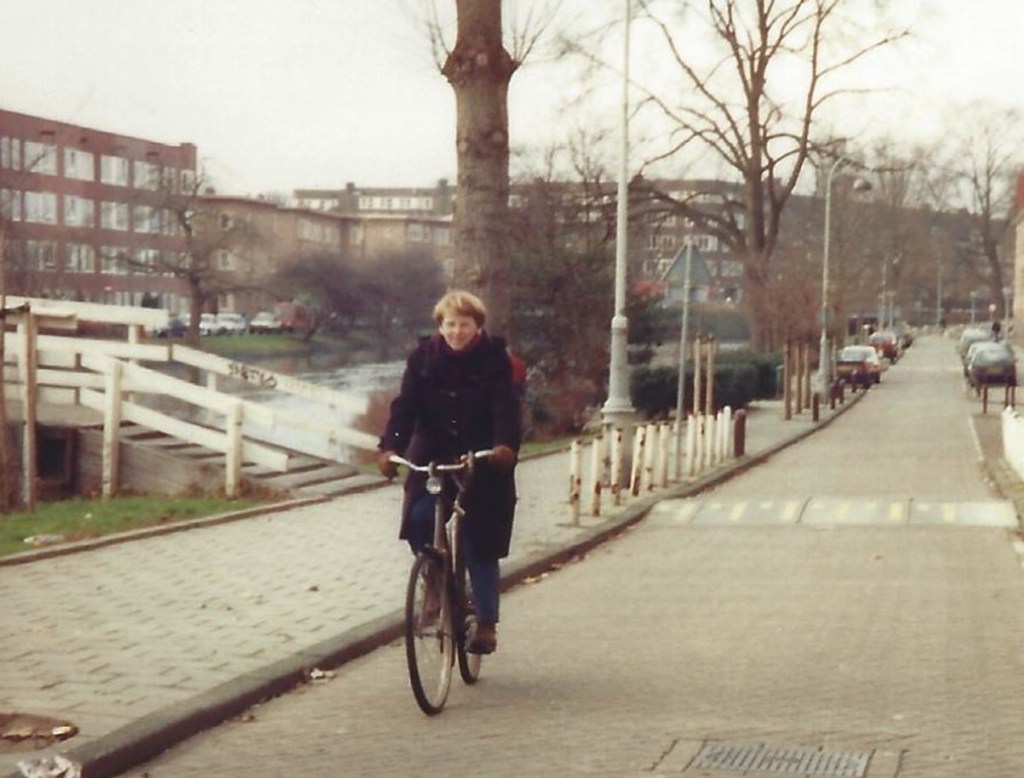
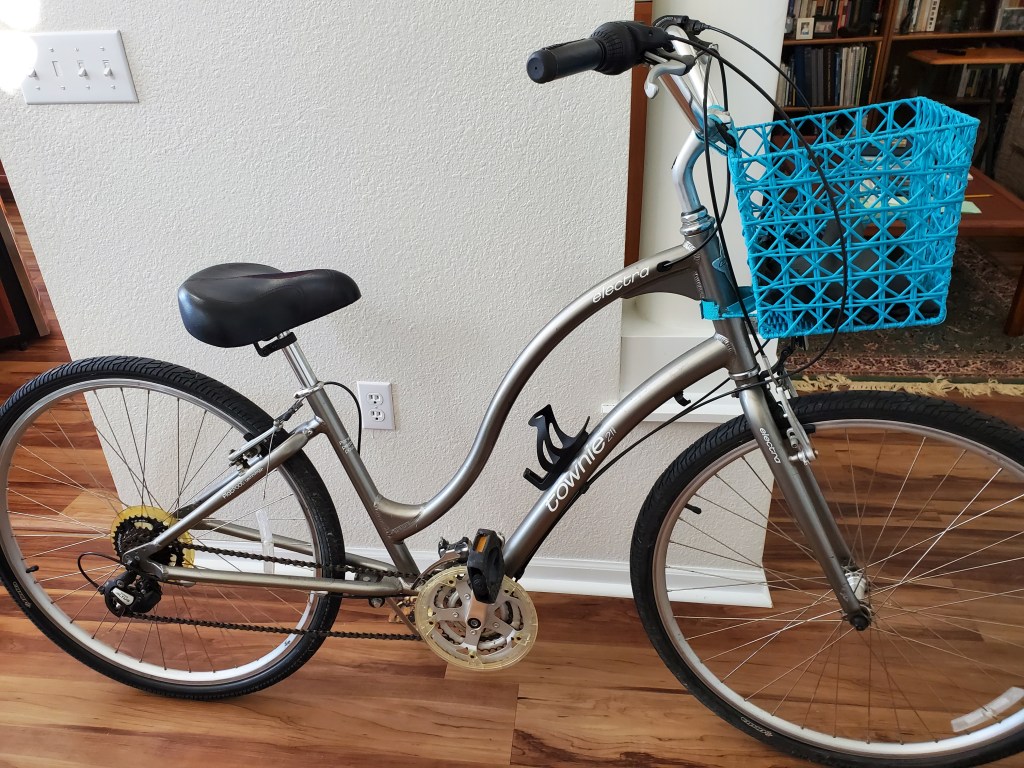
I recall the 50 mile bike race (in a hilly part of Wisconsin) that I managed to finish (first in my age category!) 25 years ago, as if it was yesterday. I no longer ride my bicycle.  In fact, I decided to give it away after we moved to Boulder and I confronted narrow bike lanes on the side of busy roads and mountain-bike ready dirt trails going up steep slopes that had replaced my treasured, leafy, flat bike paths around Minneapolis’ chain of lakes.  The cyclists in Boulder wear a lot of Lycra….Well, I have an old friend in England (even older than I am) who sold his car a few years ago and bikes everywhere on a collapsible/portable vehicle.  But he had long practice on hilly streets in Greece to fortify his balance and still lives much of the year in an urban center where everything he needs is close. 

Part of my decision about the bicycle is not the limitations of my body – it is me, always happiest when in a chair, looking at a mountain—not climbing it. Part of it is also caution: Breaking a major bone at my age is a lot tougher than when I was younger, and I was warned after my hip replacement that I should avoid, at all costs, falling backward in a certain way that I am not sure I fully understand but deeply fear….

But losing the freshness of early middle-age and the elasticity of older but still bike-ready Karen is coupled with an intensely held conviction that I am still a CUTE and FEISTY old lady: The changes are just part of being an ever-emergent human being. I have not been transformed like busy caterpillar, dissolving into nothing in order to break out as a butterfly with a very short shelf life. No, this is all part of the gradual shifts that, rather than transforming me, enable glimpses of how I am still becoming different. Like my pictures, I am evolving toward something that is still me, but changed in some ways. My sense of humor has improved – a lot.  I have a relationship with patience, meditation, and quiet that often makes me feel light somewhere in my heart region.  I have learned to listen to other people rather than immediately focusing on what I should be saying next.  I am not sure that I love more, but I know that I love more deeply.  Joy comes quite easily, in small delicious spurts.  It is all worth the deeper wrinkles, a slightly gimpy gait, and a firm preference for 7-year-old games that involve sitting in a chair rather than on the floor…

Am I raging against the dying of the light- heck no!  Dylan Thomas was not even 40 when he wrote those lines, and hadn’t a clue.  And if my skin—or yours – doesn’t fit as well as it used to…well, we still have a lot of fun.  And we appreciate what hiking poles were meant for. But I’m pretty sure about the bikini…

P.S. — the bikini grandma isn’t me. It was generated using AI with the terms grandma, bikini and fun!

Telling and Retelling the Story

A few weeks ago, I went with a small group on a pilgrimage  to visit Selma, Montgomery and Birmingham.  According to Wikipedia, “A pilgrimage is a journey to a holy place, which can lead to a personal transformation, after which the pilgrim returns to their daily life”.  We are called to a pilgrimage, whether it is to Mecca, Santiago de Compostela, or a 10-day silent retreat in the wilderness,  because it is connected to our spiritual beliefs and commitments.  A pilgrimage is not expected to be fun because transformation is challenging, even when the pilgrim experiences joy – and this was my first.

It is a stretch to think of Alabama as a holy place, but I was called to learn from sites where social and personal transformation occurred during one of the darkest times in American history. I expected that the weight of what I would see would be too difficult to bear alone, and I knew that I would depend on the group.  I anticipated visceral and emotional experiences while immersed in places and events that I experienced, as a white, northern adolescent of the 1960s, only on a small black-and-white TV.   

–National Memorial for Peace and Justice

Some of these challenges were obvious, as we silently crossed the heavily traveled Edmund Pettus Bridge, caught in the horror of Bloody Sunday.   Or while I mourned, in overwhelmed silence, in the National Memorial for Peace and Justice, built as a sacred space to honor over 4000 people who were documented Black victims of lynching between 1877 and 1955.    Each experience was painful, and each day exhausting, but they left me with a desire to go on, to understand more.

 But there were cracks in the darkness, reminding me that a pilgrimage is about being open to something new….So, unexpectedly, I found hope, even while contemplating the vast evidence of the “whitewashing” of my country’s history that began shortly after the end of slavery and continues, only minimally disrupted, in the national collective conscience.  I found hope –in the stories of people who participated in the boycotts and the marches, whose message was less words than the continuing display of commitment, persistence, and the capacity to overcome fear for a wider goal.   And I also came across younger people who are working in new ways.

I found hope at The Mothers of Gynecology Monument, a small, privately conceived and owned enterprise, whose development was the vision of Michelle Browder.  I use the term enterprise carefully, because the small lot in an inauspicious area of Montgomery did not announce its radical message on the outside.  Only when we parked our van and entered did I realize that Michelle, the artist who conceived it, did far more than create monumental sculptures memorializing three slave women whose bodies were subjected to a variety of experiments by Dr. J. Marion Sims, who became famous as the Father of Modern Gynecology.

The sculptures are magnificent, evoking both the dignity and the pain that Anarcha, Betsy and Lucy endured.  And they are technically beautiful, taking welding (not a common art form for women) and use of materials to a level than I have not previously experienced.  Unlike a Calder mobile, with its distinctive simplicity of form and movement, Anarcha, Betsy and Lucy are vividly ornate, surprisingly fleshy given their metallic glow, and terrifying in their portrayal of the consequences of involuntary, unanesthetized surgery.  They are also queenly and stoic, survivors in the face of slavery and savagery.  If anything, I thought of them as contemporary versions of the Greek kourai – the monumental females whose bodies hold up the Acropolis.

Michelle uses art as a starting point for social action – Artist as Change Agent.  Also within the Monument is a modern van, outfitted as a traveling gynecological clinic that she and her staff take out to women who do not have access to quality care.  After purchasing Dr. J Marion Sims former downtown Montgomery office, she removed a plaque lauding his accomplishments — and installed it as part of an sly artistic reimagining of what the experiments might have been like if their subject was a middle-aged White man.  His office is being re-purposed as a women’s health clinic.  Not content to limit herself to Montgomery, Michelle and her collaborators are developing educational centers and annual conferences to examine racial disparities in women’s health. If Michelle – artist, activist, and social entrepreneur – is not cause for hope, I can’t imagine where I will find it.

My pilgrimage added to my old story — that the civil rights movement’s non-violent challenge to oppression nudged the needle of justice toward freedom but left oppressive structures largely untroubled. But it also revealed new stories of subversive and novel ways of upending the story that nothing has changed or is changing.  Knowing the story.  Looking for more within the story.  Re-telling the story in new ways.  Taking the story inside and into the world to speak to our hearts.  That is what spiritual development is about.  My transformations from the pilgrimage continue to emerge.  What I did not expect was hope, yet that is what stands out.

Why Knit?

Photo provided by fellow knitter, Kathy Jensen

When people comment on a sweater that I knit for myself, it is usually followed by “My grandmother taught me to knit, but I haven’t done it since I was a kid” or “I tried it once…”.  This response astonishes me because I know, deep in my bones, that my life is enriched by knitting in so many ways.  It is rarely about the sweater, the pair of socks, or the baby blanket.  It is about a raft of other emotional and embodied experiences that I associate with knitting. 

I learned to knit when I was 11 and living with my parents in Norway for a year. Yes, knitting was part of the curriculum for all students in public schools at that time  – unfortunately, it was eliminated at some point in the 90s.  My 11-year-old school project was a ski hat with a Norwegian stranded design in the cuff…no scarves for me!   And, I still knit the Norwegian Way (which can be learned on YouTube, if you care to, from the adorable aging Norwegian knitting couple, Arne and Carlos).

I have always loved anything made of fabric…tapestries, hand-woven clothing, batik, quilts…there is something that sings to my soul when I look at the way in which women, throughout time, have used whatever they have on hand to create something beautiful – and sometimes useful.  One of my prized possessions is this untitled tapestry by Ann Baddeley, which I call Freedom to Fly.  I first saw a much larger version, requiring a house of a different size and a bank account to go with it (many tapestries are priced by the square inch).  The gallery called me six months later and said that they had found a similar but smaller and slightly more affordable one.

With the advent of a demanding career and children, I stopped knitting for many years, with a few exceptions — a poorly thought-out Icelandic pullover for my husband and an adorable Norwegian cardigan worn by both my daughters (and now several grandchildren).  But my first grandchild (now 19) inspired me, and I haven’t stopped since….I am a regular member of Ravelry.com, an on-line space for knitters, where there are always over 3000 people with me when I log in.  There I can upload pictures of my own projects (147 since I joined in 2008) and look at what other people have done with the same yarn.  We “friend” and chat – there are groups to enjoy specific yarns or designers, and KALs (knit-a-longs) where people enjoy talking about how they are re-imagining a specific project, whether it is yarn substitutions, colors, sizing, or other “mods”.

But there is much more than being part of both a very old and also very current tradition which, with a few exceptions, is female dominated from the raising of the sheep to the designs. When people ask me why I knit, I rarely refer to the objects I have made but to the process of making them.  Just as some people love the preparation of the materials for an elaborate dish – chopping this-and-that, determining the garnish, collecting the individual spices – I linger in on-line and physical yarn stores, murmuring over colors, textures, and dreaming of what COULD be done with them, even if I know that I will not go any further than the murmurs.   Like a cook loves their knives, I like all of my 50 pairs of needles, the small scissors that I use to clip loose ends, and the various colored markers that we knitters use to keep track of complicated projects.  In other words, the STUFF of knitting is appealing to me.  When we lived in Minneapolis, Dan took me to Steven B’s, lorded over by the self-designated Glitter Knitter – for a special a yearly birthday treat and a prize skein. 

But more than that, we knitters share an understanding of knitting as therapy.  I try never to knit anything that has an absolute deadline (your gift WILL be late!) because I have enough deadlines and appointments in the rest of my life.  There is something about the feel of a delicious yarn passing through the fingers that excites the senses.  Then, there is the rhythm of it – when the stitches just seem to flow and you lose track of time.  I think of it as akin to walking meditation.  There is curiosity and challenge when you want them – always new techniques, different ways of making the wool do what you hope. 

More important is that knitting is one space in my life where I rarely judge myself.  If I make a mistake – well, it always happens and, after the first unprintable exclamation, I contentedly Tink (knit backwards) until I can fix it.  Because the process, the excitement, and the tactile elements are most important, if the final product is a bit disappointing – well, someone who visits Goodwill will probably find it warm and cozy – and maybe even like it!  Or, you can always rip it all out and use that beautiful yarn for something else…

I don’t recommend knitting unless someone is really interested…but I hope that you find something equivalent in your life, something easily available that will give you the sense of being centered that I find when it is just me, a ball of yarn, and an idea of something to make with it.

From woolyknitter.blogspot. (Credit : pinterest.com)