“I’m 64, Should I Give Up Trying To Be Successful?”

Believe it or not, this is a real question, posted to the Quora feed.  What followed in a response was a post by a young woman about her father.  The upshot of her comments was:

He taught me that you can always succeed if you believe you’ll succeed.

So believe in yourself. I know that’s cheesy, but I’m currently in class with a 74-year-old woman who’s getting her psychology degree after being a housewife for 45 years. My dad was five years from retirement, and then worked an entry level job. People start over at all stages of life. If they can be a success after so long, then anyone can.

This was apparently a hit with the readers, garnering 2,700 likes and 64 shares when it appeared in my inbox.  But, if you read through the heartwarming story, her father “started over” when he was 50.  Life looks different at 64.  Or 74.  

But back to the question:  What does it mean “to be successful” much less “giving up” on trying to be successful? 

“To be, or not to be?  There is consensus that Hamlet is talking about enduring the pain of his life versus the calm of death.  But (for me) “being” is more than merely “living” and one of our biggest jobs in moving from living to being is to consider success more deeply.  I like to use the Tarot to understand this work – and to remind myself of the stories that I want to tell myself and others.

Juggling with Joy in Early Adulthood — When I was in my 30s, what I wanted most from my life was to experience my young children’s development and maintain a modest professional profile (which meant a job doing something that I liked).  In other words, success was measured primarily by short-term joyfulness and maintaining a do-able balance between family and work.  It was all about balance….and dancing a little while doing it.

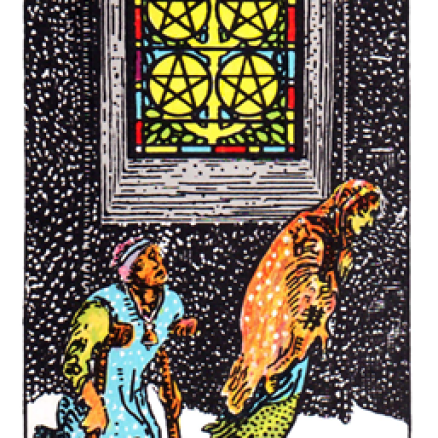
Fast-Forward to My Mid-Forties: Craftsmanship…The kids’ needs were less immediate and they were busy with friends and school.  I, on the other hand, was experiencing external “success” at work, with increased ego-stroking responsibilities and annual reviews that placed me among the “exceeds expectations” group in all of the areas associated with being an academic (the three-legged stool of teaching-research-service).  I focused on skill and artisanship at work.  At the same time, my life was not in balance.  I traveled a lot, focused on my own learning, and believed (incorrectly) that my family needed me (or even wanted me) less.  Without thinking too much about it, these external markers increased in importance over the next decade.  While the focus on skillful work resulted in lots of tokens to hand on the walls of my office, this card does not exude joyfulness….

image

A Slow Crush..My success contained the seeds of failure. While busily crafting at work, I gradually became accustomed to before-and-during dinner drinks, which allowed me to relax and avoid thinking about my marriage or the daily challenges of parenting teenagers.  Work was challenging but manageable, but not the emotions and preferences of other human beings.  I managed to hold on to the external trappings of success but lost personal direction and Shakespeare’s “not to be” became an increasingly attractive option.

One of the consequences of depression is a generalized sense of meaninglessness — what better a definition of being unsuccessful?  I looked OK on the outside, but the image captures the way life felt on the inside.

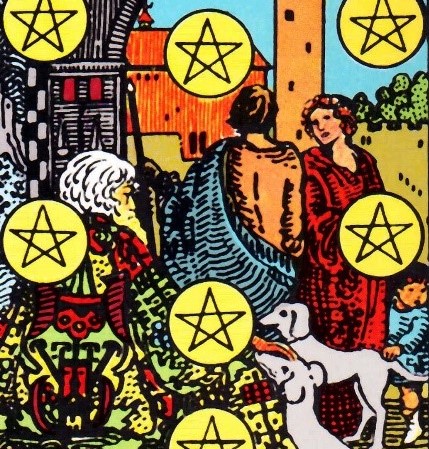
Comfort and a Different Success? Twenty years later, my life had changed radically again, with a new (and peaceful) marriage, a position within my work as an “elder stateswoman” whose job was to nurture the development of others, and grandchildren.  This Tarot card represents the abundant fruition of success and a life finally almost back in balance.  I think that in this image I am both the older person on the left and the woman on the right, in conversation (with a student? My husband?).  Bridget, my oldest grandchild, is tugging on my dress, while beloved dogs wait to be petted.  Who could ask for more in this life?

This redemptive card is part of the story of dancing while juggling, honing a craft, and ignoring relationships and self.  But, in my mid-60s, much life remained. 

Becoming New Again? So success (or failure) has meant very different things to me over the last 40 years.  Of course I cannot know what further success might look like – it is easy to tell a story after the fact, but predicting anything is a challenge.  And rather than hoping for “success” I have to keep reminding myself that I am likely to find a gift if I am willing to accept the mystery and not try to force the future. 

To return to the Quora post, what appealed to me about the story that the young woman told was not that her father founded a successful business in his 50s.  Rather, it was that he was willing to take a risk:

He said ‘I don’t think I can make this work anymore. I might have a chance if we move….Within a month, we left New York and drove 16 hours down to Georgia.

I am not sure where I will find my psychological or physical equivalent of Moving-to-Georgia.  But, I hope that I will wake up one day, and have a similar insight.  And be willing to act on it – with abandon and “wise innocence”, like my favorite Tarot card. 

The Fool has found something lasting – a “successful” understanding of joy that emerges from deep inside, seemingly for no reason at all. But he is also embracing adventure — more than willing to take a new risk.

Good News or Bad News: A Matter of Perspective

“The good news is this is the last time you will ever have to experience this procedure.”  Those were the words that lingered in the air as my physician, Angelina, left the exam room.  You would think I would be happy to hear her statement. The truth is I think the prep work is disgusting.  Not to mention the flexible camera lurking around in your body attempting to detect abnormalities or disease.  Colonoscopies are no fun, period.  Yet, that is not what really bothered me.  When Dr. Angelina left the room, I begin to ruminate on the meaning behind her words.  “What is she really saying?”  My internal critic was ready at hand with an answer. His snarly voice shouted in my ear “I think she is trying to tell you in another ten years your life will be irrelevant, or possibly over.  You are definitely on your own.”

Undoubtedly, Dr. Angelina had no idea how her words landed with me.  They triggered many repressed fears that I wasn’t even aware of, yet somehow they had taken up residency in some compartment of my mind.  Now that door was unlocked and stood wide open accompanied by Charlie the naysayer, my zealous critic. “Face it, you are much older than you would like to believe”.

I have always thought of health is a private topic, one in which I’d would prefer to keep that way.  Particularly when other well-intentioned beings alert me to the fact that I am getting older.  Even my nine-year-old grandson, Auggie, takes great pleasure in reminding me of my age. Especially since he has finally come to the conclusion that indeed I am older than his father.  When he was three, he was quite certain it was the other way around. This was due to the fact he believed his father was much smarter than I am; therefore he must be older. Since then, he has discovered the truth. He now knows I am older than his father. Somehow in Auggie’s eyes I still know less.  How can he have it both ways?

I remember the first time I read the British children’s book The Velveteen Rabbit. It was in children’s literature class when I was in college.  At the time, I didn’t relate to the passage where Margery Williams reminds her readers through the voice of the Skin Horse “By the time you are Real, most of your hair has been loved off, your eyes drop out, and you get loose in the joints and very shabby.  But those things don’t matter because you’re Real. You can’t be ugly, except to people who don’t understand.” I fell into the category of those who didn’t understand.  I do now. 

Today, I find I’d like to hold onto Mark Twain’s saying that “Age is an issue of mind over matter.  If you don’t mind, it doesn’t matter.”

Societal norms often tell a different story. These norms account for why people in an older age group feel they experience isolation and discrimination. I believe it is because they struggle with their identity.  They find themselves wrestling with a loss of personal status, loss of power and control, influence and regard.  Real or unreal they all feed into the subtle formation of limiting beliefs.  Many don’t have the skill set to turn limiting beliefs into expanding beliefs thus they get layered on top of one another. Eventually they are overpowered with beliefs that keep them stuck.

Twain is right — it is mind over matter.  However, he forgot to say it isn’t easy.  It takes commitment and the willingness to create a healthy lifestyle, beliefs, habits, and expectations.   

For me, I believe the only way that can happen is when I don’t allow the naysayers in my life to get in the way.  I don’t listen to my critic or people in my life who attempt to indoctrinate me into their lifestyle, their beliefs, their expectations.

Perhaps it all starts each morning when I look in the mirror.  I can ask the person peering back at me:  Who and what do I want to see or be today? What can I explore, rediscover, or investigate?  I think I’d much rather live in that world, the world of wonder and hope even if like the Velveteen Rabbit my joints are loose, and some days I do feel a bit shabby.

Is There Something Wild and Precious in All of Us?

Mary Oliver’s line, Tell me, what is it you plan to do with your one wild and precious life? seems to be quoted everywhere of late. It speaks of living a life of one’s own design, a design that unleashes the wild and precious rather than the banality of slugging through our days intent on keeping a roof over our heads and food in our bellies. It speaks of something wondrous that’s out there if we only let go of our need to conform and live from our true center, our spirit. 

Not too far into retirement I found myself often wondering what was wild and precious but dormant in me. My life was not exciting.  I moved between my own home, the library, the health club, my children’s homes, and the homes of friends, with an occasional trip out of town.  Not the stuff of wild and precious, of that I was certain. And here I was, free to find the wild and precious and live it.  

But how do I find that which lies dormant in me, that which yearns for expression in my life? Or perhaps I already have it, perhaps in the routine I’ve pressed upon my days. I suspect, however, that routine, while affording stability, suppresses experimentation about what might be dormant. . . and yet “a girl can dream.”

The dream went something like this. . .

She spent the entire summer dreaming of Wales. It made no sense, this yearning to leave her settled life, her children, her easy routine. Yet in her fantasies, it made all the sense in the world. She could start over, no, not start over but be born anew, without memory in a lush, beautiful place, where people speak in a language that she would have to learn—as a baby learns language from birth.

In August she booked her ticket.  She bought an enormous suitcase and packed it with her clothes. She told her children she was taking a long trip—how could she tell them her truth, that she sought a new land, a new beginning? How long will you stay, they asked, but she avoided the question. I’ll be back when I’m ready. . . 

The plane landed in Heathrow, not Wales. Wandering a bit felt right. Like Odysseus seeking his home, she sought a new home and an adventure on the way. Why had she brought such a big suitcase, she thought as she pulled it outside to find a taxi to the train station. What had she been thinking? But wasn’t that the point? To not think but to wander and live on the way?

The taxi driver left her suitcase on the curb, and she dragged it inside. The train timetable clicked with suggestions. Where in Wales should she go?  She settled on Llangollen—how many words have four “l’s”—“l” for living. She pulled the suitcase to the platform. She would need to drag it through two train changes, if she was reading the itinerary correctly. Maybe she should just leave the suitcase here. It was still baggage from her old life.  She could buy new clothes in Wales—Welsh clothes. But still, money was money, and she wasn’t sure how far hers would go in her new life.

The train ride was exhausting. For each of the two changes, she bounced the suitcase down to the platform and dragged it up and onto the next train. She slept when she could and stopped counting stations, staying awake just enough so as not to miss her stop. 

And the dream of a wild and precious life stops somewhere about here. . . 

Is this what it would be like? Is it real or an escape? What I wonder is whether and how we lose the will to live that which is wild and precious in service to work, family, security, and whatever else haunts us. Then, suddenly—and it seems sudden—we are retired, free but with baggage that we are reluctant to leave on the train platform, baggage that must be hauled up and down with every new step we take. And how do we reconcile baggage with possibility?

Image result for old woman with big suitcase

Close a Door and Begin Again?

………………………..

The (Wo)man who moves mountains starts by moving stones

-Chinese proverb

This cartoon spoofs a saying that annoys me almost as much as “Everything happens for a reason”.  My past was more happy than disappointing and I do not expect a future full of failures and distress.  BUT it is often the very idea of CLOSED DOORS between the past, the present, and the future that bothers me.  And that has not changed with age….

Doors opening – great!  The thought of a door closing has always felt wrong.  I like to move forward with the belief that the paths that I have already walked are places that I can return to as long as I do so regularly.  When I think about the often-quoted Chinese proverb, I am reminded that if I am moving mountains by moving stones, I have to keep going back for the next stone.  That means revisiting an ever smaller mountain.  Sometimes for a long time.  Eventually the mountain is so changed, that even when I go back it is not the same….and I may choose not to go back.

But I also think about the doors that haven’t closed because I go back to something different but still alive and engaging.  I can reach out to friends I haven’t seen in years – and we mix conversations as if we had not changed even as we are talking about what has happened in the intervening years.  I can reread Anna Karenina for the 5th time (I believe in reading it once every decade) and, although it is the same book with the same characters, I experience it as new and different. 

In other words, I feel as if my backpack is full of things that I carry with me and I can therefore go back with reverence but without wallowing in dusty memories (as Karen Martha warns against in Nostalgia 101).  Going back and re-opening doors is a deliberate practice, rather like walking the public footpaths that traverse private property in England in order to keep them open.  As Sam Knight remarks, “Retrieving a lost path requires a certain cussedness” and (in my experience) -the willingness to climb over stiles and between someone else’s laundry.   I have cussedness to spare, and enough friends (as well as a patient husband) that I get to tell the same story, with different acquired embellishments about the path, more than once.

Of course, that is also nonsense.  One of the mixed blessings of the internet is that it allows me to visualize closed doors in a very literal sense. The antique house that I still love (probably more than any I will ever have) was sold in 1986.  Sometimes when I have nothing else to do I Google “31 Hancock Street”, and recognize all of the things that made me love it (including the back door into the kitchen).  But it is not mine:  someone else owns it.   Even if I knocked on their door and they welcomed me in for a look, I would not be revisiting my house but one that has permanently changed and where I would not feel at home (which is why I don’t look at the pictures of the inside, which also leads me to unnecessary judgments about the last owner’s taste in colors, furniture and kitchen design…..) 

The message of “door closes-door opens” is annoying because it is often true even though I don’t want it to be.  Although difficult, the move from Lexington, MA to Minneapolis, MN opened many doors professionally and personally, and I am not going back. My daughters are in their 40s, and no matter how often I look at pictures of them when they were young, I love seeing them as parents and emerging wise women rather than as my babies. And I want to leave an institution and work that has given a lot of meaning to my life.   

I moved a lot of stones before deciding to retire, but they are now piled in the hallway between work and what comes next.  That no new door has opened yet is a fact.  I have no plan, although most people tell me that it is a mistake to retire without one.  The image of moving stones rather than mountains comforts me, because, although I have only poorly formed ideas about the path I am walking, what parts of the mountain I am trying to disassemble, or whether moving those stones will lead me to a door that is now hidden I am still moving something.  New energy.  New hope.

I started messing around in my friend Jacqueline’s studio and I have pieces that I painted in my living room.  I would continue moving artful stones with Jaqueline as my guide, but she inconveniently lives in the Netherlands.  Should I keep putting stones in that pile right now or defer it?  I have taken several years of classes to become a life coach, although I still don’t know exactly what I want to do with the new skills and ideas that I embrace.  In both cases, a “set in stone” identity as an expert has shifted to a new identity of being an even more curious novice.  Buddhists call it beginners mind – and I have discovered that it makes me more playful and less worried about the future.  As a novice, I walk through an open “being” door and leave behind a “doing” door (that is, at least temporarily, still open).  Does that count?