Well Used and a Bit Broken but Beautiful….

I was thinking about our guest blogger Ruthie’s recent post and her reference to the Velveteen Rabbit – one of my top favorite children’s books.  Our granddaughter Opal is approaching three – old enough to be past board books and just at the right age to get the copy that we already bought for her.  Of course, the point of the Velveteen Rabbit is we become more alive because we have been loved, but love has a way of being tough on us.  Toys have their fur rubbed off – we accumulate wrinkles, sags, and rusty body parts.  Since I recently finished sending my grandchildren painstakingly designed and seriously customized digital Valentines, both aging and love are on my mind.  I think, in particular, of the glow in a picture of our somewhat older friends, Belle and Bob, as they held their great grandchild.  And, how just a few years ago, another young child looked at Belle and asked with great seriousness, “why are there so many cracks in your face?” – which caused her to laugh uproariously.  Love and aging, love and aging….

photo from Wikimedia commons

I remembered today that there is a Japanese concept that places greater value on a beautiful piece of pottery that has been broken and repaired than one in its perfect original form.  My Japanese is limited to a few phrases like arigato (thank you) and konichiwa (hello) so I of course had to look it up.  The word is kintsukuroi, and like most Japanese phrases, it thick with meaning.

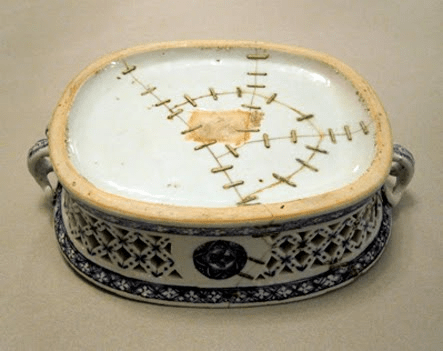
The photo of an old dish shows how skilled artisans repair broken pottery with precious metals that accentuate rather than hide the flaws, an esthetic that is foreign to the increasing value placed on the new, the currently fashionable, and the disposable.

My own feelings about repairing and reusing are mixed, at best.  I like to say that I dress at a combination of finds from resale stores and art fairs where I get one-of-a-kind objects to put on my body.  I never throw or give the artwear away. Instead, if it starts to look dated, I take it to a tailor or just mix it up with something else.  An old secondhand designer jacket goes to Goodwill, however.  I think about the old-fashioned skill of darning a sock.  The last time I did that was probably 50 years ago, in a pair of socks that I knit for my father.  However, as a knitter, I know that the socks that I have lovingly made are cherished by specific feet, but are unlikely to be darned unless I ask for them back at the sign of the first hole (which would be viewed as excessively controlling by some of the recipients….). And I know a store where I can take precious hand knit sweaters to be repaired when the task is beyond my skill. 

Kintsukuroi makes me think about these habits and their limitations.  I never really considered why I cherish some things that are old and worn (for the stories and the memories – or because they are simply beautiful) while considering others to be disposable.  One writer claims “Kintsukuroi is a way of living that embraces every flaw and imperfection.  Every crack is part of the history of the object and it becomes more beautiful, precisely because it had been broken.”  Ahh, there is the Velveteen Rabbit again — and the connection between kintsukuroi and another Japanese concept, wabi-sabi, which sees beauty in transience and imperfection.  The esthetic of wabi-sabi includes an appreciation of “asymmetry, roughness, simplicity, economy, austerity, modesty, intimacy, and appreciation of the ingenuous integrity of natural objects and processes.”

While neither kintsukuroi nor wabi-sabi are immediately accessible to an American, they inspire me to not only “accept the things I cannot change” but to embrace them.  I know that age, brittle bones and wrinkles are part of becoming a real grandmother, as long as they blend with wabi-sabi’s appreciation of modestly, intimacy and the integrity of human life – part of which is aging (and dying).  The esthetic of loving well is not a visible one, but is enhanced by a mandatory shedding of the excessive vanity of my younger adult years.  Moreover, in the last few months, I have learned about repairing some of the injured parts of my right side in Avita yoga, which focuses on gradual healing from the inside out.  The shoulder that ‘froze” and the knee that suffered a bone bruise were treated in physical therapy, but Avita requires me to fully examine each tiny restriction and focus on release rather than a “fix”.  I feel as if I am applying gold to the broken bits in a way that allows me to feel the beauty of the repairs. 

So, armed only with the vague knowledge that the Japanese understand that becoming whole requires both letting go and loving the imperfect, I have been engaging in the process of emotional and physical self-repair.  Of course, I am left with the Western desire for more.  I am not jealous, but know realistically that I may not hold a great grandchild, since my oldest granddaughter is just turning 15 (and by the looks of it now, will take her own sweet time settling down…).  That makes me feel some regret that I didn’t have children until I was in my 30s.  When it comes to my face, I often stand in front of the mirror and pull back at my sagging cheeks, wondering what it would look like if I had a face-lift (which is, in essence, a mechanical “repair” rather than a new face….).  Nevertheless, I remind myself that imperfection, brokenness and aging have their own beauty if I can slow down and let it reveal itself.  

Enjoy, Enjoy. . . Rosemåling

To begin, I need to establish that I am not artistic. I’ve read Drawing on the Right Side of the Brain, and I still can’t draw, even though I sincerely did the exercises in the book. I’m not drawn—ha—to trying to draw either. It’s not something that lies dormant in me (that which I’m constantly excavating in retirement), but I do like making things—I can still picture the Valentines box I made in 5th grade, a shoe box decorated as a bee (“Bee” My Valentine). It won first prize. I love making a fine edge on an apple pie, knitting a scarf that’s a perfect match to my jacket, like none I could buy. I once made nightgowns for my granddaughters and matching ones for their American Girl dolls.

Which brings me to the subject of this blog, rosemåling, a Norwegian folk art that dates to about 1750. Although different regions developed different styles, most of which are still taught and practiced, all emphasize ornamental flowers, structure, and the occasional dramatic flourish. After discovering my Norwegian relatives on the island of Radǿy, in the county of Hordaland, Norway, I wanted a tangible way to remember and honor my Norwegian roots, so I decided to try rosemåling.

Now I must confess that I’m not fond of kitschy stuff, and most of my exposure to rosemåling has been of items that I wouldn’t necessarily want in my home—the flowery cheese board, decorative plates, Velkommen signs, all with an abundance of hearts and sweet birdies that can overwhelm a house. I’m also not particularly drawn to big swirls and Rococo styling, which characterize some types of rosemåling, so I knew it might be a stretch to learn the craft—after all, what would I paint if I don’t like the patterns and objects? I promised myself that I wouldn’t do any borders around the ceilings in my house or force crafts I don’t want on my family and friends as Christmas gifts.

I signed up for a weekend class at the North Folk House in Grand Marais, Minnesota—I’d learn just about anything to spend a weekend in that lovely place. I had to paint something, hopefully not kitschy, so I started with a board and Christmas tree ornaments—who doesn’t like an ornament?

Turns out that even if you’re not artistic, you can learn enough to do a credible job at rosemåling. Its techniques can be taught, practiced, and “mastered.” As Shirley, my rosemåling idol says, “It’s 95% practice and 5% talent.” After the weekend I had two ornaments and some awkward leaves painted on a board. Not much, but I knew I wanted to learn more.


I later discovered ongoing classes at Richfield Community Education, just down the road from me. It’s a large group of women and a few men who all know and support each other in their art. Ages range from teenagers to retirees. I was immediately welcomed to the group, and whenever I balked at something too flowery, they reminded me that it’s my art, and I can do whatever pleases me. We meet on Tuesday evening or Wednesday morning in a dedicated classroom. In the summer, we paint outside at Minnehaha Falls. Although conversation is limited, we know each other well enough to support each other when someone is care-giving a spouse, making items to sell because money is short, or bringing up grandchildren. We always take a break and enjoy strong coffee with Norwegian goodies—lots of brown cheese, mormokake, sandbakelse, and, of course, lefse. It’s a community, of rosemålers, yes, but also of caring people.

Aside from my modest first projects are the many gifts rosemåling has given me. The value of disciplining myself to learning techniques and then practicing them over and over; the quiet in my mind as I work totally absorbed in pulling out a flower petal or doing fine line work on a leaf; the calm I experience hours after the class has ended; and the feeling of accomplishment that comes from learning something new later in life. Best of all, realizing that I don’t need to be an expert to totally immerse and enjoy myself. I leave class every Wednesday carrying two heavy bags of paints, brushes, oils, brush cleaners, carbon paper, tracing paper, practice boards, etc. with a sense of time well-spent.

And then there’s Shirley, my model for the good retirement. She’s a North Dakota school-teacher turned prize winning rosemåler. She keeps the craft alive, passing it to the next generation.  A tiny, compact, Norwegian woman, who brooks no nonsense. For example, even though most of us carry heavy bags of supplies, the school wants us to walk through the building rather than using a door near our classroom.  Shirley says it’s a rule meant to be discreetly broken.  On the other hand, some rules cannot be broken.  I’ll never forget hearing her say to one of my classmates, “Oh no! You can’t use that blue! That’s a Swedish blue. You need to paint over that!”

But where does my experience fit in the larger context of retirement? Retirement gave me permission to try rosemåling. I wouldn’t have had time or the inclination to add something to a busy schedule when I was working. And now, here I am, enjoying the community and discipline of learning something new. I’ll never be a prize winning rosemåler, and I doubt I’ll come to like some of the kitschy stuff I see people painting, but I have a new respect and understanding of what makes art “folk,” the idea that common, minimally talented people can create art of their own for the pure enjoyment of doing it—for themselves!

It Started as a Chat Between Friends…..

Two years ago, Dan and I took a grandparent trip to Paris and Normandy organized by Road Scholar. Aside from the pleasure of experiencing the world through 14-year old eyes, I became curious about the origins of Road Scholar, a non-profit organization committed to “knowledge seekers and explorers, united in the belief that lifelong learning is a vital part of overall well being..” Clicking on the Our Story tab in their website reveals that it started with a random conversation when two people at the University of New Hampshire were musing about the Scandinavian folketshusen that provide community-based adult learning and the value-for-money of youth hostels. Although it has evolved from its bare bones, learning-focused approach to travel for older people, it is still a non-profit that incorporates scholarships for those whose finances don’t accommodate much travel. 

This got me thinking about social entrepreneurs, or people who come up with new ideas whose purpose is making a difference rather than making money.

Last year I had the chance to catch up with my old friend Jan Hively, as she reappeared in Minnesota after giving a workshop at the Saging International Conference.  We were at a reception in a restaurant where I knew almost no one, although I felt as if I ought to know almost everyone because they were all roughly my age, long-time residents of the Twin Cities, and were in education or the helping professions.  Hmm…. Is this more evidence that my life is littered with missed opportunities for networking with interesting people?  Almost everyone that I talked to (once I managed to scrape myself out of my modest introversion) were (1) semi-retired or retired from a first career and (2) starting something new – often with others in the room – where doing good rather than making money was the goal.  In other words, I was in a crowd of what I could only call social entrepreneurs.

When you google social entrepreneur, however, you get a different view….the first links are degree programs in business schools and lists of successful social entrepreneurs who are also making money.  Now I have nothing against making money while doing good, but when you click on Forbes articles, you get a prominent definition that adds something new:  someone who uses business skills to solve social problems.  Those were not the people I met, few of whom had a background in business or were particularly interested in commodifying social good. 

It was not hard to find nuance when I probed my Google search more deeply.  The deep thinkers at Stanford University have come up with the insight that entrepreneurship “connotes a special, innate ability to sense and act on opportunity, combining out-of-the-box thinking with a unique brand of determination to create or bring about something new to the world.”   They go on, noting that entrepreneurs attempt to ““shift economic resources out of an area of lower and into an area of higher productivity and greater yield.”  What comes to mind are, of course, microloans to women starting small businesses in developing countries (which have proven remarkably effective in promoting gender equity)l  or the Global Soap Project that recycles semi-used bars of hotel soap to improve health in underdeveloped areas.

But what are economic resources?  Like most people, my first thought goes to money.  Then I quickly channeled Jan Hively again…

I have known Jan, an exuberant role model for successful aging, since the 1990s, when we worked together on programming and outreach for the College of Education and Human Development at the University of Minnesota. At that time, Jan, who was in her late-60s, was completing a doctorate looking at the contribution of older people to the well-being of rural communities.  Her work, which demonstrated that the unreimbursed labor of older people was critical to maintaining villages and small towns, whether as volunteers in school or at the library or babysitting for grandchildren so that their parents could hold down several jobs.  Jan drew on her work to create a Minnesota Vital Aging Network – which is now an international movement dedicated to grassroots engagement of older people in their communities.  Almost as if she were addicted to staring new initiatives, Jan went on to found SHIFT! , (an organization that provides support to boomers who are seeking employment, looking at retirement, or finding community), the Pass It On network, which is focused on peer learning for older people, and the Life Planning Network, which links professionals who support vital aging and provides professional learning opportunities to them.

Each of these organizations is non-profit, most operating on volunteers; none seem to genuinely meet Stanford’s definition because there is no significant monetary financial “yield”.  They are grassroots, locally organized and maintained, and are committed to growing interpersonal community as well as “doing good” and measurable economic value.  They are distinct from the business skills driven model and “yield” because they are, at their core, part of a challenge to redefine aging from inevitable but increasing diminishment (the current dominant and ageist perspective).  She, and other social entrepreneur “of a certain age” focus on how shared wisdom promotes a common good. 

Not everyone can be an older social entrepreneur with global impact (like Jan) but everyone can find a way to contribute to grassroots social cohesion. The premise – than small local actions can lead to large consequences – is particularly relevant for people who have more time than money.  People like me. Who knows how many new initiatives began at that reception, where everyone these was drawn to the vision of being part of that entrepreneurial social movement? 

A Cabin In My Life

I consider myself reasonably tech savvy. I had a smart phone before my kids did—a Palm Pilot. I still remember my son saying, “There’s nothing we can give mom for Xmas that will make her as happy as that Palm Pilot has.”  And how right he was! I loved my Palm and my heart was broken when it was replaced with the androids and iphones. 

I’m the grandma who hides her phone under the table when my grandchildren are told, “No phones at the table.” I lease a car so I can have the latest technology—who wants to drive without it? I prefer texting to a phone call—why waste time on all that chit chat.

Savvy about using technology, I may be, but for the nitty gritty stuff, like malware, I’m not so informed. For starters, I was not aware of how easily it slithers onto your computer when you’re trying to download a video game for your step-grandchildren, unabashedly trying to win their favor but instead wreaking havoc with your files.  I took my laptop to my son, thinking he could fix it. After he clicked a bunch of screens I didn’t know existed (younger people don’t use the mouse; they prefer the keypad), he declared it beyond his scope of expertise. Then I took it to the Geek Squad at Best Buy. That’s when I found out that I had a virus/malware (they are not the same thing)—or my computer had it, and for $149, they could fix it—the catch was that they’d need to keep it three days, until Saturday afternoon.  And for $199 I could get protection. I, who thought protection was something men wore, signed up for the whole shebang.

I went home, immediately bereft, what would I do without my laptop? After a period of mourning, watching Home and Garden TV to distract myself, I decided that I could read a book —which I haven’t completely given up on. And as much as I like technology, I don’t have a Kindle or iPad—I like turning the pages, smelling the ink, or that little hint of mildew on older library books. I read through the afternoon, and then I decided to make a lovely dinner.  After dinner, I cleaned the closet with my tablecloths—decluttering, who needs all those now that my children are grown with children of their own. Then back to reading—I finished When We Were Orphans and started The Dutch House—all on the same day, no dragging out the process over a couple of weeks. 

Thursday was troublesome.  An entire day to entertain myself without a laptop.  Tutoring in the morning and time for a real workout and sauna afterwards—and I wasn’t looking at my watch the entire time, rushing to finish. More reading in the afternoon, and then a cleaning of my desk area—this no laptop stuff had potential.  

On Friday I realized just how much time I spend on email, Facebook, Instagram, karensdescant, news sites, etc., with not much to show for it. My shoulders started to unkink, with the help of the PowerPlate at the gym. Meanwhile, the Geek Squad called to say my computer was ready for pick-up, but with the catch that I’d need to schedule a new time if I wanted it sooner than Saturday.  But there were no new times that fit my schedule, so I’d have to wait for my appointment on Saturday. Gee, too bad, but I realized, I didn’t want to pick it up. I wanted another half day of freedom from my laptop addiction. 

In what felt like borrowed time, I observed that tasks that I delay day after day—like cleaning closets—don’t look so bad when the attraction of mindless roaming is removed. Time also seemed more expansive, and best of all, I rediscovered reading until my eyes give out—like I used to do under the blankets with a flashlight as a kid. I also wonder what would happen if I abandoned the computer for—dare I suggest—over a week—including the phone, which is really a tiny computer.  

Much has been written about declining attention span as we age. Quoting from the literature (as we academics are inclined to do) Subjects over 60 years of age show progressive slowing in processing of complex tasks and a reduced capacity to inhibit irrelevant stimuli (Commodari, Guarnera, 2008), what intrigues me is not so much the slowing—after all, our brains have much to sift through—but the “reduced capacity to inhibit irrelevant stimuli.”  If there was ever anything perfectly designed to generate “irrelevant stimuli” it has to be the computer!

My son has banned TV at his cabin, and his internet is terribly slow. One needs to be quite patient to read email or surf, and patience is not something I equate with technology. The result is that when the family visits, we hike outdoors, play games, listen to his LPs (he is a bit of a Luddite) or read. It’s not uncommon to see every chair or davenport occupied by someone snuggled under a comforter, book in hand. 

So where does that leave me? Definitely respectful of the power that innocent-looking, laptop has over me. Power always suggests to me getting out from under it. Two weeks later after the incident, I am more mindful of monitoring when and how I use my computer and phone. It’s supposed to serve me. . . not me, it.

That said, the first Monday after bringing my heart throb home, I was at my desk, typing on it, checking email, taking a minute to peek at Facebook. . . .  All of which reminded me that I need to keep the cabin in my life.

A person sitting at a desk in front of a computer

Description automatically generated