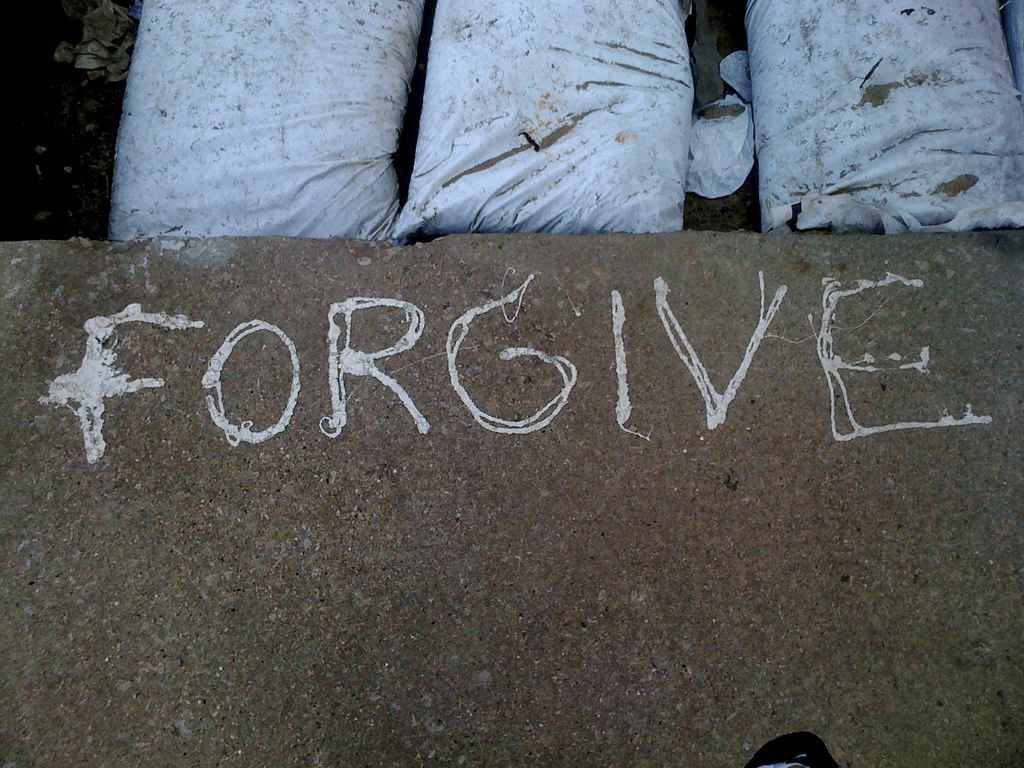
Forgiveness

For the next two blogs, we two Karen’s will focus on forgiveness. It is a part of growing older to review one’s life, and giving and receiving forgiveness inevitably surfaces.  But what is forgiveness? Here’s a psychological definition—nicely precise.

An act of deliberately giving up resentment toward an offender while fostering the undeserved qualities of beneficence and compassion toward that offender. (Freedman & Enright, 1996, p. 983).

Here’s a philosophical take, richer with the nuance implicit to forgiveness.

Forgiveness is one of the really difficult things in life. The logic of receiving hurt seems to run in the direction of never forgetting either the hurt or the hurter. When you forgive, some deeper, divine generosity takes over. When you can forgive, then you are free. When you cannot forgive, you are a prisoner of the hurt done to you. If you are really disappointed in someone and you become embittered, you become incarcerated inside that feeling. Only the grace of forgiveness can break the straight logic of hurt and embitterment. It gives you a way out, because it places the conflict on a completely different level. In a strange way, it keeps the whole conflict human. You begin to see and understand the conditions, circumstances, or weakness that made the other person act as they did.

John O’Donohue, excerpt from Eternal Echoes

Part 1: Forgiving Our Mothers; Forgiving Inter-generational Sorrow….

This blog is about forgiving our mothers — and healing.  Too many women have experienced emotionally or toxic relationships with their mothers.  We are not among them. Yet, every childhood has its scars, and many women we know trace these to their mothers rather than their fathers. 

Both of us grew up largely in the 1950s, when parenting was quite different from today. Because of the norms of the time, our mothers were more present in our lives. Fathers were out making a living. Additionally, parents had fewer resources, and children expected, at least in part, to raise themselves.  Our parents were imperfect, but in very human ways.  Both of us also raised children in the 70s and 80s, and we tried to be more attentive/better mothers, but we also made mistakes, some of which caused our children pain.  Forgiveness is what we work on, sometimes successfully and sometimes less so, in every part of our lives.  These are excerpts of our own stories.  We invite anyone who wishes to make a contribution…..

Karen Rose

The Johnson family c. 1912. Sigrid Johnson Danielson and Edward Danielson are in the middle

When I was in my late 50s, I went to a shaman – I thought of it as a kicky thing to do, and a dear friend, who is always open to alternative ways of experiencing her life, made the recommendation.  The shaman introduced himself as a psychiatrist who gave up his traditional practice to study shamanic recovery – and the experience was about as odd as I anticipated.

 I lay on a table with my eyes closed, while he was apparently dancing around me with a variety of native instruments that made subtle noises.  After several minutes of this, he stopped abruptly, and came over to speak:  “You come from a long line of unhappy women.  I can blow it out of you.”  He then put a hollow tube – was it made of bone? – near my heart and blew.  It was over.  I left, profoundly shaken but much lighter, hoping that I had not passed inter-generational sadness on to my daughters.

He was right, but I had never put the pieces together.  My two grandmothers were both, in retrospect, miserable.  Laura Rose’s father owned a sawmill on the St. Croix River in Minnesota – but drank himself and his family into poverty.  I never knew her as anything other than sour. Sigrid Johnson, from a relatively affluent immigrant farm family, was trapped in rural Minnesota with a husband and his reportedly ill-tempered father.  She and Edward Danielson (my grandfather) died in “the accident” – an apparent murder-suicide.  It was during the Depression, and their three girls were separated and dispatched to live with different distant relatives.  My mother, the oldest at 14, ended up in North Dakota—well fed and educated, but never at home.  “The accident” was taboo — neither she nor my two aunts talked about it.  According to my father, she had never discussed it with him.

Wen I was quite small I somehow understood that my job was to make my mother happy, Along with my sister, we were successful for quite a while.  She was an ideal 1950s Mommy – a good cook, active in the Democratic Party, on the board of the local Girl Scouts, happy to help with my writing, and almost always there to talk when I came home from school. When I was in high school, friends wanted to gather at my house because my mother was so welcoming.  After I left home, the weight of inherited alcoholism and untreated trauma emerged, and by the end of her life it seemed as if she was someone else – unavailable, a recluse, a non-drinker who never made peace with her addiction, and a smoker until she died, even while on oxygen.  It infuriated me to see her like that, especially when her mental illness made her largely indifferent to my children.

The shaman opened a door to forgiveness.  I slowly began to see how generations of unexamined sadness seeps through the lives of the people who are closest to us, and create pools of shared but vague disequilibrium and depression.  I am learning, albeit later in life, how to express rawer emotions in ways that bring others into my life rather than pushing them away.  Beginning to forgive my mother for what she was unable to change in her past or herself gave me a glimpse of a new kind of freedom. 

Karen Martha

In 1996, as my mother lay dying of kidney and bone cancer, in her lucid moments she agonized about the many difficulties she’d had in her life and how she had handled them. She kept saying, “I needed more time. I’m not ready. I need to fix things.”

In terms of me, her middle daughter, she felt great guilt about allowing me to be put in Taylor Home, an orphanage/home for children, when I was four. It was 1948, she was divorced and left with three girls to take care of alone. She worked days as a short order cook and nights as a bar waitress, but she could not support us. The county took her children away from her, and I’m not sure if she had choices about where we would go, but my sisters went to relatives, and I went to a home.

I suddenly found myself living in a Gothic mansion sharing a dormitory with strange and older girls, unable to see my sisters or my mother. I felt ripped from my security and at the mercy of strangers. I spent hours outdoors, sitting on a swing, twisting round and round, swinging higher and higher, waiting for someone to take me home. I was there until I started kindergarten, so about two years. My mother succeeded in getting her girls back, she remarried, and we began anew as a family.

But the story doesn’t end there, because I made it my cause to punish my mother for what she had done to me. If she tried to hug me and say she loved me, I pulled away. Sometimes I simply said, “I hate you.” She gave up, and though we lived as mother and daughter, that essential bond was never completely restored.

As my mother lay dying, she asked my forgiveness for putting me in the home. I believed I had gradually forgiven her, and I regretted that we had lost our relationship as mother and daughter. To her request for forgiveness, I remember saying, “There’s nothing to forgive. You did the best you could.” But that’s not the same as saying, “Of course, I forgive you, and I love you very much.” I never quite got to that place, and if I had the chance today, I would say that to her. I hope what I did say was enough that she died in peace.

Karen Martha and her mother, at her son’s/grandson’s high school graduation

For my mother and me, forgiveness reaches back generations. In 1924, my mother’s own mother, Ruth, “abandoned” her by dying in childbirth. My mother was four when Ruth went to the hospital to have her second baby, a brother to my mother. Ruth died in childbirth of a stroke, at age 21, and never came home. All that returned was a crying baby and a devastated father. How does a four-year-old understand this except as having been abandoned? It was a pain my mother carried her entire life. Everything about my mother can be filtered through that loss. But that’s another story.

How do you forgive someone for dying, especially when you are four? Instead, my mother carried the pain. I had the chance to forgive, and I could have made mine unequivocal. For now, I hold my mother in my heart and remember her many fine qualities. Fortunately, I have a granddaughter named after her, Margaret, whose curly brown hair, sparkling brown eyes, and effervescent personality remind me often of my mother, who did the best she could.

To be continued.

What Lies Below….

I started to think about excavation — and what it means in my life — and then I came across this poem:

Excavation

Emptying cupboards from

the pre-Homeric Classroom era,

through strata thick as Schliemann’s Troy.

I am looking for bedrock and

the world before printing

when we worked with our bare minds

— Hugh McMillan, 2015

Working with our bare minds….what a thought in this digital/technology rich world.  McMillan’s words lead me to think about all of my mental clutter, and where I might find the bedrock if I looked.  It also called me to consider how I am looking below the surface, during a time that is seriously unsettling for everyone…

We jokingly refer to our decision to be in Boulder, CO as “a Minnesotan’s idea of avoiding winter”…. A theme that came up in a previous post. Mostly true.  But, instead of returning to Minneapolis for the heady experience of watching spring emerge in the frozen northland, we knew that it would be easier and safer for us to self-isolate here.  Because of COVID, we find ourselves in Colorado for the long term, and in a rental house with a yard given over to neglect.  Since we can’t go anywhere, making a small difference in our suddenly much smaller world called us.

Dan excavates volunteer trees, sawn off but energetically leafing out due to the increasing size of their root system.  We admire each herculean effort.  Opal, our granddaughter, and I tackle the mass of weeds and grass that have overgrown the terrace.  This becomes an archeological endeavor; complete with surprises….Opal is an explorer with the fresh eye and unencumbered bare mind of a 3-year old, adept at finding little things that are hidden from this task-focused adult gardener – mostly items left in the bushes by children of previous renters.  And a stone that we turned over, with an inscription that predates the previous occupants, to complete her work.

Opal’s treasures

While she is busy, I begin to marvel at the care with which someone built in stepping-stones to the upper level and an environment for creative landscaping.  It takes prodigious effort to clear the deeply rooted weeds and grass – any less resilient but more attractive plantings have long disappeared.  There is something intensely satisfying in finding “the bones” of a once loved garden.  When I see them, I know that our small excavation is one of the things that we must be doing now, although it is much more than a summer’s project….

the old garden hardscape emerges

At the same time, I think about excavation in my other Colorado experiment – Avita Yoga.  It’s not “real yoga” (classic) or “power yoga” (sweaty exercise), but a practice focused on removing obstacles:  “The sequences help resolve limiting patterns that no longer serve us so we can remember a healthier way of being in body, mind and spirit”.  Each pose, held as long as five minutes, reveals all of the impediments that lie under my skin and muscles, and asks me to explore them, to understand rather than fight them, and to heal.  I am a healthy person and have practiced classic yoga, but it was a revelation to uncover the restrictions rather than work around them.  This is not miracle work: it requires steady practice, and I need to go deeply into unexplored places — mentally and emotionally, I am excavating my ligaments and joints.  In the process, my busy and distracting “monkey mind” becomes calm, and I feel a deep love for my physical being, including its impediments.  A bare mind becomes (briefly) almost a reality.

When I use my bare mind (ignoring the cacophony of Facebook and newspapers) the demands for justice and an end to systemic racism exploding in Minneapolis and elsewhere demand a different kind of going deeper.  It is like my first unexpected encounter with a real archeological dig in the Peloponnese, many years ago.  Most of archeologist’s work seemed to involve tediously looking for bits and pieces that, by themselves, appeared inconsequential – but eventually would restore a prehistoric dwelling (or tomb – I don’t remember). 

The call at a national level to consider how our historical injustice has bled into the everyday lives of Black people takes me into what I know of the lives of friends and their families.  Like an archeologist, I am compelled to revisit all of the (usually brief) conversations about “the talk”, “Driving While Black”, and micro and macro-aggressions, along with expressions of outrage when yet another Black person is almost casually killed. I dig up a very old conversation with a Black colleague, who said, “I told my son that if he is going to the mall he can only go with one other person and he has to wear a button down shirt.”  We didn’t need to ask why.  Nor did I need to say that my daughters, also teens, were trooping through the mall in groups of four or five.  Or another Black colleague, with a very slight build, who stated matter-of-factly that White women would often cross to the other side of the street when they saw him walking in their direction.  Closer to the surface was a conversation just a few years ago, when a White acquaintance mentioned that when they bought their South Minneapolis home in the early1960s, it included a clause that prevented them from selling to anyone who was not White.  Even more recently, a Black friend asked, with a smile, if I liked the vibrant North Minneapolis restaurant where we were lunching—she knew, without asking, that I was very aware that I was one of two White customers.  As I haul these and many other bits and pieces out of my memory and reassemble them, my bare mind acknowledges how easy it is to ignore how the pieces fit together– and how keeping the them separate has allowed me to stay mostly comfortable in my privileged life.  Like any dig, when more pieces are connected, the whole begins to emerge.

This image shows the remains of a Mycenaean palace at the archaeological site of Agios Vasileios in the valley of Sparta, Peloponnese. Image credit: Angelos Delivorias / Stavros Vlizos / Greek Ministry of Culture.
Image credit: Angelos Delivorias / Stavros Vlizos / Greek Ministry of Culture.

To some extent, personal excavation is a privilege of age. With our minds bared, we have to decide how to use them. Karen Martha and I have written about calling, purpose, and passion – sometimes sardonically, sometimes with heart.  As I look more deeply, I also have to ask:  What is the simple “next right thing” that I need to do?  If I don’t go deeper now, what will my inattention cover up? As the archeologist of my own life, what bedrock do I need to reach to become an authentic anti-racist?

Musings. . . George Floyd. . . Dreams. . . Hope

The week after the murder of George Floyd, Karen Rose and I, as Minneapolitans, were too shocked to post, write, or even think about our blog. In a place we both love dearly and call home, something so tragic happened that the sadness was overwhelming. Because I am in Minneapolis, I mostly responded by following the news 24/7, putting aside worries about the pandemic for a bigger concern. Karen Rose, who’s been away from our city because of how the pandemic unfolded, said she kept thinking of Langston Hugh’s poem Dreams.

Dreams

Langston Hughes – 1902-1967

Hold fast to dreams 
For if dreams die
Life is a broken-winged bird
That cannot fly.

Hold fast to dreams
For when dreams go
Life is a barren field
Frozen with snow.

While the George Floyd tragedy unfolded, I remembered two African American students I encountered in my preservice teaching education. The first was Kenny, at the time a fourth grader at Irving Elementary School in Minneapolis. As young as he was, Kenny had charisma. Kids and adults wanted to be around him. He exuded friendliness and confidence in himself, even though he couldn’t read. When he learned that my husband had attended Irving and that his parents still lived in the neighborhood, Kenny started visiting my in-laws who were quite taken with him. Evelyn, my mother-in-law, would have him in for a piece of cake or cookies, whatever she was baking, and Kenny became a regular at her house.

The other boy was fittingly named George, and I worked with him at Willard Elementary where I was doing my student teaching under the supervision of an incredible Black woman who ran a disciplined classroom with warm caring. She assigned George to me. George had tested below average at the start of the year and was about to be labeled educable mentally retarded (the term at the time), but she saw a spark in George’s eyes and did not want this to be his fate. George responded because Mrs. Hendrieth believed in him, and she assigned me to give him the attention he so sorely needed but hadn’t been given. By the end of the school year, he was reading on grade level and tested a 106 IQ, well within normal range. (IQ testing was the fashion of the time).

As I thought about justice and opportunity and as Al Sharpton put it, “keeping a knee on Blacks’ necks” I remembered those two boys and wondered what happened to them. That’s when I realized how big hope can be, because I always hoped that they had the opportunities and lives they deserved, that all people deserve.  

So what is hope?  It’s not just the opposite of despair, but it’s what keeps dreams alive. In early May, when it seemed things couldn’t get much worse than the pandemic, Karen Rose wrote about hope. How prescient that blog is for where we find ourselves today. She noted, hope rests on our capacity to change, even with an incomplete vision of what will be asked of us. I believe that George Floyd’s death has reminded all Americans of the dreams we hold for this country. But it also screams at us that not everyone has had a fair chance at these dreams. 

The relentless protesting, as jarring and frightening it has been at times, made us start looking for what is hopeful in our current mess of a country. Here’s our list of what gives us hope about our capacity to change.

Our Top Ten Reasons for Hope

1. Youth are energized and leading the movement for justice. A few days into the protests, Minneapolis St. Paul high school students arranged their own protest on the grounds of the state capitol. Young artists are speaking out.

https://www.startribune.com/mother-of-george-floyd-s-daughter-speaks-out-thousands-crowd-state-capitol/570964242/

https://www.startribune.com/two-young-artists-create-a-cemetery-in-minneapolis-to-honor-victims-of-police-killings/571213142/

2. People of all ages, ethnicity, race, income are standing together for justice, even in these polarizing times. Maybe we have found our unifying cause.
https://theconversation.com/george-floyd-why-the-sight-of-these-brave-exhausted-protesters-gives-me-hope-139804

3. Some police and National Guard personnel crossed lines in support of justice.
https://www.cnn.com/2020/06/01/us/officers-protesters-images-george-floyd-trnd/index.html

4. Reforms in policing are already beginning.
https://www.vox.com/2020/6/10/21283966/protests-george-floyd-police-reform-policy

5. Small town newspapers, from Brainerd, Minnesota
https://www.brainerddispatch.com/news/crime-and-courts/6522127-George-Floyd-memorial-raises-hope-of-change to Marshfield,Massachusetts
https://www.marshfieldnewsherald.com/story/news/2020/06/04/george-floyd-protest-police-attendees-hope-rally-marshfield-brings-unity/3137900001/ report hope and a chance for unity in response to George Floyd’s death.

6. Confederate statues, symbols of those who fought to preserve slavery, are finally being taken down.
https://www.nbcnews.com/news/us-news/virginia-has-most-confederate-memorials-country-might-change-n1227756 and https://myfox8.com/news/residents-react-to-confederate-monument-removal-overnight-in-alabama/

7. Faith groups are coming together to work for justice.
https://www.southwestjournal.com/news/2020/06/faith-groups-respond-to-george-floyds-death/

8. Support and calls for justice are worldwide.
https://www.npr.org/2020/06/02/867578129/cities-around-the-world-hold-protests-in-response-to-george-floyds-death

9. Businesses are speaking up for justice.
https://www.businessinsider.com/corporate-responses-to-george-floyd-death-analysis-racism-diversity-inclusion-2020-6

10. Individuals are asking what they can do and how they need to change.
https://lithub.com/letter-from-minneapolis-why-the-rebellion-had-to-begin-here/?fbclid=IwAR3EyDdOqw4dNnJ1BoiVfWgANpvdjWl0qVj966sY-5gSrG3aAUWZSt0x0pU

And now for a story that always reminds me that I can make a difference. When my second husband, Gary Stout, was dying, he felt regret that he had been nominated to be secretary of HUD, but was not given the position. He felt that he could have had a real impact on housing and urban development. In the last weeks of his life, he received many calls and letters from people he had worked with on small projects throughout the United States, including Anoka, MN. These people thanked him for the work he had done in revitalizing their communities. He was astounded by these heartfelt expressions of gratitude. He told me that he never realized the impact small projects can make in individual lives and locally. He said that for the first time he realized he had not failed even though he hadn’t made it to the pinnacle in urban development. His work had made a difference after all.

I remind myself of this often, because it’s easy to dismiss the impact of our small lives, day-by-day, person-by-person, and in our small circles. As for the lessons of George Floyd, real justice can only come when each of us commits to small changes in how we individually work for justice. I urge us all to be part of the change.

TO BE CONTINUED

Reinvention: Take #10

Who knew that every time I’d sit down to write about the notion of reinvention, so strong in the retirement literature, I’d end up more bewildered than I started. That’s why I’m on my tenth try. Here’s what I do know: most articles and books about reinvention describe it as about finding a new career late in life, something novel when compared to a person’s past life, and something that fulfills a dream. There’s also a thread of reinvention tied to greater purpose, reinvention both and in and outside of work, with deeper understanding, definition, and authenticity to one’s self with an emphasis on service. Clearly, there’s enough here for more than one blog and possibly even blogs by some re-inventers (anyone out there hearing the call to share a blog with us?)

The other thing I know with some certainty about reinvention is how riled I get when I think about it for myself. Re-inventing suggests that there was some original, invented self, or, if we limit the definition to reinvention as about career, that my career path was a deliberate invention, not a marvelous amalgam of propensities, opportunities, decisions, life experiences, roads taken and not taken, circumstances beyond and under my control—although I’m less inclined as I get older to believe we have control over much of anything besides our response—and just plain luck. And this sidesteps the whole nature nurture debate, both of which surely influenced the amalgam that is this Karen.

As I sit with the idea of reinvention, I see what it is that pokes at me, scares me, if I’m being honest. It’s the idea that the current rough draft of this self and career was somehow not okay, such that I need to pursue reinvention.  Now I know that’s not the case for many who seek something new. I get it.  There are people who showed up for their lives and did what needed to be done, and now they have a chance to show up for themselves. I am completely in support of anything they decide to do in retirement, whether it’s career reinvention or a total self-reinvention. As for the scary part, well, most new things are, and surely a reinvention at age 76 implies risk.

          I like to believe that there’s something organic about who we become, that it’s neither all purposeful nor chance, rather an unfolding of who we need to be. The reason I hold this belief is that I became a teacher so I could have summers off and play golf, but also because I didn’t know what else I could become. Researchers who study vocation know that people seek vocations for which they have models. I had working class parents who wanted their children to go to college but didn’t have jobs that required college. My models of people who went to college were primarily teachers. Regardless of why I ended up teaching, it was right for me. I was painfully shy; I could barely speak in a social group of friends, I was so shy. As a teacher, I learned to stand up and speak every day, but in front of children, far less threatening, and I practiced my way out of shyness. I also have an altruistic streak, and teaching gave me an opportunity to serve.  Gradually, teaching lost its challenge and I sought more, so I went into academia. My career, as I view it, was not an invention, but an organic unfolding.

          So what does any of this matter. . . especially as I can’t untangle the reinvention question in one blog? It matters because of where I find myself, where we all find ourselves, socially distancing in what was to be a glorious retirement of new interests and ways to engage with the world. Ironically, it feels to me like the one thing I’ve held at bay, reinvention, is what I most need to be doing. Oh, it won’t be reinventing a new career or self as much as reinventing how to use time, how to stay meaningfully engaged while sheltering-in-place, where to find opportunities to serve from a laptop or a telephone. I do believe that for many retirees like myself, purpose does matter, whether it’s Big P or little p. That may even be part of the drive to reinvent, to add greater purpose to life. So how do I find it now?

          To reinvent during COVID-19 times is a challenge unlike any other. I think of Jerry Seinfeld’s comment about living with COVID-19: It’s like you’re a bird and suddenly they change your cage. You’re just not sure who you are now. On good days I believe I will find that new direction—reinvention. Words like curiosity, opportunity, and imagination inspire me as do the amazing things I see young people doing. On not-so-good days, I’m terrified I’ll be in this new cage at least two years, consuming what life I have left, searching but finding no new way of living a meaningful life, that retirement I imagined.

For the present, I find myself holding on to interests, looking for ways to keep them alive in this changed environment, e.g., learning rosemaling from YouTube videos, supporting the youth in my life, my grandchildren, which takes the place of tutoring, which I dearly loved. Is there a way to truly reinvent my newly altered retirement? I’m not sure, and I’m running out of the time it takes for an organic evolution. I deplore ending this blog with more questions than answers. . . In front of us is a changed world, and from what I read, we will not be back to normal for some time. My eyes have been opened to reinvention. I wait expectantly to see how and if it comes about.