Unknown's avatar

About Karen Martha

I am a searcher and not always sure about what I’m looking for. I’ve lived in thirty-nine houses in four states and changed my name five times. One would think I embrace change, yet I find it discombobulating. My unrest is part of what inspires this blog on retirement. It’s like a last chance to live reflectively, instead of wandering helter-skelter into whatever shows up to keep me occupied. I’m interested in the soul work that presents itself at various times in our lives and in how that changes us. In past lives I taught middle school math and science, raised two children and helped with four grandchildren, finished four degrees, worked as a professor and researcher, and married three times—whew. In my present, retired life, I’m tutoring 4th graders, learning rosemaling, and when I’m not working out—writing—writing about this wonderful, often painful, and fascinating journey.

When Will I Be Ready to Shift into Shrink?

My husband was in one of his “move everything around” moods, so I had to clear some shelving in the master bedroom. He was moving it into his man-cave. I can’t believe at 79 I’m married to a man-cave sort of man. I thought that was a younger generation affliction.

I also couldn’t believe all the things I’d stashed away in that shelving unit. Besides two shelves of cookbooks, there were assorted threads with needles, several sanding sponges, knitting needles and yarn, workout descriptions ripped from magazines (which I’ve never done), two cameras, charging cords for whatever—I won’t bore you with the rest of the list. Take my word for it, I’ve used that shelving as an “out of sight, out of mind” receptacle.

Having no where to go with the junk, I moved it into my office, thinking I could transfer it to the shelving there—which, when I apprised it, was already full. This wasn’t going to be an easy relocation chore. And I haven’t read—nor do I want to—Marie Kondo’s The Life-changing Magic of Tidying Up. Unlike Karen Rose, who has downsized and confronted clutter twice in the last decade, my moves did not require ditching anything more significant than a dining room table that was too large for our current house.

Just as I was looking for another place to stash my junk—rather than dealing with it—what showed up on Facebook but an article by Ann Patchett called “How to Practice,” which is about clearing out her stuff in response to contemplating death. Was the universe trying to tell me something? I sat down to write this blog—anything to avoid dealing with the mess on my office floor.

*****

After taking a break, I came back to the mess. What could I possibly get rid of to make room for the things I want to keep? And what are the things I actually want to keep, surely not all those sanding sponges? Then I remembered my Aunt Selma (she was a reluctant step-grandmother who preferred to be an aunt). Selma and her husband, Uncle Earl, had a tiny duplex in my hometown of Racine. They lived on the main floor in a fortress of mahogany furniture trimmed in brass. Two pictures I loved adorned the living room walls, peacocks made from feathers in different poses. Their son, Don, my stepfather brought them from Japan after WWII.

As I grew up and as an adult, I watched Earl and Selma age. First they moved to a smaller apartment—gone was the mahogany dining room set. Earl died from Parkinson’s, and Selma moved to another small apartment. She gave my husband and me the mahogany bedroom set. She eventually landed in a Lutheran Home (for the elderly) with only those two pictures, a bed, and a couch. When she died at 99, she had a bed in a nursing home with one of the peacock pictures hanging over the head of the bed. Selma’s life kept shrinking. She knew it, she’d rationalize it, telling me that she no longer liked caring for a house.

So here I was, wondering what to get rid of and whether my life was also shrinking. When do we shift to reverse and instead of accumulating, start donating? When is it time to start shrinking our lives?  I pondered the stuff on my office floor; I noted how crowded my office is, and the books I no longer read (mostly about Piaget or other child development theories – along with and the various – previous and sometimes forgotten — crises in education).

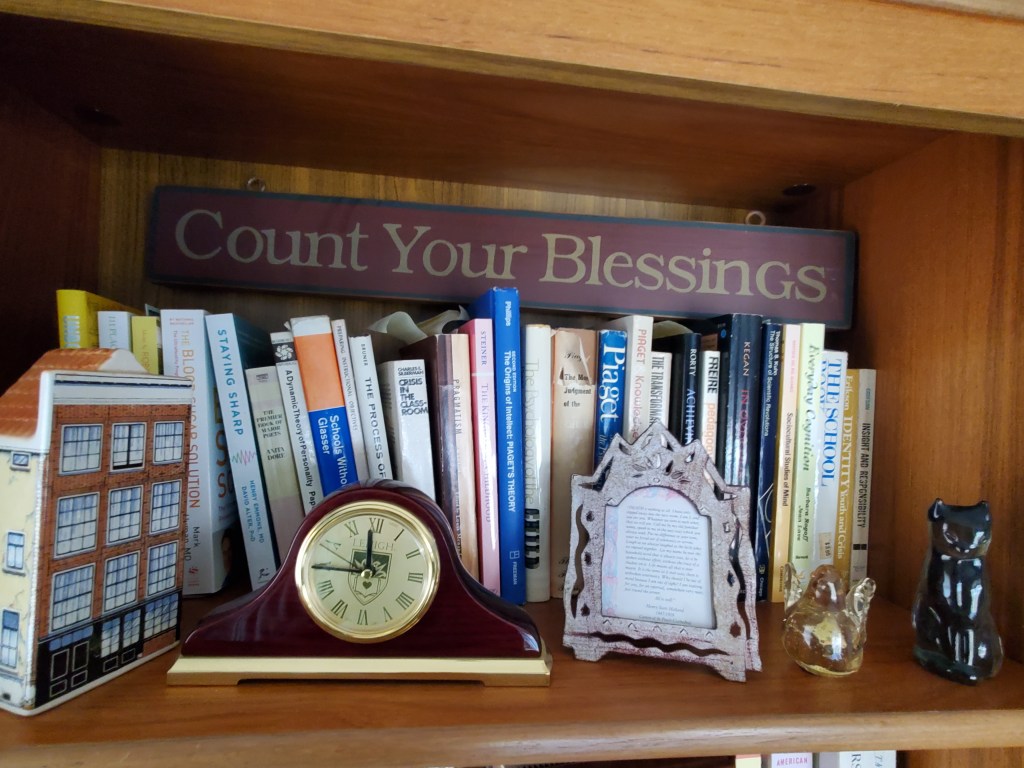
Then I perused the stuff on my shelves. Among them, a replica of the Anne Frank house, which I bought on my first trip to Europe; the clock my colleagues at Lehigh University gave me when I moved back to the Twin Cities; a crystal bird I won for scoring a birdie in the golf league I belonged to as a stay-at-home-mom; a framed card about death that I found in the last book my husband Gary read before he died (It was about J. Edgar Hoover. I kept telling him to read something more uplifting.); and a cut crystal cat that belonged to my mother, my children and I picked it out together for her. These items weren’t just stuff!  They were symbols, memories of life stages, places, and relationships—these were the stuff of love

How could I possibly let any of these items go? Karen’s life in stuff! I thought about our last blog—which apparently didn’t inspire our readers all that much—about legacy. These were part of my story, my legacy, and I wasn’t ready to let go.  Well, maybe I could ditch some of the books and a couple of the sanding sponges.

Taking stock of all I’ve accumulated reminded me of the many conversations my husband and I have about moving some place smaller—I’d have to deal with these things. That brought me back to Aunt Selma and the shrinking life. My life would and will shrink. These thoughts led inevitably to death, knowing that I, too, will die, and it’s coming sooner than I expected when I was in my 40’s and 50’s. I used to tell my grandchildren that someone has to be the first person to live forever, why not me? But I’ve stopped saying that.

For a brief minute I pictured my children sitting around cleaning out my office after I die.

 “Why do you suppose she saved this?” they would wonder, holding the Lehigh clock that no longer works or the cheap crystal birdie. I don’t know what they’d say about the sanding sponges. Maybe I should put a little label under each item describing its importance—might help me, too, if I go senile.

I thought of something Karen Rose’s husband says, “if it is smaller than a brick and has sentimental value, keep it. Otherwise, seriously consider giving it away.” Whew, I was off the hook. Most of my mementoes are smaller than a brick, although the embodied meanings are more than sentimental. I’m not ready to let go. For the time being, I won’t do anything until I get tired of walking around the mess on my office floor. I’m not dying yet, which leaves me wondering how long will it take until I reckon with death and move one more iota towards acceptance? For now, I’ll continue to treasure my artifacts of memories. I’m just not ready to shift into shrink.

Used by permission of the white board it was posted on.

Into Each Life. . .

It started innocently enough. I visited my granddaughter at college in early September—she’s the one that called me every day during the pandemic and the third of my four grandchildren off to college. The Friday after arriving home, I developed a horrific headache. I thought it would resolve quickly—sleep it off. But it lasted through September. Then came October. It would go away over night and come on quickly in the morning. Needless to say, I imagined the worst—tumor (even though the pain was mostly in my back and neck), long COVID (that didn’t occur to me until well into October), brain inflammation, Parkinson’s—a different catastrophe every day.

I saw an ENT doctor. Sinus? Allergy? I was clean as a whistle. As October wore on, I became incredibly anxious. One Sunday, Jim, my husband, had to talk me down as I learned to be anxious about being anxious—not a good thing.

My doctor did his best—a neurological test was perfect as was my blood test. He prescribed a pep talk—he believed in me; referral to a mental health professional; and an antidepressant that I was too anxious to take after reading about the side effects on the information sheet that came with the prescription.

In some deep place, I knew this was “all in my head” but anxiety overrode rational thought. Meanwhile, I was on a two-month waiting list for my doctor’s referral to a therapist, and everywhere else I called, all I heard was “We’re not accepting new patients.”

So I did what any good academic would do, bought and read books and scanned websites. There are some great resources out there, people committed to helping the suffering. One is Dr. Howard Schubiner, in Michigan, an authority on mind-body syndrome. By now I’d diagnosed myself. I bought the book and did his eight-week program. It helped. I also did PT, which also helped, but some days my neck and back felt on fire, which fed the anxiety.

About Thanksgiving I started feeling better, so I went ahead with cataract surgery. Maybe that would help. It didn’t, although the doctor called the results “amazing.” I was thrown into a new panic during my recovery and had difficulties getting new glasses. I postponed the second eye. 

Muddling through Christmas, I faked it, while inside feeling woozy. I started carrying hiking poles because I was afraid I’d fall—then, another perfect neurological test. “Your balance is amazing.” I wanted Ativan, but all I got was a lecture about how bad it is for someone my age—really? I should live in a constant cold shower (one of the recommendations for lowering anxiety) because there’s a correlation between Ativan and cognitive decline? Fortunately, my gynecologist wasn’t so opinionated, although I didn’t take it often—it made me enormously tired.

          In January, my turn with the psychologist finally came up—and she cancelled! A week later, I did my first virtual appointment and liked her immediately—the luck of the draw worked in my favor. She’s been supportive, available, responsive, and skilled.

          Like any good consumer, I turned to Facebook advertisements—once you look at something, they never stop coming in your feed. I now own a sunlight, a device you hold in your hand to help you sleep, a neck massager with heat, a bra to keep my shoulders back, my own tens device, a device for stretching your neck, a Theracane, and lessons in loosening your fascia from Daily Om. American Express loves me.

I’ve learned a lot about pain—that it really is in the head mostly, that childhood trauma and other traumas settle in the body and the brain finds pain pathways. But the brain can relearn, too. People do get over chronic pain even when there’s a basis in the body. Two people can have the same problem, and one will have pain, while the other will not. I learned about an app called CurableHealth.com. It’s a program started by young entrepreneurs who had struggled with chronic pain and tinnitus. It saved me on many days—podcasts with experts, information, meditations, writing exercises, and brain training—all for $69 a year. Another is the DARE app for anxiety.

Whew! It’s been a journey with good days and bad days – and I am not alone. The National Council on Aging says that between 3% and 14% of older adults suffer from anxiety and that estimate is based on reported cases only. Older adults have more problems with medications, since they are often taking other medications. My doctor prescribed three different antidepressants, while also saying “There is no pill for this.”

That said, I’ve learned that there are supportive friends, spouses, and family; there’s an abundance of YouTube videos about reducing anxiety and meditations; there are apps for meditation and helpful books.  These offer “solutions,” which, mainly advise “accept it and get on with the business of living and what matters to you”. Easier said than remembered when you awaken at 4am in a sweat, and you don’t know why.

My heart goes out to all chronic pain and PTSD sufferers, as well as those with Generalized Anxiety Disorder, the most common in older adults. Doctors can prescribe band-aids but getting to the root of the problem takes hard work and support. I see many articles in newspapers about the lack of mental health services for every age and the importance of having insurance coverage so people can access these services. I’ve experienced it firsthand and as one of the lucky, with insurance and now a qualified counselor.

In my bookcase directly in my sightline from my desk is a book entitled This Time Next Year We’ll Be Laughing. That’s my dream. It keeps me going as does an affirmation to get on with the business of life.

The Gift of a Child

Christmas 2011
Christmas 2022

Karen and I were looking over the blogs we’ve written and realized we’ve never written about grandparenting. So I decided to take a first stab at the topic. It felt overwhelming—like I’d be writing a dissertation in order to say all that comes up for me. I remembered my mother, who wanted to be a grandmother, even though motherhood had not been easy for her. And Gary Stout, who, when told by the doctor that he had 6-18 months to live said, “Now I’m glad I have grandchildren.” His daughter’s pregnancies were not planned and came while they were both getting a foothold on being adults. He was not happy at the time.

Then, the Sunday before Christmas, sitting in church, the topic came back to me again. A woman was reading the Christmas story to some children, and I found myself asking, “I wonder if Jesus had grandparents.” (I suspect some of you know the answer to this.) Specifically, I was thinking about a grandmother, since I’m a woman. I do not know the answer to this question, but it made me recall the birth of my first grandchild, Peter, in 1999.

When my son, Walter, announced to me that he and his wife, Elizabeth, were expecting, I was excited, but more for them than for me. I was busy trying to restart my life after Gary’s death. I cheered them on through the pregnancy, but the prospect of becoming a grandmother barely entered my consciousness.

Walter and Elizabeth were adamant about experiencing Peter’s birth privately, as a couple.  They made it clear to their large family that they didn’t want anyone with them during the birth, and they especially didn’t want a waiting room of relatives hanging outside, following every development.  We respected that.  We didn’t even ask for a call when they left for the hospital.  And we knew they would not call until it was over. 

The call came on a warm July evening. I had just laid down for bed, window open, enjoying the night breeze and sounds of the city.  The phone interrupted my drift into sleep.

“Mom, he’s here.  Peter’s born,” Walter’s sobs seemed to pour through the phone.  “It was so unbelievable.  He’s wonderful.”

“Congratulations new dad,” I said, “Pretty terrific, isn’t it?” I could imagine their night.

“Please come, please.  You have to see him.”  Now he was openly crying—the unflappable Walter was crying harder than his newborn son.

When your son implores you to come, you take off your pajamas, get dressed and drive to the hospital. They were in Abbott Northwestern Hospital. I’d last been there the day before Gary died. The halls seemed to squeeze the breath out of me, but I found the maternity ward.

And there he was, Peter, my first grandchild red and raw, wrapped in a hospital blanket, looking around at his new home and his new daddy.

“Do you want to hold him?”  Walter asked.

I didn’t need to answer.  My arms opened, and Walter laid Peter in them.  I looked down into the stone blue eyes and met my first grandson.  The room and voices seemed to fade.  We simply stared at each other.  “Hello,” I said. “I’m your grandmother.”  And he just kept staring.  I could not look away, bound by a love I’d forgotten I could feel welling into me.  Here was a new soul ready for the journey.  I gave him my promise to always be there for him. 

That was 23 years ago. Peter is now a young adult working at his first job in Washington DC. I’ve been there through most of his journey thus far. That honor, that privilege, that gift makes me think of my own grandmothers, both of whom I never met. Ruth, my mother’s mother, died in childbirth at the age of 22. My mother was three, with a new baby brother but no mother. My father’s mother, Martha, died in 1930, at the age of 51. My father was thirteen years old. Neither of these women had the chance to be a grandmother.

When I had my own children I was in my twenties. They were a precious responsibility, and much as my heart overflowed with love, there was always that looming responsibility to parent well and provide for them. But I am now older. I realize that not everyone gets the gift of grandchildren. I know what a gift a child is. I know, too, that a grandmother is another sort of gift, since I never really had one. These realizations make me want to bring joy and love into every moment I spend with my grandchildren. These realizations make me feel blessed.

My Perfect ‘Little p’

Lake Harriet Community School

If you’re someone who’s followed this blog, you know that ‘little p’ refers to one of those small purposes that each of us carries out daily, purposes that make families run smoother, make people feel loved, and spread kindness. Things like volunteering at a book sale to raise money for scholarships, preparing and serving lunch at church after a funeral, and making sure family members have a good day. These are not grand purposes, but incrementally, they make life better.

A common ‘little p’ is volunteering. Although it’s almost a cliché to say that when we volunteer, we get more than we give, I have to indulge that cliché when I talk about tutoring, my ‘little p.’ I definitely get more than I give.

I have the perfect tutoring gig—four mornings a week at a nearby school in Minneapolis where my son is the principal, Lake Harriet Community School. It’s a small school, grades 3-5, and a highly successful school—a Minneapolis Public School that ranks 4th in the state. It’s also over a hundred years old, with shiny wood floors, heavy oak doors, windows, and woodwork, and tired classrooms, even though they’ve been kept up well. Like many districts, currently, it has children who were in primary school during the COVID shutdowns, and some are not ready for grade level work (we are avoiding calling them “behind.”). One way schools are addressing the needs of these children is through tutoring. That’s one reason I’m tutoring, specifically in math. The gift to me is that I AM NEEDED.

I tutor three small groups and then I help in a classroom. I’m on my feet for three hours, and on my toes mentally, even though it’s basic mathematics—in my day we called it arithmetic. Mathematics is not being taught the way you and I learned it or the way I taught thirty years ago. Now arrays are used to teach multiplication; children learn properties like commutative and identity; and algebraic thinking is introduced in first grade, etc. Clearly I must stretch mentally and find ways to teach new ways of doing arithmetic. That’s my second gift—keeping my brain challenged.

Then there are the obvious benefits, tutoring gets me out of bed and cleaned up early in the day; it gets me moving in natural ways rather than going to a gym; and my favorite, tutoring gives a purpose to my days.

Like other things we do in our mostly small lives, tutoring, at first, felt insignificant. I initially labeled it a feel-good way to spend some of my time in retirement. (By now you know I’m a hopeless cynic). I mean, how much difference can 2-4 hours a week make in a child’s mathematical growth? But to be an educator—which I am—is to believe fervently in small steps, small miracles of understanding. So, cynicism notwithstanding, a part of me believes what I do matters. I’m a caring adult in these children’s school experience who believes in them and supports them.

Yesterday, the impart of tutoring was resoundingly brought home to me. It occurred in the 4th grade class where my role is to hang out and help as needed. I’m the right hand “woman” to the teacher, who is especially creative and commanding when she teaches. She often starts the class period with a video that gives an example of kindness. Here’s a link to the video she showed yesterday. I urge you to watch it before you read further.

Please Enjoy before You Read On!

After viewing the video, the teacher asked students what was going on, what was the video about. Why were some residents in the nursing home tearing up? It took some time for these ten-year-olds to stop focusing on the gifts and to think about what was really going on for the residents. But they got there. As one little girl put it, “She showed that she cared about them.” That led to a discussion about loneliness. I’m not sure that all the children understood, but it was one of those small steps of learning.

For the remainder of the class we studied what to do with a remainder in division. That was fun and equally challenging. In my car on the way home, I reflected on the class in the context of the video. And suddenly I felt it, the biggest reason I tutor—I feel like I belong! I belong to this one classroom, to the other teachers I support with small groups, and in this small school. Best of all, I belong in a world that I care for because I know what individual children need.  I am doing my part to make this place and their lives better in small, incremental ways. 

If you want to find out more about Ruby, here’s her website:

https://3wishesproject.org/who-we-are/